
Seven years passed more quickly than I expected.
The cottage changed.
The rose bushes grew thick along the porch.
The yellow kitchen needed repainting.
The porch railing Owen had repaired was replaced properly after a winter storm, though I kept the old screwdriver he had broken in a drawer.
Chloe went to college.
Owen became an engineer.
The baby named Evelyn Thomas grew into a curious little girl who believed every rose belonged to her.
Graham and Paige stayed together.
Not because everything had magically become easy.
They had arguments.
They made mistakes.
They learned.
Most importantly, they stopped treating money as the language through which love had to speak.
Graham called every Sunday.
Sometimes the calls lasted five minutes.
Sometimes an hour.
Sometimes he forgot and called Monday instead.
I never counted.
That was another thing I had learned.
Love becomes healthier when you stop keeping score.
The lottery money changed many practical things.
I never worried about a medical bill.
I traveled with Ruth.
I helped quietly when friends needed assistance.
I donated to organizations Thomas would have respected.
I established the scholarship.
I funded the children's trusts.
But I never bought Graham a house.
That mattered.
He and Paige paid for their own home.
They remodeled the kitchen themselves.
They argued over paint colors.
They eventually learned to laugh about the argument.
Owen became the sort of young man who fixed things before anyone asked.
Chloe became a teacher.
Little Evelyn grew up knowing that her grandmother had a yellow kitchen, a rose garden, and an unreasonable number of books.
She did not know about the lottery.
Not yet.
I wanted her to know me before she knew my bank balance.
When she turned ten, she asked me why Grandpa Thomas was in so many photographs.
I told her the truth.
“He was my husband.”
“Was he nice?”
“He was stubborn.”
She laughed.
“Was he funny?”
“Very.”
“Did he love you?”
I looked at his photograph.
“Yes.”
“How do you know?”
“Because he kept choosing me.”
She thought about that.
Then she said, “Dad chooses Mom.”
“Yes.”
“Does Mom choose Dad?”
I smiled.
“Yes.”
She seemed satisfied.
The question stayed with me.
Choosing.
That had been the heart of everything.
Graham had once chosen what he thought was best for me.
Paige had chosen where she thought I should live.
I had chosen silence.
Then the ticket had given me the ability to choose again.
Years later, I understood that the money itself had never been the miracle.
Choice was.
When I was eighty, Martin retired.
He came to the cottage for lunch.
“You've outlived three versions of my filing system,” he said.
“I liked the second one.”
“No one liked the second one.”
“I did.”
He laughed.
We sat on the porch.
He looked older.
So did I.
“Everything settled?” he asked.
“Everything that matters.”
“That is not a legal answer.”
“It is the only one I have.”
He smiled.
“You know what I remember most?”
“What?”
“The day you came into my office with that ticket.”
“I remember thinking you were going to tell me I was being foolish.”
“I thought you were frightened.”
“I was.”
“You weren't frightened of losing the money.”
“No.”
“What were you frightened of?”
I looked toward the garden.
“Finding out what people wanted from me.”
He nodded.
“And did you?”
“Yes.”
“Was it worse than you expected?”
“Sometimes.”
“And better?”
I smiled.
“Also sometimes.”
He lifted his glass.
“To sometimes.”
I raised mine.
“To choices.”
He laughed.
A year later, Martin died peacefully.
At his funeral, Graham stood beside me.
“I never thanked him,” he said.
“You should have.”
“I will miss him.”
“So will I.”
Afterward, Graham drove me home.
He did not mention the estate.
He did not ask what Martin had left.
He simply drove.
At a red light he said, “Mom?”
“Yes?”
“I've been thinking about something.”
“That can be dangerous.”
He smiled.
“When Dad died, I thought losing him was the worst thing that would happen to our family.”
I waited.
“Then you came to live with us, and I thought I was helping you.”
“You were trying.”
“I was.”
He looked through the windshield.
“But I confused helping with deciding.”
“Yes.”
“I don't ever want to do that again.”
“You don't.”
He turned toward me.
“How do you know?”
“Because you ask now.”
The light changed.
He drove on.
At eighty-two, I finally told my grandchildren about the lottery.
We were all sitting around the oak table.
Owen was married.
Chloe had a child.
Little Evelyn was now seventeen.
Graham looked at me as if he already knew what was coming.
“I have something to tell you.”
Evelyn leaned forward.
“Is it bad?”
“No.”
“Is it exciting?”
“Possibly.”
I reached into a drawer.
The original scratch ticket was not there.
I had destroyed it years earlier after the claim was settled.
Instead I had a photograph of it.
I placed the photograph on the table.
“This is the ticket that changed my life.”
Owen laughed.
“Seriously?”
“Seriously.”
Chloe picked it up.
“How much?”
“Eleven million was the advertised prize.”
Evelyn's mouth fell open.
“You won eleven million dollars?”
“Before taxes and payout adjustments.”
“Grandma!”
Everyone laughed.
Graham watched quietly.
Evelyn looked at him.
“Dad, did you know?”
“Yes.”
“Why didn't you tell us?”
He looked at me.
“Because it wasn't my story to tell.”
She stared at him.
Then she smiled.
“That was the right answer.”
I felt something loosen inside me.
Not because she understood the money.
Because she understood the boundary.
I told them about the ticket.
About Paige.
About the house.
About Pine Harbor.
About Thomas's letter.
I did not tell them every humiliating detail.
Some memories belonged to the people who lived them.
I told them enough to explain why the money had never become the center of my life.
When I finished, Evelyn asked, “Were you angry?”
“Yes.”
“Did you forgive them?”
“Yes.”
“Why?”
I looked at Graham.
“Because forgiveness gave me back my peace.”
“And did they deserve it?”
“That is not why I forgave them.”
She considered that.
Then asked, “What was the best thing you bought?”
I laughed.
“Not the house.”
“Then what?”
“A chance.”
“A chance to do what?”
“To leave when I needed to.”
She nodded.
Then she asked the question I had expected.
“If you had never won?”
I looked around the table.
That question had no easy answer.
“I would have left anyway.”
Graham looked at me.
I continued.
“It would have taken longer. It would have been harder. I might have needed help. But I would have learned that I deserved a life I chose.”
Silence settled over the table.
Then Owen reached for the photograph.
“I like the ticket.”
“Why?”
“Because it looks ordinary.”
I smiled.
“It was.”
That was the truth.
There had been no music.
No warning.
No sign.
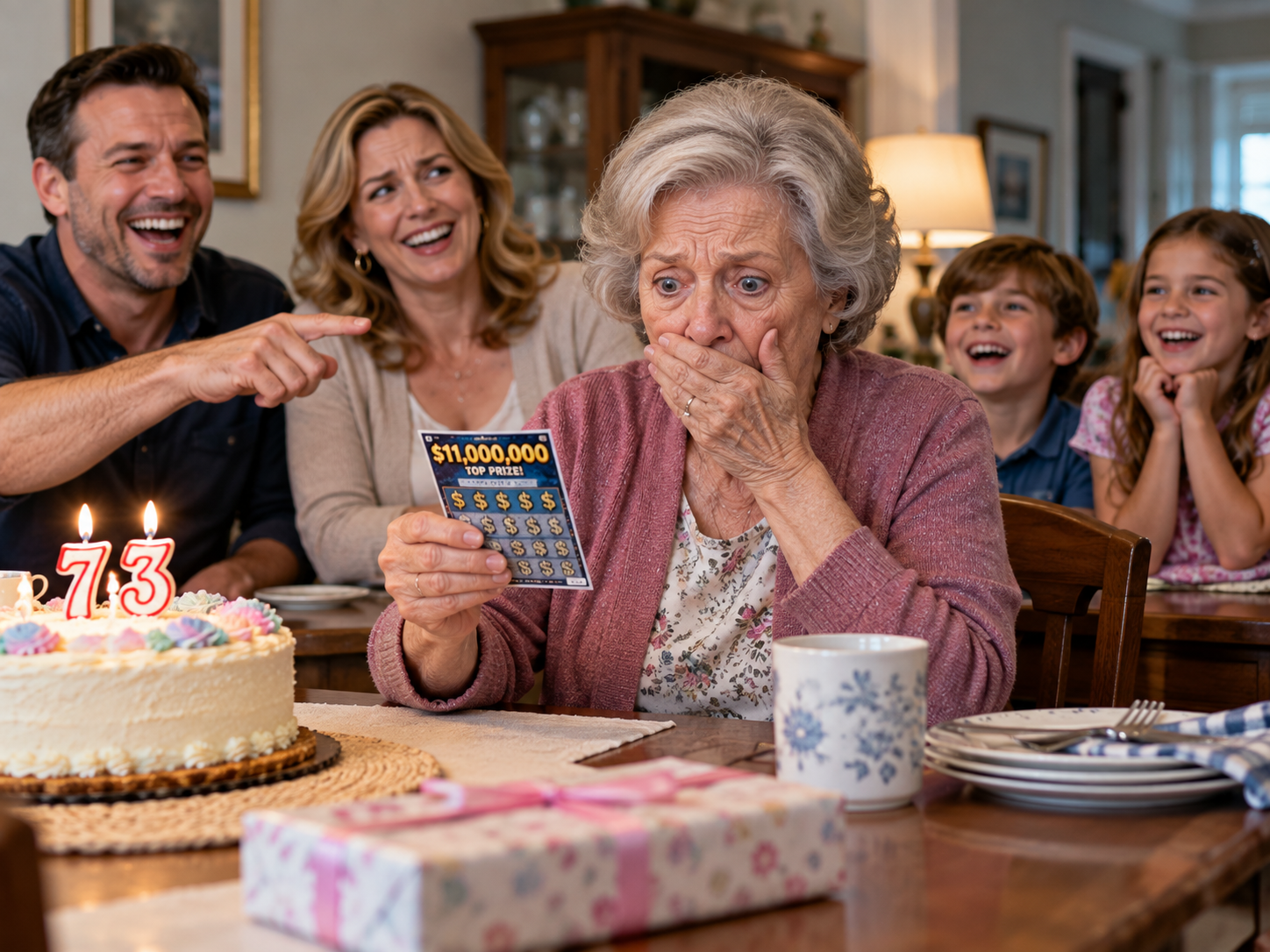
Just a cheap ticket on a birthday table.
A careless joke.
A quarter.
Three matching symbols.
And a woman who had spent too many years believing she needed permission to make decisions about her own life.
The money did not make me brave.
It simply removed one of the reasons I had been afraid.
The rest was mine.
Years later, when I could no longer climb the porch steps easily, Graham installed a small ramp.
He asked first.
That detail mattered.
“Would you like this?”
“Yes.”
“Are you sure?”
“Yes.”
“Then we'll do it.”
He hired someone.
He did not choose the color without asking.
He did not tell me it was necessary.
He asked.
That was the difference between then and now.
One evening, we sat together beneath the porch light.
The garden smelled of roses and wet soil.
Graham looked toward the kitchen.
“You still like the yellow?”
“I love it.”
“Dad would hate it.”
“He would.”
We laughed.
Then Graham became quiet.
“Mom?”
“Yes?”
“Thank you for leaving.”
I looked at him.
He continued.
“If you had stayed, I don't know whether I would ever have understood.”
I reached for his hand.
“I didn't leave to teach you a lesson.”
“I know.”
“I left because I needed to save myself.”
“I know.”
“And somehow that saved us too.”
His eyes filled.
He squeezed my hand.
Inside the house, Evelyn called that dinner was ready.
Graham stood.
“Coming?”
“In a minute.”
He went inside.
I remained beneath the porch light.
Thomas's photograph was visible through the kitchen window.
I thought about the letter.
The house.
The lottery ticket.
The years when I had been afraid that independence would cost me my family.
I had been wrong.
The opposite had happened.
The moment I stopped asking my family to prove that they loved me by needing me, they finally had room to love me without depending on what I could do for them.
The money had come and gone through accounts, investments, taxes, gifts, repairs, scholarships, and ordinary expenses.
The ticket itself had disappeared years ago.
But the choice it gave me remained.
I stood carefully and walked inside.
At the table, everyone was waiting.
Graham had saved my chair.
Chloe poured water.
Owen passed the bread.
Evelyn complained about her homework.
Paige asked whether I wanted more vegetables.
I smiled.
“Yes, please.”
Nobody asked what it was worth.
Nobody needed to.
For the first time, I understood that the greatest fortune I had ever received was not the money hidden beneath the silver coating of a two-dollar ticket.
It was the moment I realized I could walk away from a life that had stopped being mine—and still be loved when I came home.
The End
Read more original stories on Feel Every Story.
Thomas’s Letter Reached Graham at the Worst Possible Moment, and the Words Inside Forced Him to Face What He Had Been Avoiding
Part 8 of 4

