
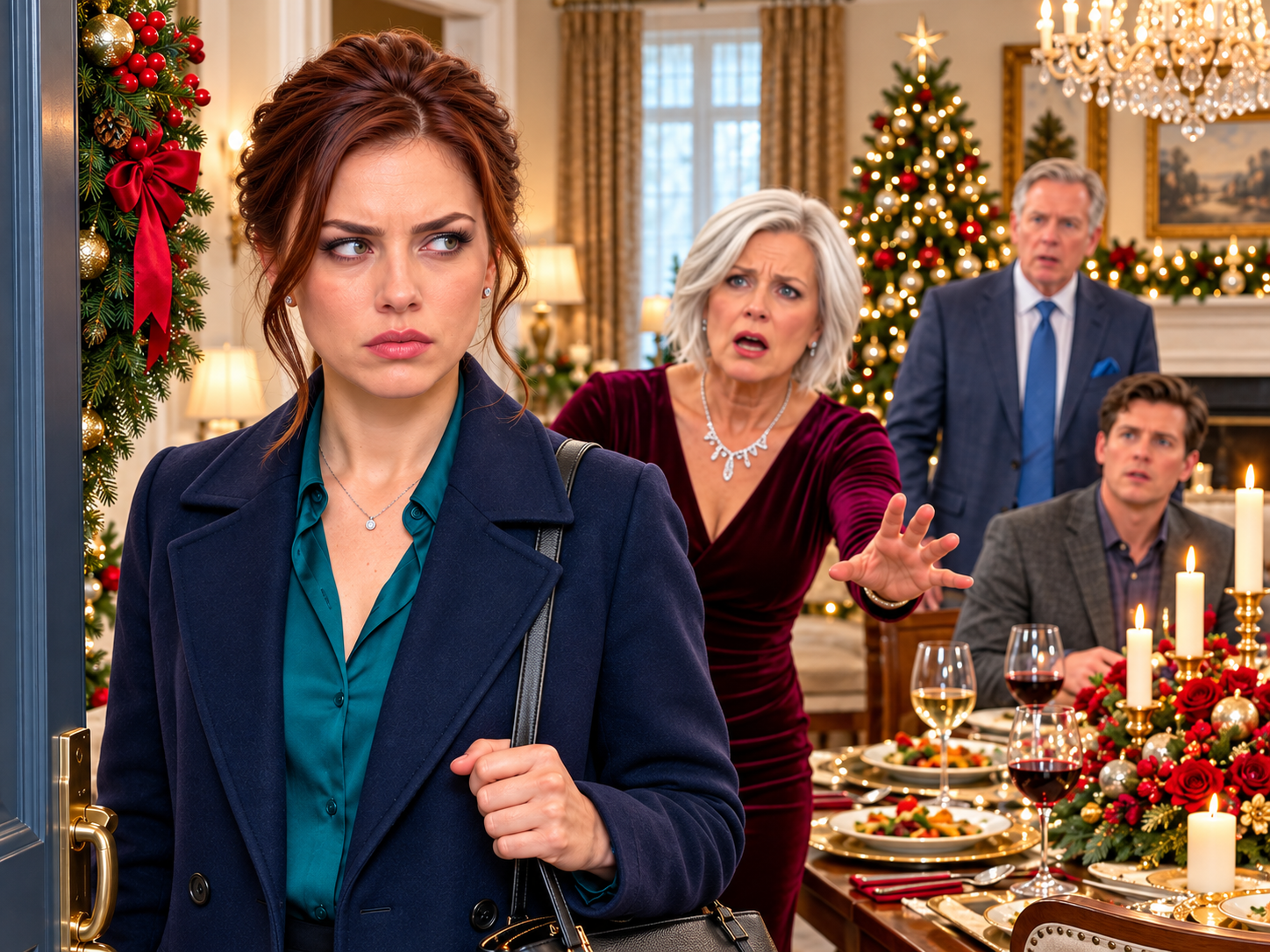
The first sign that something was wrong was not my father’s announcement. It was the way my mother kept watching me instead of eating.
She had barely touched the roast. Her fork rested beside her plate, perfectly aligned with the knife, while the candles between us burned low enough to make the crystal glasses glow amber. Outside, snow drifted against the dark windows. Inside, the dining room smelled of rosemary, baked potatoes, and the cinnamon dessert Mom had prepared every Christmas Eve since I was a child.
Across from me, Mason was eating as though nothing unusual was happening.
Then Dad cleared his throat.
“Briar, we need to talk about something.”
I set down my fork.
Dad rarely used that tone unless he had already decided the conversation was over before it began. He leaned back in his chair and folded his hands over his stomach, adopting the solemn expression he used whenever he wanted a decision to sound like a family principle rather than a demand.
“You’re twenty-five now,” he said. “It’s time you started standing on your own.”
For a moment, I thought I had misunderstood him.
I looked toward Mom.
She finally met my eyes.
“You need to move out,” Dad continued.
Mason laughed.
It was a short, careless sound, followed by a grin that told me he had been waiting for this moment.
“About time,” he said.
I turned toward him.
Mason was twenty-nine.
He had never paid rent to our parents. Not once. His phone bill came out of the household account. His car insurance was paid from the same account. Even the expensive vehicle sitting in the driveway had become a family expense in everything but name.
I knew because I had been paying many of those bills.
Mom noticed where I was looking.
“Mason is in a different situation,” she said quickly.
I gave her a small nod.
“Of course he is.”
Dad’s jaw tightened.
“Don't make this into an argument.”
“I’m not.”
I looked around the table instead.
The house suddenly seemed different.
For years I had known exactly what came out of my bank account each month. The mortgage payment. Electricity. Water. Insurance. Several recurring subscriptions. Mom’s SUV. Dad’s supplemental health coverage. Mason’s phone. Mason’s car payment. Groceries when the household account was short.
There had always been an explanation.
The mortgage was temporary.
Mom would pay me back.
Dad had a difficult month.
Mason was getting his finances together.
The family needed help.
I had believed those explanations for longer than I cared to admit.
Then, sometime during the previous year, I stopped calling it help.
I started calling it what it was.
I was financing the household.
Dad tapped one finger against the table.
“We think the end of the week is reasonable.”
“The end of the week?”
“Yes.”
Mom finally spoke.
“You’re an adult, Briar. You should have your own place.”
I almost smiled.
There was something strangely convenient about hearing this from people who had spent years making sure my income remained available to them.
“How long have you two been planning this?”
Dad exchanged a glance with Mom.
“That isn't important.”
“It is to me.”
“We've simply decided it's time.”
Mason leaned back.
“Honestly, Briar, you'll be fine.”
I looked at him.
“I'm sure.”
He picked up another piece of bread.
“Just don't take the good towels.”
Mom laughed softly.
Dad smiled.
They expected anger.
They expected tears.
They expected me to bargain for more time.
Instead, I pushed my chair away from the table.
“All right.”
The room changed immediately.
Mom blinked.
Dad frowned.
Mason stopped chewing.
“All right?” Mom repeated.
“I'll move out.”
Dad seemed almost disappointed by how easy it was.
“By the end of the week.”
“I heard you.”
I stood.
Mason watched me with a smug expression.
“See? That wasn't so hard.”
I didn't answer.
I walked upstairs.
My bedroom was exactly as I had left it that morning. A sweater lay over the back of my desk chair. A half-read book rested beside my lamp. On the wall, a framed photograph from a family vacation showed the four of us smiling beside a lake.
I looked at that photograph for several seconds.
Then I opened the closet.
Behind a stack of winter blankets sat a small suitcase.
I had packed it months earlier.
Not because I had known this particular conversation would happen on Christmas Eve, but because I had learned not to confuse preparation with paranoia.
I put a few clothes inside, added my laptop, documents, toiletries, and the small box containing my most important papers.
Then I changed into my coat.
When I returned downstairs, Dad was still at the table.
His eyebrows rose when he saw the suitcase.
“What are you doing?”
“You said to move out.”
“I meant by the end of the week.”
“I know.”
Mason laughed.
“She's actually leaving tonight?”
I pulled my gloves from my pocket.
“I don't see a reason to stay.”
Mom pushed her chair back.
“Briar, don't be dramatic.”
“I’m not.”
I walked toward the front door.
Behind me, I heard the scrape of Mom's chair against the floor.
“Briar.”
I stopped.
Something in her voice was different.
Not angry.
Not disappointed.
Afraid.
I turned around.
She was standing beside the dining table with one hand pressed against its edge.
“You’ll still take care of the bills, though, right?”
Nobody moved.
The furnace clicked on.
Snow tapped softly against the window.
I looked at her.
“What bills?”
Mom stared at me as if I were deliberately being difficult.
“The household bills.”
Dad suddenly became interested in the tablecloth.
“The mortgage,” Mom said. “Utilities. Insurance. Things like that.”
I glanced at Mason.
His smile had disappeared.
“You're asking me to move out,” I said slowly, “but you want me to keep paying for the house.”
“That isn't what I said.”
“It is exactly what you said.”
Mom swallowed.
“We just need some time to adjust.”
“To what?”
“To you not being here.”
I looked around the room.
“You told me I was supposed to support myself.”
“You are.”
“Then why would I continue supporting your household?”
Dad's face hardened.
“Because we're family.”
The words landed differently now.
For years, they had meant obligation.
Tonight, they sounded like an invoice.
I reached into my coat pocket and pulled out my phone.
Three notifications waited on the screen.
The mortgage payment was scheduled.
The electricity autopayment was pending.
Mason's car payment would be due the following Tuesday.
They were all linked, directly or indirectly, to money I controlled.
Mom watched my face.
“What are you doing?”
“Nothing yet.”
Dad sat straighter.
“Briar.”
I looked at him.
“You wanted me independent.”
“Yes.”
“Then I think I should take that seriously.”
Mason gave an uncomfortable laugh.
“You're not actually going to stop paying everything, are you?”
I looked at him.
For once, he had no joke ready.
I remembered the previous six months.
The spreadsheets.
The account statements.
The calls.
The documents I had requested.
The records I had quietly copied.
The questions I had asked people outside the family.
Most importantly, I remembered the first time I had realized that some of the debts attached to my name were not debts I had agreed to take on.
That discovery had changed everything.
My family thought I was standing in the doorway of my childhood home with a suitcase.
They did not know I had already built a life somewhere else.
They did not know that eleven months earlier I had purchased a furnished apartment downtown.
They did not know that I had spent months making sure my finances could survive without them.
And they certainly did not know that I had already separated most of my legitimate obligations from theirs.
So I gave Mom the answer she wanted.
“I’ll handle everything tomorrow.”
Her shoulders dropped.
Dad relaxed.
Mason smiled again.
“There you go.”
I opened the door.
Cold air rushed inside.
“Good night,” I said.
No one answered.
I stepped outside.
Behind me, the door closed.
At 8:03 the next morning, I stood beside the tall windows of my apartment and watched Christmas snow fall between the buildings.
The city below was quiet.
My suitcase sat unopened near the sofa.
I made coffee, set my phone beside the mug, and waited.
The first call came at 9:17.
Mom.
I answered.
Her voice was sharp.
“Why did I get an email saying the electricity payment method was removed?”
I looked out at the snow.
“Because I moved out.”
“You said you'd handle everything.”
“I did.”
“No. You said you'd keep paying.”
“I said I would handle everything tomorrow.”
“You know what I meant.”
“Yes.”
Silence.
Then Mom lowered her voice.
“Put it back.”
“No.”
The line went quiet.
Then Dad took the phone.
“You will not punish this family because you're angry.”
I stared at the city below.
“I’m not punishing anyone.”
“You're threatening us.”
“No.”
I took a breath.
“I’m becoming independent.”
Dad's breathing changed.
And in that silence, I realized something.
They had believed independence was something they could demand from me while keeping control of my money.
They had never imagined I might apply the same rule to them.
Click Here to continue read next: PART2: The Records I Had Quietly Collected Revealed That My Family’s Dependence Was Far More Dangerous Than Any Monthly Bill
The Christmas Dinner That Turned Into an Unexpected Demand for Independence, and the Question That Exposed Everything They Had Been Hiding
Part 1 of 8

