
Winter arrived early in Wyoming that year. By the first week of December, snow had gathered along the road to Evelyn’s cabin, and Daniel had begun checking the weather before every visit. The cabin was holding up well, thanks to the maintenance plan they had put in place. The repaired porch steps were steady beneath his boots, the fence no longer leaned at the corner, and the heating system had been serviced before the first hard freeze. Daniel felt a quiet satisfaction whenever he saw those improvements. They were not grand achievements, but they were evidence of a family learning to care for something without needing to turn it into a contest over ownership.
As Christmas approached, Evelyn asked whether everyone could come to the cabin for a meal rather than gathering at one of the relatives’ homes. She made the invitation casually, as though she were asking them to stop by for coffee. Daniel knew it was not casual at all. The previous Christmas had left a mark on everyone, and returning to a shared table would require more courage than anyone was likely to admit. He asked whether she was certain she wanted to host. “I want to see my family,” she said. “I don’t want to spend every December remembering the worst thing that happened at the last Christmas dinner.” Daniel promised he would come early to help.
His father called two days later and asked if Daniel knew what Evelyn had planned. “She wants everyone to come for Christmas,” Daniel replied. “I know that. I’m asking whether she intends to discuss the money.” Daniel paused. “You should ask her.” His father sighed. “I was afraid you’d say that.” “I’m not trying to be difficult. I honestly don’t know what she plans to talk about, and I don’t want to speak for her.” His father was quiet, then said, “I suppose I need to get used to that.” Daniel heard the faint sound of a drawer closing on the other end. “I suppose you do,” he answered, keeping his tone gentle.
On Christmas Eve, Daniel drove to Wyoming with a small bag of gifts, a box of books for Evelyn, and a container of food he had prepared for the meal. Snow fell lightly across the highway, and the distant hills were softened by a pale winter haze. When he reached the cabin, Evelyn was arranging branches in a vase on the table. She had placed Walter’s photograph on the shelf above the old cabinet and laid a clean cloth across the dining table. There were no envelopes waiting at each place setting, no stack of checks hidden beneath the plates, and no grand announcement prepared. The absence of those things made Daniel realize how much he had feared a repetition of the previous year.
“Do you think everyone will come?” he asked as he carried the food into the kitchen. “I hope so,” Evelyn said. “But I invited them. I did not order them.” She glanced at him with a small smile. “That distinction has taken me a long time to learn.” Daniel smiled back. He had heard similar words from her before, but they sounded different now. She was not merely advising him. She was acknowledging that even she had sometimes tried to manage other people’s feelings rather than allowing them to own their choices.
The family began arriving late in the afternoon. Diane and Martin brought dessert. Olivia arrived with her coat dusted in snow and a bag of small gifts. Daniel’s mother came in carrying a dish covered with foil, while his father followed her with firewood. The greetings were warm but slightly tentative. Everyone seemed aware that the room held memories of the previous Christmas, though nobody mentioned them immediately. Daniel helped hang coats, filled glasses with water, and carried the extra chairs into the dining area. The ordinary tasks gave everyone something to do while they found their footing.
Dinner began without a speech. Evelyn asked Martin about his work, Diane described a neighbor’s attempt to build a greenhouse, and Olivia told a funny story about a holiday shopping trip that had gone wrong. Daniel’s father listened more than he spoke. Once, when he began to interrupt his mother, he stopped himself and let her finish. Daniel noticed the change but did not point it out. The family talked about travel, work, and the cabin’s repairs. The food was good, the fire was warm, and for a while the evening seemed almost ordinary.
After the plates were cleared, Evelyn asked everyone to remain at the table. Daniel felt his stomach tighten. He looked at the empty place settings and then at his grandmother. She had not brought out checks or papers. Instead, she rested her hands on the table and said, “I want to talk about last Christmas, because I don’t want any of us to carry it into another year without understanding what happened.” No one moved. His father stared at the tablecloth, and Daniel’s mother placed her hand beside his.
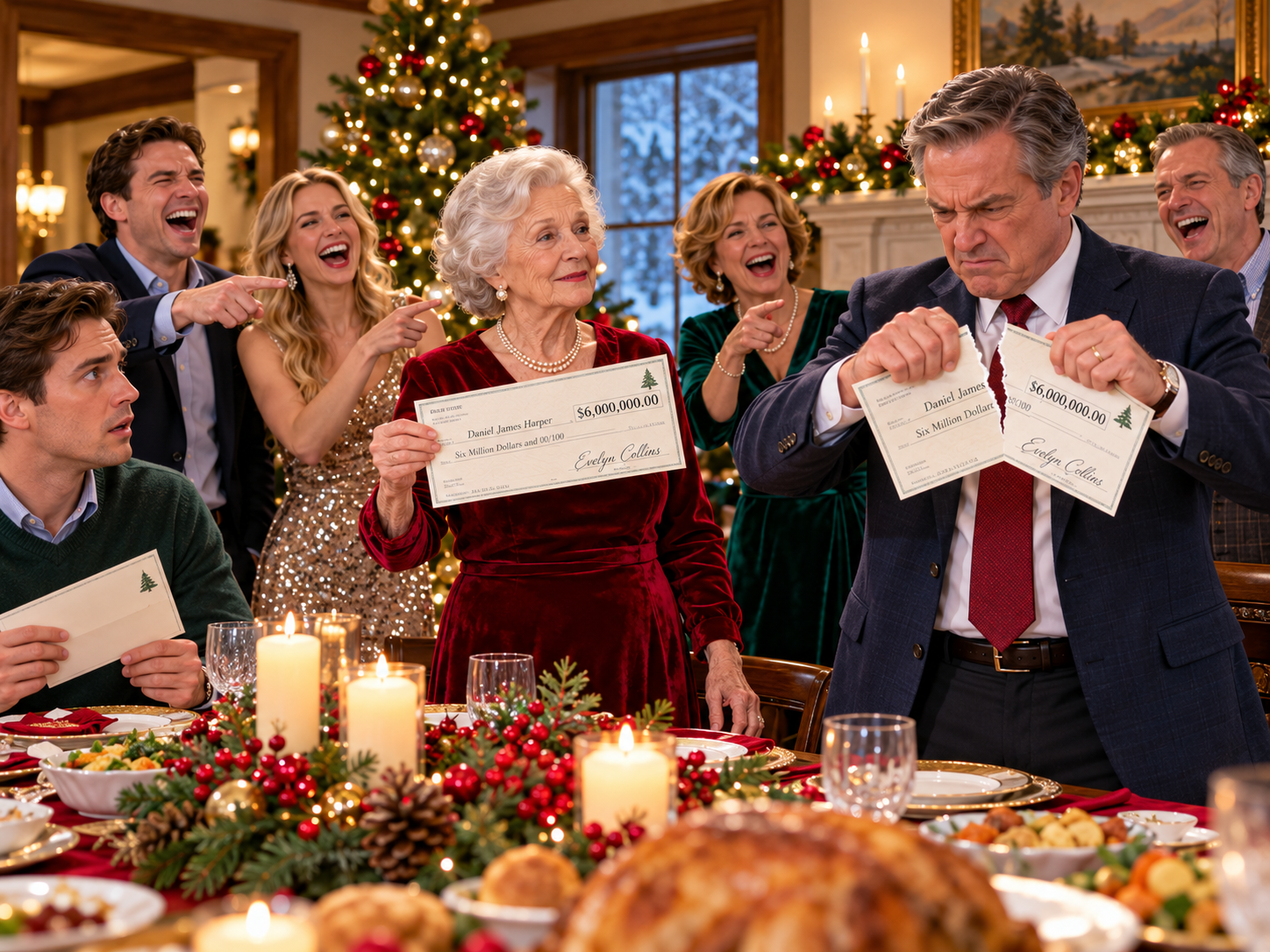
“I gave you something you did not understand,” Evelyn continued. “I should have made more room for questions. I believed I had prepared the documents carefully enough that the purpose would be clear, but I was wrong about that. I can acknowledge my mistake.” She paused. “But my mistake does not excuse what happened afterward. Some of you laughed. One of you tore a check before I had finished speaking. I was hurt, and I will not pretend otherwise.” Her voice did not rise. The absence of anger made the words harder to dismiss.
His father looked up. “Mom, I’m sorry.” Evelyn nodded. “I know you apologized. I appreciate that. I’m not asking you to apologize again tonight.” She turned toward the others. “I am asking us to remember that we do not have to understand every decision immediately. We can ask questions. We can disagree. We can even decide not to accept a gift. But we should not humiliate the person offering it simply because we are uncomfortable.” Diane wiped at the corner of one eye. Olivia looked down at her hands. Daniel felt the familiar pull to say something that would ease the silence, but he allowed his grandmother to finish.
She explained that the checks had been part of a carefully documented arrangement, and that each person had been free to seek advice, ask questions, or decide what to do. She did not disclose anyone’s private financial details or compare one person’s choices with another’s. She made it clear that the money was not a measure of affection and that accepting a benefit did not make anyone more deserving than a relative who chose differently. The family listened. There were questions about the process, but this time they were asked without laughter. Evelyn answered what she wished to answer and left the rest for private conversations with her attorney.
When she finished, Daniel’s father cleared his throat. “I want to say something, if that’s all right.” Evelyn nodded. He placed both hands on the table, as though he needed the wood beneath them to steady himself. “Last Christmas, I thought I was preventing everyone from being fooled. But the truth is, I didn’t want to be the person who believed something ridiculous in front of the family. I was embarrassed, and I tried to control the room before anyone could laugh at me.” He looked at Evelyn. “I hurt you because I was more concerned about how I looked than about what you were trying to tell us. I’m sorry.” This time, he did not add an explanation or ask her to forget it.
Evelyn reached across the table and touched his hand. “Thank you.” She held it for a moment, then let go. Daniel saw his father swallow hard. It was not a dramatic reconciliation, and nobody applauded. But the apology seemed to settle into the room instead of bouncing off the walls and returning as an argument. His father had finally spoken about the real reason he had acted as he did. He had not blamed the check, the timing, or the family’s reaction. He had named his own fear.
Diane spoke next. She admitted that she had laughed because everyone else had, and because she had found the amount unbelievable. “I didn’t stop to think how it would feel to have someone laugh at a gift you had carefully prepared,” she said. Olivia apologized for repeating her father’s dismissive comments afterward, before she knew the facts. Martin acknowledged that he had stayed silent because he had not wanted to become involved in a conflict. One by one, they recognized the choices they had made. The apologies were not identical, and neither were the wounds. But no one tried to turn the conversation into a competition over who had been most hurt.
When it was Daniel’s turn, he found himself speaking more slowly than he expected. “I kept my check because I didn’t want to decide it was worthless just because Dad said it was. But I also need to admit that, for a while, I treated keeping it as proof that I had been right and everyone else had been wrong.” He looked at his father. “I didn’t want to humiliate you, but sometimes I wanted you to understand how badly you had behaved. I had to learn that I could tell the truth without using it to punish you.” His father nodded, and Daniel felt something ease inside him. He had not been required to pretend his anger never existed. He had only needed to stop allowing it to make every decision for him.
Evelyn smiled faintly. “That is all I hoped we might learn.” She stood and walked to the cabinet. From a drawer, she took a small envelope containing a few photographs of Walter and the family from years earlier. She passed them around the table. In one, Daniel was a child sitting on Walter’s knee. His father stood behind them, younger and smiling, with one hand resting on his father’s shoulder. In another, Diane and Martin were helping Evelyn carry boxes into the cabin. Everyone studied the pictures, sharing memories of people who were no longer there and places that had changed. The conversation grew softer and warmer, not because the past had been erased, but because the family could finally remember more than one part of it.
Later, while the others gathered near the fire, Daniel stepped outside onto the porch. Snow drifted through the darkness, catching the light from the windows. His father joined him a moment later, holding two mugs of hot cider. He handed one to Daniel and leaned against the railing. For a while they watched the snow settle along the fence. “I’m glad your grandmother invited us,” his father said. “So am I.” His father looked toward the road. “I used to think being the person who made the decisions was the same as being responsible for the family.” Daniel waited. “I’m starting to understand that sometimes responsibility means letting other people decide for themselves.”
Daniel felt the old urge to reassure him, to tell him he had always been a good father and that everything was fine. But neither statement would have been entirely true, and his father did not need a comforting lie. “I think that’s a good thing to learn,” he said. His father gave a quiet laugh. “You don’t have to make it sound like a lesson from one of your classes.” “Sorry. Occupational habit.” For the first time in months, they laughed together without anyone being the target. The sound was small, but it felt genuine.
When Daniel returned inside, Evelyn was standing beside Walter’s photograph. She looked tired but content. “Do you think we can do this again next year?” she asked. “Have Christmas together?” “Yes.” Daniel glanced toward the dining room, where Diane was helping Olivia pack away leftovers and Martin was telling his mother about a repair he wanted to make in the spring. “I think we can.” Evelyn nodded. “Then we have something worth protecting.” Daniel understood that she was not talking about the money or the cabin alone. She was talking about the possibility of gathering without demanding that everyone hide the parts of themselves that made other people uncomfortable.
That night, after the family had gone to bed or returned to their homes, Daniel helped Evelyn turn off the lights. He checked the lock on the back door, placed the remaining dishes in the kitchen, and made sure the fire was safely banked. Before going to his room, he paused beside the old cabinet and looked at Walter’s photograph. The previous Christmas had begun with a gift and ended with a torn check, a pale-faced bank manager, and a family that could not hear one another. This Christmas had not solved every problem, but it had given them something the first gathering had lacked: the willingness to listen after the uncomfortable truth was spoken.
Click here to continue reading: PART 19: WHAT REMAINED AFTER THE MONEY
My Father Tore Up Six Million Dollars Before Grandma Could Explain Why She Had Chosen Us
Part 18 of 20

