
Grandma's birthday fell on a Sunday in June, and she insisted that she didn't want a party.
“I've had enough birthdays,” she told me over the phone. “They keep arriving whether I ask for them or not.”
“Would you like us to visit?”
“Of course.”
“Would you like a cake?”
She hesitated.
“A small one.”
“What kind?”
“Apple, if you can find one.”
I searched bakeries in Sheridan and found a place that made an apple cake with cinnamon and walnuts. I ordered one, arranged to pick it up on Saturday, and drove to Wyoming that afternoon.
The family had agreed to visit, though everyone arrived at a different time. Eric came first, carrying a bag of gardening supplies. Diane and Martin arrived together, bringing flowers and a card. Olivia showed up with a small gift and no phone in her hand. Mom came with a casserole, and Dad arrived last, holding a paper-wrapped package he refused to explain.
Grandma stood at the doorway and greeted each person. She looked tired, but she was smiling. The cabin filled with conversation, the clatter of plates, and the smell of warm food. It was the kind of gathering she had wanted for years, though I suspected she was watching to see whether the warmth would survive beyond the first hour.
The birthday meal was simple. We ate at the long table, with the windows open to the summer air. Eric told a story about a tenant who had tried to repair a sink with duct tape. Diane laughed so hard she had to put down her fork. Martin argued that duct tape could solve more problems than most people realized.
Grandma listened, amused, and occasionally corrected a detail when someone exaggerated.
After dinner, I brought out the cake. We sang, though none of us could agree on the proper tempo. Grandma blew out the candles and accepted our applause with a wave of her hand.
“I wish you all would stop making such a fuss,” she said.
“You ordered the cake,” I reminded her.
“I ordered an apple cake. I didn't order a choir.”
We laughed, and for a while, it felt as though Christmas had become a distant memory.
Then Olivia asked a question that changed the mood.
“Grandma, can I ask you something about the checks?”
The room quieted. Mom looked at her daughter, and Diane set down her fork.
Grandma folded her hands.
“You may ask.”
Olivia looked embarrassed. “I've been thinking about what happened. I keep wondering why I laughed so quickly. I think I assumed that because you were old and lived out here, you couldn't possibly have planned something that big.”
Nobody interrupted her.
“I don't like admitting that,” Olivia continued. “I think I was embarrassed by the idea that you might be serious, so I made it into a joke before anyone could see that I didn't understand it.”
Grandma's expression softened, though she didn't rush to comfort her.
“Thank you for telling me.”
“I am sorry.”
“I accept your apology.”
Olivia nodded, her eyes bright. She reached across the table and squeezed Grandma's hand.
The moment was quiet and genuine. It didn't erase the recording Olivia had posted or the laughter that had followed, but she had finally named what she had done without blaming Grandma for making the situation awkward.
Then Diane spoke.
“I think I did something similar. I saw the amount and immediately decided you were being irresponsible. I didn't ask how the money had been arranged. I didn't even ask whether you were serious.”
Grandma looked at her daughter.
“No, you didn't.”
Diane swallowed. “I'm sorry, Mom.”
Grandma nodded. “Thank you.”
The conversation might have ended there, but Dad shifted in his chair and began folding his napkin into a narrow strip. I knew the gesture. He did it whenever he was preparing to defend himself.
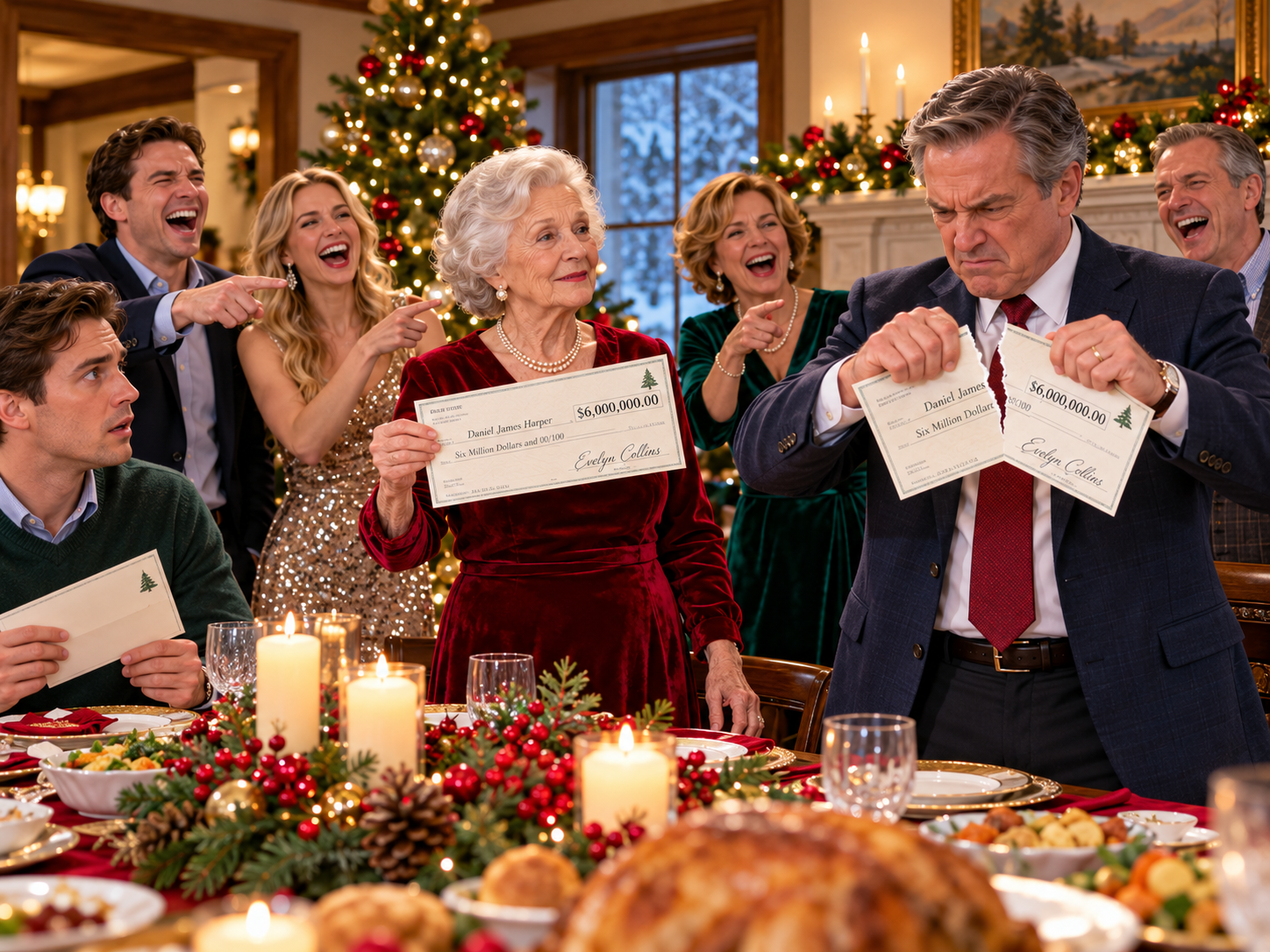
“I've apologized for tearing the check,” he said. “I know I shouldn't have done it. But I want everyone to remember that I was trying to protect Mom from making a mistake.”
Grandma's face changed.
“Daniel, you did not ask me whether I was making a mistake.”
“I thought—”
“You thought you already knew.”
He looked down at the napkin.
“I was worried.”
“Then you could have asked me what I was worried about. You could have asked me to explain. You could have called the attorney. Instead, you tore the check and laughed at me.”
Dad's jaw tightened. I could see him struggling to respond without retreating into the familiar language of intention.
“I didn't mean to humiliate you.”
“I believe you,” Grandma said. “But you did humiliate me.”
The words were plain, without anger or exaggeration. That made them harder to dismiss.
Dad put the napkin on the table.
“I don't know what else I can say.”
“You don't have to say anything else right now.”
Grandma reached for her water. The conversation could have ended, but Eric leaned forward.
“Dad, I think the problem is that you keep explaining what you meant instead of acknowledging what happened.”
Dad turned toward him.
“Stay out of this.”
“No,” Eric replied, surprising us all. “I laughed too. I acted like Grandma was making a fool of herself because I didn't want to admit I didn't understand what she was doing. I'm not pretending I was better than you. But we can't keep talking about our intentions as though they erase the way she felt.”
The room fell silent again.
Dad stared at his son. For a moment, I thought he might end the gathering or leave. Instead, he looked toward Grandma.
“I was wrong,” he said.
Grandma waited.
“I should have listened. I should have let you explain. And I should have called you afterward instead of telling Daniel to bring the check home.”
He stopped, searching for words.
“I am sorry I made you feel that nobody trusted you.”
Grandma's eyes filled, but she didn't cry. She reached across the table and touched his hand.
“Thank you.”
Dad nodded. He looked older than he had at Christmas, though only six months had passed. I wondered whether the change came from guilt, exhaustion, or the realization that he could not solve every problem by insisting that he had meant well.
After a few moments, Grandma asked whether anyone wanted more cake. The conversation resumed slowly, first around the table, then in smaller groups. Olivia helped Mom clear the dishes. Eric took the garbage outside. Diane sat with Grandma near the window, asking about the greenhouse.
Dad stayed behind to wash the pans.
I joined him at the sink.
“Are you all right?” I asked.
He gave a short laugh. “That's an odd question.”
“You look like you could use one.”
He rinsed a plate and placed it in the drying rack.
“I don't like being told I've hurt someone when I thought I was helping.”
“I don't think anyone likes it.”
“I thought I was being responsible. Mom has been alone out here for years. She refuses to move closer to town, refuses to let anyone do more than the minimum, and then suddenly hands us checks for millions of dollars. I thought she had lost perspective.”
“Did you ask her?”
“No.”
He looked at the water running over his hands.
“I keep coming back to that.”
I dried the plate he handed me.
“Maybe you were afraid she had done something you couldn't control.”
Dad stopped rinsing.
“Perhaps.”
It was the closest he had come to admitting that his reaction had been about more than money.
He turned off the tap and leaned against the counter.
“When I was young, I thought being a good son meant making sure my parents never had to worry about anything. If they were struggling, I was supposed to fix it. If they made a decision I didn't understand, I was supposed to stop them from making a mistake.”
“And now?”
“Now I think I sometimes use that as an excuse to decide for people.”
I said nothing. He had reached the conclusion himself, and I didn't want to turn the moment into a lecture.
After a while, he asked how my teaching was going. We talked about my students, his work, and the roof repairs. The conversation was ordinary, but there was less tension in it than before. He didn't ask about my bank balance or whether I planned to buy a house. He asked whether I was enjoying the extra time I had taken off.
“I am,” I said.
“Good.”
He hesitated, then added, “I know the money has changed things between us. I don't want you thinking every time I call that I'm going to ask you for something.”
I met his eyes.
“Then don't make every call about money.”
He gave a small, reluctant smile.
“Fair enough.”
When the last guests left, Grandma and I sat on the porch. The evening air smelled of grass and damp soil. A few birds moved through the trees, settling into the branches as the light faded.
“Do you think Dad meant what he said?” I asked.
“I think he meant it tonight.”
“Will it last?”
“That is something he will have to show us.”
She folded her hands in her lap.
“An apology is not a contract that guarantees someone will never make the same mistake again. It is an acknowledgment that the mistake happened. What comes next depends on what they do with that knowledge.”
I leaned back in my chair.
“You make everything sound simple.”
“No, sweetheart. I make it sound clear. It is rarely simple.”
We sat together until the porch light came on. Before bed, I placed the remaining cake in a container and put it in the refrigerator. Grandma said she would have a slice with her tea the next morning, then reminded me that I needed to leave early if I wanted to avoid traffic.
As I went upstairs, I thought about the birthday gathering. The family had not become perfect. Dad had not transformed overnight, and Eric still struggled to admit when he was frightened. But they had begun to speak more honestly, and Grandma had no longer been forced to pretend that their intentions mattered more than her experience.
For the first time since Christmas, I felt that we were not simply reacting to the money.
We were learning how to talk to one another without using it as a shield.
Click here to continue reading: PART 12: Grandma Asked Me to Walk With Her Through the Garden, and Her Final Decision Made Me Understand What She Wanted to Leave Behind
My Father Tore Up Six Million Dollars Before Grandma Could Explain Why She Had Chosen Us
Part 11 of 20

