
The first thing Grandma asked me to do the next morning was shovel the path from the porch to the woodpile.
“Not because I want to work you to death,” she said, handing me a pair of gloves. “But because if I fall on that ice, nobody will hear me yelling until spring.”
I looked at her. “You could have mentioned that before I arrived.”
“You would have worried.”
“I’m worrying now.”
“Then at least you're doing it while the snow gets cleared.”
Her dry delivery made me laugh, and for the first time since Christmas dinner, the cabin felt like home again. I shoveled the path while she made coffee. The snow had fallen in thick, dry layers overnight, and every few minutes the shovel struck the frozen ground with a hollow scrape. When I came inside, my shoulders ached, my jeans were wet at the knees, and the kitchen smelled of toast.
Grandma had set out two mugs.
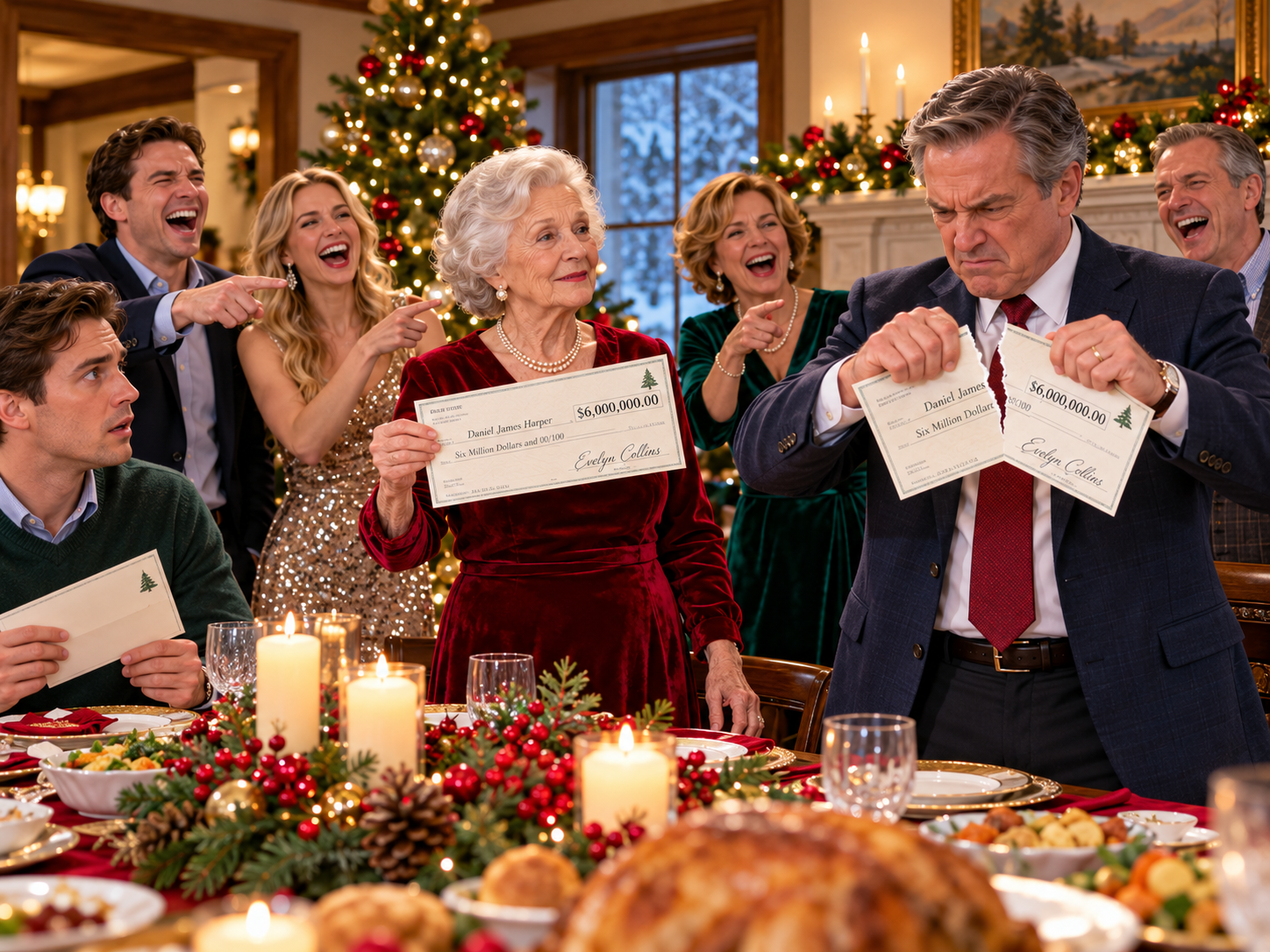
She didn't mention the checks.
Neither did I.
For the next few days, we fell into a rhythm that seemed to have been waiting for us. I cleared the snow from the porch roof, replaced a loose screw on the back door, and helped her carry firewood from the shed. She showed me where Grandpa had kept his tools, though she warned me not to trust the labels he had written on the drawers.
“He called every wrench a wrench,” she said. “Even the things that weren't wrenches.”
At night, we sat beside the fireplace. She told me stories about Grandpa Walter, who had been a mechanic before he bought the little stretch of land outside Sheridan. He had built the cabin one wall at a time, arguing with the lumber supplier over the price of every plank and then giving the man a jar of honey from Grandma's hives as a peace offering.
“He could be stubborn,” she said, turning her mug between her palms. “But when he gave his word, he kept it.”
I thought about the checks again.
“Did Grandpa ever do something like that?” I asked.
“Like what?”
“Make a decision that everybody thought was ridiculous, only to discover later that he'd thought it through?”
Grandma considered the question.
“Your grandfather wasn't fond of surprises. He liked to know what he was doing before he did it.” She paused. “But he understood that people sometimes mistake quietness for weakness.”
She said it while watching the fire. I wasn't sure whether she was talking about Grandpa, herself, or the family that had walked out of her cabin the night before.
On the third morning, I found her standing at the kitchen counter with one hand gripping the edge. A mug lay on its side near the sink, and tea had spread across the counter and dripped onto the floor.
“Grandma?”
She straightened quickly.
“It's nothing. My hand slipped.”
I fetched a towel. She reached for it, but her fingers trembled enough that I took the cloth from her and cleaned the spill myself.
“Have you been feeling all right?”
“I'm eighty-one. I'm entitled to feel a little old.”
“That isn't an answer.”
She turned toward the window. Beyond the glass, the snow-covered garden lay beneath a pale morning sky. Grandpa had built a small greenhouse behind the shed, and Grandma still grew herbs and winter greens in it, even though she had to use a cane on the icy path.
“I get tired,” she admitted. “More than I used to.”
“How long has that been happening?”
“Long enough.”
“Have you seen your doctor?”
She gave me a look that reminded me of every time I had tried to argue with her as a child.
“Yes, Daniel. I have a doctor.”
“And?”
“And he tells me I'm old.”
“I'm sure he phrases it more politely.”
That earned me a faint smile. Then she reached for the kettle and changed the subject.
I let her. I didn't want to turn every quiet moment into an interrogation, but I began noticing things I had missed on earlier visits: the way she paused before climbing the stairs, the cough she tried to hide behind a napkin, the unopened envelopes arranged in a stack near the telephone.
The cabin was full of evidence that she had learned to do everything alone.
There were jars of soup in the pantry, neatly labeled in her handwriting. The roof leak had been contained with a bucket and an old towel. A light switch near the hallway worked only if you pressed it twice. The porch rail had a slight wobble. Grandpa's wool coat still hung by the back door, and the sleeves had been brushed clean, as though he might return and need it.
On Thursday, I found an envelope addressed to Grandma on the kitchen table. It had been opened and folded closed again. The return address belonged to a law office in Sheridan.
I didn't touch it.
That evening, after dinner, she asked me to bring the small wooden box from the bedroom closet. It was the box where she kept photographs, old letters, and the jewelry she rarely wore. She sat at the table and opened it, lifting each item with the careful attention of someone handling a collection of lives.
There were pictures of Grandpa in his twenties, a faded wedding photograph, and a newspaper clipping about the opening of a community library. At the bottom lay a photograph of Grandma standing beside a man in a dark suit outside a brick building. The man was younger than I had ever seen him, with a narrow face and a serious expression.
“Who's that?” I asked.
“Your grandfather's attorney. Samuel Price.”
“Is he still around?”
“No. He retired years ago. His daughter took over his practice.”
Grandma returned the photograph to the box.
“Why do you ask?”
“Because of the envelope on the table.”
She studied me for a moment. Then she closed the lid.
“I have some business to settle. That's all.”
I wondered whether it had anything to do with the checks. The question reached my lips, but I swallowed it. If she wanted to tell me, she would. I had spent enough time around people who treated every silence as an invitation to pry.
Instead, I asked whether she wanted to watch a movie.
We chose an old mystery Grandpa had loved. Halfway through, Grandma fell asleep in her chair. I turned down the television and placed a blanket over her legs. The firelight softened the lines on her face, and I felt a sudden, uncomfortable awareness of how much time had passed since I was a child sitting on this same rug, waiting for her to read me a story.
I had built my life in Boulder. I taught students to notice the small decisions writers made, the details that changed the meaning of a scene. I spent my days discussing unreliable narrators and the distance between what people said and what they meant.
Yet I had never asked my grandmother enough questions about her own life.
The following afternoon, we went into Sheridan to buy groceries. Grandma insisted on driving, although I offered to take the wheel. She moved slowly through the aisles, comparing prices and choosing apples one by one. At the checkout, she recognized a woman from the clinic and stopped to ask about the woman's husband, who had recently undergone surgery.
The woman asked Grandma how she was feeling.
“Keeping busy,” Grandma replied.
It was the same answer she had given me.
On the drive home, I watched the mountains rise beyond the road. The snow had begun melting in the sunlight, leaving dark patches along the shoulders. Grandma drove with both hands on the wheel, leaning slightly forward to see through the windshield.
“Do you ever wish you'd moved closer to town?” I asked.
“Sometimes. But your grandfather wanted to build here, and I wanted to be where he was.” She glanced at me. “After he died, I thought I might sell the place. Then I came outside one morning and heard the creek running beneath the ice. I realized I wasn't ready to leave.”
“You don't have to leave because the house is difficult to maintain.”
“No. But I may need to let someone help me.”
I looked at her, surprised by the admission.
She kept her eyes on the road. “There's a difference between accepting help and surrendering your life to other people.”
The sentence followed me into the cabin.
That evening, I found the check again in the book beside my bed. I had placed it there for safekeeping, but now I carried it downstairs and laid it on the kitchen table. Grandma was chopping carrots for soup. Her knife paused when she saw the paper.
“I haven't forgotten about it,” I said.
“I didn't think you had.”
“Can you tell me why you gave it to us?”
She set the knife down and wiped her hands.
“I can tell you that I meant what I gave you.”
“That's not much of an explanation.”
“No,” she agreed. “It isn't.”
“Is the check real?”
She looked at me steadily.
“Would you believe me if I said yes?”
“I want to.”
“That isn't the same thing.”
I pulled out a chair. “Grandma, I don't need six million dollars. I don't even know what I'd do with it. But I need to understand why you gave it to us, especially after what happened at dinner.”
Her face tightened at the memory.
“I hoped your father would have the patience to listen.”
“He didn't.”
“No.”
She returned to chopping, but the knife moved more slowly now.
“I didn't give those checks to make anyone feel foolish,” she said. “I didn't do it to punish your father or your aunt. And I certainly didn't do it because I thought money would make our family kinder.”
“Then why?”
“Because there are things that need to be faced while I'm still here to face them.”
I waited for her to continue. She didn't.
“Is this about the lawyer?”
The knife stopped.
I wished I could take the question back, but she had heard it.
“Who told you about a lawyer?”
“Nobody. I saw an envelope.”
She set the knife down with care and folded her hands on the counter. The room seemed suddenly quieter, apart from the low hum of the refrigerator.
“Samuel Price helped your grandfather and me make certain arrangements years ago,” she said. “Some of those arrangements have to do with the family. Some have to do with property. And some have to do with money.”
I glanced at the check.
“How much money?”
She gave me a tired smile. “Enough that people might stop listening to one another and start listening only to what they think they can get.”
“That sounds like our family.”
“Daniel.”
“Sorry.”
“No, you're not entirely wrong.”
She sat down opposite me. For the first time since Christmas, she looked uncertain—not about the checks, but about whether she could trust me with what came next.
“I want you to understand something,” she said. “I didn't choose the people who received those envelopes because I thought they deserved the same amount. I chose them because each of them is part of this family, and I wanted each of them to have the same chance to respond.”
“Respond to what?”
She glanced toward the hallway, where Grandpa's photograph hung above the old telephone.
“To the truth.”
The word settled between us.
I wanted to ask a dozen questions, but Grandma looked exhausted. Her shoulders had slumped, and her hand rested against her chest as she caught her breath. I rose and put the kettle on. She let me bring her tea without protest.
Later that night, I called Dad.
He answered on the fourth ring, sounding irritated.
“What is it? I'm in the middle of something.”
“I'm still at Grandma's.”
“I know. You told us you were staying.”
“I want to ask you about the check.”
He sighed so heavily that I could picture him leaning back in his office chair.
“Daniel, please. Don't tell me you're taking that nonsense seriously.”
“I'm asking whether you contacted her after Christmas.”
“Why would I?”
“To ask what she meant.”
“Because I have a job, a mortgage, and actual responsibilities. I'm not going to waste time chasing some ridiculous fantasy.”
“Did you even call to see how she's doing?”
Silence.
Then he said, “Your grandmother is perfectly capable of taking care of herself. She has been for years.”
“She nearly dropped a mug yesterday because her hands were shaking.”
“She should see her doctor.”
“She has.”
“Then what do you want me to do?”
I gripped the phone tighter. “Maybe ask her how she is. Maybe visit when it isn't Christmas. Maybe stop acting like helping her is an inconvenience.”
Dad's voice hardened. “You don't know everything that goes on between your mother and me and her. Don't lecture me about family obligations.”
“Then explain it.”
“I'm not having this conversation.”
He hung up.
I stood in the kitchen, staring at the dark screen. Grandma had gone to bed, leaving one lamp on in the living room. Her unfinished knitting lay in a basket beside her chair. Outside, the wind rattled the porch rail.
I could have called Eric. I could have called Aunt Diane. I could have asked everyone to explain why they had been so eager to dismiss the checks.
Instead, I went upstairs and placed the envelope inside my suitcase.
The next morning, I would drive to the bank.
Click here to continue reading: PART 3: The Bank Manager Opened a Private File and Asked Me to Prove I Was the Man Named on the Check
My Father Tore Up Six Million Dollars Before Grandma Could Explain Why She Had Chosen Us
Part 2 of 20

