
The following spring, I drove back to Alabama for a visit that Lily and I had planned together. This time, the trip did not begin with a secret hope that my parents might finally explain themselves. I was going because my daughter had invited me, because we had made plans, and because I wanted to spend time with her in the place where she had built her life.
The difference was small on paper and enormous in practice.
I arrived on a Friday afternoon. Lily met me at the airport, carrying the same easy smile she had worn on the day of my previous visit. She hugged me, took my suitcase, and immediately began telling me about a new project she was considering. She wanted to create a small portfolio of independent design work and had been speaking with a few potential clients.
“I think I'm ready to try,” she said as we drove toward town. “Not because I'm certain I'll succeed. I'm just tired of waiting until I'm certain.”
I looked at her and smiled. “That sounds familiar.”
She laughed. “I thought you might say that.”
We had spent months learning how to be in each other's lives. We called regularly, sometimes for long conversations and sometimes only to share a small piece of our day. She had visited Denver once, staying in my guest room and exploring the city with the curiosity of someone who wanted to know the places that had shaped me. I had shown her my office, the café where I sometimes worked, and the mountain view from a trail I liked to walk when I needed to clear my head.
She had met two of my closest friends, who treated her warmly without trying to fill the space between us with assumptions. She had seen the business I had built and understood, perhaps more clearly than before, why work had become such an important part of my life.
I had also begun to understand her. She was thoughtful, sometimes guarded, and more determined than she realized. She loved quiet mornings, strong coffee, and music playing while she worked. She had a dry sense of humor and an impatience with people who talked around a problem instead of naming it. The more I learned about her, the less she felt like the missing piece of my life and the more she became the person she had always been: Lily, my daughter, with her own mind and her own future.
That evening, we had dinner at her apartment. She cooked pasta while I chopped vegetables, and we argued about whether the sauce needed more garlic. Afterward, we sat on the sofa and talked about the visit ahead.
“Grandma asked whether you would come to the house on Sunday,” Lily said.
I set my glass down. “What did you tell her?”
“That I'd ask you. She said she wants to see you, but she understands if you're not ready.”
I considered the invitation. The thought of returning to the house still stirred memories I couldn't control. I could picture the driveway, the porch, and the wet grass beneath my feet on the night I had been thrown out. But the house no longer held the power it once had over my choices.
“I'll come,” I said. “For a little while.”
Lily nodded. “I wanted to make sure you knew you didn't have to.”
“I know. That's why I can choose to go.”
She smiled. “I'm glad.”
On Sunday afternoon, we drove together to my parents' house. The driveway looked almost exactly as I remembered it. The same trees bordered the property, and the same porch stood beneath the roofline. The lawn had been freshly cut, and a pot of flowers sat beside the front steps. It was an ordinary home on an ordinary afternoon, which somehow made the memories more difficult to reconcile with what had happened there.
I remained in the passenger seat for a few seconds after Lily parked.
“You okay?” she asked.
“Yes.” I took a breath. “I'm remembering.”
She placed her hand over mine. “We can leave whenever you want.”
“Thank you.”
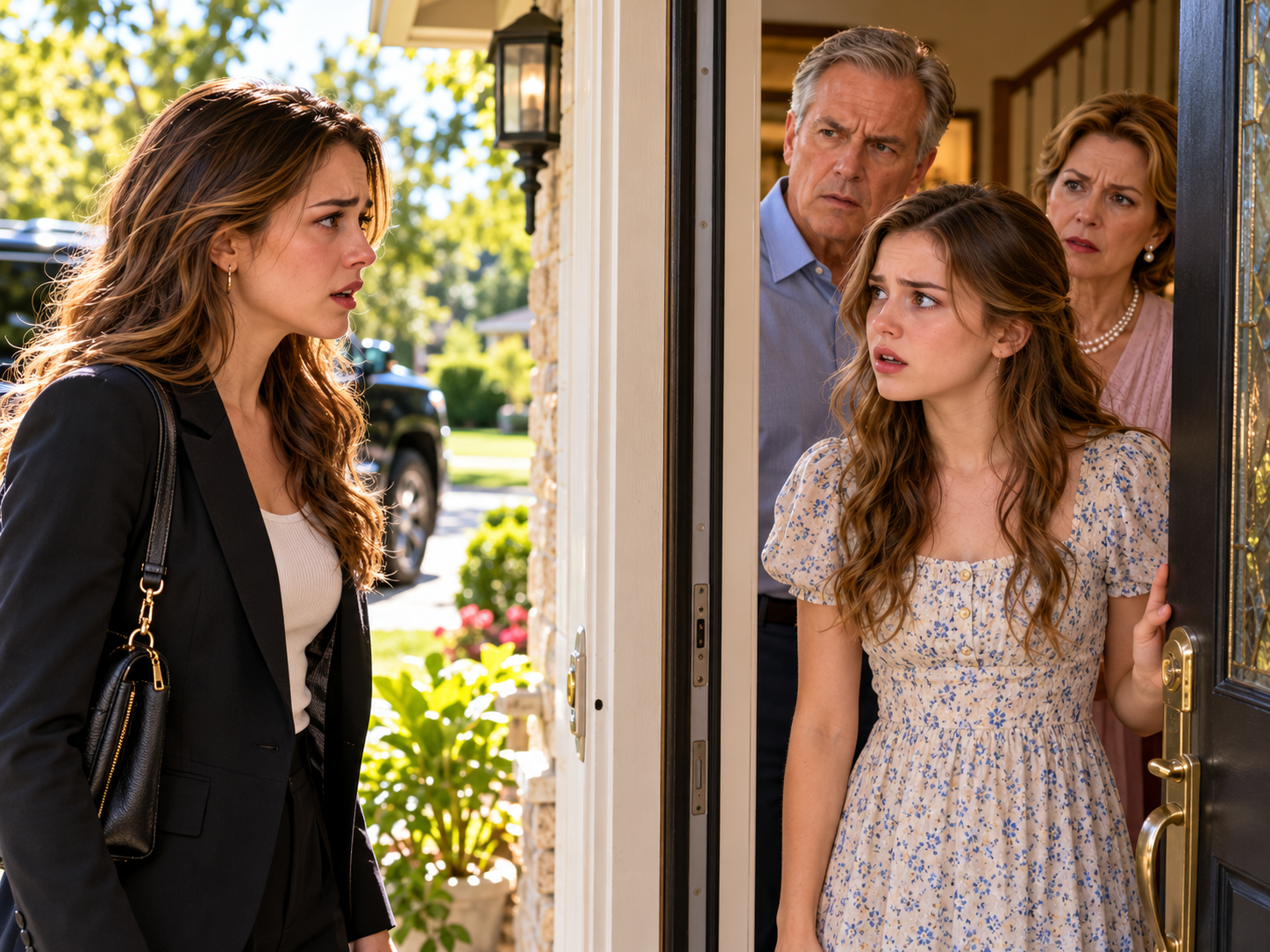
We walked to the front door together. My mother opened it before we knocked, as if she had been watching from the window. Her face brightened when she saw Lily, then softened when she looked at me.
“Come in,” she said. “I've made coffee.”
I stepped over the threshold. The hallway smelled of furniture polish and something baking in the kitchen. A framed photograph of Lily's graduation hung on the wall, and beside it was a newer photograph of the three of us taken during her birthday dinner. I stopped when I saw it.
My mother noticed. “Lily brought a copy for us.”
I looked at the photograph. Lily was smiling between my mother and me, her hands resting lightly against our backs. There was no evidence in the picture of the years we had lost, but neither was there any attempt to hide who we were to each other now.
“It's a nice picture,” I said.
My mother smiled, though her eyes filled. “I think so, too.”
My father was sitting in the living room. He stood when we entered, then hesitated as though he was unsure whether to offer a handshake or a hug. I spared him the decision by greeting him simply.
“Hello, Dad.”
“Anna. I'm glad you came.”
We sat in the living room, Lily beside me, my parents opposite us. At first, the conversation stayed with ordinary matters: the weather, my flight, Lily's work, and a repair my father had made to the back fence. The ease was not perfect, but it was real enough to let us speak without every sentence becoming a test.
Eventually, my mother brought out the coffee. She handed me a cup and asked whether I still preferred milk on the side. I said yes. She placed the small pitcher beside my saucer without comment.
I noticed the gesture and accepted it for what it was: an attempt to remember me, not a substitute for an apology.
My father spoke about the letter I had sent him. He told me he had read it several times and had begun to understand how much of my life had been shaped by the decisions he made when I was a teenager. He said he was trying to stop himself from explaining those decisions whenever someone asked about the past.
“I used to think that if people understood why I did something, they would see it differently,” he said. “I didn't understand that an explanation could become another way of avoiding responsibility.”
I watched him carefully. He was not asking me to tell him he had changed. He was describing something he was trying to change in himself.
“I'm glad you're thinking about that,” I said. “But it will take more than understanding for me to trust you.”
“I know.”
“And trust may not look the way you expect.”
He nodded. “I'll have to accept that.”
Lily remained quiet, listening. I knew she was watching not only what my father said but whether he could hear an answer that disappointed him without trying to overturn it. When he didn't argue, she relaxed slightly.
My mother spoke next. She said she had begun correcting the story whenever relatives referred to me as the daughter who ran away. She had called two family members she had misled and told them directly that I had not abandoned Lily. She had admitted that she and my father had separated us and then hidden the truth because they feared the consequences of their choices.
“I should have done it years ago,” she said. “I can't change that. But I can stop repeating the lie.”
“Thank you,” I replied.
It was not forgiveness. It was acknowledgment. I could recognize that she had taken a step without pretending that the step erased the distance between us.
We talked for another hour. Lily told my parents about her design plans, and my father asked questions without trying to decide what she should do. My mother offered to help her find a local accountant, but Lily said she would think about it. My mother accepted the answer.
Before we left, my father walked with us to the porch. He stood near the railing while Lily unlocked the car.
“I know you may never feel at home here again,” he said to me.
I looked at the house behind him. “I don't know what home will mean to me when it comes to this place.”
He nodded slowly. “That's fair.”
“But I don't need to hate this house to know what happened here. And I don't need to pretend what happened was acceptable just because I'm willing to visit.”
“I understand.”
I wasn't sure whether he understood all of it, but I no longer needed to test him with another question. I had said what I needed to say. The rest would depend on what he did with the truth after I left.
Lily hugged her grandparents goodbye. Then she returned to my side and slipped her arm through mine as we walked down the steps.
When we reached the driveway, I stopped.
This was where my mother had thrown my backpack onto the lawn. This was where my father had told me I was dead to them. This was where I had stood in the rain, frightened and pregnant, trying to gather my belongings while the people who should have protected me watched from the doorway.
For years, I had pictured that scene as the defining moment of my life. I had believed that everything afterward was a response to it: the places I moved, the work I chose, the way I guarded my heart, and the determination with which I built a life no one could take away.
But standing there with Lily beside me, I understood something I hadn't been able to see when I first returned.
That night had changed my life. It had hurt me deeply. It had forced me to survive things no teenager should have faced alone. But it had not defined the whole of who I was. My parents had made a decision about me, and for a long time I had allowed that decision to become the measure by which I judged myself.
I was no longer willing to do that.
Lily squeezed my arm. “Are you ready?”
I looked at her. “Yes.”
We walked to the car. Before getting in, she turned toward the house and watched my parents standing on the porch. My mother lifted one hand in a small wave. Lily waved back, then opened the passenger door for me.
As we drove away, I did not look back at the house until we reached the end of the road. When I finally glanced over my shoulder, it was already hidden by the trees.
I felt no sudden release, no cinematic moment when twenty years of pain disappeared. The grief was still there, and so were the memories. But they no longer seemed to be waiting for me at every turn, demanding that I return and finish an argument that had begun when I was sixteen.
The argument was over because I had stopped letting it decide the shape of my life.
That evening, Lily and I sat on her balcony with cups of tea, watching the sky darken. We talked about her freelance plans, my next work trip, and whether she might visit Denver again in the summer. She told me she wanted to start a small project of her own, helping local artists create affordable websites for their work. I offered to review her budget when she was ready, and she agreed.
“I want to try it myself first,” she said.
“That's a good idea.”
“Then I'll show you what I come up with.”
“I'd love that.”
She leaned back in her chair. “I'm glad I know you now.”
I looked at her, taking in the familiar shape of her smile, the thoughtful way she tilted her head when she was choosing her words, and the confidence she was slowly allowing herself to trust.
“I'm glad, too.”
After a while, she grew quiet.
“Sometimes I still think about what would have happened if they had told me the truth when I was little.”
“So do I.”
“I wonder whether I would have searched for you. Whether I would have been angry. Whether we would have found each other sooner.”
“We can't know.”
“Does that bother you?”
I considered the question. “It makes me sad. But I don't want to spend the rest of my life trying to solve a version of the past that we can't reach. I want to make the most of the time we have now.”
She nodded. “I think I want that, too.”
We sat together until the tea grew cold. Before I left Alabama, we made plans for another visit and agreed to keep our regular calls. We did not promise that every conversation would be easy or that we would never misunderstand each other. We promised only to speak honestly, to ask questions rather than assume, and to respect the fact that we were building a relationship between two people who had been separated for far too long.
On the morning of my flight, Lily drove me to the airport. She hugged me beside the car, then stepped back and smiled.
“Call me when you land.”
“I will.”
“And don't wait until Sunday to tell me how your week is going.”
“I won't.”
She laughed. “Good.”
I watched her walk back toward her car, then turned toward the terminal. I was carrying the same suitcase I had brought on my first trip, but the documents inside it no longer felt like evidence I had to use to defend myself. They were part of my history. I would keep them, and I would remember what they meant, but I would not spend every day reliving the moment they proved the truth.
When the plane took off, Alabama disappeared beneath the clouds. I thought about the young girl who had stood in the driveway twenty years earlier, convinced she had lost her family and every chance at happiness. I wished I could tell her that she would survive, that she would build something meaningful, and that the baby she loved would one day choose to know her.
I would tell her that she did not have to become perfect to deserve love. She did not have to prove her worth by working harder than everyone else. She did not have to carry the shame of choices other people had made.
Most of all, I would tell her that the future was not something her parents could take away by refusing to acknowledge her.
It belonged to her.
And it belonged to the daughter who was now learning to build her own life with the truth in her hands.
When I landed in Denver, a message from Lily was waiting on my phone.
Already miss you, Mom. Talk tonight?
I smiled as I walked toward baggage claim.
Of course, sweetheart. Talk tonight.
I put the phone away and continued toward the exit. The city was waiting for me, along with my work, my friends, and the life I had built through years of effort and determination. Somewhere in Alabama, my daughter was continuing her own life, no longer trapped inside a story that had been written for her by people who feared the truth.
We would keep learning each other. We would have difficult days. We would discover new things to love and old things to grieve. There would be birthdays, phone calls, photographs, and ordinary afternoons that would never make it into anyone else's version of our story.
Those ordinary moments were enough to begin with.
I had driven back to the driveway where my life had been broken, believing I needed to look my parents in the eye and finally understand what they had done. I had found the truth, but I had also found something more important: the right to decide what that truth would mean for the rest of my life.
My parents could acknowledge their choices or fail to live up to their apologies. They could become people I saw often, or people I kept at a careful distance. Forgiveness might come someday, or it might take a form neither of us could predict.
None of those decisions would determine whether I was worthy of love.
I had survived the night they cast me out. I had built a life that was mine. And now, twenty years later, my daughter knew that I had wanted her from the beginning.
The past would always be part of my story.
But it no longer owned the ending.
The End
Read more original stories on Feel Every Story.
Twenty Years After Being Thrown Into the Storm, I Returned to the House That Had Erased Me From Its Memory
Part 20 of 20

