
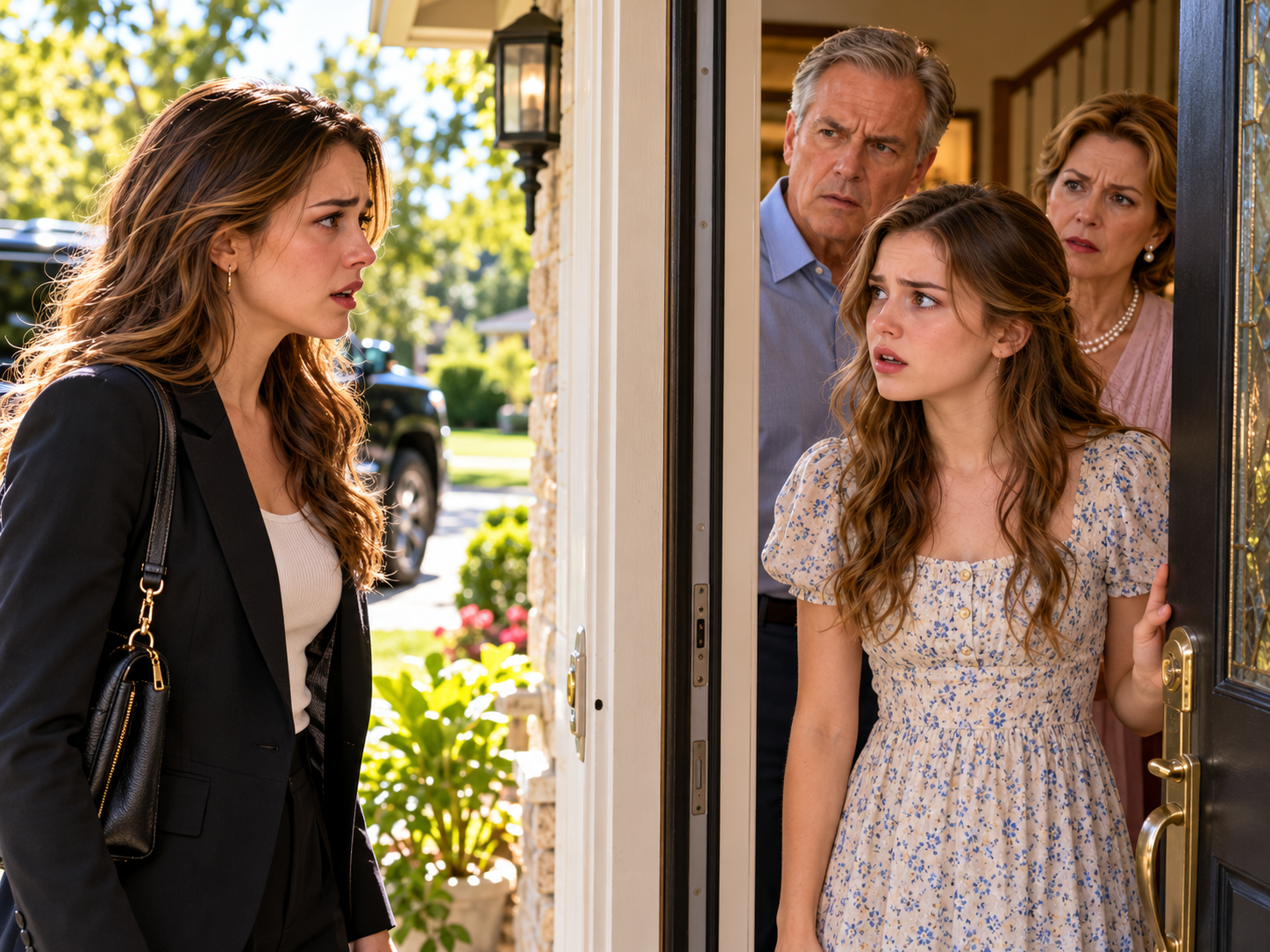
The morning after my father handed me the hospital records and the letter he had never sent, I woke before sunrise in the guest room of my childhood home. For a few seconds, I forgot where I was. Then I saw the faded curtains, the hairline crack above the window, and the dresser where I had once hidden school assignments beneath folded sweaters. Everything looked painfully familiar. The only difference was that I was no longer sixteen, and nobody could force me to believe their version of my life.
I sat on the edge of the bed with the letter in my hands. My father's handwriting had grown shakier over the years, but the words he'd written twenty years earlier remained unmistakably his. He had known I wanted my baby. He had known I had asked to see her. He had known I hadn't abandoned her. And still, he had chosen silence because silence had seemed easier than admitting what our family had done.
I read the letter again, stopping at the same sentence that had made my stomach turn the night before: I told myself you would eventually understand why we made this decision. He had written it as if time could transform cruelty into wisdom. As if the years he'd stolen from us were merely a misunderstanding waiting for the right explanation.
A soft knock came at the door.
“Anna? Are you awake?”
My mother's voice sounded smaller than I remembered. I folded the letter carefully and placed it beside the hospital records. “I'm awake.”
She opened the door only after I told her she could come in. She was carrying a cup of coffee, black with a little milk on the side, exactly how I had always taken it before leaving for school. The familiar gesture unsettled me more than an apology would have. It reminded me that she had once known every small preference of mine, even while pretending she no longer knew me at all.
“I thought you might want this,” she said.
“Thank you.”
She set the cup down, then remained standing near the door. Her eyes moved toward the papers on the dresser but didn't settle on them. “Your father hasn't slept.”
“Neither have I.”
“He knows he hurt you.”
I looked up. “Does he know what he did to Lily?”
My mother pressed her lips together. The silence that followed was answer enough.
“He loved her,” she said eventually. “We both did.”
“I don't doubt that you loved the child you raised. What I doubt is whether you ever considered what it meant to love her by lying to her about me.”
Her fingers tightened around the handle of her handbag. “We thought telling her the truth would destroy her.”
“You didn't tell her the truth when she was young. You didn't tell her when she was old enough to ask questions. You didn't tell her when she became an adult capable of understanding complicated things. At what point did protecting her become protecting yourselves?”
My mother looked toward the window. Dawn had begun to pale the sky beyond the trees, revealing the wet grass and the old driveway where my belongings had landed in the rain twenty years earlier. I could still picture my backpack lying open, my notebooks dark with water, my hands shaking as I tried to gather everything before the storm soaked it through.
“We were afraid,” she whispered.
“I know. You have told me that. But I was afraid, too. I was sixteen, pregnant, and standing outside this house with nowhere to go. You had choices. I barely had any.”
She sat down on the chair beside the dresser. For the first time since my return, she didn't attempt to explain what my father had done as if his choices had been made by some invisible force. She looked at her hands and let the truth remain between us.
“I used to drive past the bus station,” she said. “The one on the highway. For months, I wondered whether you were somewhere nearby. I told myself that if you wanted to come home, you would.”
“I didn't know whether I was allowed to.”
Her face crumpled. “I know that now.”
“No,” I said gently, though my voice shook. “You know it because I'm sitting here telling you. You didn't know it when I was the girl you threw out.”
She began to cry quietly. I felt the old instinct rise in me—the urge to comfort her, to reassure her that she wasn't a terrible person, to make the room less uncomfortable for everyone else. I had spent years learning not to let that instinct make decisions for me. I could acknowledge her pain without taking responsibility for it.
“I can't make this easier for you,” I said. “Not anymore.”
She nodded, wiping her cheeks with a tissue she pulled from her bag. “I understand.”
I wasn't sure she did. Perhaps understanding would come only after she had lived with the consequences of the truth for longer than a single morning.
When she left, I dressed and went downstairs. My father was sitting at the kitchen table, staring at a plate of untouched toast. He looked older than he had the previous evening. His shoulders slumped beneath his shirt, and his hands rested on the table as though they belonged to someone exhausted from carrying something too heavy for too long.
“Morning,” he said.
“Morning.”
He glanced at the empty chair opposite him. “Would you sit down?”
“I'll stand for now.”
He swallowed. “Your mother told me you read the letter again.”
“I did.”
“I wish I had sent it.”
I pulled out the chair but didn't sit. “Would it have changed anything if you had?”
He opened his mouth, then closed it. Finally, he shook his head. “I don't know.”
“That is the first honest answer you've given me that doesn't come with an excuse.”
He looked down at his hands. “I don't expect you to forgive me.”
“Good.”
The word came out more sharply than I'd intended, but I didn't take it back. Forgiveness was not a debt I owed him because he had finally admitted the truth. If it ever came, it would come on its own terms, after I had decided what place he could safely occupy in my life.
He nodded slowly. “Lily wants us to tell the truth to everyone who was given the wrong story.”
I had not expected that. “Everyone?”
“She says the lie didn't stay inside this house. Our relatives believed it. Some of our neighbors believed it. People were told you had left and never wanted to return.”
“And you let them believe it.”
“Yes.”
“Then she's right.”
He looked toward the hallway. “She said she would come over later. She wants to speak with both of us.”
I felt my chest tighten. “What does she want from us?”
“The truth, I think. And some boundaries.”
“That sounds reasonable.”
For the first time, he almost smiled, though it disappeared before it could become anything recognizable. “She has your stubbornness.”
“She has her own mind. Please don't turn that into another way of comparing us.”
He accepted the correction without arguing. It was a small thing, but I noticed it. Twenty years earlier, every disagreement in this kitchen had ended with my father having the final word. Now he seemed to understand that his authority had ended, whether he was ready to admit it or not.
I poured myself coffee and carried it to the back porch. The air smelled of damp earth and cut grass. Beyond the fence, the fields stretched toward the tree line, still green under the early light. I remembered sitting on these steps as a child, imagining the life I would have once I was old enough to leave. Back then, leaving had meant freedom. At sixteen, it had meant survival. Now it meant something more complicated: the freedom to return without surrendering myself.
My phone vibrated in my pocket.
It was a message from Lily.
Are you awake? Can we talk before I come over? Just you and me.
I answered immediately. Of course. Call whenever you're ready.
The phone rang less than a minute later. I stepped away from the kitchen window so my parents wouldn't hear the conversation.
“Hi,” she said.
“Hi, sweetheart.”
There was a pause. I wondered whether the endearment had been too familiar, whether I had moved too quickly into a place she wasn't ready to give me. Then she spoke.
“I've been thinking about what happened last night.”
“So have I.”
“I don't want you to feel like you have to stay here because of me. I know this house is difficult for you.”
I closed my eyes. “Thank you for thinking about that. I don't want you to feel responsible for keeping me here, either.”
“I'm not.” Her voice was firm, but there was uncertainty underneath it. “I just don't want you to disappear again.”
The words hurt because she had every reason to fear that. She had grown up believing I had made a choice to leave her. Even after learning the truth, part of her might still expect abandonment to arrive without warning.
“I won't disappear without talking to you,” I said. “I can't promise we'll never have difficult days. I can't promise we'll know how to be a family immediately. But I can promise that I won't make decisions about you without giving you a chance to speak.”
She breathed out slowly. “That's all I want right now.”
We talked for nearly twenty minutes about ordinary things. She told me she had barely eaten breakfast. I told her the coffee at my parents' house was still too strong. She laughed, and the sound made me smile before I could stop myself. We were learning each other through small exchanges, building a bridge out of moments that had nothing to do with the years we'd lost.
Before we hung up, Lily asked, “Do you still have the little bracelet?”
I knew which one she meant. My mother had shown us a photograph of it the previous afternoon, a thin silver bracelet I'd bought before my pregnancy, the only piece of jewelry I had kept from my teenage years. In the hospital, I had worn it while waiting to hold my daughter.
“I do,” I said. “It's in my bag.”
“Would you bring it when we meet? I'd like to see it.”
“Of course.”
After the call, I went upstairs and found the small velvet pouch buried in the side pocket of my suitcase. The bracelet was tarnished, its clasp stiff from years of disuse. I held it in my palm and imagined the young woman I had been, terrified and hopeful, believing that once she saw her baby, she could endure anything.
I wished I could tell that girl that her daughter had grown into someone strong enough to demand the truth. I wished I could tell her that the people who had hurt her would one day have to sit across from the child they had tried to protect with lies. Most of all, I wished I could tell her that surviving did not mean she had to spend the rest of her life proving she deserved to exist.
When Lily arrived that afternoon, she came alone. She parked behind my rental car and walked toward the porch, her hands tucked into the pockets of her jacket. She looked nervous, but she didn't hesitate at the steps.
I met her halfway.
“Hi,” she said.
“Hi.”
She glanced at the house, then back at me. “I asked them to wait inside. I don't want this conversation to become another argument about what they meant to do.”
“That's fair.”
We walked to the garden bench beneath the old maple tree. She sat at one end, leaving enough room between us that neither of us had to pretend we were more comfortable than we were. I took the bracelet from my pocket and placed it on the bench between us.
For a long moment, Lily only looked at it.
“That's the one?” she asked.
“Yes.”
She picked it up carefully, turning it in her fingers. “It's so small.”
“I was small, too.”
She gave a faint smile. “I know. I've seen the photographs.”
“Your grandparents kept them?”
“Some. They told me you were a difficult teenager. They said you wanted a life that didn't include a baby.”
I waited while she examined the clasp.
“I don't believe that anymore,” she said. “But sometimes I still hear those words in my head, and I get angry all over again.”
“You're allowed to be angry.”
“Even at them?”
“Especially when they've hurt you. Loving someone doesn't mean you have to pretend they didn't.”
She looked up at me. Her eyes were mine, but her expression belonged entirely to her. “I want to know what happened after I was born. Not all at once. I don't think I can hear everything in one conversation. But I want the truth from you, not another version designed to make somebody feel better.”
“Then that's what I'll give you. One piece at a time, whenever you're ready.”
She set the bracelet back on the bench. “And I want to know you. The real you. Not just the sixteen-year-old girl in their stories.”
My throat tightened. “I'd like that more than I can explain.”
We sat beneath the tree while the afternoon sunlight shifted through the leaves. Nothing was repaired. Nothing was suddenly simple. But for the first time in twenty years, the truth had room to breathe between us, and neither of us was being asked to pretend it wasn't there.
Click here to continue reading: PART 14: The Family Gathering Where Every Carefully Maintained Lie Finally Had to Face the People Who Believed It
Twenty Years After Being Thrown Into the Storm, I Returned to the House That Had Erased Me From Its Memory
Part 13 of 20

