
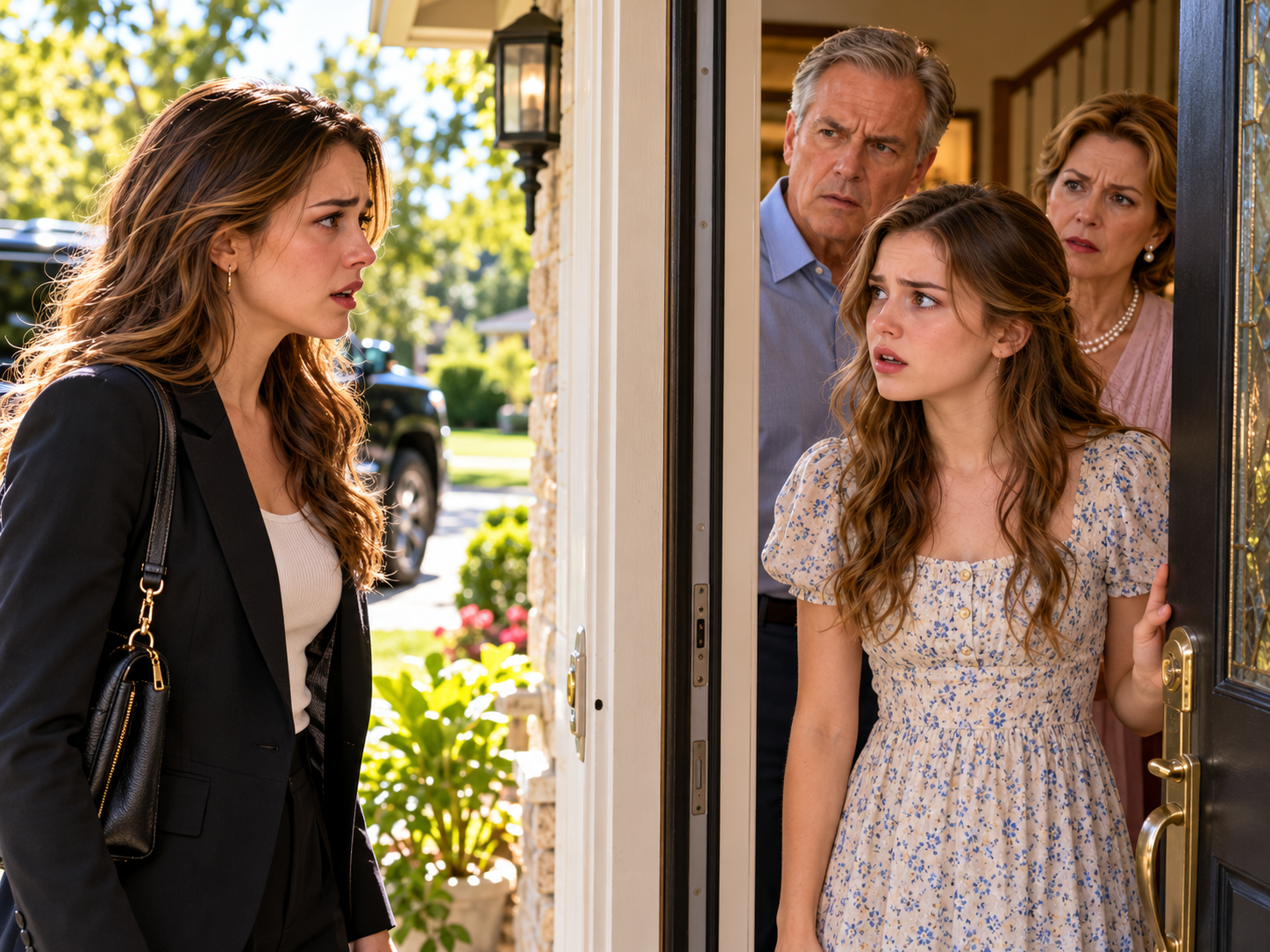
I drove back to my parents' house shortly before noon, but I didn't go inside. Lily had asked me not to start another confrontation, and I intended to respect that. Instead, I parked across the road beneath the shade of an old oak tree and called the attorney whose number I had obtained the previous evening.
Her name was Margaret Ellis. She had practiced family law in Birmingham for nearly thirty years and had agreed to review the documents I photographed. I explained the new information about the box, the hospital papers, and the possibility that my parents had kept records of the arrangements they made after my daughter's birth.
Margaret listened without interrupting.
“Don't remove anything from the house without permission,” she said when I finished. “If your mother is willing to show you the box, photograph the contents and keep copies. We need to establish exactly what happened, what documents were signed, and whether the legal arrangements were ever completed.”
“And if they weren't?”
“Then we find out what rights everyone has now. Your daughter is an adult, so her wishes will be central to whatever she decides to do next.”
I appreciated that she said your daughter without hesitation.
For twenty years, my parents had treated Lily as something they could allocate according to their preferences. Margaret spoke of her as a person whose choices mattered.
After we ended the call, I sent Lily a short message asking whether she had told her grandparents I knew about the box.
She replied almost immediately.
No. Grandma is in her room. Grandpa went to the hardware store. You can come in if you want, but please don't shout.
I read the message twice before answering.
I won't.
When I entered the house, my mother was sitting in the living room with a folded blanket across her knees. She looked up sharply, then glanced toward the stairs as if expecting Lily to appear behind me.
“Where is she?” she asked.
“Upstairs.”
“Did she tell you about the box?”
“Yes.”
My mother closed her eyes.
I waited for her to ask me to leave. Instead, she placed the blanket on the sofa and stood slowly.
“Come with me.”
She led me down the hallway to her bedroom. The room was neat, with a pale floral bedspread and matching curtains. A small table beside the window held a lamp, a glass of water, and a framed photograph of my father and mother standing outside the Baptist church.
There was no photograph of me.
She opened the closet and moved several plastic storage containers aside. Behind them sat a cardboard box sealed with yellowed tape. My name was written across the top in my mother's careful handwriting.
ANNA WHITMORE.
I stared at it.
“How long have you kept this?”
“Since you left.”
“Twenty years?”
She nodded.
“Why?”
My mother lowered herself onto the edge of the bed.
“I couldn't bring myself to throw it away.”
I looked at her, trying to understand how someone could preserve a child's belongings while refusing to let that child return home.
“You couldn't throw away a box, but you could throw me out.”
She flinched.
“I know how that sounds.”
“It sounds exactly like what happened.”
She didn't argue. She reached for the tape, then stopped.
“I want you to understand that we weren't cruel every day. We loved Lily. We took care of her. We gave her everything we thought she needed.”
“You gave her a home. You also gave her a false mother and a false history.”
My mother looked down at her hands.
“Yes.”
She peeled the tape away.
Inside were the things I had left behind on the night of the storm: a biology textbook with a cracked spine, two notebooks, a faded sweatshirt, and a small tin containing the cheap jewelry I had made from beads bought at a craft store. Beneath them lay several envelopes and a thin folder.
I lifted the textbook.
A faint water stain marked the bottom corner. I remembered leaving it on my desk, then begging my mother to let me go back inside for it. She had told me that I no longer needed schoolbooks because I had chosen to become a mother.
I had been sixteen.
The memory came back with such force that I had to sit down.
My mother watched me.
“I kept those things because I thought you might return someday.”
“You knew I was alive.”
“Of course I knew you were alive.”
“You knew where I was. You knew how to find me.”
She nodded.
“Then why didn't you?”
She took a shaky breath.
“Your father thought it would be better to let you go. He believed that if we contacted you, you'd demand the baby back. We had already told everyone that we were raising Lily. We were afraid of losing her.”
“You were afraid of losing the child you had taken from me.”
My mother began crying.
I wanted to feel nothing. I wanted to look at her tears and see only the consequences of her choices. But some part of me still remembered the woman who had once sat beside my bed when I had a fever, who had braided my hair before school, who had taught me to make biscuits by pressing the dough with the heel of my hand.
That woman had existed.
So had the woman who had thrown my backpack into the rain.
I had to accept both.
I opened the folder.
Inside were photocopies of hospital records, handwritten notes, and several letters in my mother's handwriting. The earliest note was dated three days after my daughter's birth. It described a phone call with the hospital and listed questions about the paperwork required to bring the baby home.
Another page contained the name of a social worker, followed by a series of dates. Beside one date, my mother had written, Anna asking about baby. Richard handled it.
I stared at the sentence.
“What does this mean?”
She covered her mouth.
“Your father told you about the temporary arrangement.”
“He told me you contacted the hospital. He didn't tell me you kept records of every step.”
My mother looked at the folder.
“I wrote things down because I was frightened. I thought if we kept everything organized, we could explain it someday.”
“Explain what?”
“That we believed we were doing the right thing.”
I turned another page.
There was a letter addressed to me, dated several months after I left Alabama. The envelope had never been stamped. The letter began with an apology for the way I had been treated, but halfway down the first page, my mother began explaining why I should not return until I was financially secure.
The last paragraph read, You must understand that we cannot allow you to disrupt the life we have built for the baby.
I read it again.
Then I set it on the bed.
“You wrote this to me?”
She nodded.
“Why didn't you send it?”
“Your father said it would encourage you to come back.”
“So you decided I shouldn't know my own daughter existed?”
She pressed both hands to her face.
“I was afraid.”
I had heard those words enough times to recognize how easily they could become an excuse.
“You were afraid of what I might do. You were afraid of what people might think. You were afraid of losing Lily. But did you ever stop to consider what I was afraid of?”
She lowered her hands.
“No.”
The honesty of that answer silenced me.
I examined the remaining papers. Most were copies of records I had already seen, but one envelope contained a letter from the hospital's social worker. It explained that the hospital could not determine permanent custody and that any long-term arrangement needed to be handled through the appropriate legal process.
The letter had been dated less than a month after Lily's birth.
At the bottom, my mother had written a note.
Richard says we should wait. Anna may never come back.
I felt the room grow cold.
They had known that their arrangement was not necessarily permanent. They had been warned that formal legal steps were needed. Yet instead of resolving the matter openly, they had waited and hoped that I would remain gone.
“What happened after this letter?” I asked.
My mother shook her head.
“Your father said he would take care of it.”
“Did he?”
“I don't know.”
I stared at her.
“You don't know whether you legally adopted my daughter?”
She looked so small sitting on the edge of the bed that I almost pitied her.
“We raised her. We registered her for school. We took her to the doctor. We did everything parents do.”
“That's not what I asked.”
“No,” she whispered. “I don't know.”
I took photographs of the documents and sent copies to Margaret. She replied that she would review them and contact me once she had established what further records might be available.
While I waited, I found another envelope at the bottom of the box. It contained several pages of handwritten notes dated over a period of years. Some described Lily's first words, her favorite foods, and the day she learned to ride a bicycle. Others recorded questions she had asked about her mother.
One entry, dated when Lily was eight, read, She asked whether her mother would have come to her school concert. I told her Sarah was gone and that we should not dwell on it.
I closed my eyes.
Lily had been eight years old, standing somewhere in a school auditorium, looking out at a crowd of parents and wondering whether her own mother would ever appear.
I had been in Denver at the time, working late in a small office above my first boutique, believing my daughter was beyond my reach.
My mother had known the question Lily asked.
She had written it down.
And then she had continued the lie.
“Why did you keep these?” I asked.
My mother stared at the notes.
“Because I couldn't forget what we had done.”
“Then why didn't you stop?”
She didn't answer.
I gathered the papers into a neat stack and placed them back in the folder. I wasn't ready to decide what the documents meant legally, and I wouldn't make promises based on a few pages of old handwriting. But they showed something I had not fully understood before.
My parents had not simply made one terrible choice and spent the rest of their lives regretting it.
They had documented the consequences.
They had watched Lily grow up, recorded her questions, and repeatedly chosen the lie that made their own lives easier.
When I finally left the bedroom, Lily was waiting at the top of the stairs.
“Did you find it?” she asked.
“Yes.”
“Was there anything about me?”
I handed her the page describing the school concert.
She read it in silence.
Then she sat down on the stairs.
“I remember that concert,” she said. “I played a triangle in the school band. Grandma told me my mother couldn't come because she was dead.”
I sat beside her.
“I'm sorry.”
She folded the page carefully.
“Did she ever write anything about wanting you back?”
I thought about the letters and the notes. I could have softened the truth, but Lily had asked me not to lie.
“She wrote that she was afraid I would come back and ask for you.”
Lily stared at the paper.
“So she knew you might want me.”
“Yes.”
“And she still told me you didn't want me.”
I nodded.
She pressed the page against her knee.
“I don't know how to forgive that.”
“You don't have to decide today.”
She looked at me, and I recognized the same exhausted uncertainty I had felt the previous night.
“Can I keep this?”
“Of course.”
She folded the paper and placed it in her pocket.
Then she stood and walked toward her room.
I remained on the stairs, listening to her footsteps fade. My mother appeared at the bedroom doorway behind me, but I didn't turn around.
“Anna,” she said, “I know I can't ask you to forgive me.”
I looked down at the worn wooden steps.
“Then don't.”
She fell silent.
I had spent years hoping that one day my parents would explain themselves in a way that made the past easier to bear. Instead, I was discovering that understanding their motives did not make their actions less painful.
Sometimes the truth didn't close a wound.
Sometimes it finally showed you how deep it had always been.
Click here to continue reading: PART 7: The Records Raised Questions About My Daughter’s Identity, and the Answer Could Not Be Decided by My Parents Alone
Twenty Years After Being Thrown Into the Storm, I Returned to the House That Had Erased Me From Its Memory
Part 6 of 20

