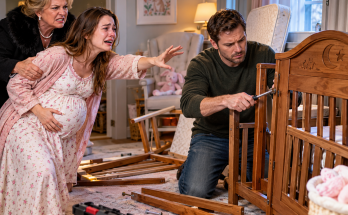
Maria arrived on Thursday carrying a small paper bag and wearing the expression she always wore when she had news she was not sure how to announce.
Mrs. Voss noticed immediately.
“What happened?”
“Nothing happened.”
“That is what people say when something happened.”
Maria laughed.
“I brought something.”
She placed the bag on the table.
Mrs. Voss opened it and found a tiny knitted sweater.
She stared at it.
“Oh.”
Maria smiled.
“The baby will need clothes.”
Mrs. Voss touched the sweater with one finger.
“It is very small.”
“That is usually how babies begin.”
“I know that.”
“I wasn't sure.”
Mrs. Voss looked at Maria.
“You're nervous.”
“A little.”
“Why?”
Maria sat down.
“Because everything is changing.”
Mrs. Voss poured tea.
“Everything always changes.”
“That isn't comforting.”
“It isn't supposed to be.”
Maria smiled.
She had become accustomed to Mrs. Voss's particular kind of wisdom.
It rarely arrived in the form people expected.
Instead of promising that everything would be easy, Mrs. Voss reminded people that difficulty did not mean disaster.
Instead of saying nothing bad would happen, she taught people how to prepare if something did.
Instead of telling Maria that motherhood would be simple, she told her that she did not have to become perfect overnight.
“You'll make mistakes,” Mrs. Voss said.
“Thank you.”
“You'll make good decisions too.”
“That sounds better.”
“And you'll learn.”
Maria looked down at the little sweater.
“I want this child to have a peaceful life.”
Mrs. Voss was quiet for a moment.
“So did everyone who came before.”
Maria looked up.
“That sounded sad.”
“It wasn't meant to.”
Mrs. Voss reached for the sweater.
“What matters is what people do when peace becomes difficult.”
Maria nodded.
The conversation moved to ordinary things.
The nursery.
The doctor's appointments.
The name they were considering.
Whether the baby would sleep.
Whether Maria would sleep.
Mrs. Voss had opinions about all of it.
She especially objected to the number of blankets Maria had purchased.
“A baby does not need twelve blankets.”
“It might.”
“No baby needs twelve blankets.”
“What if the baby likes them?”
“Babies don't have opinions about blankets.”
“You don't know that.”
Mrs. Voss smiled.
“You're becoming argumentative.”
“I learned from you.”
“That is unfortunate.”
They laughed.
After Maria left, Mrs. Voss began sorting the community notebook.
She had started keeping a list of people who attended the meetings.
Not their private information.
Just names and general reminders.
Mrs. Voss wanted to know who lived alone.
Who needed someone to check on them.
Who had trouble reading official letters.
Who had recently lost a spouse.
Who had no nearby family.
She added notes such as “call next Tuesday” or “ask whether she received the documents.”
I watched her.
“You're building a whole system.”
“I am building a list.”
“Same thing.”
“No.”
“What is the difference?”
“A system sounds impressive.”
She smiled.
“A list is something I can manage.”
Then she stopped writing.
She looked at the page.
“I should add myself.”
I laughed.
“You?”
“Yes.”
“You check on everyone else.”
“Exactly.”
She wrote her own name at the bottom.
Under it, she wrote:
“Lives alone. Has neighbors. Has emergency folder. Needs to remember to ask for help.”
I stared at the last line.
“You really wrote that?”
“Yes.”
“You don't like asking for help.”
“I am learning.”
That sentence mattered.
Mrs. Voss had spent much of her life believing independence meant handling everything privately.
She had learned that secrecy and independence were not the same.
Being independent did not mean refusing help.
It meant choosing help rather than surrendering control.
She closed the notebook.
“I wish I had understood that earlier.”
“You understand it now.”
“That has to count for something.”
“It does.”
That afternoon, we went through her emergency folder again.
She checked every page.
Medical contacts.
Insurance information.
Property documents.
Bank information.
Copies of identification.
Instructions for the house.
Names of people she trusted.
She removed an old document.
“This is outdated.”
She replaced it.
I noticed how carefully she worked.
There was no fear in her movements.
Only preparation.
“Do you think planning is frightening?” she asked.
“No.”
“Neither do I.”
She closed the folder.
“Planning is care.”
The phrase became one of her favorites.
At the next community meeting, someone asked whether preparing for emergencies meant expecting the worst.
Mrs. Voss shook her head.
“No.”
“Then what does it mean?”
“Expecting that life is unpredictable.”
She paused.
“You wear a seat belt without planning to crash.”
Several people nodded.
“You keep emergency contacts without planning to need them.”
Another nod.
“You keep copies of important papers because paper gets lost.”
Someone laughed.
Mrs. Voss smiled.
“Preparation is not fear.”
She pointed toward the folder.
“It is respect for your future self.”
The room became quiet.
That sentence appeared in the next version of the handout.
The meetings were growing.
People began bringing friends.
Then neighbors.
Then relatives.
A retired teacher offered to help read documents for people with poor eyesight.
A college student offered to help organize digital copies.
A local nurse volunteered to explain common medical paperwork.
Mrs. Voss refused to let the group become dependent on one person.
“We are not creating another authority,” she said.
“We are creating more informed people.”
That distinction mattered.
She wanted everyone to leave with more choices than they had when they entered.
One evening, I asked whether she ever missed the time before everything changed.
She thought about it.
“I miss certain people.”
“That isn't the same thing.”
“No.”
She looked toward Lucan's photograph.
“I don't miss the silence.”
“What about your husband?”
“I miss the man I thought he was.”
She paused.
“And I remember the man he actually became.”
She did not say it bitterly.
That was what struck me.
She no longer needed to turn memory into either worship or condemnation.
She could remember the whole person.
That was another kind of freedom.
The next week, Maria brought a photograph from the doctor's office.
Mrs. Voss studied it.
“I still can't tell what I'm looking at.”
“That's the baby.”
“I see.”
“You don't.”
“I do.”
“You're pretending.”
“Of course.”
Maria laughed.
Mrs. Voss kept the photograph.
She placed it beside the wedding picture.
“You are collecting photographs now,” I said.
“I always collected photographs.”
“True.”
“But these are different.”
“How?”
“They are pictures of people who are still becoming themselves.”
I thought about that.
Lucan had become a photograph too early.
My mother had become a memory.
My father had become a collection of documents and complicated recollections.
Maria's child was not yet born.
There was no story written for that child.
That felt precious.
Mrs. Voss understood it too.
“Don't give terrible events credit for good,” she said one afternoon.
“What do you mean?”
“People sometimes say something terrible happened, and afterward something beautiful came from it.”
“That can be true.”
“Maybe.”
She looked at the garden.
“But the terrible thing didn't create the beautiful thing.”
“What did?”
“People did.”
She pointed toward the house.
“People chose what to do afterward.”
She pointed toward the community center.
“People helped.”
Then toward Maria's photograph.
“People built families.”
She looked at me.
“Never let terrible people take credit for the good choices other people make afterward.”
I nodded.
That idea stayed with me.
The old network had caused harm.
But it had not created our community.
Fear had not created Maria's marriage.
The investigation had not created her future child.
The secrets had not created the roses.
People had.
Choices had.
Care had.
One Thursday, Mrs. Voss received a letter from the community center.
They wanted her to continue the meetings for another year.
She read it twice.
Then she looked at me.
“I suppose I should say yes.”
“You already know you will.”
“Yes.”
She signed the agreement.
Then she added one condition.
“What?”
“They must keep the room open for questions.”
“Of course.”
“No speeches where people are told what to think.”
“That sounds like you.”
“It is important.”
She put down the pen.
“People have had enough of other people deciding for them.”
The words were simple.
But they came from everything she had lived through.
She knew what happened when information became power in the hands of people who refused to share it.
She also knew what happened when frightened people surrendered decisions because someone sounded confident.
Her work was not about replacing one authority with another.
It was about giving people enough information to make their own decisions.
That evening, the three of us sat on the porch.
Maria rested her hands over her stomach.
Mrs. Voss watched the garden.
I watched both of them.
There was something peaceful about the scene.
Not perfect.
Not permanent.
Just peaceful.
Maria asked, “Do you ever worry that something bad will happen again?”
Mrs. Voss answered honestly.
“Yes.”
Maria looked surprised.
“Really?”
“Of course.”
“Then how do you stay calm?”
Mrs. Voss smiled.
“I stopped believing calm means nothing bad can happen.”
She looked at Maria.
“Calm means knowing what you can do if it does.”
Maria nodded.
The evening grew cooler.
Mrs. Voss stood.
“Inside.”
Maria laughed.
“Why?”
“It's getting cold.”
“You sound like my mother.”
“Good.”
They went inside.
I followed.
The blue door remained open.
No one needed to close it anymore.
Click here to continue reading: PART 26: The rose garden became Mrs. Voss’s quiet promise that the future deserved attention too, even when the past still had unanswered questions
Twenty dollars was supposed to keep me in school, but the old woman at the end of the street seemed to be waiting for something only she remembered
Part 25 of 28