Seven months before anyone told me to leave, I was sitting cross-legged on the floor of my apartment, dividing twelve dollars and forty cents into three piles. I had learned that if I gave each dollar a job, I could pretend I had more money than I actually did.
The first pile was for the bus. The second was for laundry. The third contained three dollars for dinner.
I was twenty-one and halfway through my second year at community college in Philadelphia. My apartment was a single room above a laundromat, and the walls shook whenever one of the industrial dryers downstairs entered its final cycle. At night, the radiator knocked like someone trapped inside it.
The kitchen faucet had leaked for months. I kept an old coffee cup beneath it and emptied the cup whenever the water reached the rim. The landlord had promised to fix it. He had been promising since October.
I worked four evenings a week in the college library and unloaded grocery trucks on Saturdays. It covered tuition, rent, and enough food to keep me from thinking too hard about what would happen if anything went wrong.
I had become good at not needing things.
My mother died when I was nine. After that, I lived with an aunt who already had four children and no room for another mouth, another bed, or another set of problems. When she eventually moved to Ohio, I spent two years on a family friend's sofa.
No one had abandoned me completely. That was the strange part. There was always somewhere to sleep, someone willing to hand me a plate, someone saying, “You'll be fine.” But kindness had always felt temporary.
So I learned to be useful.
I washed dishes before anyone asked. I carried grocery bags. I never left my clothes scattered around a room because I knew that one day I might have to put everything into a duffel bag and go.
That Tuesday afternoon, I was searching a neighborhood Facebook group for extra work when a short advertisement caught my attention.
“Responsible student wanted to help an elderly woman clean her home. Once weekly. Thursday afternoons. Twenty dollars per visit.”
Twenty dollars was not a fortune. To me, it was five bus rides, a carton of eggs, rice, printer paper, or enough ground beef to make three dinners if I added onions and stretched it carefully.
I answered within a minute.
A woman named Odette Voss replied.
“Thursday at four,” she wrote.
A second message arrived almost immediately.
“Please come alone.”
I remember staring at those four words.
Most people would have ignored them. I almost did. Then I looked at the three dollars sitting in my dinner pile and typed, “Okay.”
Mrs. Voss's house stood at the end of a narrow street where tree roots had pushed the sidewalk upward in uneven slabs. It was a faded two-story home with dark green shutters and a porch that leaned slightly toward the street.
A brass lion's head served as the door knocker.
I arrived at 3:58.
I knocked once.
Nothing.
I knocked again.
Nearly a minute passed before the door opened.
The woman behind it was small and thin, with silver hair twisted into a careful knot. She held a wooden cane in one hand and braced herself against the doorframe with the other.
She did not greet me immediately.
She studied my face.
Not the way someone looks at a stranger when trying to remember whether they've met before. Her gaze moved from my eyebrows to my mouth, then down to my hands.
Her eyes suddenly became wet.
“You're Merrick?” she asked.
“Yes, ma'am.”
She stepped backward.
“Come inside before you let the cold in.”
The house smelled of lavender, old wood, and dust warmed by sunlight. Photographs covered nearly every wall. There were children at graduations, couples at weddings, families around Christmas trees, people standing beside cars I couldn't afford to imagine owning.
A yellow lamp stood beside a dead radio.
At the end of the hallway was a narrow blue door with a brass lock.
Every other door stood open.
That one did not.
Mrs. Voss noticed me looking.
“Storage,” she said.
Her answer came too quickly.
“You won't need to clean there.”
She showed me the supplies beneath the kitchen sink. There was a broom, a mop, several rags, and a bottle of cleaner nearly half empty.
“The floors, dishes, and upstairs sheets,” she said. “That's all.”
“I can do that.”
“My hands aren't reliable anymore.”
She said it plainly, without asking for sympathy.
I worked for almost two hours.
The house was cleaner than I expected. There were only three plates in the sink, one cup, and a saucepan with dried oatmeal clinging to its bottom. I swept the kitchen, mopped the hallway, changed the sheets, and wiped the dust from the stair rail.
The refrigerator surprised me.
There were two eggs, half a loaf of bread, mustard, and one soft apple.
When I finished, Mrs. Voss placed a glass of water on the kitchen table.
“My daughter has my bank card,” she said. “I'll pay you next Thursday.”
I smiled.
“That's okay.”
It wasn't.
I needed the twenty dollars.
But something in her face made me swallow the complaint.
She looked embarrassed, almost frightened.
The next Thursday came.
She didn't pay me.
The Thursday after that, she didn't pay me either.
By my fourth visit, she owed me eighty dollars.
That week, the sole of my left shoe began peeling away from the upper. I wrapped black tape around the toe before class and spent the bus ride rehearsing what I would say.
I would be polite.
I would tell her I understood she had forgotten.
I would explain that I needed the money.
Then I entered the kitchen and found her cutting one baked potato in half.
She placed one piece on a plate.
The other went beneath an upside-down bowl.
“Saving that for later?” I asked.
“Dinner.”
“What are you having with it?”
She looked at me.
“Salt.”
She smiled as though she'd made a joke.
I opened the refrigerator.
It was almost empty again.
I stood there longer than I should have.
Then I walked to the grocery store.
I spent twelve dollars of my own food money on chicken, carrots, rice, celery, and bread.
When I returned, Mrs. Voss frowned at the bags.
“You shouldn't buy groceries for me.”
“I'm cooking for myself.”
“On my stove?”
“My stove barely works.”
That part was true.
I made soup.
The smell filled the kitchen, and for the first time the house seemed less like a museum and more like someone's home.
Mrs. Voss sat at the table while I chopped vegetables.
When I put a bowl in front of her, she held the spoon but didn't lift it.
“What happened?”
She looked at the steam.
“No one has cooked in this kitchen for me in six years.”
She took one spoonful.
Her eyes filled with tears.
I turned toward the sink and pretended I needed to rinse something.
After that, Thursdays changed.
I still cleaned the floors and changed her sheets. But I also picked up prescriptions, tightened the loose screws on her cane, replaced a bulb above the stairs, and marked the days of the week on her medicine bottles.
When winter came, I taped plastic over the cracked bedroom window.
She began telling me stories.
Her husband had owned a small printing business. They had raised four children in that house.
Three of them still appeared in the newer photographs.
The fourth appeared only in the older ones.
He was the youngest.
Dark hair.
Serious eyes.
A narrow smile.
Something about him bothered me, although I couldn't say why.
One afternoon, while I was putting away a jar, Mrs. Voss caught sight of my right hand.
“You bend your little finger when you grip things.”
I looked down.
My smallest finger curved inward slightly. It had always done that.
“Does it hurt?” I asked.
She shook her head.
“My youngest son held his hand like that.”
“What was his name?”
She hesitated.
“Lucan.”
The name seemed to catch somewhere in her throat.
“Does he live nearby?”
Mrs. Voss looked toward the blue door.
“Farther away than anyone can visit.”
I didn't ask again.
But from that day forward, I noticed everything.
The envelopes tied with blue ribbon.
The photograph of Lucan lying facedown on her bedside table.
The way she closed a certain box whenever I entered the room.
The way she watched every car that slowed outside.
And then, one Thursday afternoon, her children arrived.
A black SUV stopped outside at 5:20.
Two men got out.
A woman in a cream coat followed them.
She didn't knock.
She unlocked the front door.
The moment she saw me, her expression hardened.
“Who are you?”
“Merrick. I help your mother.”
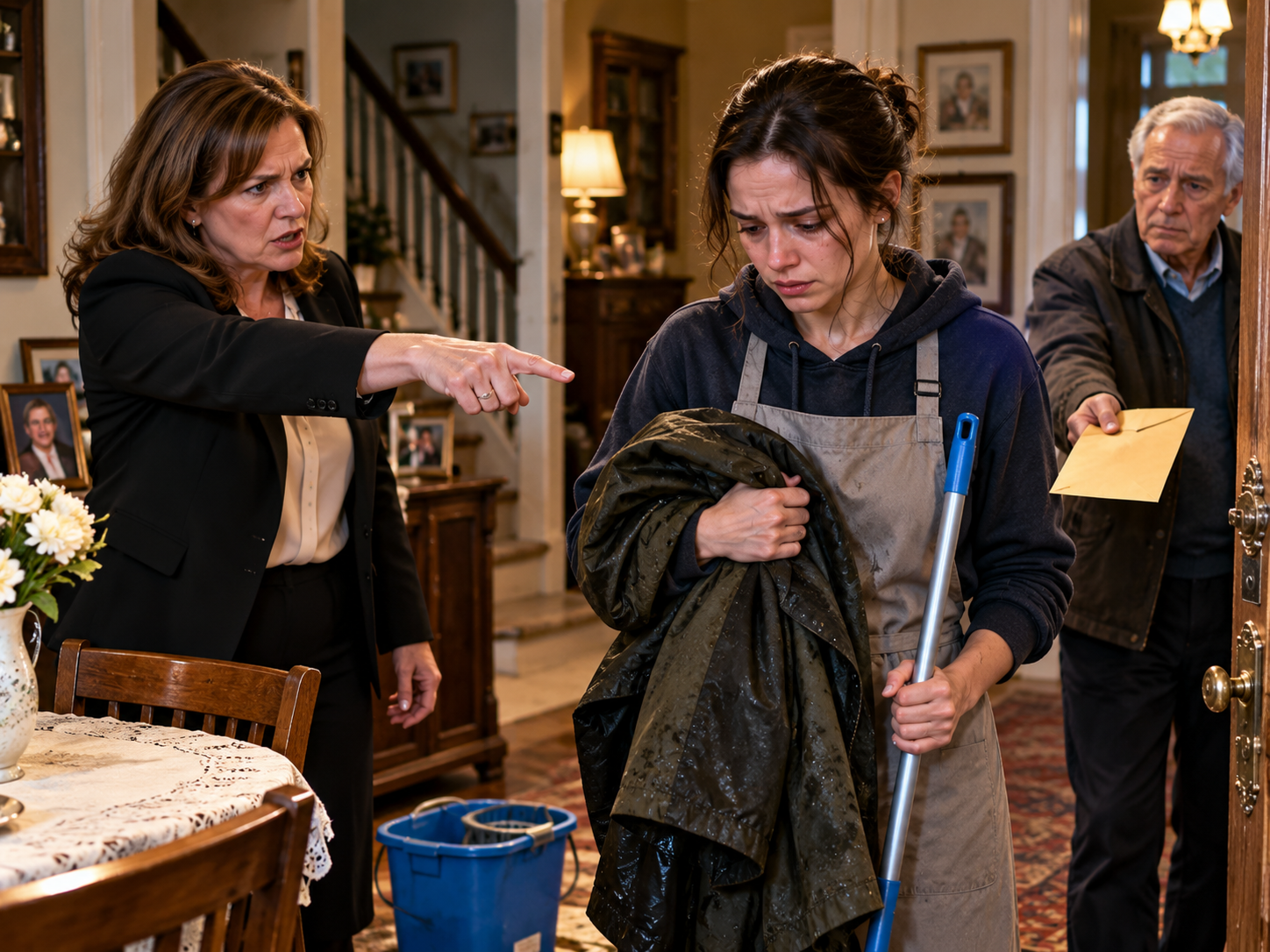
Her eyes moved to the mop in my hand.
“The cleaner.”
One of the men carried a leather folder.
“Mother needs to come downstairs.”
“She was resting.”
The woman gave a small laugh.
“We weren't asking you.”
Their names were Sabine, Calder, and Bram.
And from the way Mrs. Voss's fingers tightened around her cane when they entered the room, I understood something I had not understood during my first seven months in that house.
She was not afraid of being alone.
She was afraid of her own children.
Click here to continue reading: PART 2: The family arrived carrying papers instead of concern, and the locked blue door suddenly seemed connected to everything they wanted from their mother
Twenty dollars was supposed to keep me in school, but the old woman at the end of the street seemed to be waiting for something only she remembered
Part 1 of 28