
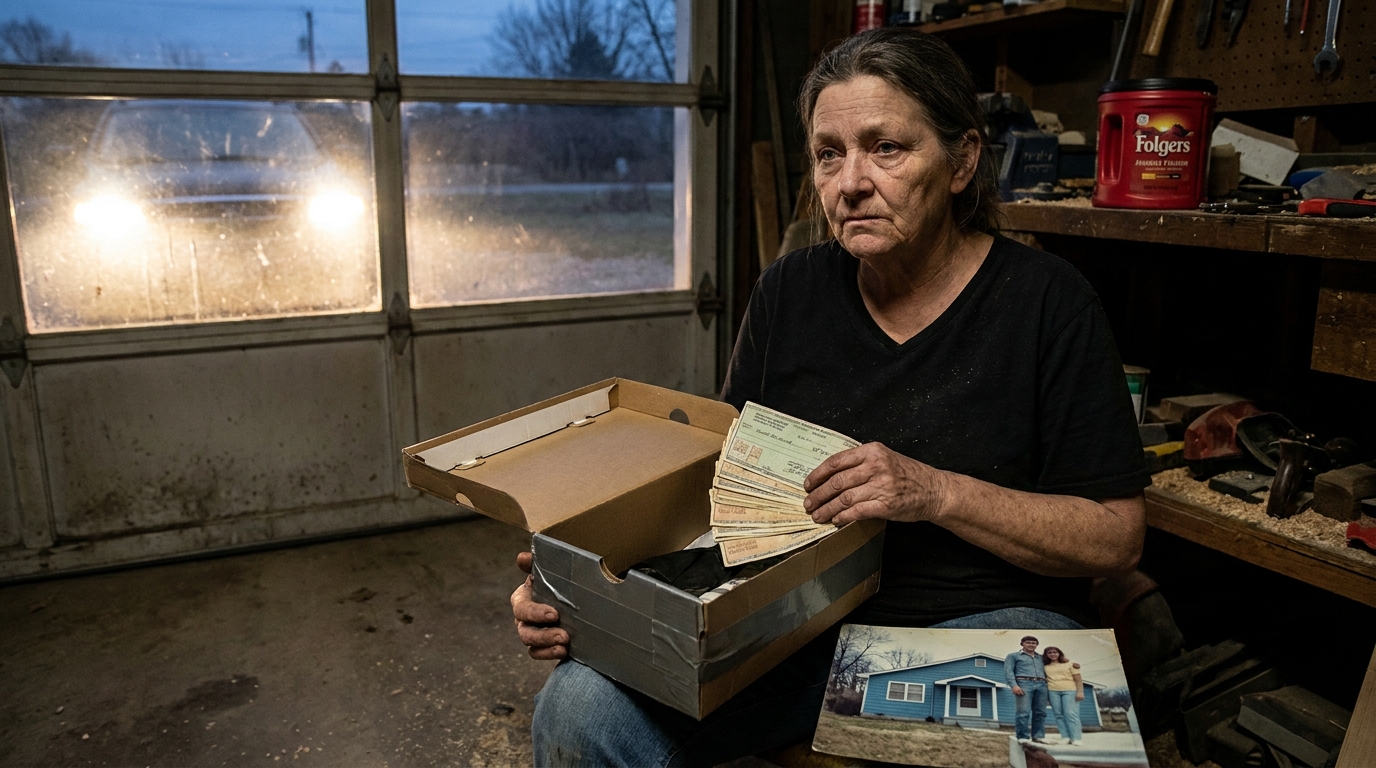
Maryanne held the envelope between both hands.
The paper had softened at the corners, and a dark line ran across the fold where it had been opened and closed too many times. Thomas's handwriting covered the front, younger and sharper than the handwriting I knew from forty years of grocery lists and birthday cards.
Emily looked at me.
“Should we open it?”
I glanced at Daniel.
He was staring at the envelope as though it might contain something capable of changing the ground beneath us again.
“We came this far,” he said.
Maryanne nodded.
She slid one finger beneath the flap.
Inside was a single sheet of paper.
There were no photographs. No legal documents. No explanations.
Just a letter.
Maryanne unfolded it carefully and began reading.
The first lines were addressed to the three of us, though none of our lives had taken the shape they eventually would.
Thomas wrote that he had made the letter because he had learned, even at twenty-three, that promises made in fear could become burdens carried by people who never agreed to them.
He said he did not know whether the future would bring him back to Minnesota.
He did not know whether Emily would grow up knowing him.
He did not know whether another family would someday stand where he stood.
But he knew one thing.
He wanted his daughter to have a home that belonged to her.
Emily covered her mouth.
Thomas explained that the blue house had been purchased with money he had borrowed from his father and savings from the lumber business. He had intended it to be the place where Maryanne and the baby would live.
If circumstances separated them, he wanted the property preserved.
He wrote that the house was not payment for love and not a substitute for being present.
It was simply one thing he could control.
Maryanne stopped reading.
“Keep going,” Emily whispered.
She continued.
Thomas wrote about his fear of becoming like his own father.
He described a man who believed providing money was the same as providing love.
He admitted that he was already beginning to understand how easily a person could confuse responsibility with affection.
Then came a sentence that made my throat tighten.
He wrote that if he ever had another child, he hoped that child would never be taught to measure love by what was left in a bank account.
Daniel looked away.
I understood immediately why.
Thomas had spent forty-two years sending money.
He had been trying to repair a wound with the only instrument he trusted.
Maryanne reached the final portion of the letter.
Thomas asked whoever eventually read it to tell Emily that she had never been forgotten.
Not once.
But he added something else.
If she learned about him only after his death, she was not required to forgive him.
She was not required to call him Father.
She was not required to love people simply because they shared his blood.
“She gets to decide,” Maryanne read.
Emily began crying again.
I felt something loosen inside me.
That sentence was the first thing Thomas had left behind that did not ask someone else to carry his choices.
Daniel sat on the porch step.
“That's Dad,” he said quietly.
I knew what he meant.
Thomas had always wanted the final word.
But here, for once, he had surrendered it.
Emily took the letter from Maryanne.
She read the last paragraph herself.
Thomas had written that the blue house should remain connected to Emily for as long as she wanted it.
If she ever chose to sell it, he wanted her to use the money for something that gave her a life she actually wanted.
Then he wrote that if Daniel ever met her, neither of them should be expected to become strangers merely because adults had made decisions before they were old enough to object.
Emily folded the letter.
“Why didn't he send this to me?”
Maryanne didn't answer.
I did.
“Because he was afraid.”
Emily looked at me.
“That isn't enough.”
“No.”
She nodded.
“I don't think it should be.”
We stayed at the blue house until sunset.
The family renting it invited us inside after learning why we were there. They had no idea the property had once been the center of a story stretching across four decades.
The living room had been repainted.
The old fireplace remained.
Emily stood beneath it and looked at the ceiling.
“Do you think he remembered this?”
“Yes,” Maryanne said.
“How do you know?”
“He described it in every letter.”
Daniel found a faint pencil mark inside a closet.
A date.
1979.
Under it was a height measurement.
Emily crouched.
“Is that mine?”
Maryanne nodded.
“I thought you erased those.”
“I couldn't.”
Emily touched the pencil line.
She was silent for a long time.
Then she asked me whether I had children besides Daniel.
“No.”
She smiled faintly.
“Then you really did get one surprise.”
I laughed despite myself.
“So did you.”
The drive back to Maryanne's house was quiet.
That evening, Emily asked if Daniel wanted to see the photographs Thomas had kept.
He did.
They sat on the floor surrounded by decades of evidence.
School pictures.
Christmas cards.
A newspaper clipping from Emily's college graduation.
A postcard from a beach trip.
One photograph showed Emily beside a yellow bicycle.
Daniel picked it up.
“I had this exact bike.”
Emily laughed.
“No, you didn't.”
“I did.”
“Everybody had that bike.”
“Mine was blue.”
“That isn't the exact same bike.”
“It was close.”
Their argument was ridiculous.
It was also the first ordinary argument between siblings.
I went into the kitchen.
Maryanne was washing cups.
“You look relieved,” she said.
“I am.”
“You shouldn't be.”
“I know.”
She dried her hands.
“Ruth, I need to tell you something else.”
I turned.
“About Thomas?”
“Yes.”
She reached into a drawer and removed a small notebook.
“This was not in the box he gave you.”
The notebook contained dates.
Calls.
Addresses.
Notes about Emily.
Thomas had apparently kept track of her life whenever Maryanne permitted contact.
But one page was different.
At the top was a date from six months before his death.
Underneath it, Thomas had written a list.
Tell Ruth.
Tell Daniel.
Tell Emily.
Sell nothing.
Explain everything.
I stared at the page.
“He was planning to tell us.”
“Yes.”
“When?”
“I don't know.”
“What happened?”
Maryanne's eyes filled.
“He called me after his diagnosis.”
I felt my stomach tighten.
“He told you?”
“He said he had cancer. He said he might not have much time.”
I sat down.
“Why didn't you tell me?”
“Because he asked me not to.”
Anger returned so quickly it felt physical.
“He had no right.”
“No.”
“None.”
“No.”
“Why did you agree?”
Maryanne looked at the notebook.
“Because I had spent forty years respecting his boundaries. By then I didn't know which promises still mattered.”
I stood.
“That was a mistake.”
“Yes.”
She did not defend herself.
That made my anger harder to hold.
The following morning, Emily asked me to walk with her.
We went toward the lake.
The wind was cold enough to make my eyes water.
She put her hands in her coat pockets.
“I keep thinking about him.”
“You barely knew him.”
“I know.”
“That doesn't make the feeling wrong.”
She looked at the water.
“Do you remember what he was like?”
I smiled.
“He snored.”
She laughed.
“No, really.”
“He was stubborn. He was kind when nobody was watching. He hated being thanked. He could spend an hour looking for a screwdriver that was in his pocket.”
Emily smiled.
“Mom says he always lost his keys.”
“He did.”
She stopped walking.
“Was he happy?”
The question caught me.
I thought about our marriage.
The difficult years.
The vacations.
The arguments.
The Sunday mornings.
The years when Daniel was young and Thomas worked too much.
The years when he slowed down.
“Yes,” I said.
“I think he was.”
Emily looked at me.
“Even with us?”
I took a breath.
“He was happy with us.”
I didn't know whether that answer would hurt her.
It seemed to comfort her.
“I wanted him to choose me,” she said.
“I know.”
“But he couldn't.”
“He made choices he thought were necessary.”
“That isn't the same thing.”
“No.”
She nodded.
“I need time before I decide what he means to me.”
“You have all the time you need.”
We walked back without speaking.
That afternoon, Daniel asked me something I hadn't expected.
“Mom, are you going to keep the house?”
I looked at him.
“The trust gives half to you and half to Emily.”
“I don't want it.”
“Neither do I.”
“Then maybe we should ask Emily.”
I found her in the backyard.
When we explained, she stared at us.
“You're giving me the house?”
“It isn't ours to give.”
She shook her head.
“I don't want a house because he felt guilty.”
I understood.
“So what do you want?”
She looked toward the lake.
“I want to know what he would have done if he'd been brave enough to tell the truth.”
Nobody could answer that.
The next day, we went back to the blue house.
This time, the renters let us examine the basement.
Thomas's old letters had mentioned a loose floorboard near the furnace.
We found it beneath a layer of dust.
Daniel lifted the board.
Underneath was a metal tin.
Inside was a small notebook, several receipts, and a photograph of Thomas holding baby Emily.
But there was one more thing.
A hospital bracelet.
The date matched Emily's birth.
Her name was printed on it.
She stared at the plastic strip.
“Why would he keep this?”
Maryanne's face changed.
“He was there.”
Emily looked at her.
“What?”
“He was there when you were born.”
Silence filled the basement.
Maryanne sat down on the bottom stair.
“He came to the hospital.”
Emily's eyes widened.
“You said he couldn't.”
“I said he wasn't there when they discharged us.”
“That's not what I asked.”
Maryanne began crying.
“He came.”
Emily stood completely still.
“Why didn't you tell me?”
“I was angry.”
“You told me he never came.”
“I was angry,” Maryanne repeated. “And ashamed.”
Daniel picked up the photograph.
Thomas had been standing beside Maryanne's hospital bed.
His hand rested lightly on the newborn baby.
On the back, he had written:
I held her for seven minutes.
I will remember every second.
Emily pressed the photograph against her chest.
For the first time since we met, she looked genuinely furious.
Not at me.
Not at Daniel.
Not even at Thomas.
At the adults who had decided what she was allowed to know.
She walked upstairs.
We followed.
Outside, she turned toward Maryanne.
“You both decided my life for me.”
Maryanne nodded through tears.
“Yes.”
“And he kept sending money because he couldn't be my father.”
“Yes.”
Emily looked toward the lake.
“I don't know whether I forgive either of you.”
“You don't have to,” I said.
She looked at me.
“You really mean that?”
“Yes.”
She nodded.
Then she turned to Daniel.
“But I think I want to know my brother.”
Daniel smiled.
“Good.”
The four of us stood together beneath the maple trees.
For the first time, the secret no longer belonged to Thomas.
It belonged to us.
And that meant we had to decide what came next.
Click Here to continue read next: PART6: Emily Asked the Question None of Us Had Wanted to Answer, and the Old Records Finally Exposed What Thomas Had Hidden
My Husband Had Been Dead for Hours When a Stranger Spoke a Woman’s Name I Had Never Heard Before
Part 5 of 8

