By the time I reached my later years, the story no longer felt like something that belonged only to me.
It had become part of Emma's history.
Then her children's history.
Not because we repeated the scandal.
Because we preserved the lessons.
The family stopped using silence as protection.
When something difficult happened, we talked about it.
When someone made a mistake, we addressed it.
When someone needed help, we didn't decide what they could handle without asking.
That was perhaps the greatest change.
For years, our family had believed love meant shielding people from painful information.
We learned that sometimes love means trusting people enough to tell them the truth.
I often thought about the sentence my father had written.
A secret meant to protect someone eventually becomes a secret that controls them.
He had been right.
He had simply learned the lesson too late.
Claire had been controlled by fear.
Daniel had been controlled by debt.
My father had been controlled by guilt.
My mother had been controlled by loyalty.
Evelyn had been controlled by threats.
And I had been controlled by anger.
Emma was the first person in our family who had the chance to grow up without carrying the same burden.
That was why I told her the truth.
Not all at once.
Not carelessly.
But honestly.
She eventually became the person in the family who reminded everyone of the rule.
"Don't make decisions for people without asking them."
Sometimes she joked about it.
Sometimes she didn't.
But she understood where it came from.
One afternoon, years after her wedding, she came to visit with her own child.
I held my grandchild and looked into that tiny face.
The feeling was overwhelming.
There was Claire's blood.
Daniel's blood.
Mine.
My father's blood.
Generations of complicated history.
And yet the child knew nothing about any of it.
She only knew that someone was holding her.
Someone was smiling.
Someone was safe.
That was enough.
I thought about how close I had come to never knowing Emma.
If I had ignored Michael's call, I might never have opened Claire's letter.
If I had refused the photograph, I might never have learned the truth.
If I had let anger decide everything, Emma might have grown up knowing only half her family.
Sometimes life changes because of one small decision.
Opening an envelope.
Answering a phone call.
Reading one page.
Asking one question.
I no longer believed those moments were accidents.
Not because everything happens for a reason.
I don't believe that.
Some terrible things simply happen.
People make choices.
People suffer.
People die.
There is no neat explanation that makes all of it fair.
But after something happens, we still get to choose what we do next.
That was the part that mattered.
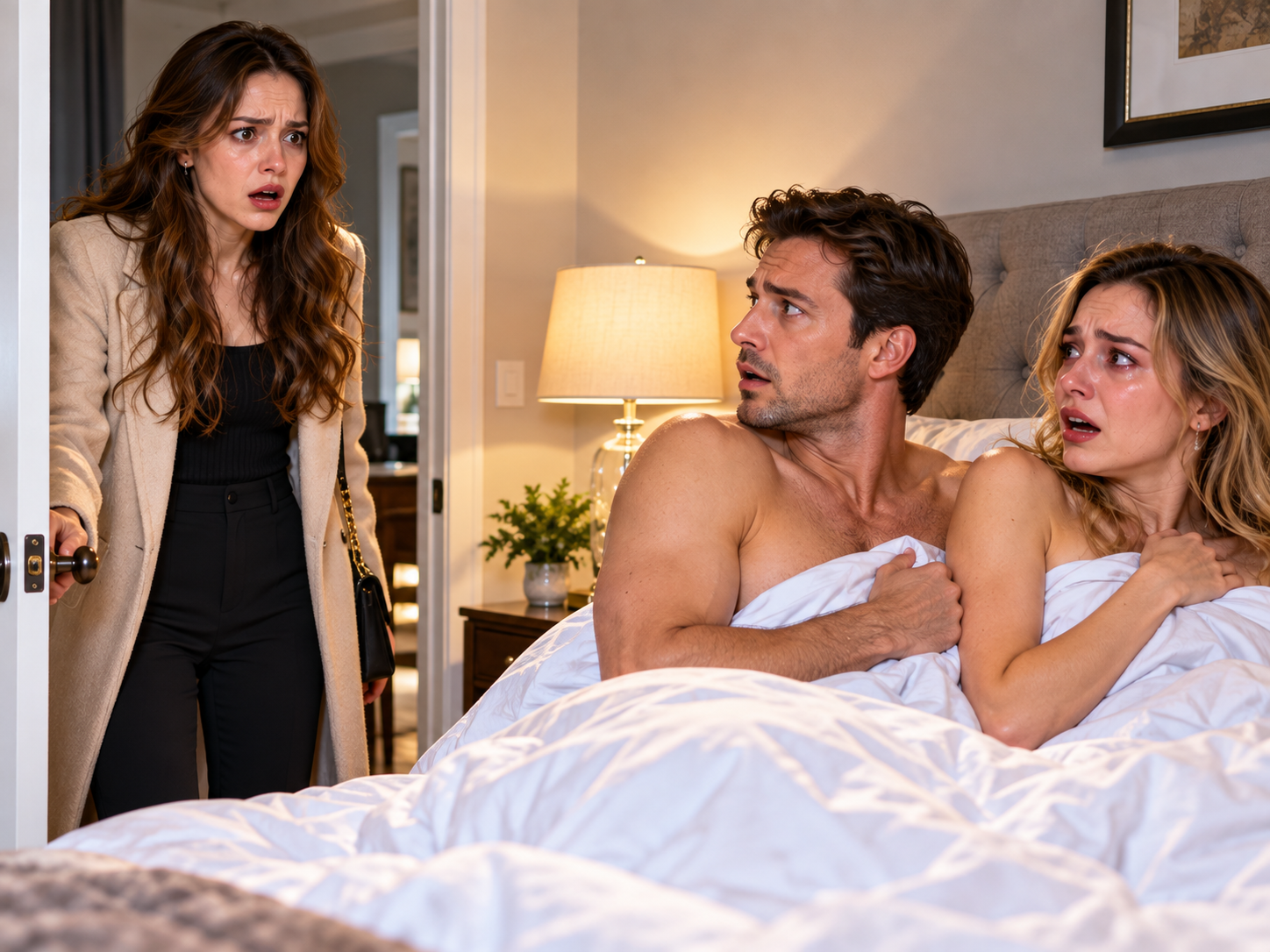
I couldn't change the bedroom door.
I couldn't change the divorce.
I couldn't change Claire's death.
I couldn't change the years I lost.
But I could decide what those years meant.
They could mean that I had been betrayed.
Or they could mean that I had survived betrayal.
They could mean that I had lost a sister.
Or they could mean that I had eventually learned how to remember her honestly.
They could mean that my family had been destroyed.
Or they could mean that we had rebuilt ourselves differently.
The choice didn't change the facts.
It changed what I carried.
One evening, Emma and I sat outside.
She was older now.
Her child was playing nearby.
She asked me whether I regretted anything.
I thought about it.
"Yes."
"What?"
"I regret that Claire and I never had a real conversation after I found out."
Emma looked at me.
"Would you have forgiven her?"
"I don't know."
"Would you have tried?"
"Eventually."
She nodded.
Then she asked:
"Do you regret cutting her out?"
I looked at the garden.
"For fifteen years, I thought the answer was no."
"And now?"
"Now I think I needed the distance. But I wish I had found a way to leave the door open for the truth."
Emma understood.
There was a difference between protecting yourself and closing every possible path to reconciliation.
At thirty-one, I had needed a wall.
At sixty, I didn't.
That was another lesson age had taught me.
The boundary that saves you in one season of life may become a prison if you refuse to reconsider it later.
I didn't tell Emma she should have forgiven Claire.
That decision belonged to me.
I told her only to be careful about permanent decisions made in temporary pain.
She smiled.
"That's very different from what you used to say."
"I know."
"You're allowed to change your mind."
"Everyone is."
That was the freedom I had eventually discovered.
I didn't have to remain the woman who had walked out of that bedroom.
I could become someone else.
Not because the betrayal had never happened.
Because it had.
And I had survived it.
Claire's grave became a place I visited occasionally.
Not every year.
Not on anniversaries.
Just when I felt like going.
Sometimes I brought flowers.
Sometimes I brought Emma.
Sometimes I went alone.
I never spoke to Claire as though she were innocent.
I spoke to her as my sister.
That distinction mattered.
One year, I brought the old photograph from our childhood.
I held it in my hands.
"We were happy here," I said.
I looked at her name on the stone.
"And then we weren't."
I smiled sadly.
"But we were more than that moment."
The wind moved through the trees.
I stood there quietly.
Then I left.
No dramatic forgiveness.
No miraculous closure.
Just acceptance.
The truth had become ordinary.
That was how I knew I had healed.
For years, I thought healing would feel like forgetting.
It didn't.
It felt like remembering without being destroyed.
I could remember Daniel without wanting revenge.
I could remember Claire without hatred.
I could remember my father without pretending he had been perfect.
I could remember myself without shame.
That was enough.
Emma eventually told her own children the family history.
She told them carefully.
She didn't make Claire into a villain.
She didn't make me into a saint.
She didn't make Daniel into a monster.
She told them that adults can make terrible choices.
She told them that secrets can damage families.
She told them that truth matters.
And she told them that they were not responsible for the mistakes of people who came before them.
I listened once while she explained it to her oldest child.
The words were almost exactly what I had once told her.
I smiled.
The lesson had survived.
The pain didn't have to.
That was the difference.
When I think about the day Claire died, I no longer remember only the phone call.
I remember what came afterward.
The letter.
The photograph.
The baby.
The documents.
The missing page.
The investigation.
The truth.
And finally, the life that grew from all of it.
Fifteen years ago, I thought erasing Claire would give me peace.
It didn't.
Truth did.
Not because truth made the past beautiful.
It didn't.
Not because truth made everyone innocent.
It didn't.
Truth simply gave me the freedom to stop carrying a story that wasn't complete.
I caught my husband cheating with my sister.
That will always be part of my story.
But it isn't the whole story.
My sister betrayed me.
That is true.
She also loved her daughter.
That is true too.
My husband betrayed me.
He also became a father who eventually accepted responsibility for his choices.
My father hid the truth.
He also believed, however misguidedly, that he was protecting me.
I was hurt.
I was angry.
I walked away.
And later, I chose to build something different.
All of those things can exist together.
Life doesn't always divide neatly between heroes and villains.
Sometimes it is simply a collection of people making choices under pressure, fear, love, selfishness, regret, and hope.
The important thing is what we do once the truth is finally placed in front of us.
I chose not to pass the hatred forward.
That was my final decision.
Not forgiveness for everyone.
Not reconciliation with everyone.
Just an end to inheritance of pain.
Emma would not carry my anger.
Her children would not carry Claire's mistakes.
And future generations would not have to live inside a secret created before they were born.
The story began with a betrayal.
It continued through death, silence, fear, and discovery.
But it ended somewhere I never expected.
With a family that finally learned how to speak.
And with me, after all those years, no longer trying to erase anyone.
Not Claire.
Not Daniel.
Not my father.
Not even the woman I had been when everything fell apart.
I finally understood that remembering does not mean returning.
Forgiving does not mean forgetting.
And moving forward does not require pretending the past never happened.
Sometimes the strongest thing you can do is look directly at everything that broke you and say:
It happened.
It mattered.
It changed me.
But it does not get to decide who I become.
Click here to continue reading: PART 13: Years After the Family Finally Learned to Speak Honestly, a New Generation Asked Me the Question I Had Spent Decades Avoiding
My Sister Stole My Husband, and I Cut Them Both Out of My Life—Until Her Death Left Behind a Secret I Never Expected
Part 12 of 16