David Keller stood behind Margaret in the photograph.
Alive.
For several seconds, I couldn't speak.
Richard took the phone from my hand.
“This was taken recently.”
Agent Cole immediately called security.
The federal building was placed under lockdown.
No one was allowed to leave.
Margaret's protective detail reported that she was still in custody.
But when officers checked the interview room, she was gone.
Her attorney was gone too.
The red notebook was gone.
Keller was gone.
The building's security cameras had been disabled for six minutes.
Six minutes.
Exactly long enough.
Anna looked at the photograph.
“She planned this.”
Richard shook his head.
“Margaret didn't.”
“Then who?”
Anna looked at the person standing beside Keller.
Not Margaret.
The photograph had been cropped.
A shoulder was visible behind her.
Someone else was there.
Anna recognized the clothing.
“The liaison.”
“What liaison?”
“The person who originally connected Margaret to the government authority.”
Agent Cole enlarged the photograph.
A reflection appeared in the glass behind them.
A woman's face.
Older.
Sharp features.
White hair.
I recognized her.
Margaret's attorney.
But she wasn't Margaret's attorney.
She was someone else.
Anna whispered her name.
“Evelyn Hart.”
Richard stared.
“Who is she?”
“The original program director.”
The woman who had overseen the witness-protection contract twenty years earlier.
The woman whose name had appeared on the earliest documents.
The woman who had supposedly retired before the first disappearance.
She had never disappeared.
She had simply changed titles.
Agent Cole searched government records.
Evelyn Hart was still alive.
Still receiving a federal pension.
Still consulting on transportation security.
And she had access to restricted facilities.
The system had not been controlled by the Vale family.
They had been contractors.
Evelyn had been the administrator.
She had created the structure.
Margaret had managed it.
Martin had expanded it.
Keller had documented it.
Nathan had exploited it.
Anna had fought it.
And everyone else had lived with the consequences.
Richard looked at me.
“That's why Margaret always said she wasn't the one at the top.”
“She wasn't.”
Agent Cole called in federal investigators.
Evelyn was located at an airport.
She was attempting to board a private flight.
They stopped her before departure.
When questioned, she denied knowing Margaret.
Then they showed her the photograph.
She changed her story.
She admitted meeting Margaret.
She admitted meeting Keller.
But she denied ordering the first disappearance.
Anna confronted her by video.
“Why did Julia Mercer disappear?”
Evelyn looked at the screen.
“She wasn't supposed to disappear.”
“What happened?”
“She became a liability.”
Claire spoke.
“My sister?”
“Anna became a liability.”
“You destroyed her life.”
Evelyn remained silent.
Claire continued.
“You destroyed thousands of lives.”
Evelyn finally answered.
“We protected national interests.”
Richard's expression hardened.
“By threatening passengers?”
“By preventing sensitive information from becoming public.”
“By altering reports?”
“Necessary.”
“By making people disappear?”
“No.”
Anna interrupted.
“You did.”
Evelyn looked at her.
Anna held up the original contract.
“You signed it.”
Evelyn stared.
“I signed a protection authorization.”
“You signed authority to relocate protected witnesses.”
“Exactly.”
“You expanded it.”
“I had to.”
“You created private facilities.”
“For security.”
“You allowed contractors to control them.”
“For efficiency.”
Anna's voice became cold.
“And when people complained?”
Evelyn said nothing.
That silence was enough.
The federal investigators obtained the original ledger.
Margaret had left it behind when she fled.
The final page contained Evelyn's signature.
Not Margaret's.
Not Martin's.
Evelyn's.
Beside it was the first authorization.
The first relocation.
The first disappearance.
Julia Mercer.
And below it:
DO NOT RETURN.
The truth was finally documented.
Margaret had concealed it.
Martin had monetized it.
Keller had weaponized it.
But Evelyn had started the structure.
That distinction mattered.
It didn't absolve anyone else.
Each person had made choices.
Each had hurt people.
Each had helped sustain the system.
The investigation expanded rapidly.
Dozens of former employees were interviewed.
Old complaints were reopened.
Families were contacted.
Passenger records were reviewed.
Security footage was recovered.
Financial accounts were subpoenaed.
The red notebook was entered into evidence.
The server was preserved.
The architectural drawings were authenticated.
And the recording from my flight became one of the first pieces of evidence reviewed.
It showed exactly what had happened.
No embellishment.
No threats.
No violence.
Just a passenger asking a reasonable question.
A flight attendant escalating the situation.
Witnesses confirming the truth.
Police arriving.
Richard intervening.
That ordinary recording became important because it demonstrated something the old cases lacked.
Independent evidence created in real time.
No corporate database could quietly rewrite it.
No executive could mark it withdrawn.
No settlement could erase it.
I gave copies to federal investigators.
I gave one to my attorney.
I kept the original.
The airline eventually issued a public statement.
Brenda was terminated.
David Keller was charged.
Martin Vale faced multiple charges.
Eric Dane was arrested.
Nathan agreed to cooperate with investigators.
Margaret testified.
Thomas turned over the trust.
Evelyn faced federal prosecution.
But the consequences were not simple.
Some people had participated because they believed they were protecting sensitive operations.
Others had participated for money.
Some had been threatened.
Some had been afraid.
And some had simply chosen silence.
Those distinctions mattered to the investigation.
They mattered to the people who had been hurt.
And they mattered to me.
Elena eventually gave a formal statement.
She sat across from investigators for six hours.
She described Flight 608.
The wrist injury.
The threats.
The private terminal.
The false report.
The settlement offer.
The years of intimidation.
Sarah testified separately.
She described Flight 441.
Her disappearance.
The underground room.
The years spent moving between safe locations.
She did not forgive Nathan.
She didn't have to.
Nathan accepted responsibility for what he had done.
He also testified against his father and Evelyn.
He admitted that he had frightened women.
He admitted that he had used the family's influence.
He admitted that he had lied.
But he also provided evidence that helped investigators locate missing records.
His cooperation did not erase his responsibility.
It simply became part of the record.
Claire reunited with Anna.
Their first meeting outside the investigation was quiet.
No cameras.
No reporters.
No lawyers.
Just two sisters sitting across from each other in a small café.
Claire told me later that she spent the first twenty minutes angry.
Then the next twenty crying.
Then they ordered dessert.
Life, she said, had to contain ordinary things too.
Elena changed her name back.
Sarah chose not to.
She said the name she had lived under for years belonged to the woman she had become.
That was her choice.
Nobody asked her to change it.
Thomas stepped away from the trust.
A new independent board was created.
The funds were placed under court supervision.
Money was distributed to victims and families.
The old shell companies were dissolved.
The private terminals were audited.
Several government contracts were suspended.
The transportation authority launched an independent review.
The investigation continued for months.
Some questions remained unanswered.
Not every missing person was found.
Not every employee remembered everything.
Not every document survived.
But the central structure had been exposed.
The system could no longer hide behind one person's version of events.
Months later, I received a letter.
No return address.
I almost threw it away.
Then I saw the handwriting.
Elena.
Inside was a photograph.
It showed several women standing together outside a courthouse.
Elena.
Sarah.
Claire.
Anna.
And others whose names had appeared in the archive.
On the back Elena had written:
WE WERE NEVER THE PROBLEM.
I stared at the sentence for a long time.
Then I turned the photograph over again.
I thought about the day I boarded Flight 247.
I remembered being tired.
I remembered wanting a quiet seat by the window.
I remembered putting my suitcase overhead.
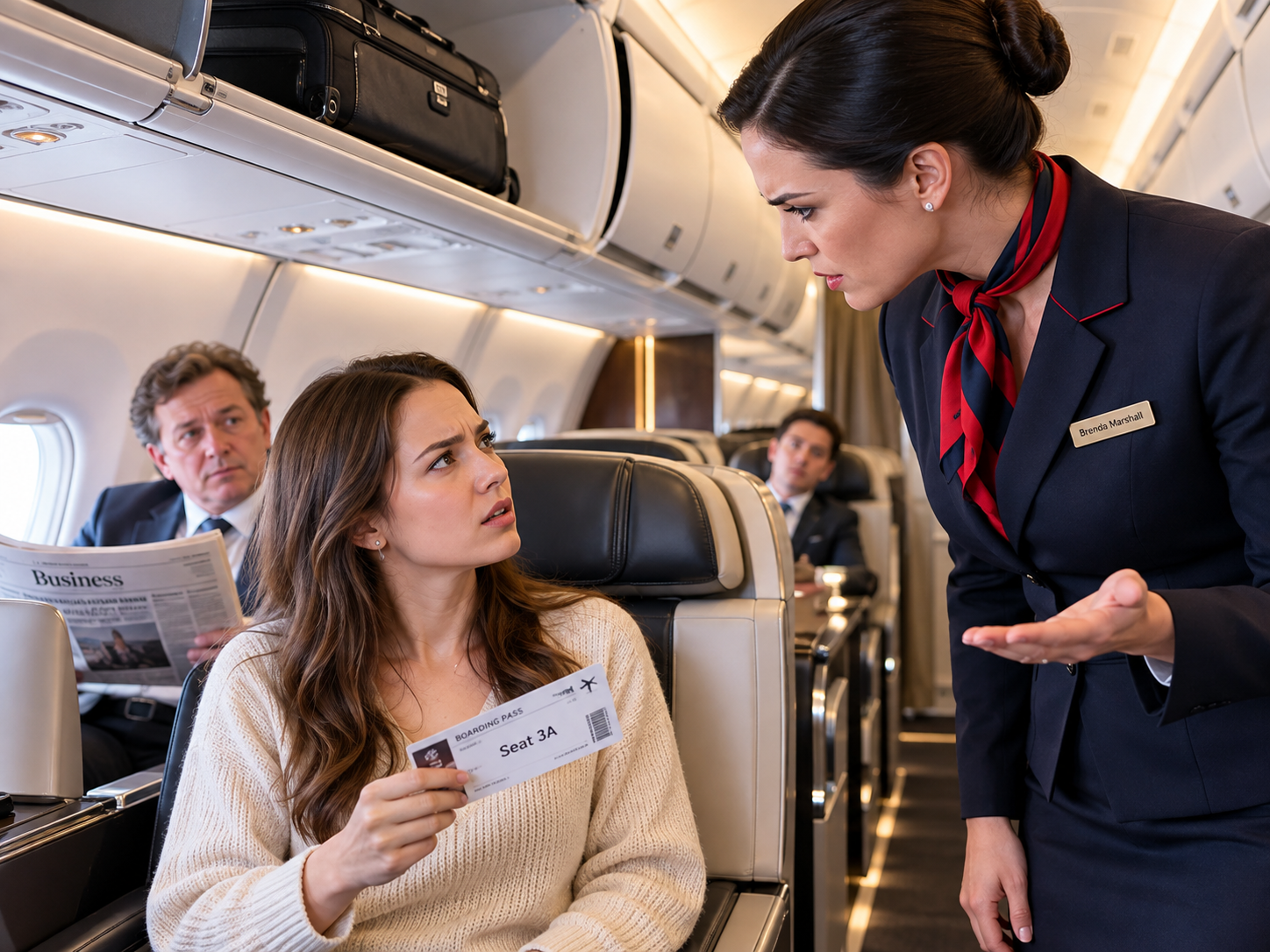
I remembered Brenda asking whether the seat was really mine.
At the time, I thought the question was about a boarding pass.
It wasn't.
It was about whether someone could decide where I belonged.
And for a few frightening minutes, I almost allowed someone else to define that.
The strange thing was that the suitcase itself had never mattered.
Neither had the seat.
The real issue had been whether a person could make an ordinary passenger doubt her own right to speak.
That was how the system had worked for years.
Make people question themselves.
Make them apologize.
Make them leave quietly.
Then close the complaint.
But one passenger had finally stayed.
Then another.
Then another.
The evidence accumulated.
The stories connected.
The buried names surfaced.
And eventually the people who had believed silence would protect them discovered that silence had protected the wrong people.
Richard left the airline board after the investigation.
He testified before an oversight committee.
When someone asked why he had intervened on my flight, he answered simply.
“Because I was there.”
That answer stayed with me.
He didn't call himself a hero.
He didn't pretend he had known what the incident would become.
He had simply witnessed something wrong and refused to look away.
I appreciated that.
Thomas apologized to me personally.
Not through a lawyer.
Not in writing.
Face to face.
“I used you,” he said.
“Yes.”
“I thought the risk was acceptable.”
“It wasn't.”
“I know.”
He didn't ask for forgiveness.
That mattered.
I told him I hoped he would spend the rest of his career making sure nobody else became acceptable collateral.
He nodded.
“I will.”
Brenda never contacted me.
Her employment case continued separately.
The airline eventually released a report acknowledging serious failures in complaint handling and employee oversight.
It also changed procedures for documenting passenger disputes.
Crew members could no longer characterize an interaction as threatening without specific supporting facts.
Complaints could not be closed without independent review.
Records could not be deleted without an audit trail.
It wasn't perfect.
Nothing is.
But the rules existed.
And people were watching.
One afternoon, almost a year after Flight 247, I boarded another plane.
First class again.
Seat 3A.
I stood in the aisle with my carry-on in my hand.
For a second, I remembered Brenda.
Then I smiled.
A new flight attendant checked my boarding pass.
“Ms. Brooks?”
“Yes.”
“Seat 3A.”
I nodded.
She stepped aside.
“Welcome aboard.”
I placed my suitcase in the overhead compartment.
Then sat beside the window.
Clouds gathered beyond the glass.
The aircraft began boarding.
For once, nothing dramatic happened.
No argument.
No police.
No executive.
No hidden archive.
Just people finding their seats.
A little girl across the aisle struggled with her backpack.
Her mother helped her.
An elderly man asked for water.
Someone laughed near the galley.
Ordinary sounds.
The kind I had once taken for granted.
Then my phone vibrated.
A message from Richard.
WE LANDED THE FINAL CASE.
I smiled.
Another message followed.
FROM ELENA.
She had attached a photograph.
The women from the courthouse were standing together again.
This time there were more of them.
Some faces I recognized from the archive.
Others I didn't.
Underneath was a sentence:
WE FOUND THEM.
I looked out the window.
For years, people had been told that disappearing was the safest thing they could do.
Change your name.
Move away.
Stay quiet.
Don't complain.
Don't ask questions.
Don't make trouble.
But the truth had done something different.
It had given people their names back.
Their records.
Their stories.
Their choices.
The plane began to taxi.
I rested my head against the seat.
The first-class cabin looked almost exactly as it had that day.
Same soft lighting.
Same narrow aisle.
Same overhead bins.
But I wasn't the same person.
Neither were the people who had been sitting there.
And I understood something I hadn't understood when Brenda first looked at my boarding pass.
A seat can be assigned.
A bag can be moved.
A flight can be delayed.
A company can issue an apology.
But once someone has taken your truth away, getting it back is different.
You have to find every missing piece.
Every witness.
Every document.
Every name.
You have to follow the trail even when it leads somewhere frightening.
And sometimes, you have to be willing to ask a question that everyone else has decided is too inconvenient to ask.
The aircraft lifted above the clouds.
My phone went quiet.
For the first time in a long time, I was grateful for the silence.
Not the silence that hides things.
The other kind.
The kind that comes after the truth has finally been spoken.
I looked down at my boarding pass.
MAYA BROOKS.
3A.
First class.
My seat.
No one had to explain why I belonged there.
I already knew.
The End
Read more original stories on Feel Every Story.
I Thought the Hardest Part of My Flight Would Be Getting Home Until the Flight Attendant Decided My Seat Wasn’t Really Mine
Part 16 of 16