
The email was six months old.
I almost skipped it.
It was buried between university payment confirmations and forwarded notices from Brittany’s apartment complex. Most of the messages were boring. Payment dates. Amounts. Reminders. Administrative clutter.
Then I saw Richard’s name.
He had forwarded Brittany a tuition notice.
A few minutes later, he had replied to her again.
I opened it.
I read it once.
Then again.
He had written that she did not need to worry about me.
According to him, I liked taking care of those expenses.
It made me feel needed.
I leaned back in my chair.
The kitchen suddenly seemed too quiet.
There are certain lies that hurt because they are false.
Others hurt because they reveal what the person telling them actually thinks of you.
This was the second kind.
Richard had taken something I believed was love and described it as insecurity.
He had taken my generosity and turned it into a weakness.
He had told his daughter that I paid because I needed to feel important.
That explanation made everything easier for them.
If I was needy, they owed me nothing.
If I was controlling, they could resent me.
If I was simply someone who liked paying bills, then nobody had to admit that I had been carrying part of their lives.
I printed the email.
Then I printed the bank records.
I printed the recurring payments.
I placed everything in a folder.
Richard watched me from the other side of the kitchen.
“What are you doing?”
“Keeping records.”
“You don't need to do that.”
“Yes, I do.”
He rubbed his forehead.
“You're turning this into something bigger than it is.”
I looked at him.
“You wrote that I liked feeling needed.”
He froze.
For a moment, neither of us moved.
“Where did you find that?”
“In our records.”
“That was taken out of context.”
“There isn't a context that makes it better.”
He looked away.
That was when I understood that the email frightened him.
Not because I had discovered some secret affair.
Not because the words were scandalous.
Because they proved that he had known exactly what he was doing.
He had been managing my image inside his relationship with Brittany.
He had made sure she never had to recognize what I contributed.
Richard picked up his phone.
“I need to call her.”
“You do.”
He walked away.
I stayed where I was.
For the first time since I had married him, I did not feel responsible for repairing the consequences of his decisions.
That afternoon, I called Carol.
She answered on the second ring.
“Are you okay?”
I almost said yes automatically.
Instead, I said, “No.”
There was a pause.
“Tell me.”
I told her about the dinner.
Then the payments.
Then the email.
Carol was quiet for several seconds.
Finally she said, “That's not just disrespect.”
“I know.”
“He's been explaining your generosity to his daughter in a way that protects himself.”
“I know.”
“You need to document everything.”
“I am.”
“Good.”
Carol had always been practical.
She believed in keeping receipts, writing things down, and never trusting a verbal promise when something important was at stake.
I needed that.
Not comfort.
Structure.
After we hung up, I went grocery shopping.
The store was crowded with people preparing for Thanksgiving.
Carts were full of potatoes, pies, canned vegetables, and things nobody would buy again until next November.
A cashier asked whether I was getting ready for the holiday.
“Something like that,” I said.
I carried the bags to the car.
Then I sat behind the steering wheel and cried.
Not because I wanted Richard back.
Not because I regretted stopping the payments.
I cried for the woman I had been.
The woman who believed competence would protect her.
The woman who thought being useful meant being valued.
The woman who had mistaken her ability to carry a burden for proof that the burden belonged to her.
I wiped my face.
Then I drove home.
Richard was waiting in the kitchen.
“We need to talk.”
“We're talking.”
“You embarrassed me.”
I put the grocery bags on the counter.
“You humiliated me first.”
“That was not my intention.”
“It was your choice.”
He looked exhausted.
“Can you please just turn the payments back on?”
“No.”
“Just temporarily.”
“No.”
“We'll figure everything out afterward.”
“You have been saying that for a year.”
His shoulders dropped.
“You're going to hurt her.”
I looked at him for a long moment.
“Richard, she is twenty years old.”
“She’s still my daughter.”
“Then take care of her.”
He had nothing to say.
I unpacked the groceries.
He stood there watching me.
The absurdity of it almost made me laugh.
The marriage was cracking apart, and I was still putting milk into the refrigerator.
But that was how real life worked.
There was no soundtrack.
No dramatic lighting.
The trash still needed to go out.
The dishwasher still needed unloading.
Bills still arrived.
And somewhere between putting away the bread and closing the refrigerator door, I realized I had already made the decision.
I was leaving.
I did not announce it that night.
I did not threaten him.
I simply began preparing.
Over the next few days, I copied financial statements.
I changed passwords.
I reviewed account access.
I made notes about which expenses belonged to whom.
I checked beneficiary designations.
I looked at insurance documents.
I scheduled a consultation with a family attorney in Chicago.
I kept everything quiet.
Richard noticed the distance.
He started staying later at work.
He took phone calls outside.
He slept farther away from me.
Neither of us shouted.
That almost made the situation sadder.
There was nothing left to argue about.
Three days after the dinner, Richard suggested brunch.
He chose a busy restaurant in Naperville.
I knew immediately why.
A public place.
Neutral surroundings.
People nearby.
The kind of setting where he could lower his voice and present himself as the reasonable husband trying to save his marriage from an emotional misunderstanding.
I agreed.
I arrived early.
I carried the folder in my bag.
I ordered coffee.
Then I waited.
Richard arrived with Brittany.
She looked angry.
Not frightened.
Not ashamed.
Angry.
Her car problem, insurance problem, and school payments had suddenly become real problems in her life, and she had decided that I was responsible.
She sat beside her father.
Richard gave me a careful smile.
“You came early.”
“I prefer being on time.”
The server came over.
Richard ordered coffee.
Brittany ordered an elaborate drink.
Then they looked at me.
Richard leaned forward.
“Brenda, we don't need to make this bigger than it is.”
“I agree.”
He seemed relieved.
Then I continued.
“I just want everyone to understand what happened.”
Brittany folded her arms.
“You already destroyed my finances.”
I looked at her.
“Did I?”
“Yes.”
“Were they mine?”
She stared at me.
“What does that have to do with anything?”
“It has everything to do with it.”
Richard interrupted.
“Let's keep this calm.”
I looked directly at him.
“You like things calm when the truth is inconvenient.”
His face tightened.
Brittany glanced between us.
“I don't understand why you're doing this.”
I took a sip of coffee.
“Because you told me I was the help.”
She looked away.
“And your father told me I had no right to correct you.”
Richard sighed.
“That was one sentence.”
“No,” I said. “It was a decision.”
Brittany shook her head.
“You've always been controlling.”
I reached into my bag.
“Then let's look at what I was controlling.”
I placed the first page on the table.
Brittany looked down.
Her expression changed.
Car lease.
Insurance.
Phone.
School payments.
Apartment transfers.
Books.
Miscellaneous expenses.
Her eyes moved slowly across the page.
Then she looked at her father.
“You told me you were paying for these.”
Richard cleared his throat.
“I was handling them.”
“You weren't,” I said.
Brittany looked back at the papers.
“How much?”
I gave her the total.
She stopped breathing for a second.
Her father looked uncomfortable.
“You didn't have to show her all of this.”
“Yes,” I said. “I did.”
Brittany's voice became smaller.
“I thought Dad was paying.”
“I know.”
She looked at Richard.
“Why didn't you tell me?”
He did not answer immediately.
That silence told her more than any explanation could.
Then I placed the printed email on the table.
Richard saw it.
His face changed.
Brittany picked it up.
She read it.
Then read it again.
She looked at him.
“Dad?”
Richard swallowed.
“It's not what you think.”
“What does it mean?”
He glanced at me.
I answered.
“He told you I enjoyed paying because it made me feel important.”
Brittany's cheeks flushed.
“You said she volunteered.”
“I did.”
“You said she wanted to.”
“She did help.”
“That isn't what I asked.”
Richard looked trapped.
I watched his daughter finally realize that she had never known the entire arrangement.
She had been receiving benefits while being given a story about the person providing them.
And the story had made me the villain.
I folded my hands on the table.
“I never paid because I needed you to admire me.”
Brittany stared at me.
“I paid because I believed I was part of this family.”
Nobody spoke.
Around us, plates clattered.
A child laughed at another table.
Someone near the bar was telling a loud story.
The ordinary world continued while our family sat inside a truth none of us could put back.
Richard finally said, “You're embarrassing me.”
I looked at him.
“You humiliated me at dinner.”
“That was different.”
“How?”
He had no answer.
Brittany looked at him again.
“You lied to me.”
Richard stiffened.
“I was trying to keep things together.”
“No,” I said. “You were trying to keep things easy.”
His eyes hardened.
“You're enjoying this.”
“No.”
I pushed the folder toward him.
“I am finished.”
Brittany stared at me.
“What does that mean?”
“It means I am not paying for anything else.”
She shook her head.
“So you're just walking away?”
“No.”
I stood.
“I am walking away from responsibility you never gave me the right to carry.”
The server approached carefully.
“Are you ready to order?”
I opened my wallet.
“Just my coffee.”
Richard looked up at me.
“You're serious?”
“I have been serious for a long time.”
I paid.
Then I left.
Outside, the cold air hit my face.
My hands trembled when I reached the car.
I sat there for several minutes without starting the engine.
For the first time, I realized something had changed.
I was no longer trying to make Richard understand.
And once that need disappeared, I knew exactly what I had to do next.
Click Here to continue read next: PART3: I thought the hardest part would be admitting the marriage was over, until I discovered how much of my life had been quietly built around keeping everyone else comfortable.
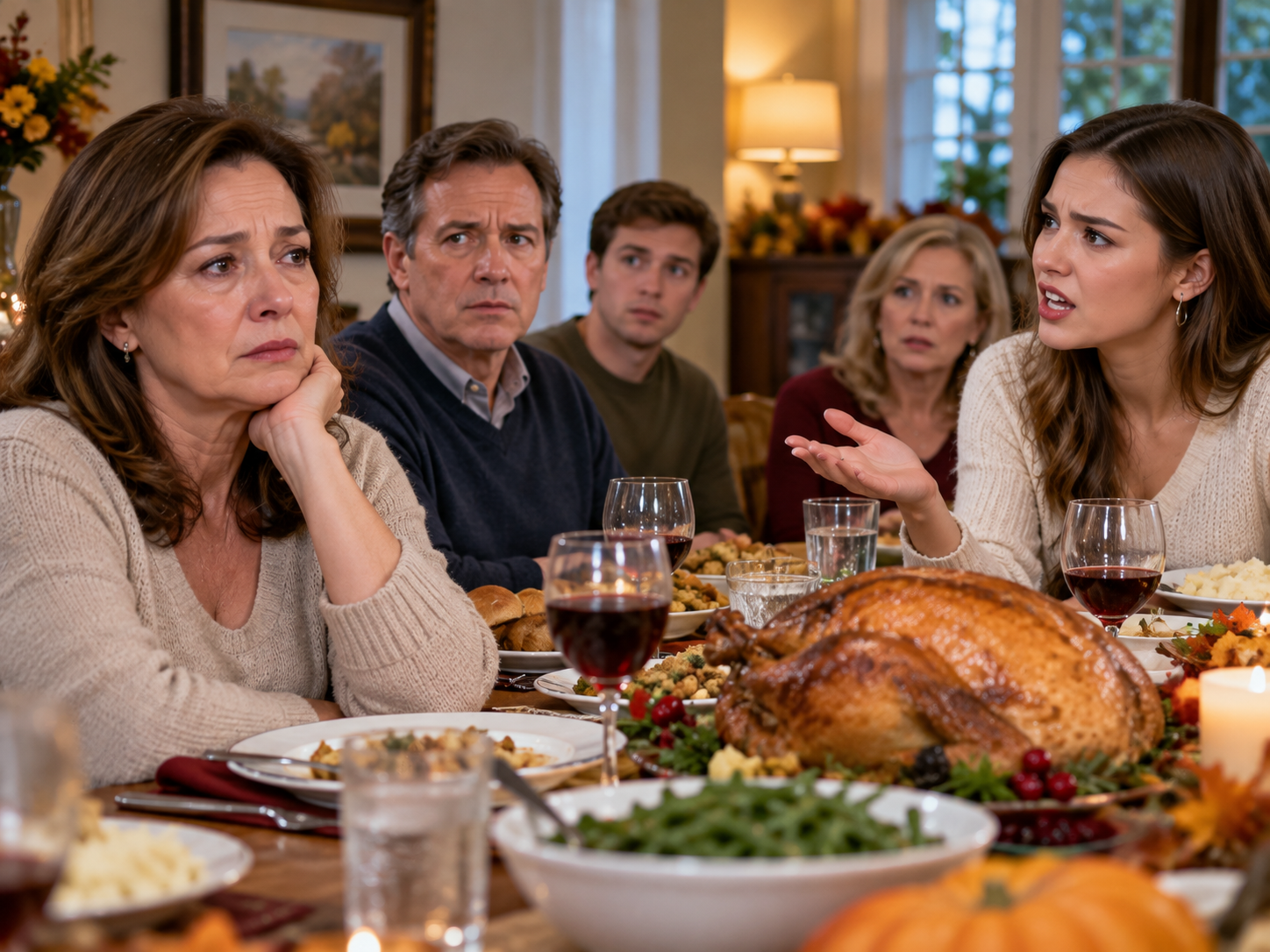
One careless sentence at Thanksgiving finally showed me what my husband had been expecting from me all along, and what he had never intended to give back.
Part 2 of 16

