
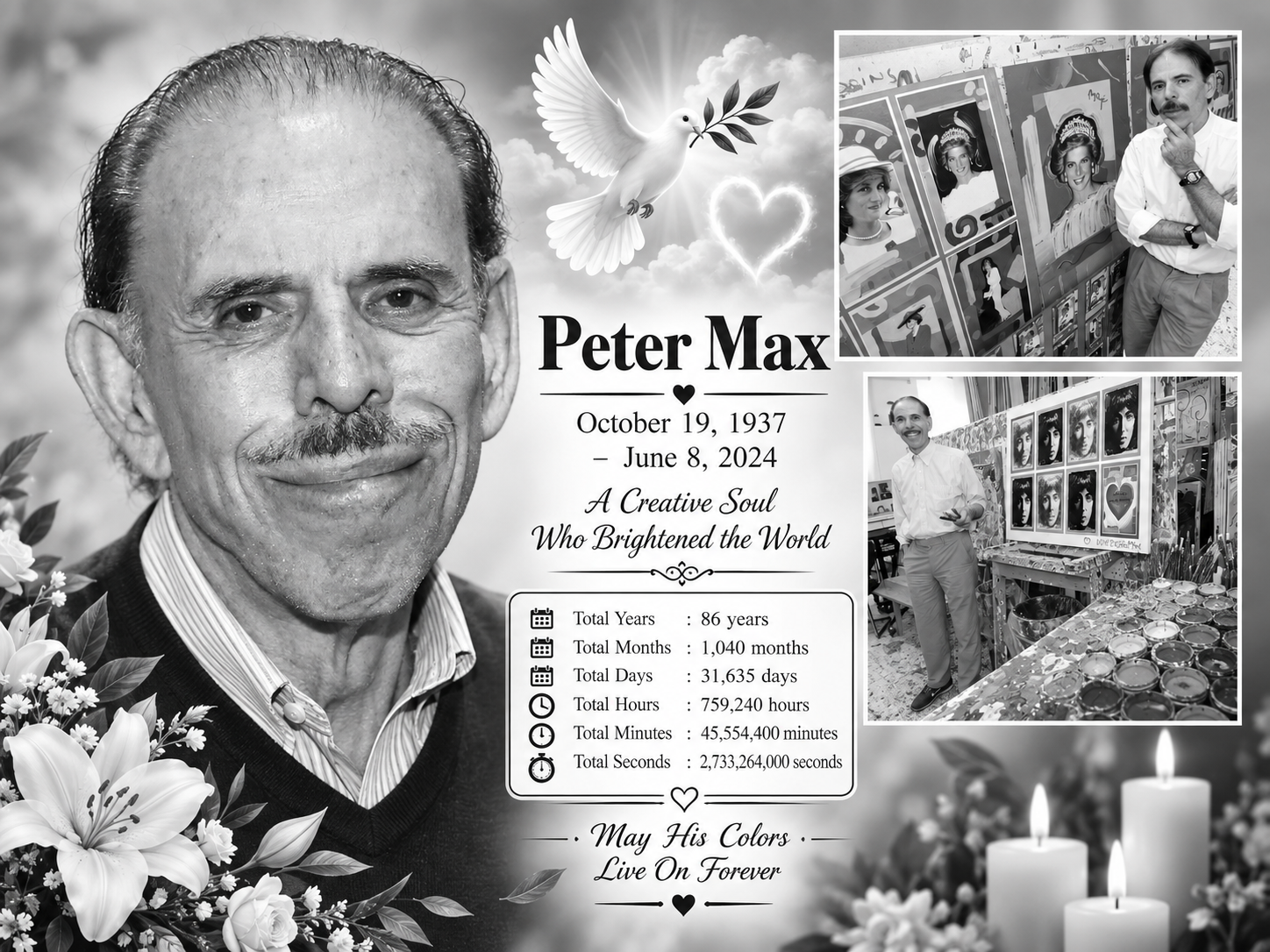
Peter Max's death did not end the movement of his images through the world. It ended the possibility of another painting made by the same hand, another interview answered in his own voice, another public appearance in which he could explain what a particular color, face, star, or Statue of Liberty meant to him.
That distinction became important immediately. The man was gone, but the work remained distributed across galleries, museums, private collections, public institutions, commercial reproductions, archives, and the memories of people who had encountered it decades earlier.
For most of his career, Max had been unusually visible. His name appeared beside his art so often that the two became difficult to separate. Yet visibility had never guaranteed complete understanding. A person could recognize his colors without knowing that he had been born in Berlin, spent formative years in Shanghai and Israel, studied traditional drawing in New York, and only later became associated with psychedelic design.
His biography therefore contained a chronology that was much longer than the period for which he was most famous.
The 1960s remained the chapter most closely attached to his public identity. His saturated colors and cosmic imagery became part of the visual atmosphere surrounding youth culture, music, posters, and the counterculture. But Max continued working for decades after that period had passed.
That longevity changes the way the early work can be understood.
A poster produced during the late 1960s belonged to a particular historical moment, but the person who made it continued to experience new decades. He watched the culture that had first embraced his work become history. He watched its symbols become familiar to younger people who had not lived through the original events.
The images therefore developed two lives.
The first belonged to the era in which they were created.
The second belonged to the generations that encountered them afterward.
That second life was especially important because Max's work was unusually reproducible. A painting could exist as a unique object, but the visual language could appear again on posters, books, products, stamps, public commissions, and other formats.
This meant that people could encounter something unmistakably associated with Max without ever seeing an original painting.
A young person might recognize the radiant sun before knowing the artist's name. Another viewer might know the Statue of Liberty image from a reproduction but never realize how deeply the subject was connected to Max's own history as an immigrant.
That separation between image and biography is common in popular art, but Max's life makes it particularly striking.
The man who became known for cheerful American imagery had begun life in Germany under circumstances that forced his family to leave. His family reached Shanghai when he was an infant. Later he lived in Israel before coming to the United States.
The journey was not a decorative detail added to his biography after the paintings became famous. It preceded them.
His fascination with America also began before he lived there. As a child overseas, he encountered American popular culture through comics, movies, and music. By the time he arrived in New York at sixteen, the country was both new and strangely familiar.
New York then supplied what his earlier life had lacked: direct contact with the machinery of American popular culture.
The city offered signs, magazines, theaters, advertisements, music, architecture, and the constant movement of people. For a young artist, it was an enormous visual education.
Max responded by studying seriously.
His training in anatomy and figure drawing mattered because the later style could make technique seem invisible. Bright colors and simplified forms sometimes create the impression that an image was produced quickly, but Max's early education gave him an understanding of structure that allowed him to simplify deliberately.
The difference is subtle.
A person who cannot draw realistically may produce an awkward simplified figure because the structure is uncertain. An artist who has studied anatomy can distort a figure while understanding exactly what is being changed.
That background helps explain the confidence of Max's later faces and bodies.
It also helps explain why his career moved naturally between illustration, graphic design, and painting.
He understood how an image could communicate quickly.
That ability became central when he began working commercially in the early 1960s. His work was designed for reproduction, and reproduction demanded clarity. The image had to survive being reduced, printed, moved onto another surface, or viewed from a distance.
The very qualities that made the work commercially useful also helped make it culturally memorable.
Yet commercial success created the problem already established earlier in his story: Max eventually felt that the business surrounding his imagery was pulling him away from painting.
His withdrawal therefore deserves to be remembered as an important artistic decision, not simply a career interruption.
He had already achieved what many artists spend their lives pursuing. His name was known. His images sold. His designs appeared everywhere. But he wanted to recover the physical experience of painting.
The large brushes and acrylics that became part of his later process changed the character of the work.
Instead of depending entirely on crisp graphic reproduction, he could allow the paint itself to become visible. Brush movement, overlap, texture, and scale became part of the image.
That return to painting also complicates the popular assumption that Max simply repeated one psychedelic formula for the rest of his life.
He did not.
The recognizable vocabulary remained, but the methods changed. His public subjects changed. His commissions changed. His relationship with American culture changed.
The Statue of Liberty became one of the clearest examples.
When Max began returning to Liberty in the years following the 1976 Bicentennial, the image offered him an almost inexhaustible subject. The monument could be painted realistically, symbolically, abstractly, patriotically, or through his cosmic visual language.
He repeatedly chose transformation.
Liberty became brighter than bronze.
The surrounding sky could become another universe.
The familiar figure could be surrounded by stars, flowers, hearts, or bands of color.
Yet the basic form remained recognizable.
That balance between familiarity and transformation was one of Max's central artistic strengths.
He could alter an established symbol without making it disappear.
The same method appeared in his treatment of famous faces.
Portraits could be repeated in different colors and arrangements. A recognizable person remained identifiable even after Max transformed the surface.
That technique connected his work to the broader history of Pop Art, where familiar images from mass culture could become raw material for artistic transformation.
But Max occupied a distinctive position within that history.
He was more openly optimistic than many artists associated with the period. His images generally avoided the harshness or irony that characterized some other forms of Pop Art.
His preferred vocabulary was different.
He returned to stars, suns, flowers, peace symbols, human faces, and the Statue of Liberty.
Even when the subject was politically or historically significant, he tended to approach it through color and accessibility.
That choice became part of the reason his work remained popular.
It also created a critical question that followed him throughout his career: could art remain serious while being so accessible and commercially successful?
There was never a single answer.
Some viewers valued his ability to reach audiences beyond museums. Others questioned whether the enormous commercialization of his imagery weakened its standing as fine art.
Those disagreements were part of his historical position rather than something that could be solved by a single label.
His work existed in both worlds.
A museum could display it.
A collector could own it.
A company could license it.
A traveler could see it on a ship.
A viewer could encounter it on a postage stamp.
A child could see one of his brightly colored images without knowing anything about art history.
That breadth was itself an achievement.
It also meant that Max's influence could not be measured only through auction prices or museum exhibitions.
His deeper influence was visual familiarity.
He helped establish a style that ordinary people could recognize immediately.
After his death, that recognition became independent of his physical presence.
A viewer could look at one of his suns without needing the artist to explain it.
A museum could exhibit one of his paintings without the painter standing nearby.
A book could reproduce his work decades after the original canvas was made.
The work had acquired its own life.
And that was the point at which the biography reached its quietest conclusion.
The artist who spent decades putting his signature on images eventually had to surrender control over what those images would mean after him.
The future would belong to the paintings.
Click Here to continue read next: PART10: The Symbols He Repeated for Decades Were Never Quite the Same, and Their Changing Meanings Revealed How One Artist Could Move Through an Entire American Lifetime
Before the Colors Became Famous, a Child Escaped a Dangerous Europe and Carried a Memory of the World Into His Art
Part 9 of 16

