
Among the most persistent features of Peter Max's career was repetition.
He returned to the same subjects again and again: Liberty, flowers, faces, suns, planets, stars, hearts, peace imagery, and figures surrounded by color.
At first glance, repetition might suggest that the artist had discovered a successful formula and simply refused to leave it. A closer look reveals something more complicated.
Max was interested in symbols precisely because they could survive repetition.
The Statue of Liberty remained the Statue of Liberty even when the surrounding colors changed.
A human face remained recognizable even when Max divided it into contrasting fields.
A sun remained a sun whether it appeared against a dark cosmic background or inside a dense arrangement of other forms.
The symbol provided stability.
The color provided change.
That relationship allowed Max to work within a recognizable visual vocabulary without producing exactly the same picture each time.
Liberty was especially powerful because the symbol could carry several meanings simultaneously.
It represented the United States.
It represented New York.
It represented immigration.
It represented arrival.
It represented freedom.
For Max, those meanings were not merely theoretical. His own family had crossed borders in search of safety, and he had arrived in New York as a teenager after years spent living outside the United States.
His later attachment to Liberty therefore had a biographical foundation.
The recurring image also connected his private history to public history.
When he painted Liberty for the Bicentennial period, he was participating in a national celebration.
When he helped with the restoration campaign, the image became connected to preserving a physical monument.
When he painted Liberty in later years, he was continuing a personal tradition that had become part of his professional identity.
The symbol accumulated history every time he returned to it.
The Berlin Wall carried a different kind of weight.
Max was born in Berlin, but his family fled Germany while he was still an infant. Decades later, the fall of the wall created a historical moment in which Berlin was no longer represented only by the divided city of the Cold War.
Max received a piece of the wall and carved a peace dove into it.
The concrete itself mattered.
This was not an illustration of history printed on paper. It was part of the historical object.
The artist took something that had physically separated people and altered it into an artwork associated with peace.
The symbolism was direct, but the personal chronology behind it made it more complicated.
A child born in Berlin had escaped Germany.
An adult artist later held a piece of the wall that had divided Berlin.
The object could therefore be read through both public history and private biography.
Max's cosmic imagery operated differently.
There was no single historical event attached to a star or planet.
The connection was more personal.
He had been fascinated by astronomy since childhood, and the subject remained visible throughout his career.
The universe gave him an almost unlimited visual field.
Stars could fill empty space.
Planets could become decorative forms.
Suns could function as faces.
Figures could appear to float through an imagined cosmic environment.
The effect was not scientific illustration.
Max was not attempting to reproduce astronomy accurately.
He was using the emotional scale of the universe.
That distinction matters.
His cosmic paintings were about wonder rather than measurement.
They transformed the idea of outer space into a visual language accessible to people who might know nothing about astronomy.
The moon landing of 1969 provided an especially powerful historical moment for that interest.
Humans were reaching the moon at the same time Max's cosmic imagery was becoming widely known.
His commemorative work connected the personal fascination he had carried since childhood with one of the defining events of twentieth-century science and American history.
The timing gave his imagery another layer.
The stars were no longer simply imaginary decoration.
For millions of people, space exploration had become an immediate reality.
Max's art could absorb that reality without abandoning its visual character.
His interest in spirituality added another dimension.
His meeting with Swami Satchidananda in Paris in 1966 influenced his thinking about yoga, consciousness, and creativity. The relationship became part of Max's broader interest in ideas that connected the individual to something larger.
That interest appeared alongside astronomy rather than replacing it.
Outer space suggested physical vastness.
Spiritual practice suggested inner awareness.
Art became a place where both could coexist.
This helps explain why Max's pictures so often felt larger than their immediate subjects.
A portrait might become cosmic.
A flower might become symbolic.
A patriotic monument might become part of a universe of color.
The ordinary object could be expanded until it suggested something beyond itself.
That approach also helped him communicate with viewers who did not share the same cultural background.
Symbols travel.
A flower does not require a translation.
A sun is immediately visible.
A human face remains recognizable even when its colors are transformed.
A planet suggests distance and mystery.
Max's international childhood may not have been the direct cause of this approach, but his life had given him repeated experience of crossing cultures.
He knew what it was like to encounter a place through images before living there.
He knew that visual information could arrive before language.
His career eventually turned that experience into an advantage.
His work crossed borders easily.
It appeared in Russia.
It was used for international sporting events.
It traveled through commercial products.
It appeared on aircraft and ships.
The images could function outside the specific American context in which they had first become famous.
That international reach also complicated the label “American artist.”
Max was certainly associated with American popular culture and became deeply connected to New York.
But his biography began in Europe, continued through Asia and Israel, and only later settled into the United States.
His artistic identity therefore contained migration from the beginning.
Perhaps that helps explain why the Statue of Liberty could become such a central subject.
The monument was about arrival, and Max knew what arrival meant.
But his work was not simply a biography painted literally.
He did not need to paint a portrait of his childhood every time he painted Liberty.
Instead, the personal history remained beneath the symbol.
That is why repeated subjects could continue to feel meaningful.
The symbol carried memory without requiring the viewer to know the entire biography.
The same principle applied to peace imagery.
Max created works associated with environmental causes, humanitarian themes, and public events. His “I Love the World” image after Live Aid was one example of how he used his visual vocabulary to respond to a large public gathering.
Again, the image was direct.
A planet.
An embracing figure.
A message about connection.
The simplicity was intentional.
Max's art rarely demanded that the viewer decode a complicated intellectual argument before understanding the basic image.
That quality contributed to his mass appeal.
It also explains why his work became associated with optimism.
But optimism should not be confused with a claim that Max's life itself was uncomplicated.
His tax conviction remained part of the historical record.
His family relationships became entangled in legal disputes.
His later dementia changed his ability to participate in his own career.
The bright colors did not erase any of those facts.
They existed alongside them.
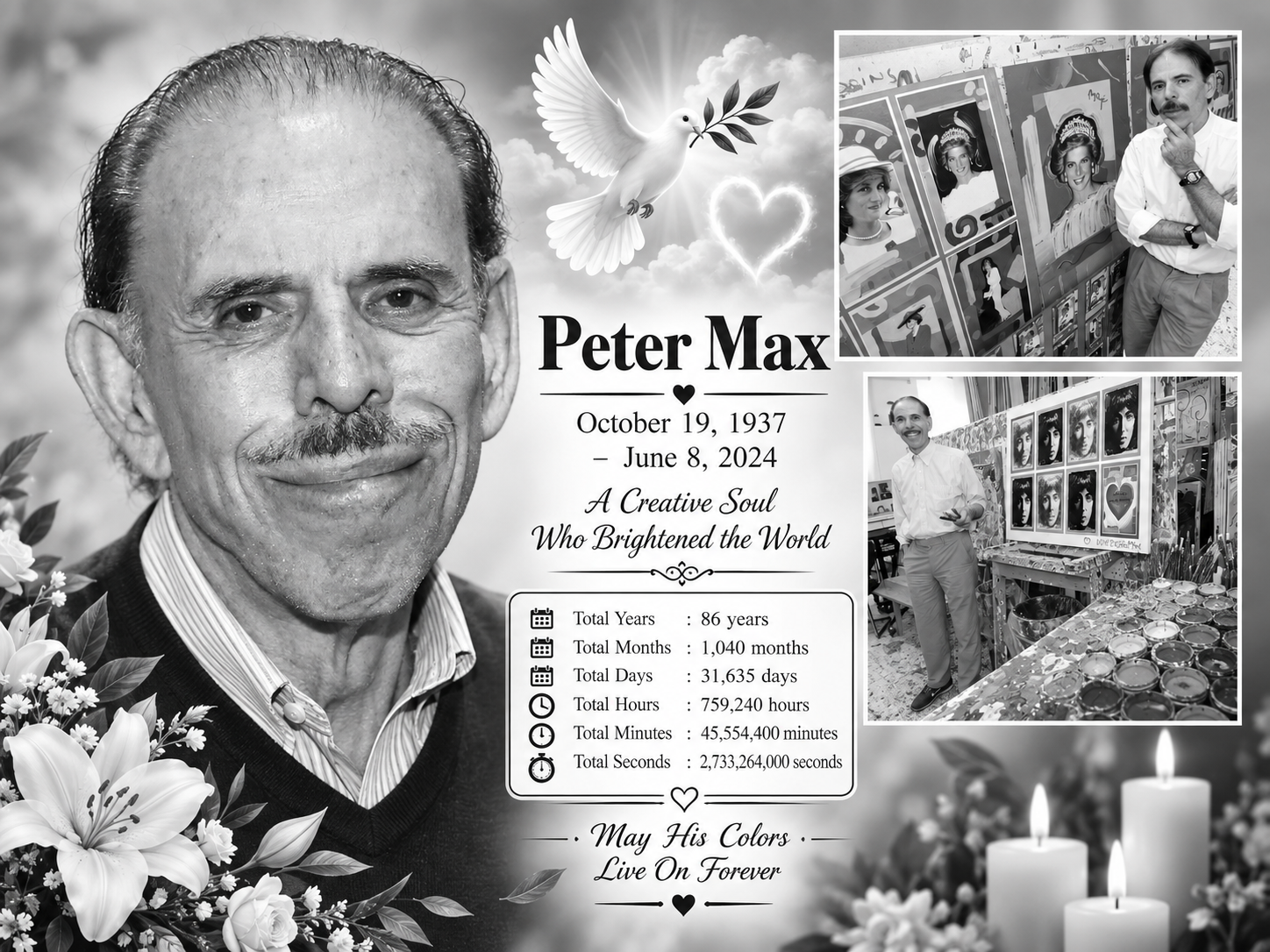
That distinction becomes especially important when looking at the final image of Max.
The older man in the photograph is surrounded by colorful paintings, but the photograph itself does not show the struggles behind the scenes.
It shows only a moment.
A slight smile.
A studio.
Paintings.
A recognizable face.
The biography has to supply what the photograph cannot.
The photograph cannot show the child leaving Berlin.
It cannot show Shanghai.
It cannot show the sixteen-year-old arriving in New York.
It cannot show the young artist learning anatomy.
It cannot show the commercial success that eventually became overwhelming.
It cannot show the retreat from that success.
It cannot show the Berlin Wall fragment.
It cannot show the White House.
It cannot show the decades of painting Liberty.
It cannot show the final years of dementia.
A photograph freezes a surface.
A biography restores movement.
That movement is what made Max's life unusually long and difficult to reduce to one sentence.
He was an artist of the 1960s, but he was not only an artist of the 1960s.
He was a commercial designer, but he was not only a commercial designer.
He was a painter, but his work cannot be separated from the mass culture that carried it to millions.
He was an American public figure, but his biography began across the Atlantic.
He was known for optimistic images, but his life contained painful and complicated episodes.
He became famous for being visually unmistakable, yet the final years of his life were marked by a condition that weakened memory and recognition.
Those contradictions remain.
They do not need to be resolved into a single judgment.
They are the evidence of a life that continued changing long after its most famous style had been established.
Click Here to continue read next: PART11: His Greatest Legacy Was Not One Famous Painting but an Entire Visual Vocabulary That Allowed Ordinary People to Recognize His Hand Before They Read His Name
Before the Colors Became Famous, a Child Escaped a Dangerous Europe and Carried a Memory of the World Into His Art
Part 10 of 16

