
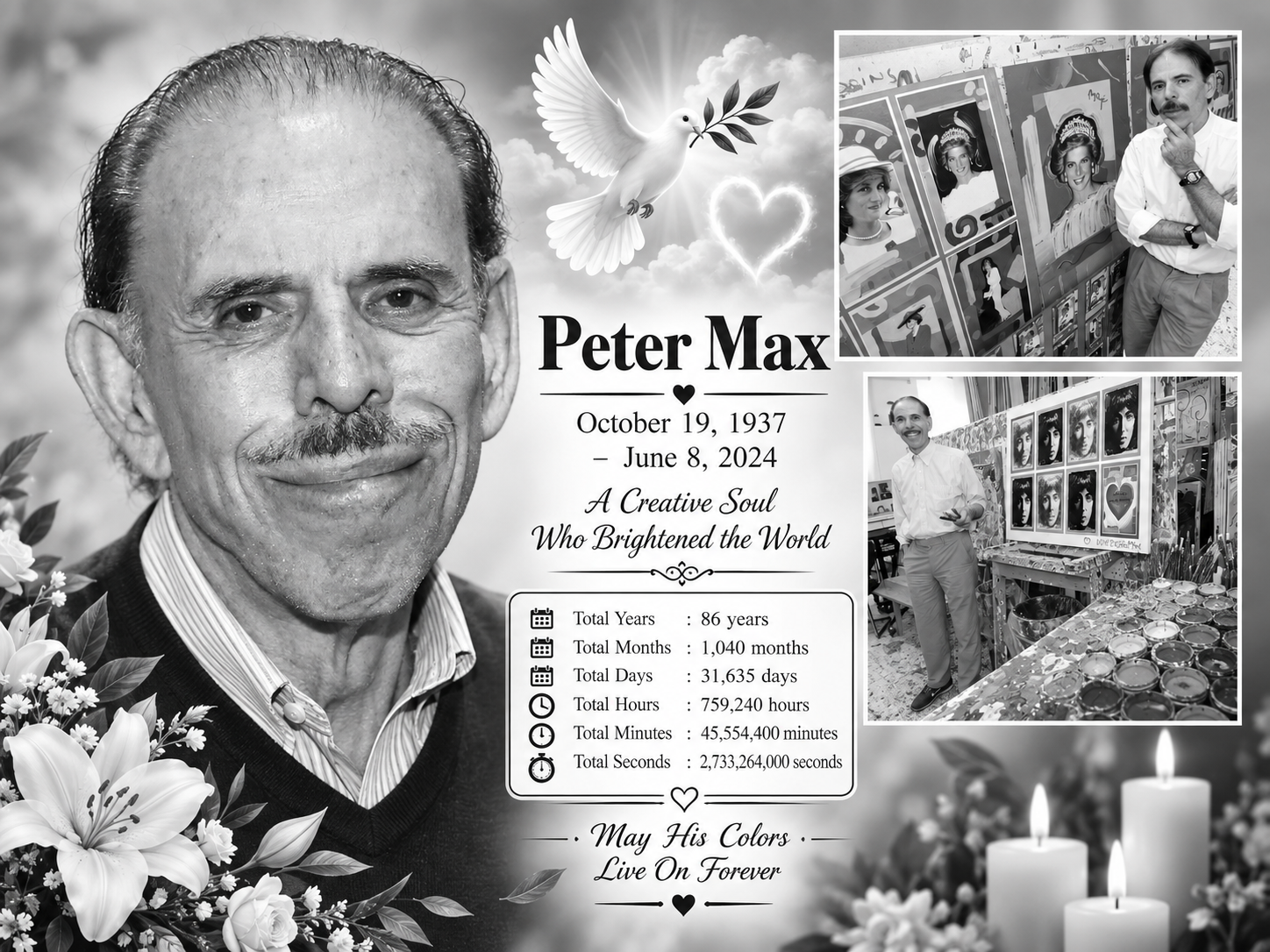
The problem Peter Max faced after becoming one of the most recognizable artists in America was unusually difficult: the public had learned his visual language so thoroughly that it could appear without him.
By the early 1970s, Max's name was attached to an extraordinary range of commercial products. His images appeared on posters, household furnishings, clothing, mugs, scarves, ties, and other merchandise. What had begun as a graphic style had become a marketable identity. The success was enormous, but Max later acknowledged that something about it troubled him: he was no longer painting as much as he wanted to paint. ([AP News][1])
That distinction became decisive. A commercial commission could place his image in front of thousands or millions of people, but a painter's private relationship with a canvas was different. The canvas did not need to sell a product. It did not need to fit a package or a magazine page. It could remain unresolved while the artist worked through it.
Max eventually stepped away from the commercial operation. The decision did not erase the success that had already happened, and it did not make his earlier work disappear. Instead, it allowed him to return to painting on his own terms and to explore materials that felt less controlled by reproduction. ([AP News][1])
He began working with acrylics and broad brushes, sometimes using house-painting brushes to create large fields of color. The physical character of the brushstroke mattered. Paint could overlap, collide, leave edges imperfect, and record the movement of the hand. The work no longer depended entirely on the clean graphic contours that had helped make his posters so easily reproducible.
The change was important because Max had never been only a manufacturer of cheerful images. His training had begun with anatomy, figure drawing, and composition at New York art schools. Beneath the psychedelic surfaces was an artist who understood structure. His later freedom came partly from knowing what he was choosing to abandon. ([Los Angeles Times][2])
His decision also complicated the usual story of artistic success. Max had achieved exactly what many commercial artists wanted: recognition, demand, money, and enormous exposure. Yet the same success had created a separation between his public image and the private activity that had drawn him to art in the first place.
He was not rejecting the audience. He was trying to recover the act of painting.
That recovery became visible through public projects that gave his work a new purpose. One of the clearest examples arrived in 1974, when Max created artwork for Expo '74 in Spokane, Washington. His environmental design became the first U.S. environmental postage stamp, carrying the message “Preserve the Environment.” ([AP News][1])
A postage stamp was still a reproducible object, of course, but the subject was different. The image was no longer simply an extension of a commercial product line. It carried a public message about the relationship between people and the natural world.
The commission fit comfortably with another recurring element in Max's imagination: the universe beyond ordinary human scale. He had been fascinated by astronomy since childhood. Stars, planets, suns, and cosmic space repeatedly appeared in his work, not simply as decoration but as a way of expanding the frame around human life.
That cosmic vocabulary also helped explain why his pictures could feel simultaneously intimate and enormous. A face might occupy the center of a canvas while planets floated behind it. A flower could sit beside a starburst. A human figure could become part of a field of color that suggested an entire universe.
In 1976, the subject of America itself became increasingly important. Max created the book Peter Max Paints America for the United States Bicentennial. The project brought him to Washington, where he attended a White House celebration connected with the publication. Afterward, he returned to New York with a new artistic subject that would remain with him for decades: the Statue of Liberty. ([AP News][1])
For another artist, Liberty might have been simply a national monument. For Max, it contained several personal meanings at once. He had entered the United States as a teenager after his family had crossed continents to escape Nazi Germany. He knew what it meant to arrive somewhere new and begin again.
His paintings of Liberty therefore became more than exercises in patriotic color. They allowed him to combine the public symbolism of the statue with the private history of an immigrant who had made New York his home.
The following years expanded that relationship. In 1981, President Ronald Reagan and First Lady Nancy Reagan invited Max to the White House for the president's first Fourth of July celebration. Max painted six large Statue of Liberty works in the Rose Garden. After he finished the sixth, Reagan was invited to make the final brushstroke. ([AP News][1])
The scene was almost perfectly suited to Max's public persona: a famous artist, an American symbol, a presidential setting, and a huge burst of color. But beneath the spectacle was a more personal story. The man painting Liberty had once been a sixteen-year-old newcomer trying to understand the visual language of his adopted country.
Max's relationship with public symbolism continued to grow. In 1985, he attended the Live Aid concert in Philadelphia and was moved by the enormous gathering. He created an image called “I Love the World,” showing an angel embracing the planet. The subject returned his art to a theme that had appeared repeatedly throughout his career: a desire to place human beings inside a larger, shared world. ([AP News][1])
Then came an opportunity to work directly with another symbol that had personal resonance. The Statue of Liberty needed restoration, and Max became involved in a campaign supporting the effort. His connection with the monument was already well established, but now his artwork and public profile could be used to help preserve the physical structure itself.
By the time the restoration was celebrated in 1986, Max's Liberty imagery had become one of the most recognizable parts of his career. The subject had survived changes in fashion, politics, and popular taste because it allowed him to return repeatedly to the same basic ideas without making exactly the same picture.
His work was also increasingly entering the world of major public events. In 1987, People magazine asked him to create a cover commemorating the twentieth anniversary of the Summer of Love. He responded with a collage of cultural figures associated with the era, including musicians and writers whose names had become part of the mythology of the 1960s. ([AP News][1])
That assignment placed Max in an unusual position. He was not merely remembering the 1960s from outside. He had helped create its visual vocabulary.
The same was true when he became involved with major international events. His work was eventually commissioned for the Olympics, the Super Bowl, the World Series, the Kentucky Derby, the Indianapolis 500, and the World Cup. His imagery could move from an intimate gallery setting to a stadium, broadcast, aircraft, or ship without losing its recognizable character. ([AP News][1])
The public scale of the work was enormous, but Max continued to return to painting. The tension that had caused him to withdraw from his commercial business never completely disappeared. His career kept moving between the worlds of fine art, design, merchandising, public commissions, and mass culture.
That mixture became one of the central facts of his identity.
He could not be separated from commercial culture because commercial culture had helped make him famous. But he also could not be reduced to it because he repeatedly returned to the studio and produced paintings that existed independently of products.
The distinction became especially clear in 1990, when Max received a section of the Berlin Wall. He carved a peace dove into the concrete and painted it. The object carried a weight that no poster or household product could easily reproduce. It was literally a piece of the political division that had shaped modern Europe. ([AP News][1])
For Max, Berlin was not an abstract location. It was where his life had begun.
He had been born there in 1937, when Nazi Germany was tightening its grip. His Jewish family had fled while he was still an infant. Decades later, a fragment of the wall that had divided Berlin became material for one of his artworks.
The image of the peace dove therefore contained an unusual loop in his biography. The child whose family escaped a dangerous Germany had grown into an artist holding a piece of divided Berlin in his hands. The wall had once been a barrier. He transformed a fragment of it into an object associated with peace.
Yet even as those symbolic projects accumulated, another part of Max's story was becoming harder to separate from the art: the demands and consequences of enormous commercial success.
Click Here to continue read next: PART6: The Public Image Grew Brighter While Private Troubles Became Harder to Hide, Revealing a Life Far More Complicated Than the Happy Colors Suggested
Before the Colors Became Famous, a Child Escaped a Dangerous Europe and Carried a Memory of the World Into His Art
Part 5 of 16

