
Peter Max's fame was built on images that could be understood quickly.
A viewer did not need to read an essay before recognizing the central subject.
The sun was immediate.
The face was immediate.
The flower was immediate.
The Statue of Liberty was immediate.
The colors announced themselves before the viewer had time to ask what they represented.
That immediacy was a major part of Max's success.
But a biography moves in the opposite direction.
It slows the image down.
It asks where the artist came from.
It asks what happened before the famous work.
It asks what changed afterward.
It asks which parts of the public story are documented and which parts became legend.
For Max, that process reveals a life that was far more complicated than the familiar psychedelic imagery suggests.
The first complication was geography.
Peter Max was not born into the American culture that later made him famous.
He was born in Berlin.
His family fled Nazi Germany while he was an infant.
He grew up in Shanghai.
He later lived in Israel.
Then he arrived in New York.
Those movements created a childhood in which home was never a single permanent location.
The United States became the place where his professional identity eventually took shape.
New York became especially important.
It was where he studied art.
It was where he entered graphic design.
It was where his work began attracting the attention that would eventually make him famous.
It was also the city to which he repeatedly returned in his public identity.
New York offered him the visual density he needed.
Its advertisements, buildings, music, people, and commercial culture gave him material.
But he did not simply copy what he saw.
He transformed it.
The transformation became more pronounced in the 1960s.
Max's work became increasingly associated with psychedelic culture.
The style fit the period because it offered a visual alternative to the muted, restrained design associated with earlier decades.
Color became louder.
Forms became more playful.
Cosmic imagery became common.
The ordinary world could be transformed into something more imaginative.
Max's work fit naturally into that atmosphere.
Yet his career was never completely dependent on the counterculture.
He moved into other subjects.
He created environmental imagery.
He painted national symbols.
He became involved in international sporting events.
He worked with public institutions.
He continued making portraits.
The public could therefore encounter his work in places that had nothing to do with the 1960s.
That flexibility extended his career.
It also meant that Max's later work could not be judged solely against his early psychedelic imagery.
The artist continued changing.
His materials changed.
His scale changed.
His subjects changed.
His relationship with commercial production changed.
His place in American culture changed.
The public around him changed.
Only the recognizable visual language remained as a constant thread.
That consistency was valuable.
It gave viewers a way into unfamiliar works.
They could see a Max image and know where they were.
But consistency could also become a trap.
Once an artist develops an unmistakable style, audiences often expect repetition.
The familiar becomes commercially valuable.
Any departure can seem like a mistake.
Max experienced that tension directly.
The commercial success surrounding his imagery eventually became so extensive that he stepped away from the business to paint more freely.
That decision reveals an important aspect of his career.
He wanted the freedom to create even though his existing style was already profitable.
He was not simply trying to become more famous.
He was trying to remain an artist.
The distinction may sound obvious, but it mattered greatly in Max's case.
His images had become products.
The products had become part of American visual culture.
Yet the person making the paintings still wanted the private experience of the studio.
That desire remained visible in his later work.
The large brushes.
The acrylic paint.
The broad marks.
The crowded canvases.
The physical scale.
The sense that the surface had been worked rather than mechanically reproduced.
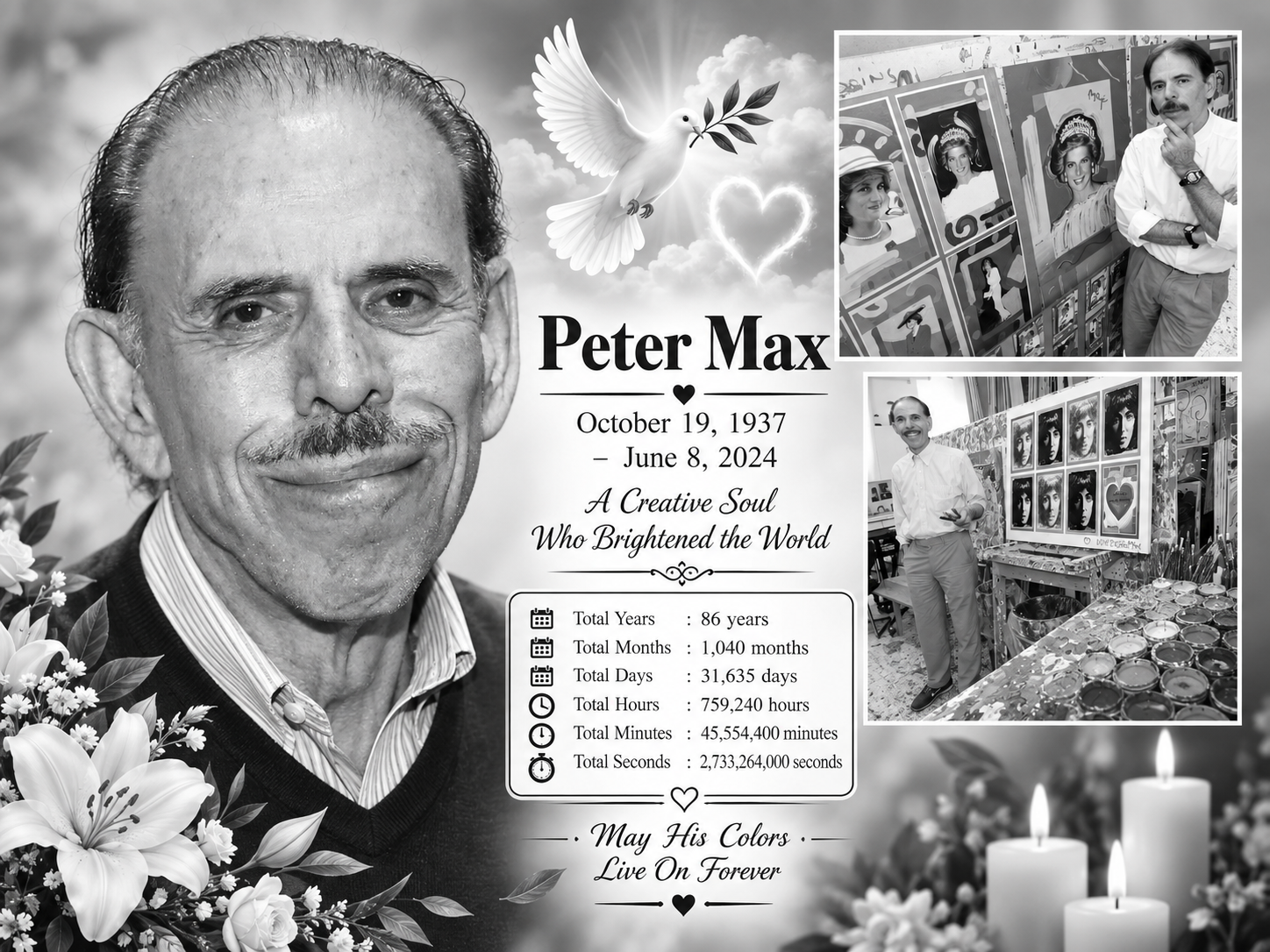
The studio photographs in the supplied image provide a glimpse of that environment.
Max stands among paintings that surround him almost completely.
Faces look out from canvases.
Bright colors overlap.
Paint containers occupy the foreground.
The setting looks more like a working laboratory of images than a quiet gallery.
That matters because Max's art was always connected to production.
There were paintings to make.
There were commissions to complete.
There were images to reproduce.
There were public projects to organize.
There were exhibitions to prepare.
The career had a physical workload.
As Max grew older, maintaining that workload became more difficult.
Age itself changed the circumstances.
Then dementia changed them further.
The later condition was not simply another chapter in the professional career.
It altered the person's relationship to memory and participation.
The public image remained available.
The man became increasingly difficult to reach.
That separation was particularly painful because Max had spent decades making himself visible.
He had appeared on television.
He had given interviews.
He had stood beside his paintings.
He had painted in front of audiences.
He had become a recognizable public personality.
Dementia undermined that continuity.
The person could no longer necessarily provide the same connection between past and present.
The archive therefore became increasingly important.
Photographs preserved earlier moments.
Paintings preserved earlier decisions.
Interviews preserved earlier statements.
Public records preserved commissions.
The documents became a substitute for the living artist's explanation.
That is why accuracy matters in the final account.
It is easy to invent a final sentence.
It is easy to imagine what an artist must have thought.
It is easy to turn illness into symbolism.
It is harder to leave an uncertainty untouched.
Peter Max died on September 14, 2026, at age eighty-eight.
The Associated Press reported his death in Manhattan and noted his advanced dementia, while no specific cause of death was publicly provided in the report.
That is the appropriate boundary.
There is no reliable basis here for inventing a particular medical event as the cause.
The uncertainty does not weaken the biography.
It simply describes the state of the public record at the time.
The known facts are sufficient to establish the final chapter.
Max had lived nearly nine decades.
He had witnessed enormous historical change.
He had created an artistic vocabulary recognized internationally.
He had become associated with one of the most visually distinctive periods of American popular culture.
He had continued working long after that period ended.
He had experienced enormous commercial success.
He had also experienced legal trouble and family conflict.
His later life was affected by dementia.
And then he died.
The ending is quiet compared with the scale of the career.
There was no need for another spectacular public event.
The artist's life had already contained enough.
His story had begun with migration.
It continued through art.
It passed through commercial culture.
It reached public symbols.
It survived controversy.
It endured changing tastes.
And finally it entered history.
What remains is therefore not a single lesson.
There is no need to claim that Max's life proves one particular philosophy.
His work can be appreciated without turning him into a perfect figure.
His mistakes can be acknowledged without erasing his achievements.
His commercial success can be recognized without pretending that every commercial product was equivalent to a unique painting.
His influence can be discussed without declaring that he was the only important visual artist of his generation.
The record is stronger when it remains specific.
He created the environmental stamp.
He painted Liberty repeatedly.
He participated in the restoration campaign.
He created the Berlin Wall peace dove.
He designed for major events.
He appeared on television.
He became associated with the psychedelic visual culture of the 1960s.
He stepped away from commercial production to focus on painting.
He continued working for decades.
Those are accomplishments that can be documented without exaggeration.
And the personal chronology remains equally clear.
Berlin.
Shanghai.
Israel.
New York.
The studio.
The posters.
The television appearances.
The public commissions.
The later illness.
The final hospital.
The death.
The colors between those points are the visible record.
But the biography is what gives those colors a human chronology.
The young man who arrived in New York could not have known that his visual vocabulary would one day become part of the city's cultural identity.
The artist who first gained attention through psychedelic design could not have known that his work would eventually be discussed as part of American art history.
The man who stepped away from commercial success could not have known how large the archive would become.
The elderly artist living with dementia could not control how future generations would interpret that archive.
Now they must decide for themselves.
The work cannot decide for them.
Neither can the biography.
A biography can only preserve the evidence and make the sequence visible.
Peter Max's sequence is unusually long.
And the final image is not one of a young artist beginning his career.
It is an older man standing among paintings that have already outlived many of the cultural moments that produced them.
That is where the story finally becomes still.
The paint remains on the canvas.
The colors remain visible.
The signature remains.
The artist is gone.
Click Here to continue read next: PART16: When the Signature Became the Last Voice Left Behind, Peter Max’s Long Journey From Berlin to New York Finally Became a Story Belonging to History
Before the Colors Became Famous, a Child Escaped a Dangerous Europe and Carried a Memory of the World Into His Art
Part 15 of 16

