
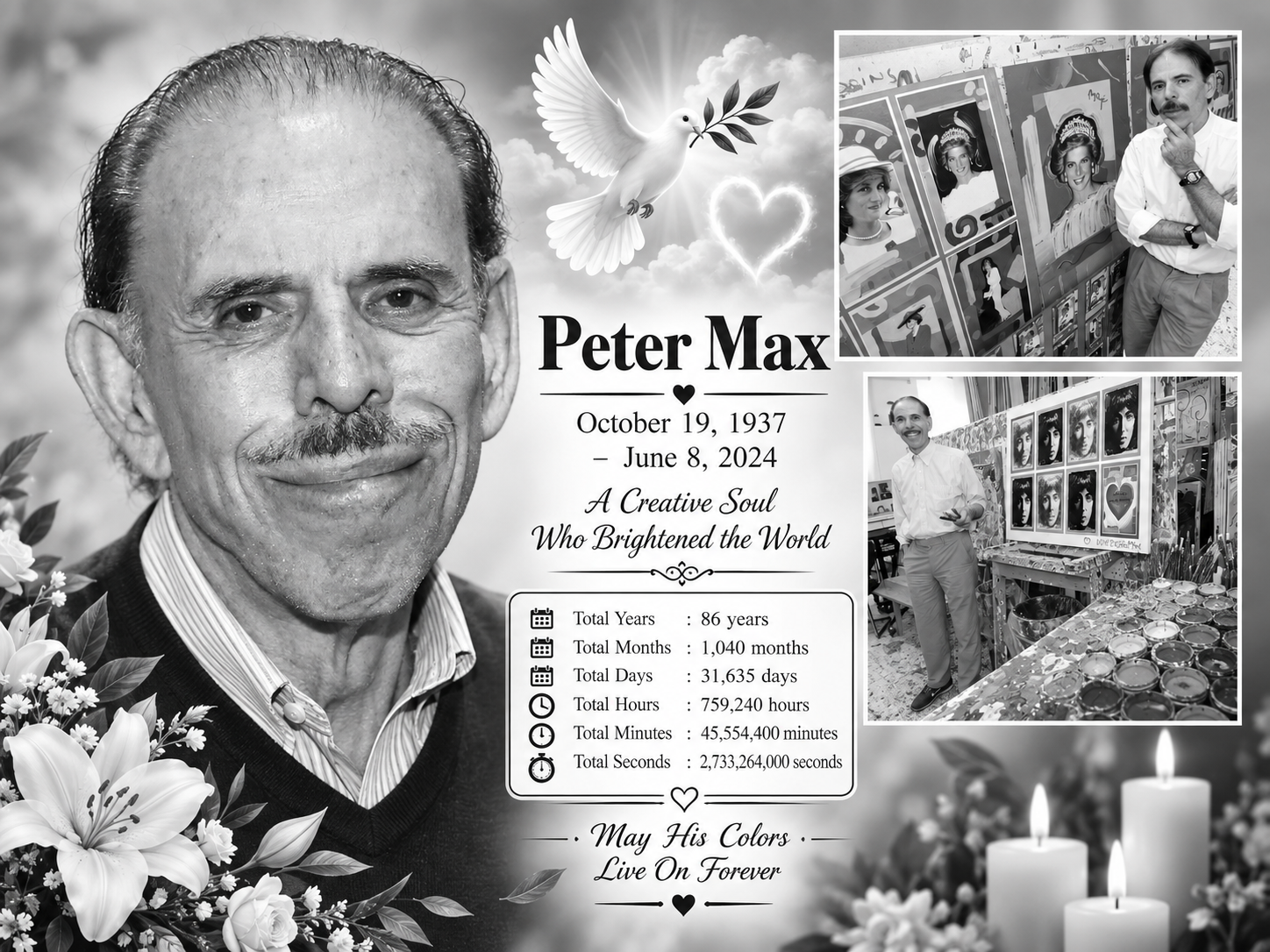
The studio photographs left behind after Peter Max's death present an unusual contrast. There are canvases crowded with color, faces, flowers, stars, and familiar figures, while the man whose name became attached to them is no longer there to explain what viewers are seeing.
That absence changes the way the work is encountered.
During Max's lifetime, the artist and the image were constantly connected. His signature appeared beside his paintings. His face appeared in interviews and photographs. His name accompanied exhibitions, commissions, products, and public appearances. When people saw his work, they could still imagine the person who had made it.
After September 14, 2026, that relationship became historical rather than immediate.
Max had died in Manhattan at eighty-eight. Reports stated that his final years had been affected by advanced dementia, while no specific cause of death had been publicly established in the reliable reporting available immediately after his death. That distinction remains important because a biography should preserve what is known without turning uncertainty into fact.
The end of his life therefore did not produce a final medical explanation that neatly closed the story.
Instead, it returned attention to the much larger record of his career.
That record began long before the colors for which he became famous.
Peter Max was born Peter Max Finkelstein in Berlin on October 19, 1937. His Jewish family left Germany when he was an infant, taking him first to Shanghai. The child who would eventually become associated with American psychedelic imagery therefore began life as part of a family moving across borders in search of safety.
Shanghai became an important setting for his childhood.
The city exposed him to a mixture of cultures and visual traditions. Buddhist imagery, Asian art, Chinese calligraphy, architecture, streets crowded with movement, and the presence of Western popular culture all contributed to the visual environment surrounding him.
Those experiences were not a simple recipe for his later style.
Artistic development is rarely that neat.
But they gave him an unusually broad visual vocabulary before he had even begun his professional career.
The family later moved to Israel, adding another cultural landscape to his childhood. By the time Max arrived in New York at sixteen, he had already lived through several dramatic changes of place.
New York introduced another world.
The city was louder and faster. Advertisements competed for attention. Broadway signs, newspapers, magazines, cars, buildings, music, and crowds created an enormous collection of images.
Max had encountered American culture before arriving in America.
Now he was surrounded by it.
He studied art seriously and developed a foundation in anatomy, drawing, composition, and design. That training became increasingly important as his style moved away from conventional realism.
The later paintings could appear effortless, but the confidence of their simplified figures came from someone who had learned how bodies were structured.
He knew what he was changing.
He knew how far a face could be simplified before it stopped being recognizable.
He knew how a figure could be reduced to a few shapes and still communicate movement.
That knowledge became useful when he entered commercial design.
In the early 1960s, Max worked in graphic design with Tom Daly. Their studio handled commercial assignments, and Max developed an increasingly distinctive visual vocabulary.
At first, the work was not a cultural revolution.
It was work.
Book covers, illustrations, records, and design commissions provided practical opportunities to develop his skills.
Then the visual atmosphere of America changed.
Youth culture became increasingly visible.
Music changed.
Graphic design changed.
The counterculture emerged.
And Max's imagery found an audience ready for exactly the kind of saturated, cosmic, optimistic visual language he was developing.
His work began appearing on posters and in magazines. His imagery became connected with the psychedelic period, and his name increasingly became associated with the visual identity of the late 1960s.
The transformation was rapid.
An artist who had begun working professionally in design became a cultural figure.
Television amplified the change.
Audiences could watch Max draw live. His ability to create images in front of cameras turned the process of drawing into part of his public identity.
He was no longer simply someone whose work people saw.
He became someone people watched making the work.
That distinction helped make his personality part of the brand surrounding his art.
By 1969, Life magazine placed Max on its cover.
The young immigrant who had arrived in New York as a teenager was now a nationally recognizable artist.
His images were appearing everywhere.
But that success eventually created its own problem.
Max's artwork became so commercially successful that it began appearing on a vast range of products. His imagery could be reproduced endlessly.
That was a triumph from a business perspective.
It was more complicated from the perspective of the painter.
Max eventually stepped away from the commercial operation because he wanted to paint.
The decision is one of the most revealing moments in his career.
It showed that fame and artistic satisfaction were not identical.
The public wanted more of the familiar Peter Max imagery.
The artist wanted room to work.
He returned to painting with acrylics and broad brushes, producing larger and more physical works. The brushstroke itself became part of the composition.
This change did not erase his recognizable vocabulary.
The suns remained.
The stars remained.
The faces remained.
The colors remained.
But the physical character of the painting changed.
That distinction matters because it prevents his career from being reduced to one decade.
Max continued evolving after the 1960s.
His public commissions expanded.
He created environmental imagery.
He worked on major national and international events.
He became closely associated with the Statue of Liberty.
That symbol had a particular personal significance.
Max had arrived in America as a teenager after his family had crossed several borders. Liberty could therefore represent more than patriotism.
It could represent arrival.
It could represent belonging.
It could represent the country that became the setting for the majority of his adult life.
His repeated paintings of the monument turned it into one of the central subjects of his career.
The connection deepened in 1981 when he painted six large Statue of Liberty works in the White House Rose Garden during President Ronald Reagan's first Fourth of July celebration. Reagan was invited to add the final brushstroke to the sixth painting.
The episode belonged to Max's public career, but the image of Liberty also carried a quieter personal meaning.
The immigrant artist had become one of the people most closely associated with the visual representation of an American symbol.
That relationship continued into the restoration of the Statue of Liberty.
Max helped support the campaign to restore the monument, bringing his artistic identity and public visibility into a practical preservation effort.
His career had therefore moved far beyond posters.
He had become a participant in the visual history of public America.
That history included environmental awareness.
It included major sporting events.
It included presidential celebrations.
It included humanitarian projects.
It included the fall of the Berlin Wall.
When Max received a section of the wall in 1990, he carved a peace dove into it and painted the piece.
The object connected his personal history with European history in a way that few commercial products could.
The boy born in Berlin had lived long enough to hold part of the wall that had divided Berlin.
The piece of concrete was no longer simply a barrier.
It had become material for an artwork.
That transformation was characteristic of Max's career.
He repeatedly took familiar symbols and altered them without destroying their identity.
The Statue of Liberty remained recognizable.
A famous face remained recognizable.
A flower remained a flower.
A planet remained a planet.
But color changed the emotional atmosphere.
Scale changed the meaning.
Repetition changed recognition.
Arrangement changed context.
That was one of the reasons his work remained accessible.
Viewers could understand the subject immediately.
They could then decide what the transformation meant.
After his death, that process became even more important.
Max could no longer explain a new painting.
He could no longer answer questions about his intentions.
He could no longer decide how a new generation should understand his earlier work.
The paintings had to stand without him.
And perhaps that was the final test of the career he had built.
Could the work continue to communicate after the person behind it was gone?
The answer would not come from one final painting.
It would come from every future viewer who encountered one.
Click Here to continue read next: PART14: The Artist Who Once Filled Television Screens With Moving Color Eventually Became a Historical Figure, Leaving Future Viewers to Separate the Man From the Myth
Before the Colors Became Famous, a Child Escaped a Dangerous Europe and Carried a Memory of the World Into His Art
Part 13 of 16

