
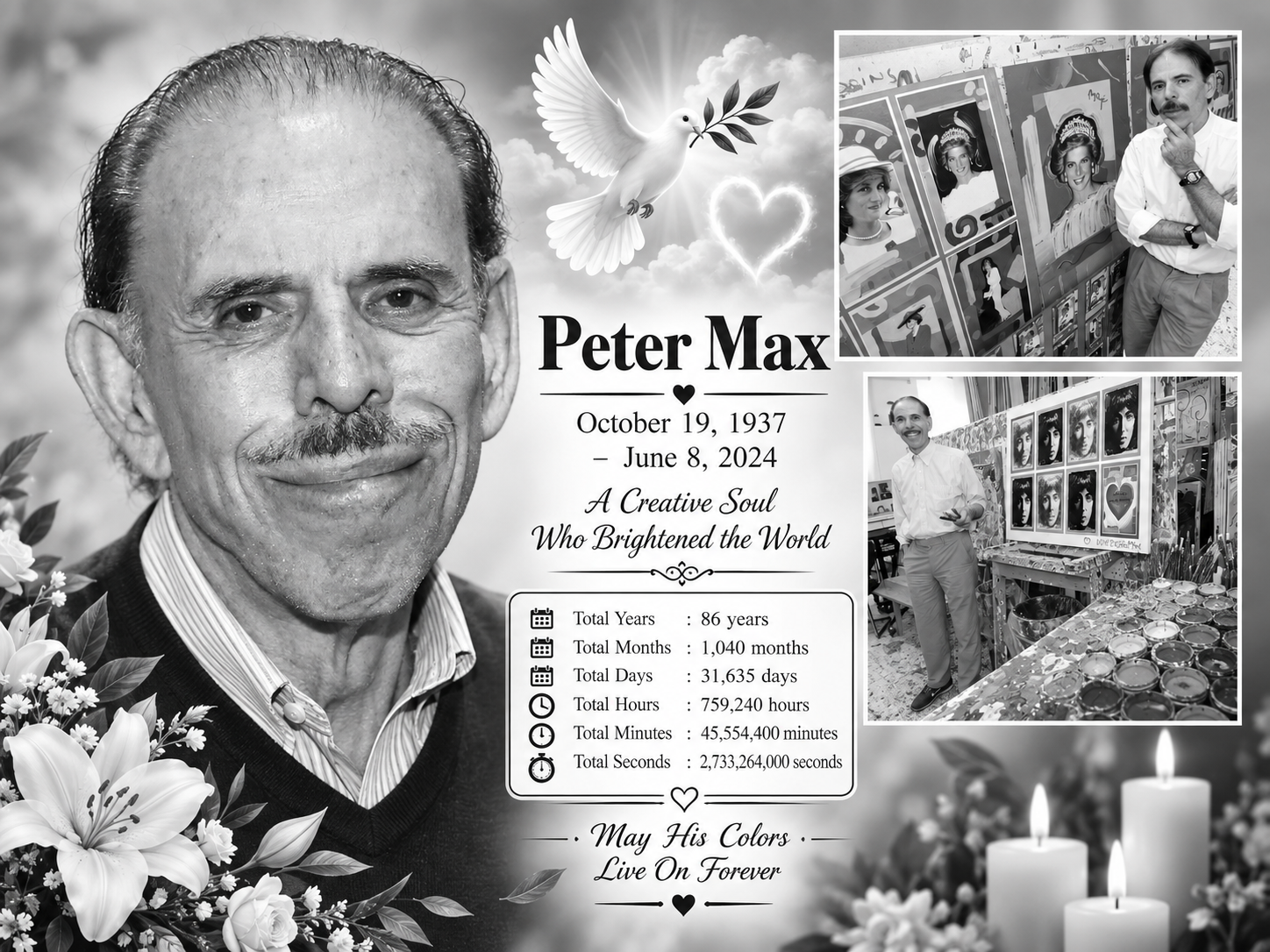
Peter Max's story began with departure.
He was born Peter Max Finkelstein in Berlin on October 19, 1937, into a Jewish family living under the growing threat of Nazi Germany. When he was still an infant, his family fled to Shanghai. His childhood continued across different countries and cultures before the family eventually settled in New York City, where Max arrived at sixteen. ([AP News][1])
The boy who arrived in New York already knew something about America.
He had encountered American comics, movies, and jazz while still living overseas. By the time he reached the city itself, American popular culture was not entirely foreign. It was something he had been observing from a distance and was finally able to enter directly.
New York became the place where those influences met his formal artistic education.
At the Art Students League, the School of Visual Arts, and Pratt Institute, he developed skills that gave structure to the visual imagination he had been carrying since childhood. He studied drawing and design before his work became associated with the free-flowing imagery of the psychedelic era. ([AP News][1])
In the early 1960s, he entered graphic design.
That decision changed everything.
His style was quickly adopted by advertising, publishing, corporate clients, and popular culture. The imagery became increasingly colorful and recognizable. By the late 1960s, Max was no longer simply a designer trying to build a career. He had become one of the visual figures most closely associated with the period's flower-power aesthetic. ([AP News][1])
His work reached an enormous audience.
Posters appeared on dormitory walls. Products carried his designs. Magazines reproduced his images. Television audiences watched him draw. In 1969, Life magazine placed him on its cover. His name became inseparable from the saturated colors and cosmic forms that had come to represent a particular vision of the 1960s. ([AP News][1])
But success created the crisis that shaped the next stage.
His work was everywhere.
He could see his images on mugs, clothing, household furnishings, and other products. The business was thriving, but he felt that commercial demand had taken him away from the thing he actually wanted to do: paint. He therefore stepped away from the commercial operation and returned to fine art. ([AP News][1])
That decision prevented his career from becoming a simple story of repetition.
Instead of spending the rest of his life reproducing the imagery that had made him famous, Max expanded it.
The Statue of Liberty became a recurring subject.
The environment became a public concern.
The Berlin Wall became a physical object to transform.
The Olympics, World Cup, Super Bowl, World Series, and other major events became opportunities to create public imagery.
His art moved into museums and institutional collections while remaining available to mass audiences.
The boundaries between fine art and popular culture remained deliberately blurred.
That was not a flaw that needed to be corrected in the telling of his life. It was one of the defining facts of his career.
Max's work had unusual accessibility.
A person did not need an art-history degree to recognize its emotional vocabulary. The colors were immediate. The symbols were familiar. The compositions could be understood quickly.
At the same time, his training and long career meant that the pictures could not accurately be described as accidental explosions of color.
Behind the famous style was a man who had studied anatomy and composition, worked professionally as a designer, and spent decades experimenting with different forms of painting.
The same artist could produce a widely reproduced commercial image and a unique canvas.
The same artist could create an environmental postage stamp and a large painting.
The same artist could paint Liberty at the White House and carve a dove into a fragment of the Berlin Wall.
Those apparently different acts were connected by recurring concerns: America, freedom, peace, nature, the cosmos, human faces, and the movement of color.
His personal history made some of those subjects especially resonant.
The Statue of Liberty was not only an American symbol.
For an immigrant who arrived in New York at sixteen, it was also part of the physical landscape of becoming American.
The Berlin Wall was not only a historical object.
For someone born in Berlin and forced to leave Germany as an infant, it carried a different kind of personal geography.
The universe was not simply decorative.
Astronomy had fascinated him since childhood.
Even his interest in Eastern spirituality belonged to the same broad search for something larger than ordinary daily experience.
Those connections do not mean every painting had a hidden autobiographical message.
They mean that the subjects Max repeatedly returned to were consistent with the experiences and interests documented across his life.
His career also contained failures and controversies.
The 1997 tax-fraud conviction became part of his public record. Family disputes later became public and deeply complicated. His second wife, Mary Max, died by suicide in 2019 after years of conflict surrounding his finances and artwork. ([AP News][1])
These facts matter because a biography should not turn a human being into a single mood.
Peter Max's paintings were often bright.
His life was not always bright.
The two facts can exist together.
The colors do not prove that he experienced every moment with optimism, just as the difficult episodes do not invalidate the meaning viewers found in his art.
They belong to different parts of the same life.
His later health added another painful layer.
The Associated Press reported that Max had advanced dementia before his death. His final years therefore involved a condition that affected the person whose identity had been built around visual memory, creativity, recognition, and constant production. ([AP News][1])
Yet the exact cause of death was not publicly disclosed in the reliable reports available immediately after his passing.
That point should remain clear.
Peter Max died on September 14, 2026, in a Manhattan hospital, at the age of 88. His son Adam announced the death. Reports stated that Max had been suffering from advanced dementia, but no specific cause of death was given. ([AP News][1])
His surviving children were Adam Max and Libra Astro. ([AP News][1])
His death therefore closed a life that had begun in one of the most troubled periods of twentieth-century Europe and ended in a New York hospital almost nine decades later.
Between those two points was an extraordinary visual journey.
The refugee child became a New York art student.
The student became a graphic designer.
The designer became a cultural phenomenon.
The cultural phenomenon became a painter who deliberately stepped away from the commercial machine.
The painter became an artist of public symbols.
The public artist became an international name.
And the international name eventually became an elderly man whose own memory was increasingly fragile while the images associated with him remained vivid.
That final contrast may be the most difficult part of his story.
Art is often described as a way of remembering.
Max spent his life making images that could be remembered instantly.
But dementia attacked the very faculty that allows a person to hold a continuous narrative of the self.
The paintings did not experience that loss.
A sun remained a sun.
A face remained a face.
A Statue of Liberty remained recognizable.
A fragment of the Berlin Wall remained concrete.
A painting made decades earlier could still be looked at today without knowing what the artist remembered when he made it.
That independence is part of what gives art its unusual longevity.
It also changes the meaning of an artist's death.
Peter Max cannot add another chapter to his own career.
He cannot correct a new interpretation.
He cannot repaint a familiar image.
He cannot explain what he intended in a work made fifty years ago.
From this point forward, the conversation belongs to viewers, historians, museums, collectors, family members, and future artists.
They will decide which works receive attention.
They will examine his place in the history of Pop Art and psychedelic design.
They will debate the relationship between commercial success and artistic seriousness.
They will preserve or reinterpret his recurring symbols.
They will continue to encounter the images without the physical presence of the man who created them.
That is not the same as saying that his legacy has one fixed meaning.
It does not.
One viewer may see a record of 1960s counterculture.
Another may see a commercial design revolution.
Another may focus on immigration and American identity.
Another may see an artist fascinated by astronomy and spirituality.
Another may simply see a colorful painting that makes a room feel different.
All of those responses can exist without changing the documented facts of his career.
And the documented facts are substantial.
Peter Max was born in Berlin in 1937.
His family fled Nazi Germany when he was an infant.
He grew up across several cultures before settling in New York.
He studied art.
He became a graphic designer.
His psychedelic imagery became widely recognized in the 1960s.
He later stepped away from commercial production to return to painting.
He created major public works and commissions.
He painted recurring images of the Statue of Liberty.
He created artwork connected to environmental causes and major international events.
His work entered museums and public collections.
His life also included legal and family controversies.
His final years were marked by advanced dementia.
He died in Manhattan on September 14, 2026, at 88, with no specific cause of death publicly provided in the reliable reports available immediately after his death. ([AP News][1])
The photograph accompanying this story captures only a fraction of that life.
It shows an older Peter Max surrounded by examples of his visual world.
But behind the bright paintings was a much longer journey: a child leaving Berlin, a teenager arriving in New York, an artist learning to draw, a designer discovering a new visual language, a celebrity confronting the consequences of commercial fame, and an older man whose personal memory became increasingly difficult to preserve.
The colors became famous.
The paintings became collectible.
The symbols became recognizable.
The name became part of American cultural history.
But the final truth of the biography is quieter.
Peter Max was not only the man who painted bright pictures.
He was a person who spent nearly ninety years moving through countries, artistic movements, public attention, private difficulty, and changing ideas about what an artist could be.
He left behind more than a style.
He left behind a body of work large enough to continue creating encounters with people who never met him.
The child who once crossed continents could not know where his images would eventually travel.
The young artist who arrived in New York could not know that his suns and stars would become familiar around the world.
The older man whose memory eventually weakened could not continue shaping the public meaning of his work.
But the work remained.
And when the person behind the colors was finally gone, those colors were still there—bright against the canvas, carrying forward a story that had begun with one child leaving Berlin and ended with an artist whose imagination had traveled much farther than he ever could.
Click Here to continue read next: PART9: After the Painter Could No Longer Speak for Himself, His Images Became the Evidence Through Which Future Generations Would Reconsider the Life Behind Them
Before the Colors Became Famous, a Child Escaped a Dangerous Europe and Carried a Memory of the World Into His Art
Part 8 of 16

