
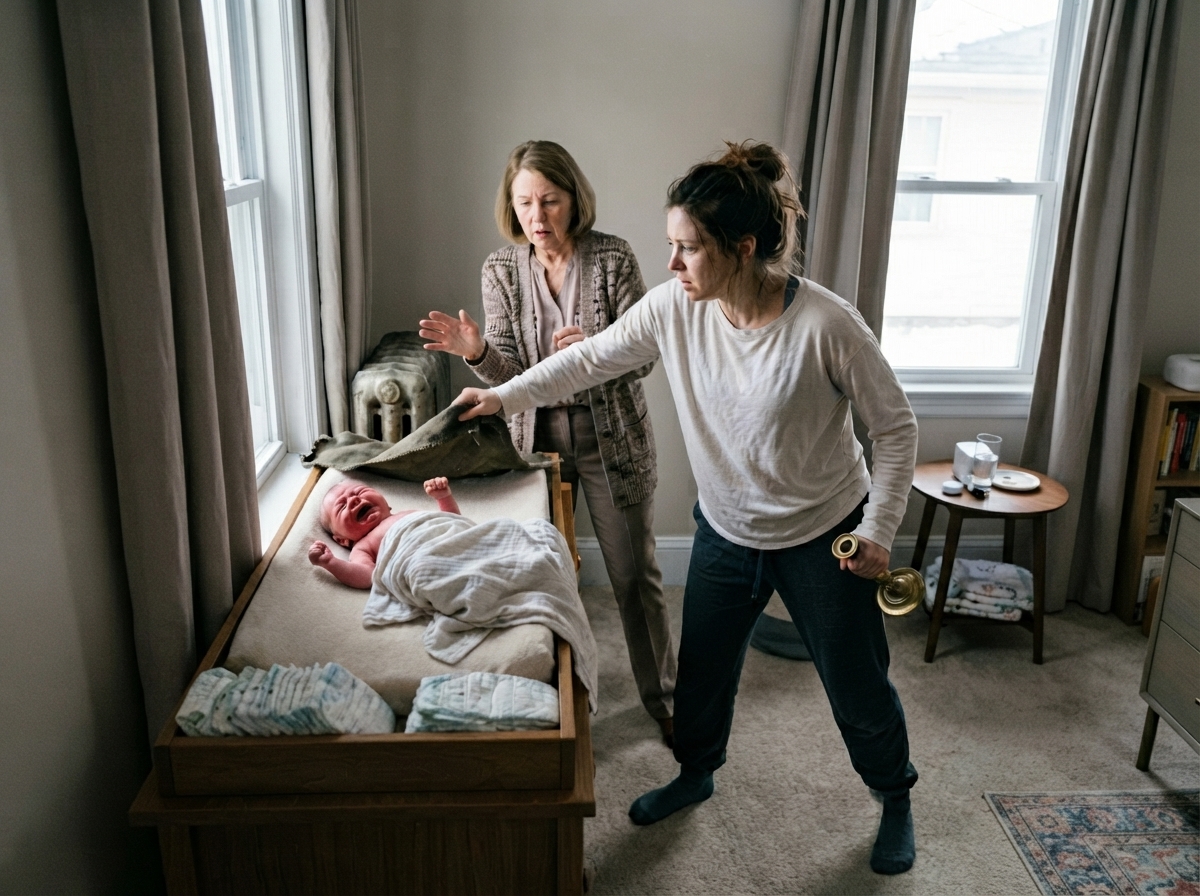
NOTE: This part resolves the mystery surrounding the blanket, the surveillance, the family research records, and the person behind the manipulation, while showing the emotional consequences for the family.
The photograph of my sleeping daughter was the moment I stopped believing this was only a family argument.
Someone had entered our nursery.
Someone had watched her.
Someone had photographed her.
And someone wanted us to believe the danger came from Margaret.
The police secured the house.
Every room was searched.
The nursery was examined carefully.
Behind the dresser, investigators found a tiny recording device.
It had been placed where it could see the crib.
I felt sick.
Daniel stood beside me.
"I didn't know that was there."
"I know."
This time, I believed him.
The device had been active for several weeks.
The recordings showed someone entering the nursery at night.
The face was never visible.
But the person wore gloves.
They never touched our daughter.
They only watched.
That distinction mattered.
The recordings did not show an attempt to harm her.
They showed surveillance.
The investigators compared the dates with Margaret's visits.
She had been present on several nights.
But she had not installed the device.
Another person had.
The police traced the equipment.
It had been purchased through a company connected to Dr. Alan Pierce.
That discovery changed everything.
Pierce had not died.
He had changed his name years earlier.
He had continued medical research privately.
And someone had been helping him.
The person was not Margaret.
It was the former administrator of the old clinic.
A woman named Helen.
Helen had been collecting information about descendants of families included in the original research.
Our family was one of them.
The old documents revealed that Daniel's father had been obsessed with hereditary patterns.
But there was no evidence that his research had predicted anything supernatural or inevitable.
He had simply believed that certain inherited conditions required long-term monitoring.
His methods had been unethical.
Records had been collected without proper consent.
Families had not been informed.
The research had eventually been shut down.
But the records survived.
Helen had continued the monitoring after the clinic closed.
Margaret discovered pieces of the truth.
Instead of going directly to the authorities, she became frightened.
She believed that if she exposed the records, the family would be investigated.
She also believed that Daniel's daughter might be in danger.
That fear caused her to make terrible choices.
She took the strange blanket.
She watched our nursery.
She confronted Michael.
She hid information from Daniel.
But she had not created the entire scheme.
Someone else had manipulated her fear.
Helen had contacted Margaret months earlier.
She had told her that Daniel's daughter might inherit a dangerous condition.
She had sent anonymous warnings.
She had shown her old medical documents.
She had convinced Margaret that the baby needed to be monitored.
Margaret believed her.
That did not excuse what she did.
But it explained why she had behaved so strangely.
The investigators found messages between Helen and Margaret.
One message from Helen said:
"Do not tell them yet."
Another said:
"Keep the baby away from unnecessary visitors."
Another instructed Margaret to use a specific blanket.
The blanket had been treated with a harmless testing substance.
It was not intended to injure the baby.
But Margaret had used it without our permission.
That was still unacceptable.
The investigators also discovered that Helen had created the anonymous photograph.
She had entered the house using a copied key.
She wanted me to suspect Margaret.
She knew our family already had tension.
She exploited it.
The goal was to keep us divided while Helen continued accessing the nursery.
When the evidence was presented, Margaret finally admitted what she had done.
She had taken the key from Daniel years earlier.
She had made a copy.
She had entered the nursery while we slept.
She had allowed Helen to access information.
She had believed she was protecting the baby.
But she had also been terrified that Daniel would blame her if something happened.
That fear had made her secretive.
Daniel was devastated.
"You should have told me."
"I know."
"You put our daughter at risk."
"I know."
He looked away.
"I don't know how to forgive you."
Margaret cried.
"I don't expect you to."
That was the first honest thing she had said in days.
The investigators questioned Helen.
She denied everything.
Then they showed her the recordings.
Her story changed.
She admitted entering the house.
She admitted placing the camera.
She admitted communicating with Margaret.
But she insisted she had never intended to hurt the baby.
Her goal, she said, was to document inherited medical traits.
That explanation did not erase the invasion of privacy.
The authorities handled the matter through the legal process.
The old research program was reopened for investigation.
Families connected to the records were contacted.
Our daughter's name was removed from the private monitoring list.
The gray blanket was destroyed after testing and documentation.
The hidden camera was removed.
Every lock was replaced again.
This time, Daniel did it himself.
He stood at the front door with a screwdriver.
Margaret watched from the driveway.
She had been told she could no longer enter the house without permission.
She looked at me.
"I am sorry."
I believed that she was sorry.
But forgiveness did not mean access.
"I know."
"I love her."
"I know."
"Will I ever see her again?"
I looked toward the nursery.
"I don't know."
Margaret nodded.
She accepted the answer.
That was the beginning of a different kind of boundary.
Not revenge.
Not cruelty.
Protection.
Months passed.
Our daughter grew stronger.
The irritation disappeared.
She began smiling whenever Daniel entered the room.
She started reaching for toys.
She learned to crawl.
The nursery became bright again.
The curtains stayed open.
The windows stayed locked.
There were no cameras.
No strangers.
No secret blankets.
No whispered conversations.
Daniel and I also changed.
He stopped dismissing my concerns.
I stopped assuming every explanation was a threat.
We learned to ask questions.
We learned that protecting peace was not the same as protecting family.
Sometimes peace required confrontation.
Sometimes love required distance.
Margaret eventually entered counseling.
She acknowledged that fear had controlled her decisions.
She also accepted responsibility for crossing our boundaries.
We did not immediately restore contact.
Over time, carefully supervised visits were considered.
When she finally saw our daughter again, she cried.
She did not reach for her.
She waited.
That small act meant more to me than any apology.
She was finally asking permission.
I handed her the baby.
Margaret held her gently.
Our daughter looked up at her.
For a moment, nobody spoke.
Then Margaret whispered, "I'm sorry."
The baby obviously didn't understand.
But I did.
Years later, I still remembered the morning I walked into the nursery and saw that gray blanket.
At the time, I thought the blanket was the danger.
It wasn't.
The real danger was the secrecy surrounding it.
Margaret's fear.
Helen's manipulation.
The old medical records.
The hidden camera.
The copied key.
The lies.
Each piece had created a situation where nobody knew whom to trust.
But the truth eventually came from evidence.
Not suspicion.
Not family loyalty.
Not fear.
Evidence.
Our daughter never knew how many adults had once argued over her safety.
She only knew that her parents loved her.
That was enough.
Daniel kept the final report in a locked cabinet.
I never read it again.
We didn't need to.
The investigation had answered the important questions.
Our daughter had not been targeted because of something she had done.
She had been caught in the consequences of an old research program and the fears of adults who believed they were entitled to control what happened to her.
Margaret had made serious mistakes.
Helen had deliberately crossed boundaries.
Daniel had initially dismissed my concerns.
And I had learned to trust my instincts without letting fear control me.
That was the lasting lesson.
A family does not become safe because everyone agrees.
It becomes safe when people can speak honestly.
When a child cannot speak for herself, adults must speak carefully for her.
When someone says, "Trust me," the right response is not always yes.
Sometimes it is:
"Show me."
My daughter grew up.
The nursery changed into a bedroom.
The crib became a bed.
The blankets changed.
The old gray one disappeared completely.
But I never forgot what happened.
Not because I wanted to live in fear.
Because I wanted to remember what protecting my child really meant.
It meant asking questions.
It meant setting boundaries.
It meant accepting that someone could love us and still make dangerous choices.
And it meant understanding that forgiveness, when it came, did not require forgetting.
One evening, years after that terrible morning, my daughter asked me why I always locked the nursery window.
I smiled.
"Because that's what mothers do."
She laughed.
"You're always checking everything."
"I am."
"Why?"
I looked at her.
"Because I love you."
She hugged me.
And that time, there was nothing hidden beneath the blanket.
Nothing behind the curtain.
Nothing waiting outside the window.
Only a child who was safe, a family that had learned to tell the truth, and a mother who finally understood that protecting someone never means taking away their right to know what is happening around them.
STORY TITLE: My Mother-in-Law Reached for My Newborn With a Blanket, but What She Was Hiding Beneath It Made Me Lock the Nursery Door
Click Here to continue read next: PART5: The Investigation Was Supposed to Be Over, Yet One Quiet Question About the Blanket Made Me Realize We Still Did Not Know Everything
The Moment I Walked Into the Nursery, My Mother-in-Law Was Standing Over My Crying Newborn With Something She Refused to Explain
Part 4 of 8

