
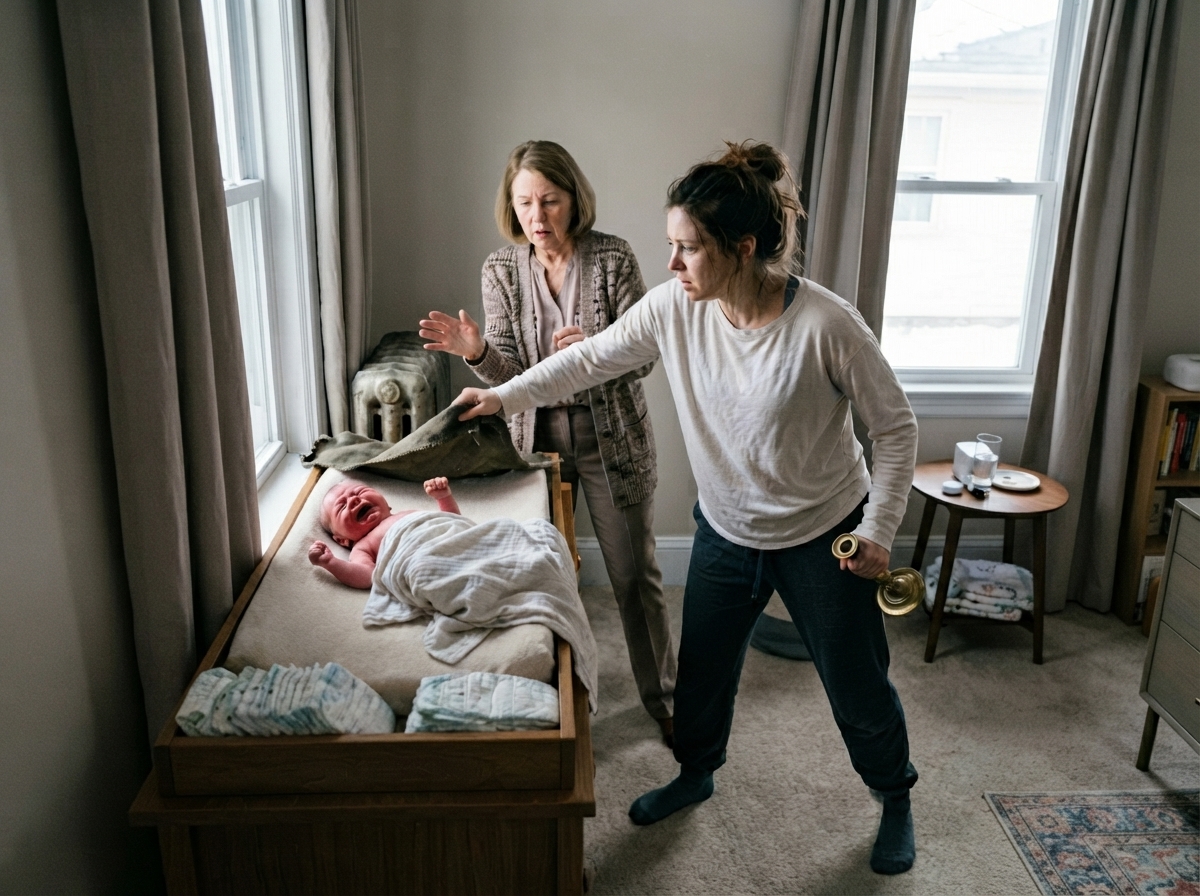
NOTE: This part shows the family rebuilding relationships without erasing accountability, while the narrator learns that forgiveness and trust are separate choices.
Margaret's first unsupervised visit happened almost a year after the nursery incident.
She did not ask for it.
Daniel suggested it.
I hesitated.
"You trust her?"
"I trust her more than before."
"That's different."
"I know."
I looked at our daughter.
She was playing with wooden blocks on the living-room rug.
Margaret had been consistent for months.
She asked permission.
She followed instructions.
She never questioned our medical decisions.
She never entered private rooms without asking.
She never mentioned Helen.
She never tried to investigate the old records.
Most importantly, she accepted the consequences of what she had done.
Trust was beginning to return.
But slowly.
I agreed to let her spend an hour alone with the baby while Daniel and I went to the grocery store.
Before we left, I gave Margaret clear instructions.
"Call if anything feels wrong."
"I will."
"Don't change her routine."
"I won't."
"Don't give her anything new."
"I understand."
She smiled.
"You don't have to worry."
I almost corrected her.
Then I realized she meant something different.
She was not telling me that I should stop being careful.
She was telling me she would be careful too.
When we returned, our daughter was asleep.
Margaret was sitting quietly in the living room.
"Everything okay?"
"Perfectly."
I checked the nursery.
Everything was exactly as we had left it.
The window was locked.
The curtains were open.
No strange objects.
No unfamiliar blankets.
I felt something I hadn't expected.
Relief.
Not because Margaret had proven she could never make another mistake.
Because she had shown that she could respect a boundary.
That mattered.
Later that evening, Daniel asked whether I regretted allowing the visit.
"No."
"Me neither."
Our family had reached a new stage.
The crisis was over.
The consequences remained.
And life continued.
Noah, our daughter, and Margaret slowly developed their own relationship.
Our daughter adored her grandmother.
Margaret loved reading to her.
She bought books instead of medical products.
She brought stuffed animals instead of blankets.
She asked what our daughter liked.
She learned to follow our daughter's routines instead of imposing her own.
That transformation was not instant.
But it was real.
One afternoon, Margaret gave me a small box.
"I found this in the attic."
Inside was an old photograph of Daniel's father.
I stared at it.
"Do you want it?"
I wasn't sure.
"Maybe."
There was writing on the back.
A date.
A name.
Nothing mysterious.
Just history.
I placed it in the drawer.
I no longer needed every old object to explain something.
Some things were simply memories.
That realization was freeing.
Michael also visited more often.
He and Daniel had become closer.
They still disagreed.
They still had difficult conversations.
But they were no longer avoiding the past.
One evening, Michael asked me whether I hated their mother.
I answered honestly.
"No."
"Do you forgive her?"
"Some things."
He nodded.
"That's fair."
"I don't think forgiveness means pretending nothing happened."
"No."
"It means deciding what I want to carry forward."
He smiled.
"I like that."
The legal records eventually became public.
People who had been connected to the old research were notified.
Some families were angry.
Some were relieved.
Some wanted no involvement.
Others wanted access to their records.
Our family chose to keep our involvement private.
The most important information had already been established.
Our daughter was healthy.
The old research had no predictive power over her future.
Helen had violated our privacy.
Margaret had been manipulated but was still responsible for her choices.
Daniel's father had created a flawed and unethical research system.
And we had survived it.
That was enough.
One night, Daniel and I sat beside our daughter's crib.
She was sleeping peacefully.
He whispered, "Do you ever think about the first night?"
"Yes."
"Does it still scare you?"
"Not like before."
"Why?"
"Because I know what happened."
He nodded.
"The unknown was worse."
"Exactly."
That was something I had learned.
Fear thrives in empty spaces.
When you don't know what happened, your mind fills the gaps.
Evidence closes those gaps.
Not always completely.
But enough to breathe.
Our daughter stirred.
Daniel touched her blanket.
It was a simple cotton blanket we had bought ourselves.
He smiled.
"Safe."
I laughed quietly.
"Very."
A few months later, Margaret asked if she could keep our daughter overnight.
That was a much bigger step.
I wasn't ready.
I told her so.
She did not argue.
"Okay."
That response surprised me.
"You're not upset?"
"I understand."
"You really do?"
She smiled sadly.
"I finally learned that love doesn't give me authority."
That sentence stayed with me.
Because that had been the heart of the entire problem.
Margaret had loved her granddaughter.
She had also believed love entitled her to make decisions.
It didn't.
Daniel's father had believed knowledge gave him authority.
It didn't.
Helen had believed expertise gave her authority.
It didn't.
And I had learned that being a mother meant I had authority over my child's care.
But even I had limits.
I couldn't control every danger.
I couldn't predict every problem.
I could only make careful choices.
The family learned to respect that.
Our daughter grew.
Her first birthday arrived.
We invited everyone.
Margaret cried when she saw the cake.
Michael laughed.
Daniel gave a speech.
It wasn't long.
He thanked everyone for being there.
Then he said something that surprised me.
"Family isn't about never making mistakes. It's about taking responsibility when we do."
Margaret looked down.
I squeezed her hand.
Our daughter smashed her fingers into the cake.
Everyone laughed.
It was messy.
Wonderful.
Normal.
Exactly what I wanted.
After the party, I cleaned frosting from the floor.
Margaret helped.
"Can I tell you something?"
"Sure."
"I still think about that morning."
"So do I."
"I hate that I frightened you."
"I know."
"I wish I could go back."
"I know."
She looked at me.
"Would you change anything?"
I thought about it.
"I'd ask more questions sooner."
She nodded.
"So would I."
Neither of us said more.
We didn't need to.
The past could not be changed.
But the future had become different because of it.
Years later, our daughter would not remember the blanket.
She would not remember the hidden camera.
She would not remember Margaret standing beside the crib.
She would not remember the investigators.
She would remember birthdays.
Books.
Walks.
Her grandmother's stories.
Her father's terrible singing.
My habit of checking whether she had packed everything before leaving the house.
Those would be her memories.
The fear belonged to us.
And eventually, even we would remember it differently.
Not as the moment our family almost ended.
As the moment we finally understood what our family needed.
Honesty.
Boundaries.
Evidence.
And patience.
The last time I visited the investigator, she handed me a copy of the final report.
"Your case is closed."
I thanked her.
On the drive home, I placed the folder in the trunk.
I didn't take it into the house.
I didn't need it anymore.
That night, Daniel asked where it was.
"In the car."
"Why?"
"Because I don't want our home filled with old investigations."
He smiled.
"Fair."
I looked at our daughter.
She was asleep upstairs.
"Some things belong in the past."
Daniel nodded.
"And some lessons don't."
Exactly.
The documents could stay behind.
The lesson could come with us.
Click Here to continue read next: PART8: Years After the Nursery Door Was Finally Left Open Again, I Understood That Our Family Had Not Been Saved by Secrets but by Choosing Truth
The Moment I Walked Into the Nursery, My Mother-in-Law Was Standing Over My Crying Newborn With Something She Refused to Explain
Part 7 of 8

