
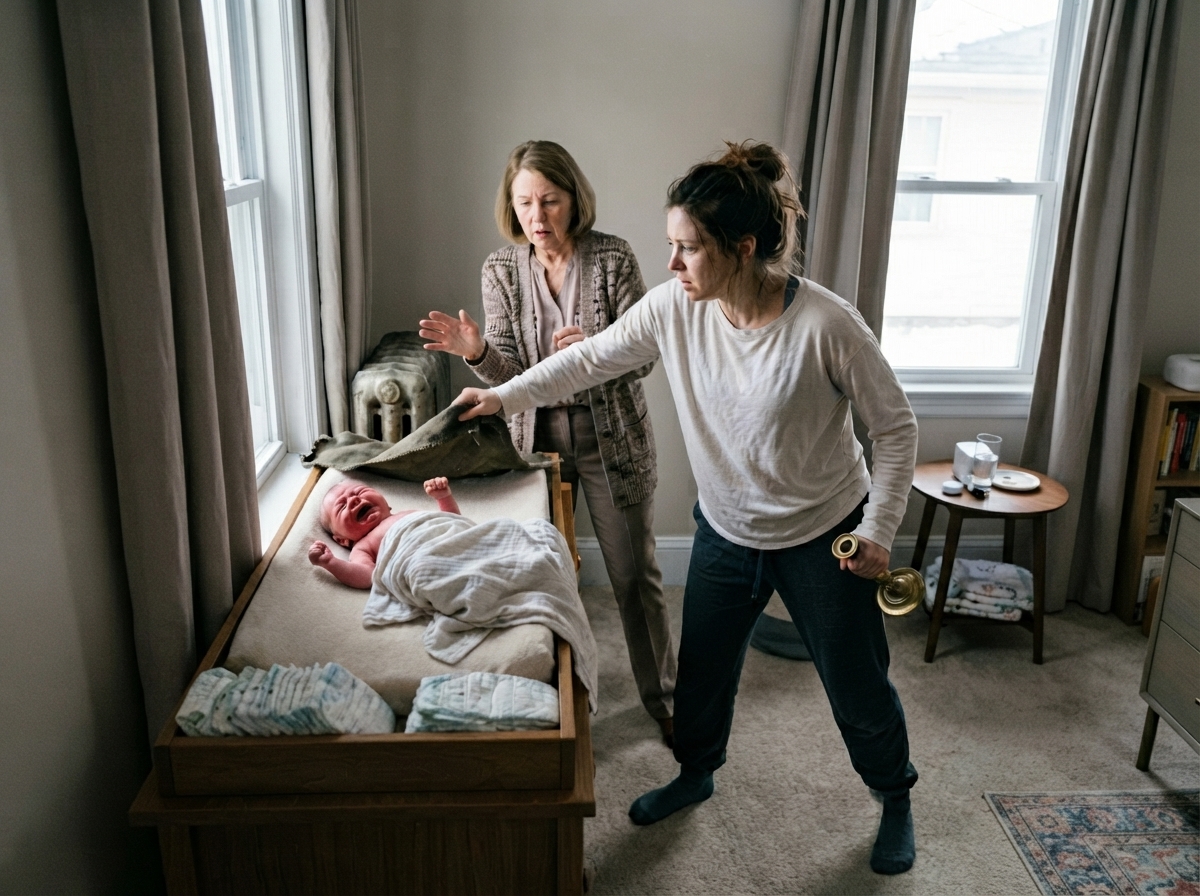
NOTE: This final part delivers the emotional resolution, showing the family's long-term healing, the lasting consequences of the investigation, and the lesson that protecting a child means respecting truth and boundaries.
Years later, I still remembered the blanket.
Not because it remained in our lives.
It didn't.
The gray blanket had been destroyed after the investigation.
The hidden camera was gone.
The copied key was gone.
The anonymous photographs were stored as evidence.
The old medical files were archived.
Helen was no longer part of our lives.
Margaret was.
That difference mattered.
She had spent years rebuilding trust.
Not by demanding forgiveness.
By earning it.
She came to birthdays.
She attended school performances.
She brought books.
She asked permission.
She respected boundaries.
When our daughter became old enough to say no, Margaret respected that too.
That was perhaps the clearest sign that she had changed.
She had learned that love did not mean possession.
Our daughter grew into a confident child.
She loved asking questions.
She wanted to know how everything worked.
When she was five, she asked why doctors checked her heartbeat.
I told her because doctors like to make sure children are healthy.
She nodded.
"Can I hear yours?"
I laughed.
"Of course."
She pressed her ear against my chest.
"It's fast."
"Because you're tickling me."
She giggled.
Those ordinary moments were the life we had once feared losing.
Daniel became more open.
He never again dismissed one of my concerns by telling me someone was simply trying to help.
If I said something felt wrong, he listened.
If he disagreed, he explained why.
That was enough.
We didn't need to agree about everything.
We needed to trust each other enough to talk.
Michael became part of our daughter's life too.
He was the funny uncle who brought ridiculous gifts.
He told stories about Daniel as a child.
Most of them embarrassed my husband.
Our daughter loved them.
Margaret sometimes laughed.
Sometimes she became quiet.
But she stayed.
That was her choice.
She did not run from the past.
She lived differently because of it.
The old research case eventually became a historical matter.
The affected families received access to records.
Some filed complaints.
Others chose not to reopen the pain.
The institution connected to the research issued statements acknowledging the failures of the original program.
Helen's actions remained part of the legal record.
There was no grand public ending.
Real life rarely provides one.
The important consequences were quieter.
Families learned what had happened.
Records were secured.
Privacy procedures were strengthened.
Our family moved on.
When our daughter turned ten, she asked me why her grandmother always asked before entering her room.
I smiled.
"Because everyone deserves privacy."
"Even kids?"
"Especially kids."
She thought about that.
Then she said, "That's fair."
I almost laughed.
She sounded exactly like Daniel.
One evening, while helping her clean her room, I found a box containing old photographs.
She pulled one out.
It was a picture of her grandmother holding her as a baby.
"She looks scared."
I looked at the photograph.
Margaret's expression was nervous.
She had been terrified of making another mistake.
"She was learning."
"Learning what?"
"How to love someone without controlling everything."
My daughter frowned.
"Was she bad?"
I considered the question carefully.
"No."
"Then why was she scared?"
"Because people can make mistakes even when they love someone."
She nodded.
"Did you forgive her?"
"Eventually."
"Did Dad?"
"Yes."
"Did Grandma forgive herself?"
That question surprised me.
"I think she's still learning."
My daughter placed the photograph back in the box.
"Maybe everybody is."
I smiled.
"Maybe."
She had understood something I had taken years to learn.
People were complicated.
A person could hurt you and still love you.
A person could apologize and still need boundaries.
A person could change without being entitled to forget what they had done.
That was maturity.
Not pretending people were good or bad.
Understanding choices.
One summer afternoon, Margaret asked me whether she could take our daughter to the park.
I said yes.
She looked surprised.
"Are you sure?"
"Yes."
"Really?"
"Really."
She smiled.
"I'll bring her home before dinner."
"I know."
They left together.
I stood at the doorway.
For a second, I remembered the first time Margaret had walked into the nursery without permission.
Then I looked at the open front door.
Nothing about it frightened me.
The door was open because I had allowed it to be open.
That was the difference.
Control had become choice.
Fear had become judgment.
The house felt safe.
Not because nothing bad could ever happen.
Because the people inside understood boundaries.
Daniel came into the room.
"Where are they?"
"At the park."
He smiled.
"Want coffee?"
"Yes."
We sat in the kitchen.
He looked at me.
"Do you ever wish none of it had happened?"
I answered honestly.
"Yes."
"Me too."
"But if it hadn't, we might never have learned what we needed to learn."
He nodded.
"That's true."
"I don't think the pain was necessary."
"No."
"But the lesson was."
He reached for my hand.
"I love you."
"I love you too."
The words were simple.
But they carried years behind them.
Not promises.
History.
Choices.
Repair.
Our daughter returned an hour later covered in grass.
Margaret was laughing.
"She insisted on racing me."
"Who won?"
Margaret looked offended.
"She did."
Our daughter grinned.
"I was faster."
"You were."
Margaret looked at me.
"She gets that from you."
Daniel laughed.
"No chance."
Our daughter ran upstairs.
Margaret stayed in the kitchen.
She looked toward the nursery hallway.
"I still remember that room."
"So do I."
"I wish my first memories there were different."
"They are different now."
Margaret smiled.
"Yes."
That was enough.
She left before dinner.
I watched her walk to her car.
Then I closed the door.
Not because I was afraid.
Because it was evening.
There was a difference.
The door no longer represented danger.
It represented a boundary I could control.
That night, our daughter asked whether she could sleep with her bedroom door open.
"Of course."
She smiled.
I tucked her in.
The hallway light remained on.
As I walked away, I heard her call.
"Mom?"
"Yes?"
"Thank you for always listening."
I stopped.
"Always."
She smiled.
"Good night."
"Good night."
I closed her door halfway.
Then I stood in the hallway.
For a moment, I remembered the baby she had been.
Crying.
Red-faced.
Surrounded by adults who thought they knew what was best.
She had been too young to understand what was happening.
But she had not needed to.
We had needed to understand.
That was the responsibility of adults.
Not children.
I went downstairs.
Daniel was waiting.
"She's asleep?"
"Yes."
He smiled.
I sat beside him.
The house was quiet.
The kind of quiet I had once feared.
Now I loved it.
I thought about everything that had happened.
The gray blanket had seemed like the beginning of the nightmare.
It wasn't.
The blanket was only evidence.
The real problem had been the belief that people could make decisions for someone else without telling them.
Margaret believed it.
Helen believed it.
Daniel's father had believed it.
And for a while, I had been so afraid that I nearly stopped trusting my own judgment.
But the truth had changed everything.
Not a dramatic confession.
Not a perfect explanation.
The truth came through evidence.
The laboratory analysis.
The security footage.
The old letters.
The medical records.
The messages.
The admissions.
The boundaries.
Piece by piece.
That was why I never regretted asking questions.
Questions had not destroyed our family.
Secrets had.
Truth had given us a chance to rebuild.
Years later, our daughter would become a doctor herself.
Ironically, she chose medicine because she loved helping people understand their health.
But she never became interested in the old research.
She knew the history.
She understood why it had been wrong.
She believed patients deserved consent.
She believed families deserved information.
She believed children deserved adults who listened to them.
When she graduated, Margaret cried.
Daniel cried.
I cried.
Our daughter stood beneath the lights with her degree in her hand.
Afterward, she hugged me.
"You always told me to ask questions."
"I did."
"I listened."
I smiled.
"Good."
She laughed.
"Probably too much."
"Never."
That night, she asked me whether I was proud.
"More than you know."
She looked toward Daniel.
"Are you proud too?"
He smiled.
"Every day."
She hugged us both.
For a moment, the past felt impossibly far away.
But it wasn't gone.
It had simply become history.
And history is different when you survive it.
The final photograph I kept was not of the blanket.
Not of the nursery.
Not of Margaret.
It was a picture of our family standing together years later.
My daughter was grown.
Daniel stood beside me.
Margaret stood on the other side.
Everyone was smiling.
The photograph would have meant nothing to a stranger.
To me, it meant everything.
Because I knew what it had taken to reach that moment.
Trust had been damaged.
Boundaries had been broken.
Truth had been hidden.
Fear had been manipulated.
But eventually, people had made different choices.
That was what saved us.
Not the absence of mistakes.
The willingness to face them.
I still believe that love matters.
But I learned that love without boundaries can become control.
Protection without honesty can become secrecy.
Knowledge without consent can become intrusion.
And forgiveness without accountability can become permission.
Our family learned all four lessons.
We learned them slowly.
Painfully.
But we learned them.
The nursery door is still there.
It was replaced years ago.
The wood is different.
The paint is different.
The child who once slept behind it is grown.
Sometimes I walk past it and remember that terrible morning.
Then I hear my daughter's voice from downstairs.
She is laughing with her father.
The sound brings me back.
I keep walking.
I no longer need to check the window.
I no longer need to search beneath blankets.
I no longer need to wonder who is watching.
The house is quiet.
The people inside are safe.
And if something ever changes, I know what I will do.
I will ask.
I will listen.
I will look at the evidence.
I will protect my daughter without hiding the truth from her.
Because that is what I finally understood.
A child does not need a world where nothing frightening ever happens.
No family can promise that.
A child needs adults who will face frightening things honestly.
Adults who will admit when they are wrong.
Adults who will say no when necessary.
Adults who will respect boundaries.
Adults who will never make a child carry a secret that belongs to them.
That was the promise we eventually made.
And this time, we kept it.
The gray blanket was gone.
The camera was gone.
The old investigation was finished.
The fear had faded.
But the lesson remained.
Protecting someone does not mean controlling their world.
It means making sure they are never alone inside it.
The End
Read more original stories on Feel Every Story.
The Moment I Walked Into the Nursery, My Mother-in-Law Was Standing Over My Crying Newborn With Something She Refused to Explain
Part 8 of 8

