
NOTE: This part resolves the meaning of the old research, separates legitimate medical history from manipulation, and gives Daniel and the narrator the factual information they need to stop living under inherited fear.
The next meeting with the investigators took place in a plain conference room.
There were no dramatic revelations.
No threatening phone calls.
No mysterious stranger.
Just boxes of old records spread across a long table.
That was almost comforting.
The lead investigator explained that they had reconstructed the original research project.
Daniel's father had not been searching for a specific future child.
He had been studying patterns across several generations.
The phrase "priority lineage" had been misunderstood.
It did not mean that something was expected to happen.
It meant that certain families had enough documented medical history to make them useful for statistical observation.
That did not make the research ethical.
It simply made it less mysterious.
I looked at Daniel.
He seemed relieved.
"So there was never anything specifically predicting our daughter?"
"No," the investigator said.
"Nothing in these records supports that conclusion."
I felt something inside me loosen.
For months, I had feared that my daughter had been born into a story written before she existed.
Now I understood that the story had never been written for her.
Other people had decided to make it about her.
That distinction changed everything.
The investigator continued.
"Helen appears to have taken the original records and continued tracking descendants without authorization."
"Why?"
"We don't know her exact motive."
There was no need to speculate.
Her actions were documented.
She had obtained information.
She had contacted Margaret.
She had installed surveillance.
She had entered our home.
Those facts were enough.
The investigator handed Daniel a photocopy.
It was a letter from his father.
The final page contained an apology.
He wrote that he regretted the way his work had affected the family.
He had believed knowledge justified intrusion.
Eventually, he understood that it did not.
Daniel read the letter twice.
Then he handed it to me.
"That's him."
"What do you mean?"
"He always believed he was right."
I looked at the page.
"Maybe he finally realized he wasn't."
Daniel nodded.
That was perhaps the most human part of the entire story.
People could believe they were helping and still cause harm.
Margaret had done it.
Daniel had done it.
His father had done it.
Helen had done it deliberately.
Intent mattered.
But consequences mattered too.
When we returned home, Daniel put the copy of the letter away.
"I feel sorry for him."
"Your father?"
"Yes."
"Why?"
"Because he spent his life trying to understand people and forgot to respect them."
I understood.
The old records had been built from human lives.
Names.
Families.
Children.
Medical histories.
The people inside those documents had never been numbers.
They had been families like ours.
That evening, Margaret called.
She asked whether she could visit.
Daniel looked at me.
I nodded.
Margaret arrived carrying flowers.
She stayed on the porch until Daniel invited her in.
She immediately apologized.
Not for the first time.
But this time, she did not say she had only been trying to help.
She said exactly what she had done.
"I gave Helen information."
"Yes."
"I entered the nursery."
"Yes."
"I used the blanket."
"Yes."
"I should have told you."
"Yes."
Margaret began crying.
"I thought if I handled everything myself, nobody would get hurt."
I answered gently.
"That's what makes it dangerous."
She nodded.
"I understand now."
She asked whether she could hold the baby.
I told her she could.
But only if she followed our rules.
She agreed.
Margaret washed her hands.
She sat down.
I handed her the baby.
For several minutes, she simply held her.
There was no blanket.
No hidden object.
No whispered instructions.
Just a grandmother holding her granddaughter.
Margaret cried.
"I almost ruined this."
I said nothing.
She looked at me.
"I know you may never trust me the way you did."
"That depends on what you do from now on."
She nodded.
That was the only answer I could give.
Trust was not a speech.
It was a pattern.
Michael also began rebuilding his relationship with Daniel.
The brothers had spent years separated by their father's secrets and Margaret's fears.
They could not erase those years.
But they could talk about them.
One afternoon, they sat together in our backyard.
I watched through the window.
They were not laughing.
They were not hugging.
They were simply talking.
That was enough.
Healing did not always look dramatic.
Sometimes it looked like two brothers finally staying in the same conversation long enough to finish it.
The legal proceedings involving Helen continued.
She eventually admitted to entering our house.
She claimed she believed she was continuing legitimate research.
The investigators disagreed.
The old authorization had expired decades earlier.
There was no consent.
There was no legal basis for monitoring our child.
The case focused on what could be proven.
Unauthorized access.
Surveillance.
Possession of private information.
The gray blanket became evidence of deliberate contact testing.
The hidden camera became evidence of surveillance.
The messages became evidence of manipulation.
The photograph became evidence of unauthorized entry.
Together, the evidence told a coherent story.
Not the frightening story Helen had wanted us to believe.
A simpler one.
She had found an old research project.
She had become obsessed with continuing it.
She had convinced Margaret to help.
She had crossed boundaries.
And when she realized we were asking questions, she tried to create distrust inside the family.
That was the part I found hardest to forgive.
Not because she frightened me.
Because she understood how frightened I already was.
She used that fear.
The legal process eventually ended.
Helen was held accountable for her actions.
The exact consequences were determined through the court process.
Our family was no longer part of the investigation.
For the first time, nobody needed anything from us.
No more interviews.
No more evidence.
No more documents.
No more questions.
We could simply be parents.
Our daughter was growing quickly.
She learned to roll over.
Then crawl.
Then stand.
Every milestone felt enormous.
One evening, Daniel and I were sitting on the floor while she tried to pull herself up using the sofa.
"Come on," Daniel encouraged.
She grabbed the cushion.
Her knees shook.
Then she stood.
For three seconds.
She fell backward into my arms.
We laughed.
She laughed too.
That moment felt almost sacred.
Nothing mysterious.
Nothing complicated.
Just a baby discovering she could stand.
I thought about the old file.
People had once watched children like her through charts and notes.
Now I understood why that was so disturbing.
A child is not a research project.
A child is a person.
Our daughter deserved to grow without someone deciding what her future meant before she could speak for herself.
We made sure her medical care came from her pediatrician.
Not old family theories.
Not frightened relatives.
Not strangers with documents.
That distinction became one of our strongest boundaries.
Margaret respected it.
Eventually, she became a regular visitor again.
But things were different.
She asked before picking up the baby.
She asked before buying anything.
She never entered the nursery alone.
She never brought medical products without permission.
She never dismissed my concerns.
It was a small change.
But it mattered.
Daniel changed too.
When I said something worried me, he listened.
Sometimes he disagreed.
That was okay.
Disagreement was not the same as dismissal.
We had learned that.
The most important change was that we no longer treated peace as the goal.
Truth was the goal.
Sometimes truth made a room uncomfortable.
Sometimes it made someone angry.
Sometimes it meant saying no.
But discomfort was better than pretending everything was fine.
A year after the first incident, we replaced the nursery furniture.
The old crib went into storage.
The blanket was long gone.
The camera had been removed.
The room looked completely different.
My daughter played on the floor.
Margaret sat nearby.
She was reading a children's book.
I watched them.
There was no fear.
Not because I had forgotten.
Because I knew the boundaries were real.
When Margaret left, she hugged me.
"Thank you."
"For what?"
"For giving me a chance to prove I can do better."
I nodded.
"Keep proving it."
She smiled.
"I will."
After she left, Daniel stood beside me.
"Do you think she'll be okay?"
"I think she's trying."
"That's enough?"
"For today."
He smiled.
"Fair."
That night, I opened the old folder one final time.
The records no longer frightened me.
They looked old.
Yellowed.
Ordinary.
Human.
I closed the folder.
Then I placed it in the cabinet.
The past could stay there.
Our daughter belonged in the present.
Click Here to continue read next: PART7: When Margaret Asked to Be Trusted Again, I Realized Forgiveness Would Mean Nothing Unless Everyone Accepted the Boundaries That Kept Our Daughter Safe
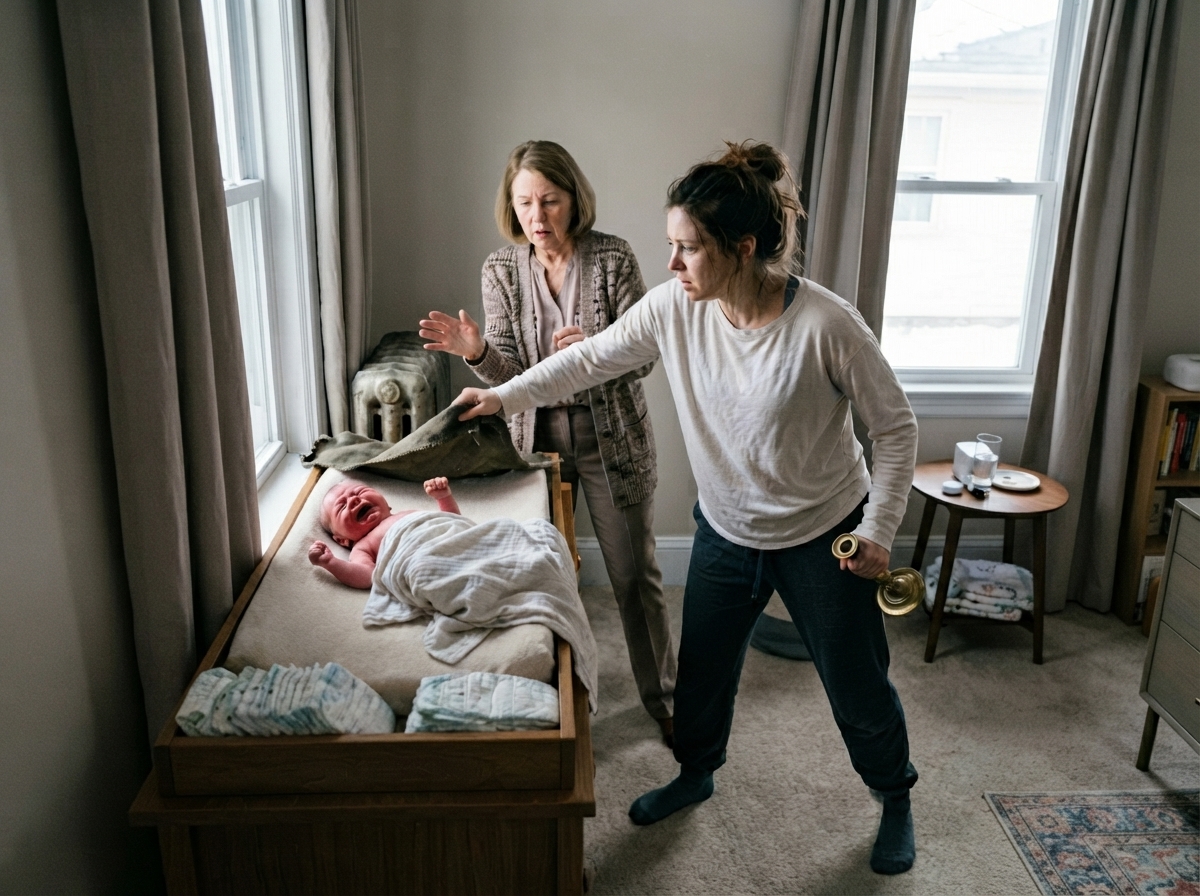
The Moment I Walked Into the Nursery, My Mother-in-Law Was Standing Over My Crying Newborn With Something She Refused to Explain
Part 6 of 8

