
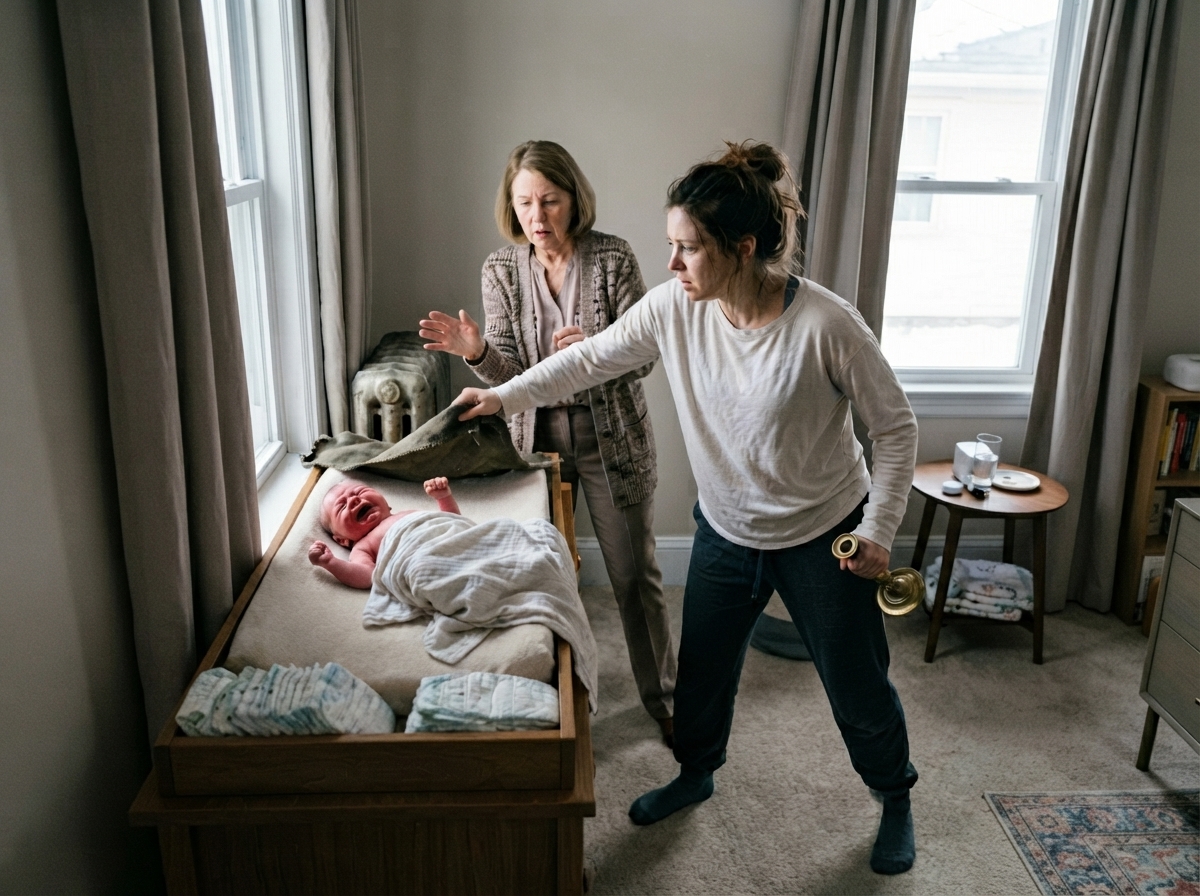
NOTE: This part follows the immediate aftermath of the investigation, explores Margaret’s accountability and the family’s damaged trust, and reveals a remaining uncertainty about the old research records.
For the first time since my daughter was born, I slept through an entire night.
There was no crying from the nursery.
No footsteps in the hallway.
No strange sounds outside the window.
No reason to wake up and check whether the door was locked.
When morning came, sunlight filled the bedroom, and for several seconds I simply lay there listening to the quiet.
Then I remembered everything.
The blanket.
The hidden camera.
The photograph.
Margaret.
Helen.
The old medical records.
My daughter's name written in a file decades after the research had supposedly ended.
The quiet suddenly felt different.
It was not peaceful yet.
It was simply empty.
Daniel was already awake.
He was sitting at the edge of the bed, looking at his phone.
"What is it?" I asked.
He turned the screen toward me.
There was a message from the investigator.
The laboratory analysis of the gray blanket was complete.
I felt my stomach tighten.
"What did they find?"
Daniel read the message again.
"Nothing dangerous."
I exhaled.
"Then why are you worried?"
He hesitated.
"They found traces of a harmless fluorescent marker."
I frowned.
"What does that mean?"
"It was probably used to identify whether the blanket had touched something."
I looked at him.
"Something like what?"
"We don't know."
The investigator later explained that the substance itself was not harmful to the baby.
It was commonly used in controlled environments to trace contact.
But it confirmed something important.
The blanket had not been brought into our home by accident.
Someone had deliberately prepared it.
That knowledge made my relief disappear.
The danger had not been physical in the way I had first feared.
It had been deliberate.
Someone had wanted information.
Someone had wanted to know whether the blanket had been used.
And someone had involved my newborn daughter without our consent.
That was enough.
Margaret came to the house that afternoon.
She did not walk inside.
She stood on the porch with her hands clasped together.
Daniel opened the door.
"What do you want?"
She looked at him.
"To see the baby."
Daniel remained silent.
Margaret's eyes filled with tears.
"I understand if you don't want me inside."
He looked toward me.
I joined him at the doorway.
Margaret looked at me.
"I was wrong."
I said nothing.
"I thought I was helping."
"You crossed a line."
"I know."
"You entered the nursery without permission."
"I know."
"You brought something into our baby's room without telling us."
"I know."
"And you let Helen influence you."
Margaret lowered her head.
"Yes."
I had expected excuses.
There were none.
That made the conversation harder, not easier.
"I don't hate you," I said.
She looked up.
"But I don't trust you."
She nodded.
"I understand."
"Trust doesn't come back because someone says sorry."
"I know."
"If you want to be part of her life again, you have to accept our rules."
Margaret wiped her eyes.
"I will."
She was allowed to see the baby through the doorway.
She did not ask to hold her.
She simply watched.
My daughter was sleeping.
Margaret whispered, "She's beautiful."
Then she left.
Daniel closed the door.
Neither of us spoke for a while.
Eventually he said, "Was that too harsh?"
"No."
"I don't know how much distance is right."
"Neither do I."
That was the truth.
There was no perfect answer.
Margaret was still my daughter's grandmother.
She was also someone who had violated our trust.
Both things could be true.
The investigators continued reviewing the records from the old clinic.
They discovered that the original research was larger than Margaret had described.
It involved several families.
Some records contained detailed observations.
Others were incomplete.
The program had been officially closed decades earlier.
But the files showed that Helen had continued accessing them long afterward.
That raised another question.
Why had she chosen our family?
The answer appeared in one of the oldest documents.
Daniel's father had marked several families as "priority lineage."
Our family was one of them.
But the classification did not mean that our daughter had a predetermined medical condition.
It meant that Daniel's father believed the family should receive follow-up observation.
The theory was outdated.
The methods were unacceptable.
But the investigators found no evidence that the old research predicted anything about our daughter's future.
That distinction was important.
Fear had turned a questionable historical study into something that sounded almost prophetic.
It wasn't.
It was a record of flawed science and unethical behavior.
Nothing more.
Nothing less.
I asked the investigator whether our daughter needed special medical testing.
She said the pediatrician should decide based on current medical evidence, not on the old records alone.
That answer comforted me.
For months, I had allowed the old documents to make me imagine illnesses that did not exist.
Now we had facts.
Our daughter was developing normally.
Her earlier skin irritation had disappeared.
Her pediatrician had no concerns beyond ordinary newborn care.
The gray blanket had not harmed her.
That should have ended the medical part of the story.
But the emotional part was harder.
I began noticing how often I questioned myself.
When the baby coughed, I worried.
When she slept longer than usual, I checked her breathing.
When someone approached the nursery window, I looked twice.
Daniel noticed.
"You don't have to be on guard every second."
"I know."
"You aren't responsible for controlling everything."
"I know."
"But you keep trying."
He was right.
The investigation had ended, but my fear had become a habit.
I had spent weeks believing that danger was hiding somewhere around us.
Now I needed to learn how to live without searching for it.
Our counselor suggested something simple.
"Let ordinary life become ordinary again."
So we did.
We took the baby for walks.
We went to the grocery store.
We visited friends.
We sat in the backyard.
We opened the nursery curtains during the day.
I stopped checking the window every ten minutes.
Slowly, the house began to feel like a home again.
Then Michael called.
He had found something else among their father's records.
Daniel put him on speaker.
"What did you find?"
"A letter."
"From Dad?"
"Yes."
Michael sounded uneasy.
"It was addressed to both of us."
Daniel went quiet.
"Why didn't you mention it before?"
"I didn't know it existed."
Michael read the first few lines.
Their father wrote that the research had been suspended because the conclusions were unreliable and the methods had violated ethical standards.
He warned his sons never to allow anyone to revive the program.
Then came the sentence that changed everything.
"If someone attempts to continue the observation of our descendants, do not cooperate."
I looked at Daniel.
The old man had known.
He had known that someone might try to continue the research.
But there was more.
The letter mentioned Helen.
She had been a junior administrator.
Their father had suspected that she was removing copies of records without authorization.
The letter had been written decades earlier.
Helen had been watching.
Not recently.
For years.
The investigators were informed.
That helped explain how she had known so much.
But one question remained.
How had she known about our daughter's birth?
Michael answered.
"Mom told her."
The room became silent.
I looked at Daniel.
Margaret had not intentionally endangered the baby.
But she had contacted Helen.
She had given her information.
She had opened the door.
That was a consequence Margaret would have to live with.
Daniel called her.
"Did you tell Helen about the baby?"
Margaret began crying.
"I told her you had a daughter."
"Why?"
"She said she could help."
"You knew what she was doing?"
"Not at first."
"And later?"
"I suspected."
Daniel's voice hardened.
"Mom."
"I was scared."
"You should have told us."
"I know."
The call ended.
Daniel sat motionless.
I placed my hand on his shoulder.
"She's responsible for that choice."
"I know."
"But so are we."
He looked at me.
"We trusted her."
"Yes."
"And we should have noticed more."
"Maybe."
He shook his head.
"No. We shouldn't blame ourselves for someone else's manipulation."
That was something I needed to hear.
We had made mistakes.
But we had not created the situation.
The investigation later confirmed that Helen had obtained our address through information Margaret provided.
The hidden camera had been installed afterward.
The anonymous photograph had been designed to make me suspect Margaret.
The plan had been calculated.
But it had failed because evidence had been preserved.
The blanket.
The camera.
The messages.
The photographs.
The records.
Each clue had eventually connected to another.
There was no supernatural mystery.
No prediction.
No inevitable tragedy.
There were simply people making choices.
Some careful.
Some selfish.
Some frightened.
And some cruel.
One evening, I held my daughter by the nursery window.
She was asleep against my shoulder.
The sunlight was fading.
I looked outside.
Nothing moved.
The street was quiet.
For the first time, I did not feel watched.
I felt tired.
But safe.
Daniel entered the room.
"Ready for bed?"
"In a minute."
He stood beside me.
Our daughter stirred.
Daniel touched her tiny hand.
"She's getting bigger."
"Too quickly."
He smiled.
Then he looked at me.
"Are you okay?"
I thought about the question.
"Yes."
"Really?"
"Not completely."
He nodded.
"Me neither."
I smiled.
"Maybe that's okay."
"It is."
We stood together.
The investigation had answered most of our questions.
But one question remained.
Why had Daniel's father marked our family as a priority lineage in the first place?
The answer was buried somewhere in the old medical records.
And until we understood it, I knew part of the story was still unfinished.
Click Here to continue read next: PART6: The Last Records From Daniel’s Father Changed What We Thought the Research Meant, and Suddenly Our Daughter’s Story Became Much Less Mysterious
The Moment I Walked Into the Nursery, My Mother-in-Law Was Standing Over My Crying Newborn With Something She Refused to Explain
Part 5 of 8

