I thought my parents coming to the house would be the end of the confrontation.
It wasn't.
A week later, my cousin Sarah forwarded me a message Rachel had sent to several relatives.
Sarah's message began with an apology.
“I don't know if you should see this,” she wrote. “But I thought you should know what they're saying.”
I opened the attachment.
Rachel had written several paragraphs about me.
She described me as unstable.
Obsessive.
Overly attached to Maya.
According to Rachel, I had taken an ordinary disagreement and turned it into a family crisis. She suggested Maya was difficult and ungrateful. She implied I had allowed my relationship with my daughter to become unhealthy.
She never directly accused Maya of doing anything terrible.
That would have been easier to challenge.
Instead, Rachel used softer language.
Concern.
Worry.
Sadness.
She made cruelty sound like responsibility.
I read the message twice.
The strangest part was how familiar it sounded.
Rachel had not invented a new version of me.
She had simply collected every criticism my family had used throughout my childhood and arranged them into a story where I was the problem.
Sarah added another message.
“I'm sorry. I don't agree with her.”
I thanked her.
Then I closed the conversation.
I thought about ignoring everything.
Maybe that would be easier.
Maybe silence would allow the situation to fade.
Then Maya showed me a comment someone had left on one of her art posts.
“You're lucky. Don't forget who gave you a home.”
Maya had not deleted it.
She had not responded.
She had simply stared at it until her face went blank.
I knew that expression.
I had seen it when she was little.
It was the look she wore when she was deciding whether something hurt badly enough to tell me.
“Who wrote that?” I asked.
“I don't know.”
“Did they know you?”
She shook her head.
I looked at the screen.
My family had taken their version of events outside the family.
That changed things.
Not because I cared what strangers thought.
Because Maya should not have to encounter accusations about her own childhood from people she had never met.
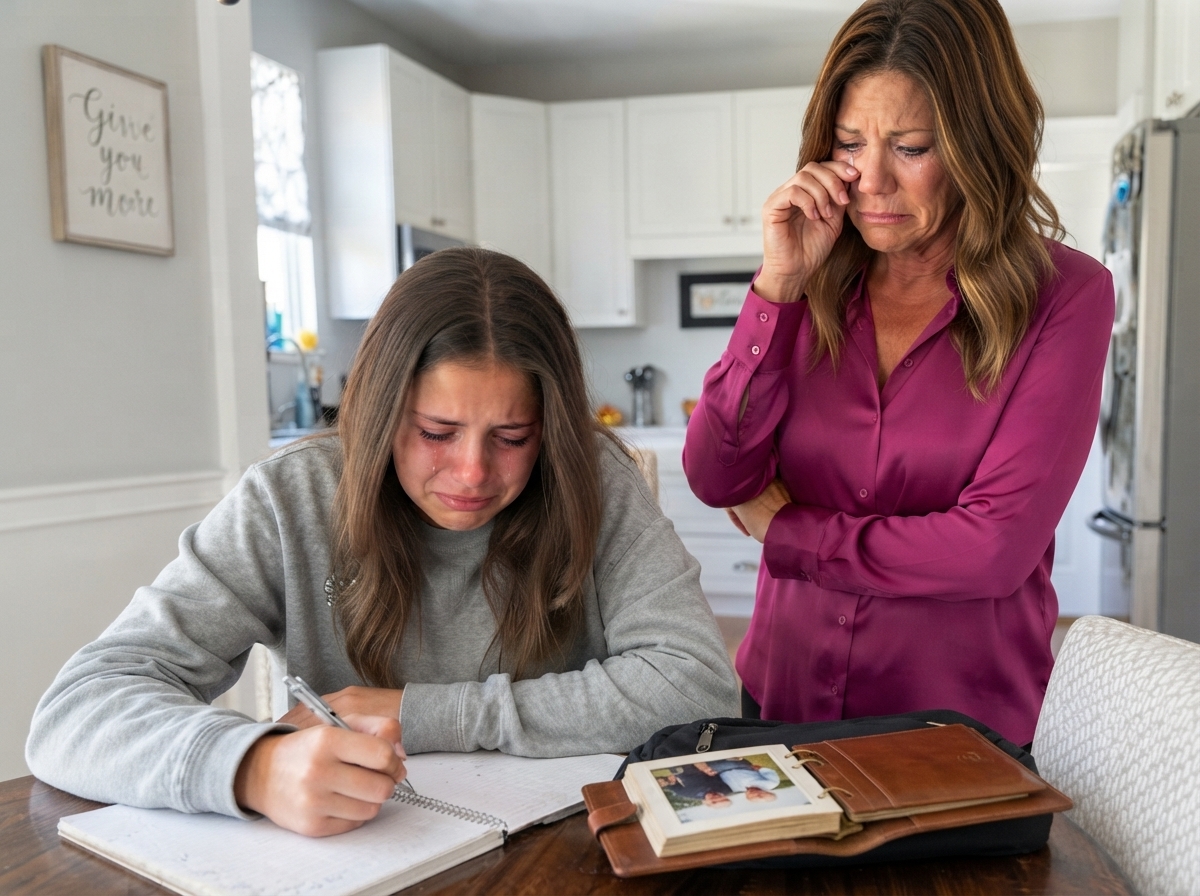
I sat at the dining table that night with my laptop open.
Ethan was across from me.
I had collected the wedding invitation.
The group messages.
The Christmas card.
Screenshots.
Dates.
Photographs.
The comment on Maya's art.
I did not write down every unpleasant thing my family had ever done.
I wasn't building a case to win an argument.
I was building a record.
Ethan watched me for a while.
“Are you sure?”
I looked at the screen.
“I need her to know she didn't imagine this.”
He nodded.
“That matters.”
“It matters more than making them understand me.”
I started writing.
I kept the language simple.
No insults.
No dramatic accusations.
Just what happened.
The date.
The message.
The exact words.
The invitation.
The response.
The visit to my house.
My mother's statement.
Rachel's message to relatives.
The more I wrote, the calmer I became.
Facts did something anger couldn't.
They stayed still.
They didn't need to shout.
When I finished, I saved the document.
Then I closed the laptop.
The next morning, Mom called.
I almost didn't answer.
“Claire,” she said. “We need to get past this.”
I waited.
“It's Christmas. We should be together.”
“We don't have to.”
There was a pause.
“You can't keep doing this.”
“Doing what?”
“Cutting us off.”
“I didn't cut you off.”
“You refused the wedding.”
“Because Maya wasn't invited.”
“And now you're refusing Christmas.”
“Yes.”
Mom's voice tightened.
“This is becoming ridiculous.”
I looked through the kitchen window at the bare branches outside.
“What do you want?”
“We want to sit down like adults.”
I knew what that meant.
They wanted a room where the story could be negotiated again.
They wanted emotion instead of evidence.
They wanted me tired enough to compromise.
Still, I agreed.
Not because I believed the conversation would change them.
Because I had already decided what I was going to do.
Christmas Eve came.
The neighborhood looked different after sunset. White lights hung from rooftops. Inflatable decorations leaned slightly in the cold wind. Cars passed with headlights sweeping across the windows.
Inside our house, the table was set simply.
Real plates.
Cloth napkins.
A bowl of salad.
Lasagna warming in the kitchen.
Maya's favorite sparkling cider chilled in the refrigerator.
She came downstairs wearing a dark green sweater.
Her hair was pulled back.
She looked older than she had a month earlier.
Not physically.
Something else had changed.
She no longer looked toward the front door with the nervous hope of a child waiting to be accepted.
She looked prepared.
“Do they know I'll be here?” she asked.
“Yes.”
Her hands tightened briefly.
“If anyone says something unkind, we leave.”
“Together?”
“Together.”
She nodded.
The doorbell rang ten minutes early.
My family had always arrived early when they wanted to establish control over a situation.
Mom entered first, carrying a pie from the store.
Dad followed.
Tessa and Rachel came behind them.
The hugs were exaggerated.
Loud greetings.
Too much laughter.
Everyone behaved as if we were returning to an old routine.
As if six months had not happened.
Mom looked around the room.
Then she saw Maya.
Her eyes moved over her quickly before shifting away.
Tessa gave a stiff smile.
Rachel said, “Wow. You've gotten tall.”
Then she turned to me.
Maya heard it.
She didn't react.
She walked to the table and sat down.
I watched her unfold her napkin.
Her hands were steady.
Dinner began with small talk.
Dad complained about traffic.
Mom discussed the weather.
Tessa talked about the wedding venue.
Rachel mentioned a restaurant she wanted to try.
Nobody mentioned the invitation.
Nobody mentioned the porch.
Nobody mentioned blood.
The silence around those subjects was so deliberate that it became louder than conversation.
Ethan poured drinks.
I served the lasagna.
Forks moved across plates.
Someone laughed at a joke that wasn't funny.
For several minutes, the room looked almost normal.
That was the danger.
Families like mine were very good at creating photographs in which nothing appeared wrong.
My phone sat beside my plate.
The screen was dark.
The document was ready.
I had checked the recipients twice.
Extended family.
The relatives Rachel had already contacted.
The people who had been given her version first.
I could have waited.
I could have sent it later.
I could have protected myself from the accusation that I was ruining Christmas.
Then I looked at Maya.
She was sitting quietly beside me, listening to my family talk as though she were a guest at someone else's table.
I touched the phone.
Once.
Then again.
Send.
For a few seconds, nothing changed.
My father continued talking.
Mom reached for the salad.
Rachel took a drink.
Then Dad's phone vibrated.
He looked down.
Mom's phone buzzed next.
Tessa's screen lit up.
Rachel frowned as hers began vibrating too.
My mother looked at the subject line.
Her face changed.
Tessa stopped moving.
“What is this?” Rachel whispered.
I didn't answer.
Across the table, the first reply appeared.
Then another.
Then another.
My mother opened the message.
Her eyes moved rapidly across the screen.
She looked at me.
“Claire.”
I kept my hands on the table.
“You sent this?”
“Yes.”
Dad picked up his phone.
His expression hardened.
“You had no right.”
The room went quiet.
I looked at him.
“No right to tell the truth?”
Rachel pushed her chair backward.
“This is unbelievable.”
Tessa stood halfway before sitting again.
“You sent private messages to everyone?”
“Messages you sent to everyone first.”
“That isn't the same thing.”
“It is when you're telling people a different story.”
Mom's hands were trembling.
“You're embarrassing us.”
I looked around the table.
“You were comfortable discussing Maya when she wasn't in the room.”
Maya's fingers tightened around her napkin.
Rachel turned toward her.
“This isn't about you.”
I answered before Maya could.
“It is about her.”
Rachel shook her head.
“You're using her.”
“No.”
My voice stayed quiet.
“Maya isn't a weapon.”
I looked at my daughter.
“She never asked for any of this.”
Then I looked back at the others.
“You made her the subject of your conversations. You questioned her place in the family. You told people she was difficult. You told them I was obsessed with her. I'm not allowing you to rewrite those things after the fact.”
Tessa's face had gone pale.
“You're turning everyone against us.”
“No.”
I tapped the phone beside my plate.
“I'm letting them decide what they think after seeing what was actually said.”
My father's hand came down hard on the table.
“You need to fix this.”
I looked at him.
“I can't.”
His expression sharpened.
“What?”
“I can't fix it.”
The words sat between us.
“You sent the messages,” I continued. “They're already in people's hands.”
Mom began crying.
But I recognized the difference between regret and losing control.
Her tears were not about what she had said.
They were about who knew she had said it.
Rachel called me selfish.
Tessa demanded to know who else had received the document.
Dad accused me of destroying the family.
Maya remained silent.
Then Ethan stood.
His voice was even.
“You need to leave.”
Dad stared at him.
“This is a family matter.”
Ethan did not move.
“This is our home.”
Nobody argued after that.
Coats were grabbed.
Chairs scraped the floor.
The front door opened and cold air rushed into the room.
Mom turned once before stepping outside.
Her face was wet with tears.
She looked at me as if she expected me to stop her.
I didn't.
The door closed.
The house became quiet.
The holiday music continued playing softly from the living room.
It sounded almost absurdly cheerful.
Maya looked at me.
“They can't pretend anymore.”
I reached across the table and took her hand.
“No,” I said.
“They can't.”
For the first time since the wedding invitation arrived, she smiled.
Not because my family had been humiliated.
Because the truth was no longer something she had to carry alone.
Click Here to continue read next: PART4: When the House Finally Went Quiet, My Daughter Asked the Question I Had Been Afraid to Hear Since She First Called Me Mom
The Invitation Had Only My Name, and the Rule Printed Beneath It Told Me Exactly Where My Daughter Stood
Part 3 of 8