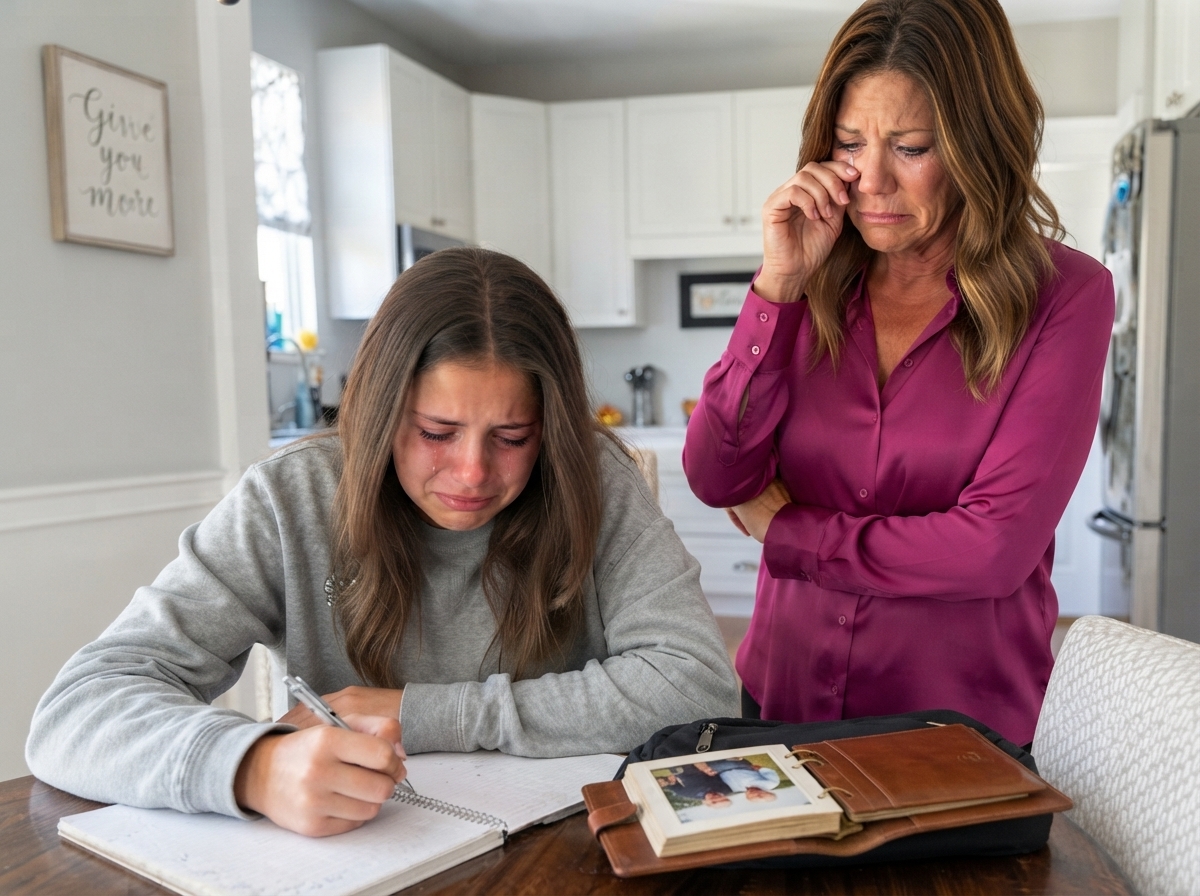
Maya came home in May.
I waited in the driveway when her car pulled in.
She stepped out carrying two bags and a portfolio case.
For a moment, she looked exactly as she had before college.
Then she smiled.
“Mom.”
I hugged her.
“You're too thin.”
She laughed.
“You said that last time.”
“Because it's still true.”
We carried her things inside.
Her old room looked almost untouched.
She stood in the doorway.
“Wow.”
“What?”
“You really didn't change anything.”
“I moved your desk.”
She looked at me.
“That is not nothing.”
We laughed.
The first few days were easy.
She slept late.
Cooked with me.
Spread art supplies across the dining table.
She complained about professors.
I listened.
Then, on Sunday afternoon, someone knocked on the door.
It was my mother.
Maya froze.
Mom stood on the porch holding a small box.
“I brought something for you.”
Maya looked at me.
I didn't answer for her.
She opened the door wider.
“Come in.”
Mom entered slowly.
The box was wrapped in plain brown paper.
“I wasn't sure whether to bring this.”
“What is it?”
“Something I should have given you years ago.”
Maya opened the box.
Inside was a framed photograph.
The same photograph from the old box.
Maya at three.
Sitting on my lap.
Looking at the camera.
Maya stared at it.
“You kept this?”
Mom nodded.
“I should have put it somewhere everyone could see.”
Maya touched the frame.
“Why didn't you?”
Mom swallowed.
“Because I was afraid of what it meant.”
Maya looked at her.
“It means I was your granddaughter.”
“Yes.”
“Even then.”
“Yes.”
Maya placed the frame on the table.
“I wish you had acted like it.”
Mom nodded.
“I wish I had too.”
There was no dramatic embrace.
No sudden healing.
They sat together.
They talked for almost two hours.
My mother answered questions.
Some answers were ugly.
She admitted she had spoken about Maya's adoption with relatives.
She admitted she had compared Maya to the other grandchildren.
She admitted she had sometimes deliberately excluded her because she wanted me to realize how much she disliked the changes in my life.
Maya listened.
Sometimes she asked another question.
Sometimes she looked at me.
I stayed silent.
This was hers.
When Mom left, Maya walked her to the door.
“Grandma?”
My mother turned.
“I don't hate you.”
Mom's face crumpled.
“But I don't trust you yet.”
“I understand.”
Maya nodded.
“That might take a long time.”
“I'll wait.”
The door closed.
Maya stood there for several seconds.
Then she turned to me.
“That was hard.”
“I know.”
“But I think I needed it.”
That summer, things changed slowly.
Not perfectly.
Slowly.
Rachel sent Maya occasional messages.
Tessa mailed her birthday card.
Dad called on Sundays.
Nobody expected immediate closeness.
Nobody demanded forgiveness.
That was the first sign that perhaps they had finally understood.
Then came the invitation.
Not another wedding.
A family reunion.
Dad wanted everyone together for his birthday.
The message arrived in our group chat.
Maya read it over my shoulder.
“Are you going?”
I looked at her.
“I don't know.”
“Do you want to?”
I thought about it.
“I want to see whether they can behave differently.”
Maya nodded.
“Then I'll go.”
The reunion was held at my parents' house.
When we arrived, the driveway was full.
Cars.
Voices.
People carrying food.
For a moment, I felt the old anxiety return.
Then Maya reached for my hand.
“We don't have to stay.”
“I know.”
We entered together.
Mom met us at the door.
“I'm glad you're here.”
She looked directly at Maya.
Not through her.
Not past her.
At her.
Maya smiled.
“Thank you.”
Inside, relatives greeted us.
Some awkwardly.
Some warmly.
Nobody made a comment about blood.
Nobody asked whether Maya was staying long.
Nobody treated her like an exception.
At dinner, there were too many people for the original table.
Dad stood up.
“I need another chair.”
He looked around.
Then he carried one from the dining room and placed it beside him.
“This one's for Maya.”
She sat down.
I watched my father serve her first.
It was such a small thing.
Yet I nearly cried.
Later, Rachel found me in the kitchen.
“I want to ask you something.”
“What?”
“Do you think we can start over?”
I shook my head.
“No.”
She looked hurt.
“I don't mean forget everything.”
“Neither do I.”
I dried my hands.
“We can't start over. We can start from here.”
She nodded slowly.
“I think that's fair.”
Across the room, Maya was talking with Tessa.
They weren't close.
But they were talking.
That was enough.
After dinner, Dad asked Maya about college.
She told him about her paintings.
He asked to see them.
She showed him photographs on her phone.
He studied each one.
“This one is good.”
Maya smiled.
“Thank you.”
Then Dad looked at her.
“I should have said that when you were three.”
Maya lowered the phone.
“Probably.”
He laughed softly.
“I deserved that.”
“Yes.”
He smiled.
There was no resentment in the exchange.
But there was honesty.
And honesty felt stronger than forced affection.
As the evening ended, Mom approached me.
“Thank you for bringing her.”
I looked at her.
“I didn't bring her.”
Mom understood.
“You came together.”
“Yes.”
She nodded.
“I've learned the difference.”
We hugged.
It was the first time I had hugged my mother since the hospital.
It wasn't a return to the past.
It was a new moment.
When Maya and I drove home, she was quiet.
“What are you thinking?” I asked.
“That was weird.”
I laughed.
“Very.”
“But good.”
“Yeah.”
She looked out the window.
“I think I can forgive them.”
I glanced at her.
“You don't have to.”
“I know.”
She smiled.
“I want to.”
There was a long silence.
Then she said, “But I don't want to forget.”
“You shouldn't.”
“I won't.”
We drove the rest of the way home.
The next morning, Maya placed the framed photograph on the bookshelf in her old room.
She did not hang it.
She simply put it there.
Beside it, she placed one of her own paintings.
The painting of the house.
The open door.
The figures outside.
She stood back and looked at them together.
“That's better,” she said.
“What is?”
“The old picture finally has the right picture next to it.”
I looked at the two frames.
One showed the beginning.
The other showed what had changed.
I understood then that healing was not about pretending the first photograph had never happened.
It was about refusing to let it define everything that came afterward.
Click Here to continue read next: PART8: Years Later, the Invitation Was Still in My Desk, but Its Meaning Had Changed More Than I Ever Thought Possible
The Invitation Had Only My Name, and the Rule Printed Beneath It Told Me Exactly Where My Daughter Stood
Part 7 of 8