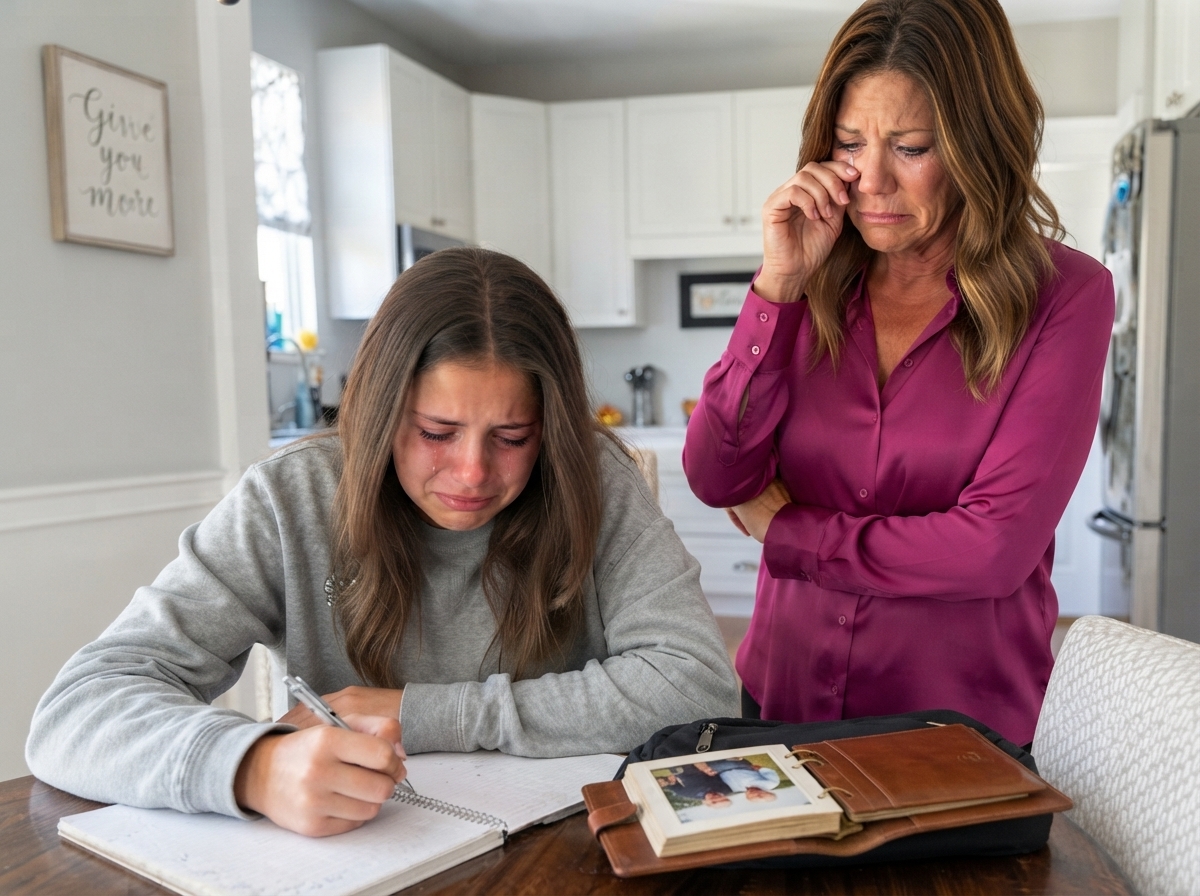
After that Christmas Eve, the family noise changed.
It did not disappear immediately.
For a few days, my phone filled with messages from relatives who had received the document. Some supported me. Some criticized me. A few said I should have handled everything privately.
I expected that.
What I didn't expect was how little I cared.
For years, I had measured every decision by how my family would react.
Would Mom be offended?
Would Rachel accuse me of being dramatic?
Would Tessa think I was selfish?
Would Dad stop speaking to me?
That habit had shaped my entire adulthood.
Now it felt strangely irrelevant.
I blocked the numbers I needed to block.
Not because I wanted revenge.
Because I wanted quiet.
Some relatives contacted me privately.
Aunt Linda said she had not understood how long the problem had been going on.
Uncle John apologized for believing Rachel's version without asking me.
Sarah simply wrote, “I'm glad Maya has you.”
I saved that message.
I did not save the angry ones.
Maya noticed the difference.
“You aren't checking your phone every five minutes anymore,” she said one evening.
“No.”
She smiled.
“That's probably good.”
We were sitting in the sunroom.
Snow wasn't falling, but the windows were cold enough to make the glass feel almost damp beneath my fingertips. Maya was working on her college portfolio.
She had become serious about art again.
Not cautiously.
Not as a hobby she needed permission to defend.
She was building a portfolio for an art program.
One evening, I found her surrounded by sketches.
Faces.
Buildings.
Hands.
A kitchen table.
A pair of worn shoes.
Our front porch.
She had drawn the porch from memory.
I sat beside her.
“You've never drawn that before.”
“I've been thinking about it.”
“What were you thinking?”
She looked at the picture.
“About people standing outside.”
I knew exactly what she meant.
She didn't need to explain.
I rested my hand on the table.
For several seconds, neither of us spoke.
Then she asked, “Do you think Grandma hates me?”
The question was softer than the one she had asked weeks earlier.
“If I say no,” I answered, “I don't want you to think I'm protecting you from the truth.”
She nodded.
“I don't know exactly what she feels.”
Maya looked down.
“But I know how she treated you.”
She was quiet.
“And that's enough for me.”
Maya traced one pencil line with her fingertip.
“Was I the reason you stopped talking to them?”
“No.”
She looked up.
“You were the reason I finally stopped pretending.”
That made her smile.
Only a little.
But it was real.
The weeks that followed were quieter.
My family eventually stopped calling.
Not all at once.
First there were angry messages.
Then explanations.
Then silence.
The silence was the strangest part.
I had spent my life assuming that losing contact with my family would feel like losing part of myself.
Instead, the house seemed larger.
There was less tension in the rooms.
Maya stopped asking whether someone was going to be angry.
She stopped watching faces before speaking.
She started leaving her sketchbooks open on the coffee table.
She started singing while cooking.
She began inviting friends over without asking me three times whether it was okay.
Small things.
The kind of things I should have noticed much earlier.
One afternoon, she came home with a college acceptance letter.
She stood in the doorway holding the envelope.
I knew from her face before she spoke.
“I got in.”
I hugged her.
She laughed into my shoulder.
“I got in.”
“I know.”
“You don't even know where.”
“I don't care.”
She pulled back.
“You should at least ask.”
“Fine. Where?”
She told me.
It was an art program several hours away.
The thought of her leaving frightened me.
But it was not the fear my parents had predicted.
I was not afraid she would forget me.
I was afraid I would miss her.
There was a difference.
On the evening before we began preparing for the move, Maya sat beside me on the couch.
“Mom?”
“Yeah?”
“Do you remember the first time I called you that?”
I smiled.
“The car.”
“You cried.”
“You noticed?”
“You thought I didn't.”
I laughed.
She leaned her head against my shoulder.
“I was scared.”
“I know.”
“I thought you might tell me I was wrong.”
“About what?”
“Calling you Mom.”
I looked at her.
“You were three.”
“I remember.”
Her voice had become quiet.
“I remember thinking I needed to check first.”
That sentence stayed with me.
A child should not have to check before calling the person who loves her mother.
I put my arm around her.
“You never needed permission.”
“I know that now.”
We sat there for a while.
Then she said, “I'm glad you didn't make me go to that wedding.”
“So am I.”
“I thought maybe you would.”
“I almost did.”
She looked at me.
“Why?”
“Because I spent a long time thinking keeping the family together was my job.”
She considered that.
“It wasn't.”
“No.”
“It was never your job.”
I smiled.
“You're right.”
The next morning, we packed another box.
Her room slowly became less crowded.
Posters came down.
Books went into cartons.
Art supplies were sorted.
A small collection of childhood drawings went into a folder.
At the bottom of one box, Maya found an old photograph.
She held it up.
It was from one of her first Christmases with us.
She was three years old, sitting on my lap.
I looked exhausted.
She looked suspicious of the camera.
Maya laughed.
“I was so tiny.”
“You wouldn't let anyone put you down.”
“You were safe.”
The words were simple.
They nearly broke me.
That night, after she went upstairs, I sat alone in the kitchen.
I thought about the invitation.
The glittering card.
The porch.
My mother's sentence.
The Christmas table.
The messages.
Everything that had happened had begun with something so small.
One line on a piece of paper.
Adults only.
No exceptions.
But the wedding invitation had not created the problem.
It had exposed it.
The problem had existed long before anyone printed a guest list.
It had existed in the way my mother introduced Maya.
In the way Tessa treated her.
In the way Rachel's children were embraced without hesitation while Maya learned to wait.
In the picture Maya drew and watched disappear from the refrigerator.
In the card I found crushed beneath a coffee cup.
The invitation simply made the invisible impossible to ignore.
A few months later, I drove Maya to college.
The car was packed with boxes.
Her portfolio case was wedged carefully between bags.
She kept checking her list.
Laptop.
Chargers.
Paints.
Sketchbooks.
Bedding.
Documents.
I watched her through the rearview mirror.
She was nervous.
Excited.
Seventeen had somehow become eighteen while I wasn't paying attention.
When we arrived, she stood beside the dorm entrance with both hands tucked into her sweater sleeves.
Students moved around us carrying lamps, boxes, laundry baskets.
Parents hugged their children.
Some cried.
Some gave instructions nobody wanted.
Maya looked at me.
“I'll call tonight.”
“You better.”
She smiled.
Then she hugged me.
She didn't let go quickly.
“I love you, Mom.”
“I love you too.”
She stepped back.
For a second, I thought she was going to say goodbye.
Instead, she whispered, “I'm not going anywhere.”
I understood what she meant.
Not literally.
She was moving away.
She was beginning her own life.
But the fear my family had tried to plant in me—that one day my daughter would leave and prove she had never truly belonged—had finally disappeared.
She could leave.
She could grow.
She could build a life I was not at the center of.
And she would still be my daughter.
When I drove home, the house felt different.
Quieter.
But not empty.
There was a sketchbook on the coffee table.
A mug in the sink.
A sweater hanging over the back of a chair.
Evidence that someone I loved had lived there and was still part of me, even from a distance.
I never reconciled with my mother.
Tessa and Rachel eventually stopped trying to control the story.
Some relatives remained distant.
A few relationships repaired slowly, but only after people learned that access to me was no longer guaranteed by blood.
I stopped explaining myself.
That was perhaps the greatest change.
For years, I had believed family loyalty meant enduring things quietly.
I no longer believed that.
Love could be generous without being submissive.
Forgiveness could exist without reopening a door.
And family could be chosen.
Sometimes, late at night, I still think about that invitation.
I remember Maya looking at me across the kitchen table and asking whether they excluded her because she was adopted.
I remember how quickly I said no.
I remember knowing that my answer had to become more than words.
Because children remember what adults do when the choice becomes difficult.
Maya is older now.
She sends photographs of her artwork.
Sometimes she calls just to tell me something ordinary.
A professor liked a painting.
She found a good coffee shop.
She stayed up too late.
She misses home.
She is learning who she is.
And every time she says good night, I hear the same child from the back seat of my car, carefully testing a word she wasn't sure she was allowed to use.
Mom.
Only now there is no hesitation in it.
No permission required.
No question about whether she belongs.
She knows.
And so do I.
I did not choose Maya instead of family.
I chose Maya as my family.
That distinction changed everything.
The people who believed blood gave them the right to diminish her eventually discovered that blood could not force me to remain where my daughter was treated as an outsider.
The table I once spent years preparing for everyone else became ours.
The holidays became quieter.
The house became calmer.
And the place where Maya had once waited to be invited became the place where she never had to ask.
That was the promise I made when she was three.
I simply needed the courage, years later, to keep it.
Click Here to continue read next: PART5: The Call From Home Arrived After Midnight, Carrying an Apology That Was Too Late and a Truth Nobody Had Told Me
The Invitation Had Only My Name, and the Rule Printed Beneath It Told Me Exactly Where My Daughter Stood
Part 4 of 8