The envelope was waiting beside the mail when I came home Tuesday afternoon. It was heavier than the usual bills and advertisements, cream-colored with my name printed across the front in elegant lettering. I knew immediately what it was. Tessa had been talking about her wedding for months, and every family conversation eventually circled back to flowers, venues, dresses, menus, or the guest list. I carried it inside with the strange caution people use around things they already suspect might hurt.
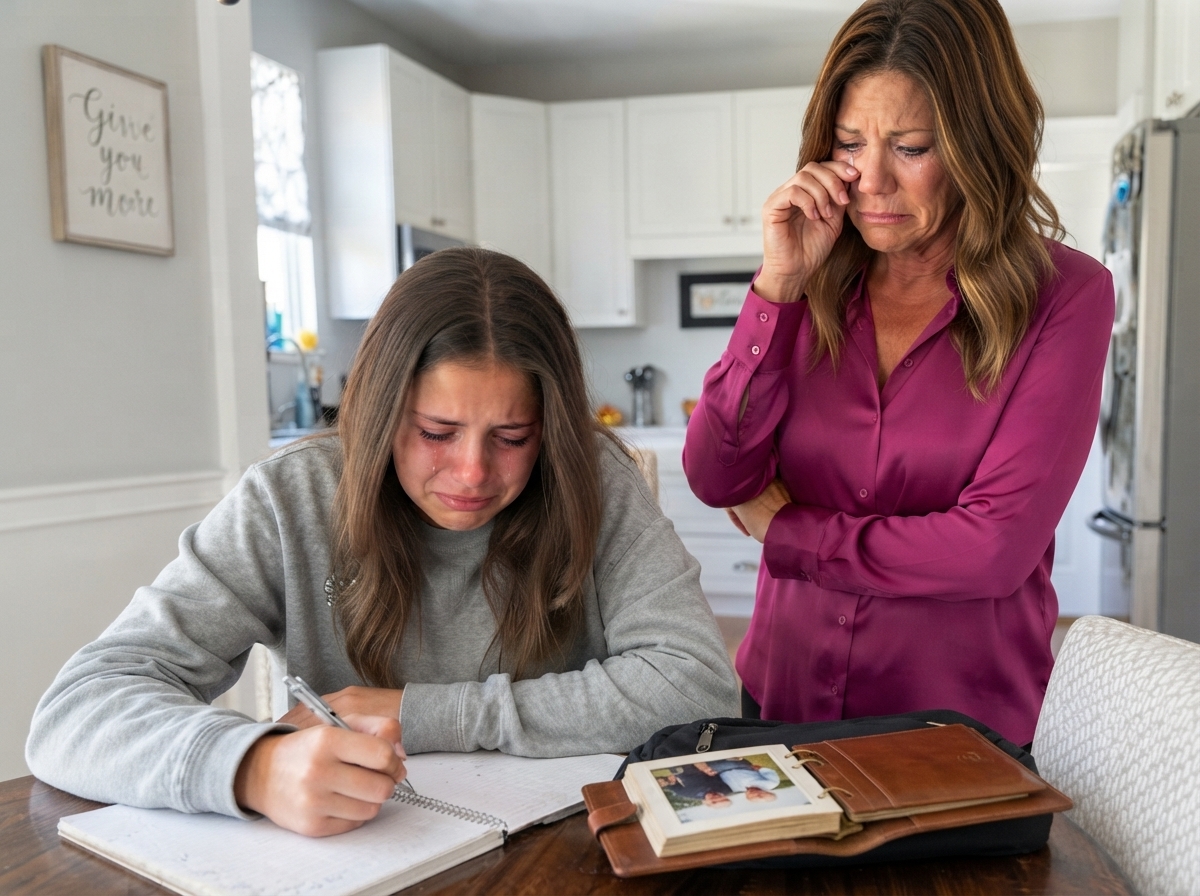
Maya was sitting at the kitchen table with one earbud tucked into her left ear, working through a stack of homework. Her pencil tapped lightly against the page whenever she paused to think. At seventeen, she had developed the ability to look completely absorbed while noticing absolutely everything happening around her. I had learned not to mistake her quietness for distraction.
Ethan was still at work, so the house was unusually still. I slipped my finger beneath the envelope flap and opened it. The paper smelled faintly of ink and flowers. Tessa's wedding details were printed in neat blocks: ceremony location, reception information, dress expectations, RSVP instructions. I read the first half with a small smile, remembering the little girl who used to steal my shoes and parade around our parents' house pretending she was grown.
Then I reached the bottom.
Adults only. Eighteen and over. No exceptions.
I stared at the sentence until the words stopped looking like language and became something harder. Maya was seventeen. She was not a toddler who needed someone to keep her from knocking over centerpieces. She could drive. She was preparing college applications. She babysat Rachel's children when Rachel needed an evening away. She was old enough to understand wedding vows and sit quietly through a ceremony, but apparently one year short of being considered welcome.
I looked across the table.
Maya had already noticed my expression.
“What does it say?” she asked.
I hesitated for half a second. That was enough.
Her pencil stopped moving. “I'm not invited.”
“It says adults only.”
She lowered her eyes to the worksheet. “So I'm not going.”
The way she said it was almost frighteningly calm. There was no tantrum, no accusation, no demand that I call Tessa. Maya had learned something children should never have to learn: sometimes rejection arrives quietly, and the safest response is to make yourself smaller before anyone has to ask.
I sat beside her. “Maya.”
She kept looking at the paper. “Is it because I'm adopted?”
The question hollowed me out.
I had spent fourteen years trying to make sure she never had to ask it. I adopted Maya when she was three, after a beginning she was too young to explain and I was too protective to make her relive. She had come into my life with solemn brown eyes and a habit of watching adults before answering them. Even ordinary kindness seemed to surprise her at first.
The first time she called me Mom happened in the back seat of my car. We were driving home from preschool, and she was buckled into a booster seat that still smelled new. She said the word softly, almost experimentally, as though she wanted to know whether it belonged to her. I smiled at her through the rearview mirror and waited until I reached home before crying in the driveway.
That night, I made myself a promise. Whatever had happened before she came to me, she would not grow up believing she had to earn a place in her own home. She would know exactly where she belonged.
For years, my family made that promise harder than I wanted to admit.
Nobody ever announced that Maya was less important. There was no dramatic confrontation at a holiday dinner. Instead, there were dozens of small moments that could each be dismissed on their own. My mother introduced her as “Claire's girl” instead of her granddaughter. Tessa sometimes said “your daughter” when talking to me, never “my niece.” At Thanksgiving, Maya would offer to help in the kitchen and receive a distracted, “We're fine,” while Rachel's children could wander in demanding whipped cream and immediately become the center of attention.
I kept translating those moments into kinder explanations.
They are adjusting.
They don't mean anything by it.
They just need time.
But Maya noticed everything.
When she was six, she told my father that she wanted to be an artist. He smiled and told her she should choose something practical. When she was eight, she drew a picture of our family—Ethan, me, and herself—and gave it to my mother on Christmas Eve. My mother thanked her and placed it on the counter.
A week later, Maya asked why her picture wasn't on the refrigerator with the cousins' drawings.
I remember standing at the sink with my hands submerged in warm dishwater, staring at a row of snowman magnets.
I could not think of an answer that would not teach my daughter something terrible.
Still, she kept trying.
That was what hurt most. She never demanded that anyone prove they loved her. She tried to become easy to love. She watched people carefully. She offered help. She brought handmade cards. She asked permission before assuming she belonged. Children who have experienced loss sometimes become experts at reading rooms, and Maya had become very good at it.
When Tessa announced her engagement the previous spring, Maya was thrilled.
Not loudly. Not recklessly. She simply began collecting wedding ideas on her phone. She showed me photographs of hairstyles and asked whether an understated manicure would be better than something bright. She wondered what kind of dress would look appropriate and whether she should bring a card.
“She's my aunt,” Maya said one evening, smiling at the screen.
She had made Tessa a card herself.
It was covered in glitter and tiny paper wedding bells. The word Congratulations was written in careful bubble letters. Maya held it out with both hands when Tessa visited, her face open with hope.
Tessa laughed affectionately. “That's adorable.”
She kissed Maya's forehead and carried the card to her car.
Two weeks later, I found it in the back seat, bent beneath an empty coffee cup. Glitter had fallen across the paper. I picked it up and stared at the crushed corner.
I did not show Maya.
I threw it away after she went upstairs.
Then I stood at the kitchen sink with the water running over my hands and tried to convince myself that one discarded card did not mean anything.
Now the wedding invitation was sitting on my counter, proving that it did.
Maya looked at me.
“I don't want you to fight with them,” she said.
“I haven't decided what I'm doing yet.”
“Yes, you have.”
I looked at her.
She finally raised her eyes. “You're not going without me.”
There was no accusation in it. She sounded as though she were describing the weather.
I reached across the table and took her hand.
“You are my daughter,” I said. “You don't have to earn your place in this family.”
She swallowed.
“I know you're my daughter.”
“No. I need you to hear the rest.”
Her fingers tightened around mine.
“You don't have to earn a seat at a table where you already belong.”
She nodded, but I could see that the words had not completely reached the place where they needed to go.
That evening, after Maya went upstairs, I opened the invitation again beneath the bright kitchen light.
Adults only.
No exceptions.
The phrase bothered me less than the certainty behind it.
A rule could be neutral. A rule could also be used as a shield. It could allow people to behave cruelly while insisting they were merely following policy.
I opened the RSVP page.
For a moment, my cursor hovered over “accept.”
Then I selected “decline.”
I gave no explanation.
The next morning, Tessa texted.
“Hey! Saw your RSVP. Everything okay?”
Another message followed.
“If this is about the age rule, I hope you understand. We're applying it consistently. Nothing personal.”
I stared at those last two words.
Nothing personal.
Except Maya was not a stranger's teenager.
She was Tessa's niece.
I didn't answer.
A few minutes later, Rachel messaged me. Then my mother called.
I watched my phone vibrate against the counter before finally picking it up.
“Claire,” Mom said, already sounding exhausted with me. “I heard you're skipping the wedding.”
“Maya wasn't invited.”
“It's an age requirement.”
“I know what the invitation says.”
“She'll be eighteen soon.”
“She's still my daughter now.”
There was a pause.
My mother's voice softened. “Don't punish your sister because of one rule.”
“I am not punishing anyone.”
“Then come.”
“Without Maya?”
“Claire, it's one evening.”
I looked toward the staircase.
“No,” I said. “It isn't.”
My mother sighed. “You always make everything bigger than it has to be.”
I felt something settle inside me.
“Then we won't be there.”
I ended the call.
The family group chat became noisy almost immediately.
Rachel said I was creating unnecessary drama.
Tessa repeated that the rule applied to everyone.
Mom said family mattered more than one disagreement.
Then came the quieter accusations.
Maya wasn't the only young person excluded.
I was taking it personally.
I was making Maya's feelings the center of everything.
One message stopped me completely.
“If Maya is really that sensitive, maybe it's better she doesn't come.”
I read it twice.
Then I turned the phone face down.
Ethan came home after seven. He found me at the kitchen table in the dark except for the light above the stove.
He didn't ask me to compromise.
He didn't tell me my family probably meant well.
He put both hands on my shoulders and said, “You did the right thing.”
Upstairs, a door opened.
A few minutes later, Maya came down holding her phone.
She had been looking at dresses.
I watched her delete every saved photograph.
One by one, the little hearts disappeared.
She didn't cry.
That was what nearly broke me.
She had already learned how to erase her own hope before anyone else could do it for her.
The wedding was three weeks away.
And for the first time in my life, I knew exactly what I was willing to lose.
Click Here to continue read next: PART2: After the Wedding Passed Without Us, My Family Expected Christmas to Restore the Old Order We Had Finally Refused
The Invitation Had Only My Name, and the Rule Printed Beneath It Told Me Exactly Where My Daughter Stood
Part 1 of 8