“She Took Five Bullets For The Mafia Boss’s Mother—Then His Reaction Left Everyone Speechless
The green dot settled on Rosa Marino’s chest like a final verdict.
Clara Hughes saw it land — a thin blade of laser light cutting through the dust and smoke of the underground garage, past the shattered glass of the Cadillac’s rear window, coming to rest over the old woman’s heart. She saw the shooter silhouetted on the hood of the lead Escalade, a black-wrapped figure raising a suppressed pistol with the calm of a man signing checks. She saw everything, the way people see everything in the last second before their world ends.
And in that frozen moment, Clara Hughes — therapist, debtor, the invisible woman who had spent her whole life being overlooked — understood that she had exactly one decision left to make.
She had not been born for this. She would have told you that herself, if you’d asked her, back in the days when she still believed the universe sorted people into cages and kept them there. Clara Hughes was twenty-six years old and owned nothing that mattered: a cramped apartment in Queens, a subway pass, a wardrobe of clean but tired clothes, and a mountain of medical debt that had buried her so deep she’d stopped measuring herself against the surface. Her father had died of leukemia the year before, and the hospital bills had outlived him, breathing down her neck every month like a second job.
She was a physical therapist. She was good at it — the kind of quietly good that never got noticed, because the world noticed loud things and bright things and expensive things, and Clara was none of those. She was the one who stayed late, who remembered the names of her patients’ grandchildren, who hummed off-key while she stretched muscles that had forgotten how to move.
That was how she had come to stand in a blood-slicked parking garage, three stories beneath a Manhattan hospital, watching a laser sight find the chest of a seventy-year-old woman.
It had started with a manila folder. A man in a charcoal suit had walked into the clinic where she worked, bypassed the receptionist entirely, and laid the folder on her desk as if he owned the building. Inside: a non-disclosure agreement, a background check on Clara herself, and a certified check for one hundred thousand dollars.
For the first three months, the man had said. Live-in physical therapy and medical supervision for a stroke victim. The work is simple. The discretion is not.
She had almost refused. She had looked at the check, then at the eviction notice propped on her kitchen counter at home, then at the stack of final notices from the hospital where her father had died — and she had signed her name in ink that felt like a confession.
The estate lay behind twenty acres of rolling green and iron gates in Oyster Bay, a fortress of a house that swallowed light. The family name was Marino. The son was Dante Marino, a man the FBI had spent a decade failing to cage, a name the newspapers printed with the same careful distance people use for weather disasters. Clara had been told the rules by a housekeeper who crossed herself while speaking: never ask questions, never look him in the eye, never forget that the walls have ears and the ears have teeth.
Rosa Marino was the one exception to the crater of ice her son had become. Seventy years old, left side paralyzed by a stroke, razor-sharp wit intact. She laughed at her son’s coldness, called him a man who had forgotten how to smile because he spent too much time worrying about rats in the cellar.
Clara spent her days stretching the old woman’s atrophied limbs, brushing her silver hair, reading aloud from worn paperbacks, listening to stories about a New York that no longer existed. And slowly, across the weeks, the two of them had fallen into something neither had expected: the bright, exhausted therapist and the fierce old matriarch, two women taking care of each other in a house where everyone else only took.
Dante had watched from the shadows. At first Clara barely noticed him — a presence at the edges, a cold current in a warm room. Then she began to find him in the kitchen at midnight, a glass of scotch in his hand, a cigar burning in the ashtray, asking after his mother’s grip strength in a voice like gravel shifting.
She kept her eyes on the floor, as instructed. He told her, one night, very quietly, that she didn’t have to look at the floor — and when she looked up, she saw, for half a breath, not the lord of the underworld but an exhausted son, terrified of losing the only family he had left.
She knew she was playing with fire. She knew the headlines, the body counts, the war with the Russo family that had turned the city’s evenings into a casualty list. She told herself every morning that Dante Marino was a monster and she was a woman who fixed knees and shoulders and backs, and the two truths could never touch.
October wore a gray, weeping sky. Rosa needed a specialized MRI — a scan that could prevent a second stroke. Dante had wanted to cancel; Clara had argued, gently, that they could not gamble with his mother’s brain. He had agreed, and decreed he would come himself. No chances.
Now the lasers were dancing in the smoke, and Clara Hughes understood that the whole ambush had never been about killing Dante Marino at all. You didn’t break a king by shooting him. You broke him by taking his heart.
The green dot trembled on Rosa’s chest.
The shooter’s finger began to squeeze.
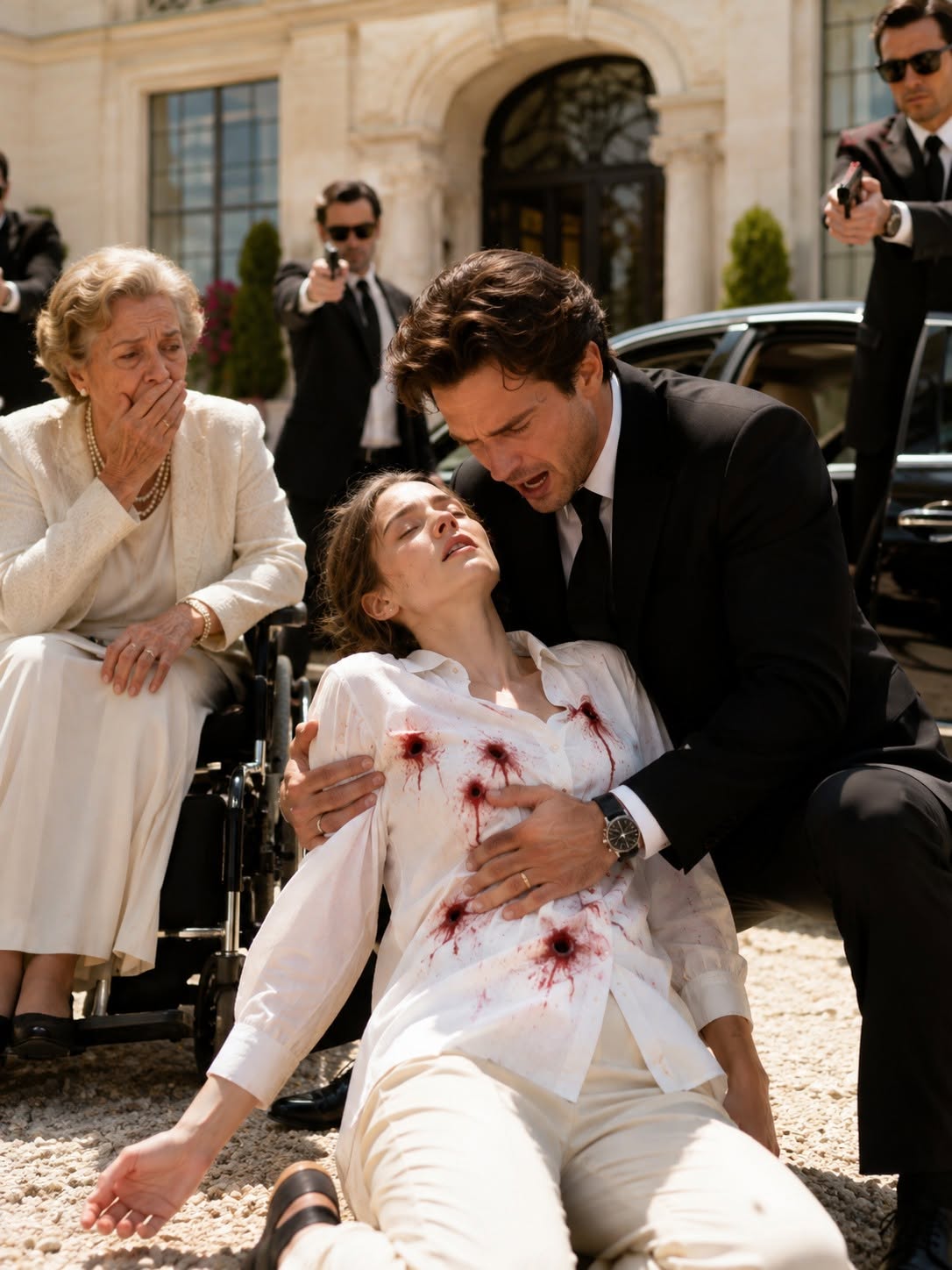
Clara’s body moved before her mind could catch up, throwing itself across the old woman’s lap like a coat over a fire. She heard Dante scream her name — a sound she had never heard a man make before, primal and splintered — and then the world became pain.
The first bullet took her in the shoulder, and the impact spun her like a weather vane in a storm. The second and third tore through her lower back and side as she twisted, and the fourth and fifth found her abdomen as she collapsed over Rosa like a shield that had been broken but refused to fall.
Five hollow-point rounds. Two seconds. A lifetime.
She could not scream. Her nervous system had overloaded, shorted out, gone to static. She lay draped across the old woman’s lap, her white uniform blooming crimson, tasting copper, hearing — from very far away — the roar of Dante’s voice and the crack of return fire and the wail of sirens arriving, always, always too late.
The last thing she saw was the fluorescent light flickering above her, and the last thing she felt was the terrible, tender weight of the most feared man in New York hauling her out of the wreckage and cradling her against his chest as though she were made of glass and he were made of nothing but grief.
Dante, she tried to whisper. I kept her safe for you. But the darkness rushed in, heavy and absolute, and Clara Hughes went limp in the arms of a weeping king.
(I know you’re all very curious about the next part, so if you want to read more, please leave a ‘NEXT’ comment below!)