
Audrey remained beside the foyer table, one hand resting on her handbag. William stood opposite her, gripping the financial summary so tightly that the paper had begun to crease beneath his fingers.
I watched them look at each other.
Whatever happened next belonged first to their marriage.
“Explain,” William said.
Audrey looked at me.
“Victoria has never understood how complicated this became.”
“Then make it simple.”
Her eyes hardened.
“You bought this house and acted as though that gave you a say in everything we did.”
“I bought the house. That gives me an interest in what happens to the house.”
“It was never only the house.”
William stepped between us.
“Audrey, stop avoiding the question.”
He lifted the papers.
“Did you know money was going to your mother?”
Audrey swallowed.
“Yes.”
The answer was barely audible.
William lowered the documents.
For a moment he looked more confused than angry.
“Why?”
“She was helping us.”
“With what?”
“Finances. Planning. Protecting ourselves.”
“From whom?”
Audrey looked at me.
William followed her gaze.
His expression changed.
“From my mother?”
“Your mother controlled everything.”
“I controlled property I owned,” I said.
“You controlled our lives.”
“No. I paid for a large part of them. Those are not the same thing.”
Audrey’s face flushed.
“You don’t know what that felt like.”
“Then why did you continue accepting the arrangement?”
She had no answer.
William stepped closer.
“Did you tell me those documents were ordinary household forms?”
“I told you what I thought you needed to know.”
“That is not an answer.”
“I was trying to protect us.”
“By moving money to your mother?”
“It wasn’t stealing.”
William flinched at the word.
I looked at Audrey.
“Then what do you call taking money from accounts for services your mother never provided?”
Her mouth tightened.
“Those accounts supported our household.”
“They supported expenses permitted under the trust.”
“Your trust.”
“Yes.”
“My mother said—”
William struck the papers against the table.
“Stop.”
Audrey stared at him.
“Stop telling me what your mother said.”
The silence that followed felt unfamiliar.
For years, William had surrendered whenever Beatrice entered an argument, even when she was not physically present. He had allowed her opinions to become part of the air inside his marriage.
Now he looked sickened by the habit.
“Did you forge my signature?” he asked.
“No.”
“Did you use authorizations I signed without reading?”
Audrey lowered her eyes.
William stepped backward.
“Oh God.”
“I didn’t forge anything.”
“You used documents you knew I didn’t understand.”
“I was trying to protect us.”
“Protected from what?”
“From losing everything!”
His laugh was short and painful.
“We were living in a ten-million-dollar house without paying rent.”
“That was exactly the problem.”
There it was.
Not poverty.
Not danger.
Dependence.
Audrey had become so frightened of living in a house she did not own that she had apparently convinced herself that taking control of it was justified.
I picked up my purse.
William turned toward me.
“Where are you going?”
“Home.”
“We’re not finished.”
“You two certainly aren’t.”
“Mom, please.”
I looked at him.
He seemed caught between wanting me to stay and needing me to leave so he could face his wife without me there.
“You have thirty days,” I reminded him.
His shoulders dropped.
“Are you really going through with this?”
“Yes.”
“Even after learning I didn’t know about the payments?”
“You knew enough to distrust me without asking questions. You signed documents without reading them. You allowed other people to control something for which you had responsibility.”
“I made mistakes.”
“Yes.”
“That means I lose my home?”
“It means you finally experience a consequence I cannot remove for you.”
His eyes reddened.
I wanted to hug him.
Instead I walked toward the door.
Before I reached it, my phone rang.
Richard.
I answered outside.
“What happened?”
“We found another transfer.”
I stopped beside my car.
“How much?”
“Eight hundred and twenty thousand.”
For a moment I thought I had heard him incorrectly.
“From the same accounts?”
“The trail is complicated.”
“To Beatrice?”
“No.”
“Then where?”
“A law firm.”
I looked back at the mansion.
“What law firm?”
“The firm preparing the trust challenge.”
Cold moved through me.
“When was the transfer?”
“About two months ago.”
Two months.
Before the birthday.
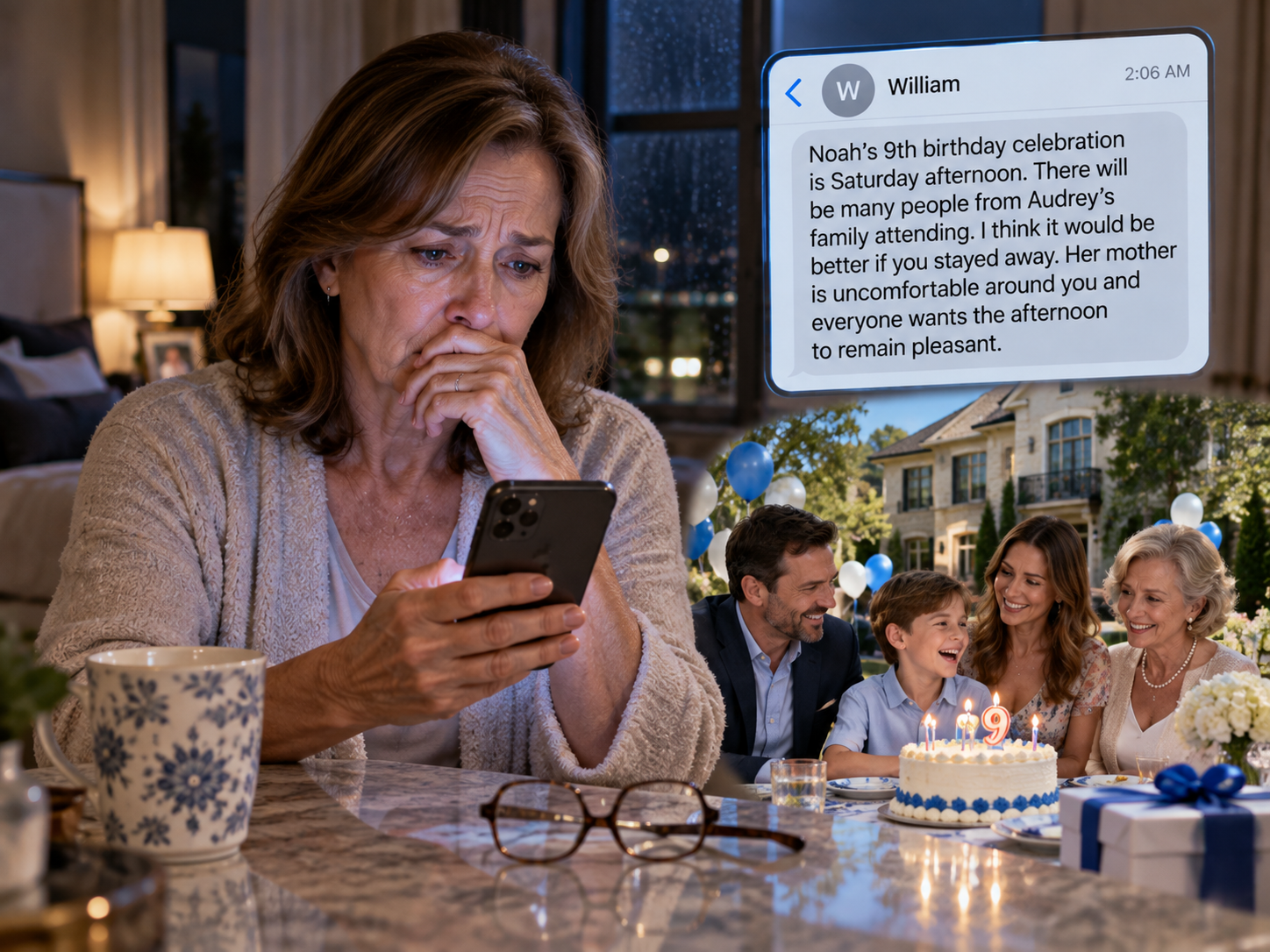
Before William’s message.
Before anyone had supposedly become uncomfortable with my presence.
“They used money connected to my property to finance an attempt to challenge my ownership?”
“That appears to be part of what happened.”
“Part?”
“We are tracing the source of the $820,000. It may not all have originated from trust accounts.”
“Whose money was it?”
“We do not know yet.”
Richard paused.
“There is another complication.”
“Of course.”
“The law firm appears to have been involved in preliminary discussions about a sale.”
“A sale of what?”
“The mansion.”
I straightened.
“They cannot sell it.”
“Not legally while the trust stands.”
“Then why discuss a sale?”
“Because they appear to have expected the ownership question to be resolved first.”
I thought of the screenshots.
Remove my influence.
Challenge the trust.
Keep me distracted.
Make the birthday seem like the issue.
The pieces were beginning to fit.
“Who was buying?”
“We are working on that.”
“Find out.”
“I will.”
“And Richard?”
“Yes?”
“Find every person who received money.”
When the call ended, I remained beside my car.
One of the upstairs curtains moved.
A small figure appeared behind the glass.
Noah.
He could not see me clearly from that distance, but I knew him immediately.
The sight steadied me.
Whatever the adults had done, I would not allow their choices to turn him into collateral damage.
William came outside.
“Mom?”
I put my phone away.
“What did Richard want?”
I studied him.
There were two possibilities. Either my son knew about the plan to challenge the trust and sell the property, or he had been manipulated so thoroughly that his earlier carelessness looked almost innocent.
Neither possibility was good.
“Have you ever discussed selling this house?”
His face changed.
It happened quickly.
A tightening around his mouth.
A delay before answering.
That was enough.
“William.”
He looked toward the driveway.
“Not seriously.”
My stomach sank.
“So you knew.”
“Mom—”
“How long?”
“It wasn’t my idea.”
“How long?”
He rubbed the back of his neck.
“A few months.”
I stared at him.
“You knew somebody wanted to sell property you do not own.”
“I told Audrey I wouldn’t agree.”
“You never thought I should know?”
“I thought I could stop it.”
“How?”
“I kept telling her no.”
“And when she continued?”
“I didn’t know what to do.”
“You could have called me.”
“I was afraid.”
“Of Audrey?”
He looked toward the house.
“Of everything falling apart.”
I lowered my voice.
“So you let me remain ignorant because telling me the truth would force you to choose.”
His eyes filled.
“Yes.”
That admission hurt more than a lie.
“Who wanted to buy it?”
“I don’t know the company.”
“Try.”
“Something Pacific.”
“Who introduced them?”
“Audrey and Beatrice handled most of it.”
“Did money change hands?”
His head snapped toward me.
“What?”
“Did anyone receive money?”
“I don’t know.”
This time I believed him.
I opened my car door.
“Mom, what did Richard find?”
“Enough.”
“Tell me.”
“No.”
“Why not?”
“Because I need to know whether you will tell me the truth without first knowing what I can prove.”
He stared at me.
“What does that mean?”
“It means you have one opportunity left.”
“To do what?”
“Stop protecting people who are using your fear.”
I drove away.
Richard called before I reached home.
“We identified the prospective buyer.”
“Who?”
“Blackwell Pacific Holdings.”
I knew the name. The company was known for acquiring expensive older properties, securing development rights and replacing them with projects that extracted far more value from the land than the original homes ever could.
The mansion stood on nearly two acres.
The land might be worth far more than the building.
“Why would they negotiate with people who do not own it?”
“They appear to have believed the trust challenge had a realistic chance.”
“Based on what?”
“Representations made to them.”
“By whom?”
“We’re tracing that.”
When I arrived home, Richard was already waiting.
He opened a series of transaction records across my dining table.
Blackwell Pacific had made three payments totaling $820,000.
The recipient was an entity called A.K. Consulting Services.
I stared at the initials.
“A.K.”
Richard nodded.
“Audrey Kensington.”
I sat down.
The payments were described as consulting compensation tied to access, development information and preliminary cooperation.
Audrey had not merely known about a potential sale.
She had been paid.
“Does William appear anywhere?”
“Not as a recipient.”
“Beatrice?”
“Not on these payments.”
“Then Audrey took $820,000 from a developer in connection with property she did not own.”
“That is what the records suggest.”
“And some of that money supported the legal challenge?”
“Some funds appear to have been used that way.”
I pressed my fingers against my forehead.
The birthday suddenly made terrible sense.
They had not simply wanted to avoid an awkward afternoon.
They had been creating distance.
If William accepted excluding me once, perhaps he could be persuaded to accept more.
If I remained silent, they could later portray me as detached.
If the ownership dispute came afterward, they might claim I had already withdrawn from the family.
It was not a sophisticated plan.
Families rarely destroy themselves with sophisticated lies.
They do it with small lies repeated until everyone stops noticing them.
“Do we call the police?” Richard asked.
“Not yet.”
He studied me.
“Why wait?”
“Because William admitted knowing about the proposed sale.”
Richard’s expression hardened.
“How much did he know?”
“Enough to betray me. Perhaps not enough to participate in the financial scheme.”
“That distinction may matter legally.”
“It matters to me first.”
I looked toward the windows.
“I want him to have one chance to tell the complete truth.”
“And if he doesn’t?”
“Then we proceed without protecting him.”
The next evening I returned to the mansion.
William was alone in the living room.
His shirt was wrinkled. A coffee cup sat untouched beside him. He looked like a man who had spent a night arguing with himself and lost.
“Where are Audrey and Noah?”
“Noah is with a friend. Audrey went to her mother’s.”
“Good.”
He stood.
“Mom, I need to explain.”
“Then explain.”
I remained standing.
He admitted that Audrey had told him three months earlier about a developer interested in the property. She had described it as an opportunity. If they could establish stronger ownership rights, they could sell and become financially independent from me.
“What did you say?”
“I said no.”
“And then?”
“She kept talking about it.”
“And?”
“I found out she had already accepted money.”
My chest tightened.
“You knew about the payments?”
“Not the amount.”
“But you knew she had been paid.”
“Yes.”
“And you told me nothing.”
He looked down.
“I thought I could convince her to return it.”
“Did she?”
“No.”
“Did you tell Beatrice to stop?”
“Yes.”
“And?”
“She said I was choosing you over my wife.”
“So you chose silence.”
His eyes closed.
“Yes.”
I walked toward the window.
Rain had left the garden damp. Small lights along the stone path reflected on the wet ground.
“I could have forgiven a bad investment,” I said.
He said nothing.
“I did forgive you. That is why you are standing in this house.”
“I know.”
“I could have forgiven foolishness. I could have forgiven embarrassment. I might even have forgiven your fear.”
“Mom—”
“But you allowed people to convince you that I was your enemy.”
His face crumpled.
“I know.”
“No. You are only beginning to know.”
He covered his eyes.
“I’m sorry.”
I believed him.
That was the cruelest part.
My son was genuinely sorry.
But remorse could not restore trust any more than an apology could return money that had already been taken.
“Is there anything I can do?” he asked.
“Yes.”
His hands fell.
“What?”
“Tell the truth.”
“To you?”
“To everyone.”
He stared at me.
“The developer. The attorneys. Richard. Anyone who investigates this. Audrey. Beatrice. Yourself.”
His breathing became unsteady.
“If I do that, Audrey could be in serious trouble.”
“Yes.”
“My marriage might end.”
“Yes.”
He looked toward the staircase.
“And Noah?”
“You protect Noah by becoming someone he can trust. You do not teach him that lying is acceptable whenever honesty becomes expensive.”
William sat down.
For a long time he said nothing.
Then he nodded.
The following morning, he went to the attorneys representing Blackwell Pacific.
He brought messages.
Emails.
Documents.
Records he had saved without fully understanding why.
He admitted that he knew about the proposed sale and had hidden that knowledge from me.
He admitted that Audrey had accepted money.
He admitted that Beatrice had spent years telling him my financial support was another form of control.
By noon, Blackwell Pacific suspended the deal.
They wanted no part of a property surrounded by disputed ownership, questionable payments and an investigation.
Richard preserved the records.
The trustees froze unauthorized activity.
The mansion remained legally where it had always been.
Mine.
But stopping the sale did not end the conflict.
At 2:18 that afternoon, my assistant called from reception.
“Victoria, two women are here asking to see you.”
“Names?”
“Audrey Kensington and Beatrice Kensington.”
I looked through the glass wall of my office.
Beatrice stood near reception in a cream coat, composed from a distance.
Audrey stood beside her.
Even through the glass, I could tell she had been crying.
“Send them in.”
Beatrice entered first.
She did not sit.
“You have destroyed my daughter’s marriage.”
I folded my hands on the desk.
“No.”
“You humiliated her.”
“No.”
“You turned William against his wife.”
“No.”
Her composure cracked.
“You took their home away because you could not tolerate being told no.”
I stood.
“You attempted to gain control of property that did not belong to you.”
“We were protecting them.”
“From what?”
“From you.”
Audrey closed her eyes.
I looked at Beatrice.
“For years you told my son that accepting help made him weak. Meanwhile, money connected to the same household was flowing into companies you controlled.”
“That is not what happened.”
“Then investigators will reach a different conclusion.”
For the first time, fear appeared on her face.
Audrey stepped forward.
“Victoria.”
I turned toward her.
“I was wrong.”
Beatrice spun around.
“Audrey.”
“No, Mom.”
Two quiet words.
But the room changed.
Audrey wiped her face.
“I thought if we sold the house, William and I would never have to worry about money again.”
“You already lived there without rent.”
“I know.”
“You had access to a life most people could never afford.”
“I know.”
“And it still was not enough.”
She lowered her head.
“No.”
I felt no satisfaction.
Only exhaustion.
I took two envelopes from my desk.
One contained the occupancy notice.
The other contained instructions concerning the financial investigation.
I placed them in front of Audrey.
“You and William have thirty days to move.”
Beatrice stared at me.
“You cannot throw my daughter into the street.”
“I am not.”
“She has a child.”
“So does William.”
“You would punish Noah?”
“Noah is the reason I am giving them time.”
Audrey looked at the envelope.
“Where are we supposed to go?”
I thought of William asking the same question.
“Somewhere you can afford.”
Her eyes filled.
I continued before sympathy could weaken the boundary I had finally drawn.
“You wanted independence from me. You are going to have it.”
Beatrice stared at me with open hatred.
“You think this makes you powerful.”
“No.”
I looked at Audrey.
“It makes me finished with paying for people who resent me for what they willingly accept.”
Neither woman answered.
Thirty days later, William, Audrey and Noah left the mansion.
They moved into a modest rental across the city.
There was no marble foyer.
No private gate.
No staff.
For the first time in years, William paid his own housing costs. Audrey returned to work. The financial investigation continued. Some of the money would eventually be recovered. Some might never return.
But standing alone inside the mansion after they left, I realized the missing money was no longer the question that mattered most.
The rooms were silent.
Noah’s model airplane was gone.
The moon-shaped night-light had disappeared from his bedroom.
His drawings had been removed carefully from the walls, leaving pale rectangles where the paper had shielded the paint from sunlight.
I touched one of those marks.
Taking back the house had been easier than standing inside it afterward.
I had protected the property.
I had stopped the scheme.
I had forced my son to face the consequences of his choices.
Yet I did not know whether I had saved my family or merely ended the version of it I had spent years trying to preserve.
Then my phone vibrated.
A message from William.
We’re moved in. Noah says his room is smaller, but the window is better for model airplanes.
A second message appeared.
I’m going to rebuild without your money. I should have done that years ago.
I read it twice.
Then another arrived.
I know saying sorry isn’t enough. I’m going to prove it.
I put the phone down without answering.
Outside, the garden lights came on automatically.
For years I had believed the mansion represented security.
Now, standing alone inside ten million dollars of silence, I understood that ownership had never been the hardest thing to protect.
Trust was.
And unlike a house, there was no legal document that could simply give it back.
Click Here to continue read next: PART5: Thirty Days Had Passed, Yet the Quiet House Was Not the End of the Story Because William Finally Brought Me the Truth He Had Hidden
The Mansion Finally Became What I Had Wanted From the Beginning, Not a Prize for My Family but a Promise to Those Who Came After
Part 4 of 24

