
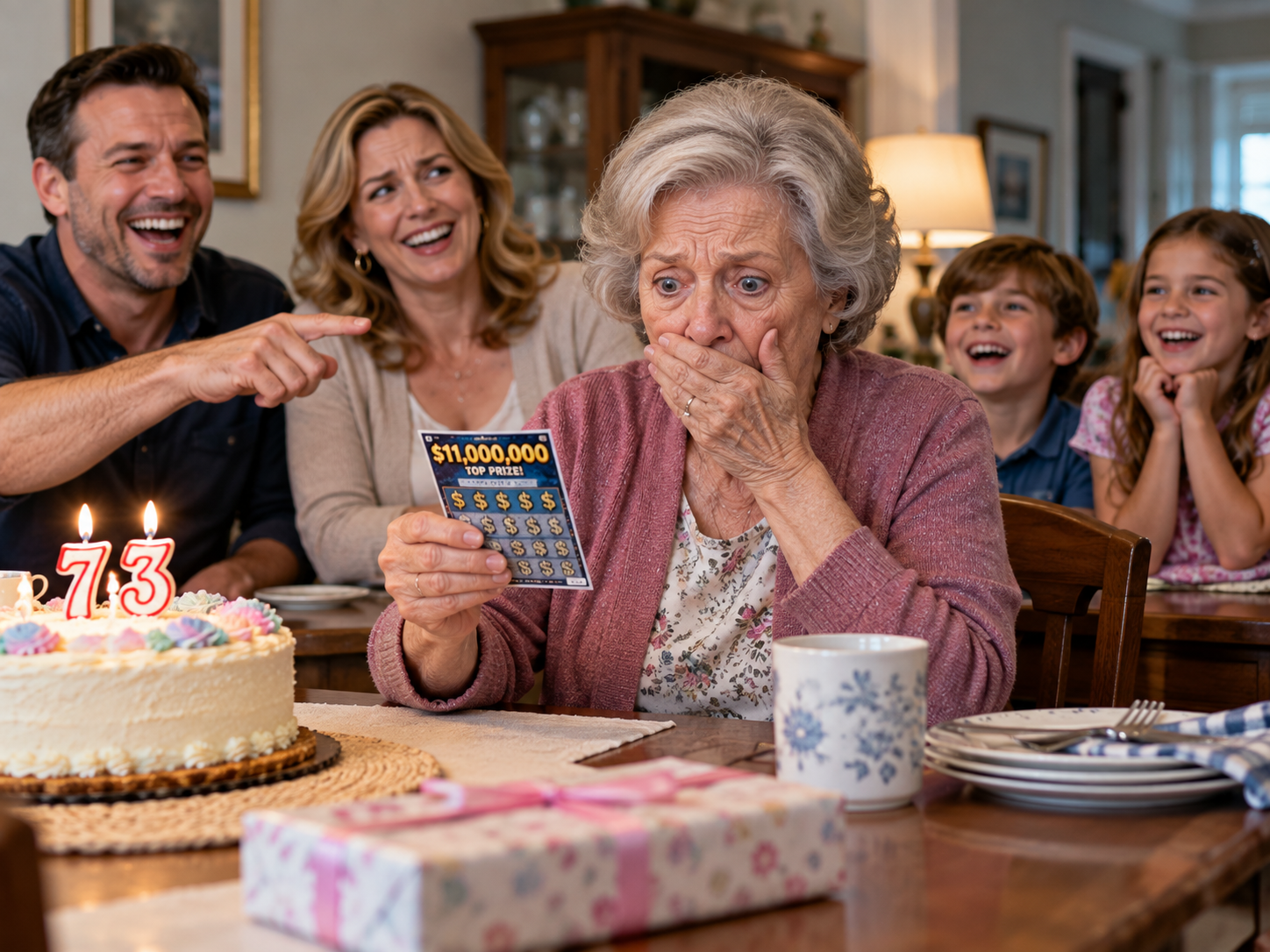
The ticket cost two dollars. The little white sticker was still stuck to one corner, and I could see it clearly under the dining-room light. Paige had not even bothered to remove it before handing it to me.
It was my seventy-third birthday, and the cake I had baked myself was leaning slightly toward the left because the frosting had softened. Graham was topping off his wine. Owen and Chloe were quietly arguing over a phone charger. Paige pushed the ticket toward me with a smile that did not quite reach her eyes.
“Go ahead, Evelyn. Maybe this is the night you become rich.”
Graham laughed. “If she wins anything, Mom can finally buy us coffee.”
Paige shook her head. “I was thinking more along the lines of bus fare.”
The children laughed because their parents did. I smiled because I had learned, over the previous few years, that defending yourself against every small insult can leave you exhausted while changing nothing. I reached for a quarter beside Graham’s keys and began rubbing it over the silver coating.
Nobody cared enough to watch.
That was fortunate.
The first symbol appeared. Then another. Then a third.
My hand stopped.
I checked the instructions printed along the bottom. I checked the symbols again. The room seemed suddenly smaller, as though the walls had moved inward while everyone else continued behaving normally.
Eleven million dollars.
That was the advertised prize.
For several seconds, I could hear Graham talking about Owen’s soccer practice, but his voice sounded distant. My heart was beating so hard that I could feel it beneath my jaw. I thought perhaps I had misunderstood the rules. Surely a two-dollar joke from a gas station could not have changed my life beneath a homemade birthday cake.
“Anything?” Graham asked.
I folded the ticket before he could reach for it.
“No bus fare,” I said.
Paige laughed and began collecting plates. “I knew I should have bought you the crossword one.”
I slipped the ticket into my cardigan pocket.
Nobody noticed.
That became the first thing I learned about winning money: sometimes the most important secret is not the amount itself, but how little anyone notices you holding it.
My name is Evelyn Mercer. By then, I had lived with Graham, Paige, Owen, and Chloe for nearly four years. My husband, Thomas, had been dead long enough that the sharpest part of grief had faded, but not long enough for his absence to feel ordinary.
We had been married for forty-six years.
After he died, Graham insisted I move in with his family. He told me he worried about me living alone. He said there was plenty of room. He said he wanted me close.
At the time, those words felt like love.
I packed my clothes, Thomas's photographs, several boxes of books, and the quiet habits of a woman who had spent most of her adult life sharing a home with someone else.
At first, everything really was gentle.
Owen used to climb onto my lap before school. Chloe would bring me her hairbrush and ask me to braid her hair. Graham sometimes brought me coffee without being asked. Paige asked my opinion about curtains and paint colors.
I cooked because I enjoyed cooking.
I did laundry because I was already standing near the machine.
I bought groceries because the supermarket was on my walking route.
I drove the children places when I could.
None of those things felt like sacrifice.
The trouble came quietly.
The grocery list stopped being a question and became a text message. Graham stopped asking whether I had plans before telling me he and Paige needed childcare. If dinner was late, people asked what had happened. If I left dishes in the sink because my knees hurt, Paige washed them with the clipped movements of someone correcting a mistake.
I still had a bedroom.
My clothes were still in the closet.
My books still stood on the shelves.
But I had slowly become less like a member of the household and more like the mechanism that kept the household running.
Six months before my birthday, I learned how Graham and Paige had begun describing me when they thought I could not hear.
I was carrying clean towels down the hallway when I heard my name from the kitchen.
I stopped.
Paige sounded tired.
“Your mother is becoming a burden, Graham.”
There was a pause.
Then Graham sighed.
“What am I supposed to do? She’s my mother.”
I stood there with the towels pressed against my chest.
I waited for him to say something else.
He didn't.
He did not say that I helped.
He did not say that I belonged there.
He did not say that he loved me.
He simply sounded trapped by the problem of me.
I walked upstairs without making a sound.
I put the towels away.
Then I sat on my bed and stared at a photograph of Thomas until the afternoon light disappeared.
I never confronted Graham.
Perhaps I should have.
But something about that conversation told me that reassurance would not solve what I had heard. If someone has begun thinking of you as a burden, asking them whether they still love you does not necessarily change the answer.
So when the two-dollar ticket became worth millions, I kept my mouth shut.
That night, after everyone went to bed, I locked my bedroom door.
I placed the ticket beneath my lamp.
Then I checked it again.
And again.
I used my old tablet, turned the screen brightness down, and verified the prize information twice. My fingers trembled so badly that I had to put the tablet on the nightstand.
The ticket was real.
The prize was real.
The number was real.
Eleven million dollars before taxes and payout adjustments.
Thomas would have known what to do.
That was my first thought.
My second was more frightening.
I could not tell anyone.
Not yet.
Graham was my only child. Under different circumstances, I would have called him immediately. But when I imagined walking downstairs and telling him, I did not picture an embrace.
I pictured Paige's expression changing.
I pictured Graham silently calculating mortgages, school expenses, retirement plans, car payments.
Maybe that was unfair.
Maybe four years of feeling useful had made me suspicious.
But money that large does not simply solve problems.
It changes the shape of every problem around it.
The following Monday, I told Paige I had a dental appointment.
Instead, I took a taxi downtown with the ticket sealed inside an envelope beneath my blouse.
Martin Hale had handled some of Thomas's estate paperwork years earlier. His office looked almost exactly as I remembered it: old books, dark wood, the faint smell of coffee, and papers arranged in neat stacks.
He examined the ticket without speaking.
Finally he looked up.
“Who knows?”
“No one.”
“Your son?”
“No.”
“Paige?”
“No.”
He leaned back.
“Keep it that way for now.”
I had expected him to tell me I was being overly cautious.
He did not.
Instead, he asked questions I had never considered.
Where had I bought the ticket? Had Paige clearly given it to me? Did anyone have access to my accounts? Was my will current? Did Graham have any authority over my finances? Did I own property? Did I have debts?
By the time Martin finished, the ticket no longer felt like a miracle.
It felt like something enormous that could become dangerous if handled carelessly.
Over the next several weeks, he helped me claim the prize as privately as the law allowed.
The money left me stunned.
Even after taxes and the payout structure were considered, I had more money than Thomas and I could have accumulated in several lifetimes.
Martin helped me separate accounts, update my estate documents, and put protections around the money.
The first thing I asked him to establish was for Owen and Chloe.
“Education trusts,” I said.
Martin looked at me.
“You want the children to have access?”
“For education. Not their parents.”
He nodded slowly.
“I don't want Graham or Paige borrowing against it,” I said. “I want the money to belong to Owen and Chloe.”
“That can be arranged.”
The trusts were funded generously enough to give both children a secure educational future. Their parents would not control the principal.
That decision mattered to me.
I still loved my son.
I was not trying to punish him.
But loving someone does not require handing them every door key to your financial life.
Before I left Martin's office, he gave me one final piece of advice.
“Don't suddenly become somebody else.”
I smiled.
“I’m seventy-three. I think the opportunity has passed.”
He smiled back.
“You'd be surprised what money can do.”
I went home and changed almost nothing.
I still clipped coupons.
I still bought store-brand flour.
I still made Graham's favorite chicken stew.
I still drove Chloe to appointments and waited in the rain for Owen after soccer.
Paige still left grocery lists on the counter.
Graham still asked me to watch the children when he and Paige had plans.
But inside me, something had shifted.
I knew I could leave.
That knowledge changed everything.
When Paige criticized the detergent I bought, I no longer felt trapped by her displeasure.
When Graham casually told me I would need to watch the children on Saturday, I told him I already had plans with Ruth.
He stared at me.
“Can't you move them?”
“No.”
“We already bought tickets.”
“I’m sorry.”
He waited for me to give in.
I didn't.
Eventually he said, “Okay. I'll figure something out.”
I went upstairs afterward and sat on my bed.
Nothing had collapsed.
Graham had survived.
The family had survived.
The world had continued.
I had discovered something more valuable than the money.
I had discovered that saying no was possible.
Months later, Martin mentioned that the owner of the house Graham and Paige rented was considering selling.
I looked around the kitchen while he explained.
The refrigerator was covered with school notices. There was a dent in the pantry door from an old scooter accident. Thomas had helped Graham install shelves in the garage before he became sick.
It was not my house.
But my grandchildren's lives were rooted there.
“How much?” I asked.
Martin told me.
“And can it be purchased without my name appearing prominently?”
“Yes.”
“Look into it.”
Three weeks later, T&E Property Holdings bought the house.
The initials were Martin's idea.
Thomas and Evelyn.
Thomas had used those letters on his old business invoices and boxes for years.
Graham did not recognize them.
At dinner, he mentioned that an investment company had bought the property.
“T&E Property Holdings,” he said.
Paige frowned.
“Should we worry?”
“Nah. The lease stays the same.”
I calmly served myself another spoonful of potatoes.
For the first time in my life, my son was paying rent on a house I owned.
He had no idea.
I did not buy it to control him.
I told myself I was protecting the grandchildren's home.
For a while, I believed that was the whole truth.
Then Ruth found a cottage near Wilmington.
She called one afternoon.
“I found your house.”
“I’m not looking for a house.”
“Yes, you are. You just haven't admitted it.”
The cottage had two bedrooms, old hardwood floors, a small porch, rose bushes, and a kitchen painted a warm, cheerful yellow.
One window stuck in humid weather.
The porch railing leaned slightly.
The cabinets needed work.
I loved it immediately.
I could imagine Thomas's photograph near the refrigerator. I could imagine books on the shelves and a kettle on the stove. Most importantly, I could imagine nobody telling me what room I was allowed to occupy.
“I want it,” I told Ruth.
We bought it quietly.
I furnished it slowly.
An oak table.
A blue sofa.
A brass reading lamp.
Guest beds.
Curtains.
Herbs by the kitchen window.
I still did not move.
Some part of me was waiting for Graham to notice that I had begun creating a life outside his house.
He didn't.
Then November arrived.
One evening, Graham placed a glossy brochure beside my dinner plate.
“Mom,” he said, “Paige and I have been talking.”
Paige smiled too brightly.
The brochure showed an older couple walking beside a pond.
Across the top were the words PINE HARBOR SENIOR LIVING.
I looked at the photograph.
Then at my son.
Paige opened the brochure.
“They have independent living. Meals. Transportation. Activities.”
I looked at the floor plan.
It was tiny.
“You chose a room?”
Graham shifted in his chair.
“We put down a refundable deposit.”
“When?”
“Last week.”
I looked at him.
“When were you planning for me to move?”
“January first.”
It was November.
“Why January?”
Graham hesitated.
“Owen is getting older. He needs more privacy.”
The answer settled over me.
My bedroom.
They wanted my bedroom.
“You've been discussing giving Owen my room?”
No one answered.
“How long?”
Graham looked down.
“A few months.”
I folded my hands in my lap.
They had planned where I would live, selected my room, chosen my moving date, and paid a deposit without asking me once.
Paige reached across the table.
“Evelyn, you'll have your own life.”
I looked at her.
My own life.
The phrase almost made me smile.
They had decided what my own life would look like.
I folded the brochure carefully.
“All right.”
Paige blinked.
“You'll go?”
“I think January first is an excellent date for everyone to start living differently.”
Relief crossed their faces almost immediately.
That was the moment I stopped wondering whether I should leave.
I finished dinner.
I loaded the dishwasher.
I wiped the counter.
Then I went upstairs, closed my bedroom door, and called Martin.
He answered on the second ring.
“Evelyn?”
“I’m ready.”
A pause.
“Tell me what you want done.”
I looked at the Pine Harbor brochure beside my suitcase.
“Everything.”
Click Here to continue read next: PART2: While They Prepared My Small Room Somewhere Else, I Began Quietly Moving My Life Toward a Home Nobody Had Chosen for Me
A Birthday Joke Became Worth Millions Before Anyone at the Table Realized I Had Just Found My Way Out
Part 1 of 8

