
The first time Julian called me from the hospital, I knew before he spoke that something had happened.
His breathing was uneven.
“Mom?”
I sat down at the kitchen table.
“What is it?”
“She’s here.”
For a second, I did not understand.
Then I did.
“The baby?”
“Yes.”
His voice broke into a laugh.
“She’s here.”
I covered my mouth.
“Is she okay?”
“She’s perfect.”
I started crying.
There was no way around it.
Joy and fear arrived together.
I was going to be a grandmother.
My son was going to be a father.
And somewhere inside that hospital, a little girl had just entered a family that had already been fractured before she was born.
“What is her name?” I asked.
“Sophia.”
I repeated it quietly.
“Sophia.”
Three weeks later, Julian brought her to our house.
I knew he was coming because he had called that morning.
But when the car pulled into the driveway, I still stood at the window watching.
He came around the passenger side and carefully lifted the baby carrier.
Tom was outside.
I opened the door before Julian reached it.
He stopped on the porch.
For a moment, neither of us spoke.
Then he smiled.
“Mom.”
I looked at the tiny bundle wrapped in a pale yellow blanket.
“Is that my granddaughter?”
He nodded.
“Meet Sophia.”
I reached for her.
The first time I held that child, something inside me became quiet.
She was so small that her hand disappeared around one of my fingers.
Her face was wrinkled from sleep.
I whispered, “Hello, sweetheart.”
Julian stood beside me.
I looked at him.
His eyes were wet.
“I want her to know you,” he said.
“Always.”
“She will.”
He nodded.
“I hope so.”
I looked down at Sophia.
“You're going to have a very loud grandmother.”
Julian laughed.
“That part I believe.”
But the months that followed were not simple.
Rachel and Julian separated before Sophia was born.
There was no dramatic scene.
No single conversation that solved everything.
There were arguments, lawyers, tears, accusations, and long stretches when neither side knew what the next week would look like.
Stella blamed me.
She left a voicemail saying I had ruined her daughter's marriage.
I listened to the first few seconds.
Then I deleted it.
I had learned something important.
Not every accusation deserved an answer.
Julian focused on Sophia.
He attended appointments.
He learned how to prepare bottles.
He kept spare diapers in the car.
He carried snacks in every pocket.
He tried to braid the baby's hair once she grew enough to have any, and the result was so crooked that even he laughed.
He became the kind of father I had always hoped he would become.
He was not perfect.
But he showed up.
That mattered.
My relationship with him also changed.
I stopped rescuing him.
If he made a mistake, I let him own it.
If he was upset, I listened without immediately fixing the problem.
If he needed help, I helped when I could.
But I stopped confusing love with doing everything for him.
It was difficult.
Sometimes the old habit returned.
Then I remembered the containers.
Not the plastic itself.
What they had represented.
A lifetime of assuming that because I loved people, I should absorb whatever they handed me.
I did not want Sophia growing up believing that was what love looked like.
So I changed.
Not overnight.
Quietly.
One boundary at a time.
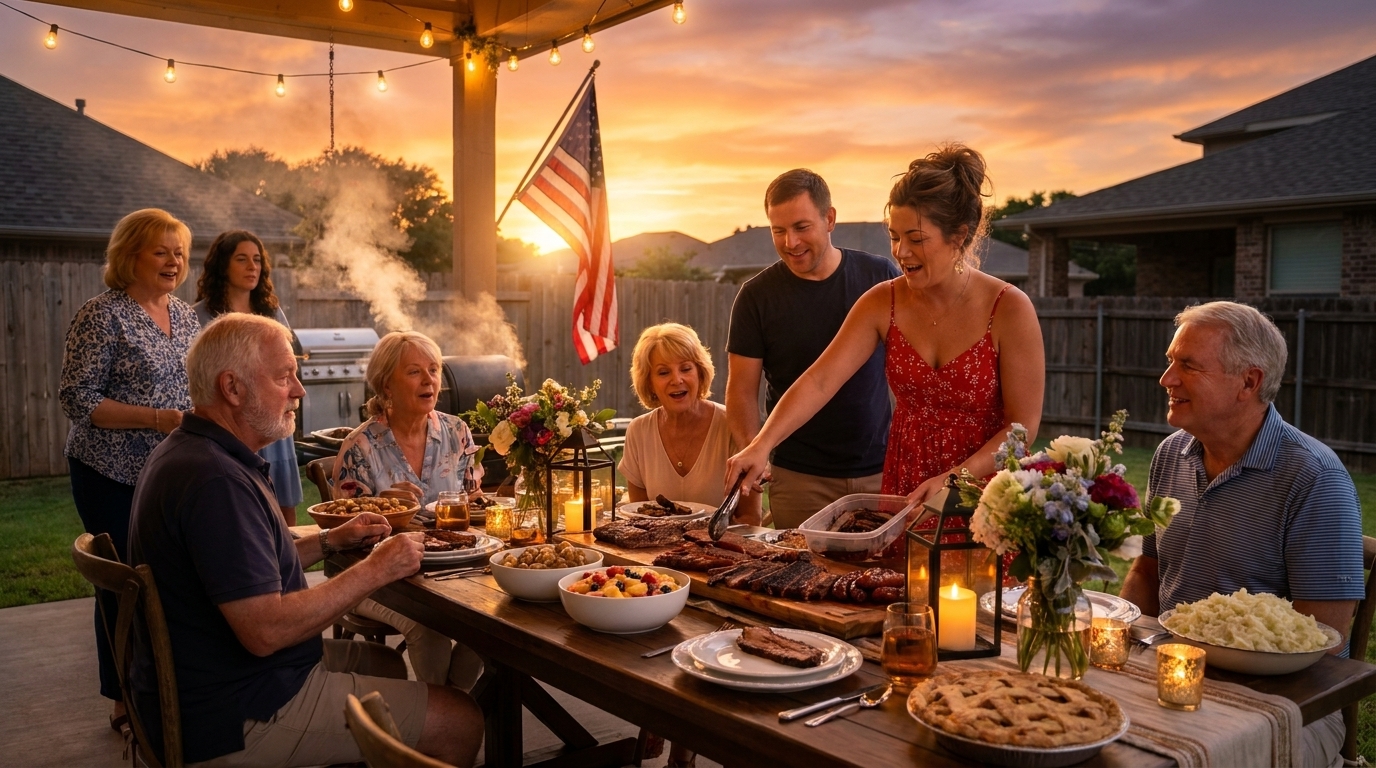
Two years after the barbecue, I stood in the same kitchen preparing another Sunday meal.
This time, I bought eleven pounds of beef.
Eleven.
Tom noticed the difference.
“Only eleven?”
I smiled.
“Plenty.”
He nodded.
“You've finally learned.”
“No.”
I looked toward the backyard.
“I've finally stopped trying to feed twenty people when eleven pounds will do.”
He laughed.
Outside, the grill was heating.
Isabella had driven up from San Antonio for the weekend.
Erica and Louisa were coming later.
Both had already announced what they were bringing.
Corn salad.
Brownies.
Bread.
Nobody had asked what I would provide for them.
They had simply decided to contribute.
Julian was in the living room picking up Sophia's toys.
Sophia herself was in the backyard.
She wore pink sneakers and was chasing butterflies across the grass.
Then I heard her voice.
“Grandma Betty!”
I wiped my hands on a towel.
“What?”
“Come see!”
I walked outside.
She was standing near the patio stones, holding a tiny white daisy.
She raised it toward me.
“Look.”
I crouched beside her.
“That's beautiful.”
“Can we save it?”
I smiled.
“We can.”
We found a small glass.
We filled it with water.
Sophia placed the daisy inside.
Then she carried it carefully to the table.
I set it in the middle.
For a moment, I looked at that table.
The same patio.
The same wooden chairs.
The same grill.
Even the same tablecloth I had once inherited from my mother.
I still used it sometimes.
But the reason had changed.
I no longer used old things to prove that my home mattered.
I used them because they mattered to me.
Sophia climbed into a chair.
She looked at me seriously.
“Daddy says you're brave.”
I glanced toward the doorway.
Julian was pretending not to listen.
“Does he?”
Sophia nodded.
“He says you tell the truth even when people get quiet.”
My throat tightened.
I sat beside her.
“Sometimes being brave just means telling someone when they've crossed a line.”
She considered that.
“Like when Mason takes my crayons?”
I smiled.
“Exactly.”
“What do I say?”
“You can say, ‘Please stop.’”
She nodded solemnly.
“Please stop.”
“Good start.”
She smiled and ran back outside.
Julian entered the kitchen.
“She gets that serious look from you.”
“I don't know what you're talking about.”
He smiled.
Then he began setting the table.
I watched him for a moment.
He picked up plates.
Counted forks.
Placed napkins.
He did not ask where anything was.
He had learned.
That small fact moved me more than any apology.
“Mom?”
“Yes?”
“Do you ever think about that day?”
I knew exactly which day he meant.
“Yes.”
He lowered his eyes.
“I do too.”
We stood in silence.
“I wish I had handled it differently,” he said.
“You did.”
He looked at me.
“And you changed.”
“Yes.”
“I should have stood beside you.”
“You should have stood for what was right.”
He nodded.
“I know.”
That was enough.
Not because the past disappeared.
It didn't.
But because we no longer pretended it had been something else.
Erica arrived with corn salad.
Louisa came carrying brownies.
Isabella brought fresh bread.
Everyone put something on the table.
Everyone helped.
Tom sliced the beef.
Julian carried plates outside.
Sophia sat beside me, swinging her legs.
Nobody reached for a container before dinner was finished.
That detail made me smile.
After we ate, I packed leftovers myself.
A little beef for Erica.
Potatoes for Louisa.
A plate for our elderly neighbor, Mr. Hernandez.
A small container for Julian.
“Sophia likes the brisket,” I said.
Julian smiled.
“She does.”
He took the container.
“Thank you.”
I nodded.
This time, I had offered.
That was the difference.
No one had taken.
The sun dropped behind the houses.
The backyard filled with the soft golden light of evening.
Sophia chased bubbles while Tom and Isabella talked near the fence.
Julian sat on the porch steps watching his daughter.
I stood in the kitchen doorway.
For years, I had believed that a full table meant a successful family.
Now I understood that a full table meant nothing if everyone sitting around it believed they were entitled to what the person at the head had provided.
Love was not measured by how much one person could give.
It was measured by whether everyone could give something back.
Later that night, after everyone had gone home, Tom and I sat beneath the string lights.
The patio was quiet.
There were a few crumbs on the table.
A glass sat beside Tom's chair.
He reached for my hand.
“Do you ever regret it?”
I knew what he meant.
“Those three words?”
He nodded.
I looked across the yard.
I remembered Rachel's red dress.
Stella's expression.
The containers lined up across my table.
Julian holding the tongs.
The silence after I told them to leave.
I remembered the weeks without my son.
The drive to San Antonio.
Isabella's porch.
Julian crying in her living room.
The news that Sophia was coming.
The first time I held my granddaughter.
I thought about everything I had lost.
Then everything I had gained.
“No,” I said.
Tom squeezed my hand.
“I don't regret it.”
He waited.
“Those words didn't just end a barbecue.”
I looked toward the house.
“They ended the version of me who believed love required me to swallow every insult.”
Tom nodded.
“They ended the habit of smiling when someone crossed a line.”
I took a breath.
“And they taught my son something he needed to learn.”
“What?”
“That being a good husband doesn't mean becoming blind to right and wrong.”
Tom smiled.
“You're proud of him.”
“I am.”
I looked toward the driveway.
“He had to become a father before he fully understood what kind of man he wanted to be.”
Tom leaned back.
“And you?”
I smiled.
“I had to become something too.”
“What?”
“His mother.”
He looked confused.
“I thought you already were.”
“I was.”
I laughed softly.
“But I thought being his mother meant protecting him from consequences.”
I shook my head.
“Sometimes being his mother meant letting him face them.”
The next morning, I woke early.
I went into the kitchen.
I made coffee.
I opened the refrigerator.
The small container of brisket was still there.
I smiled.
Then I heard footsteps.
Sophia had spent the night with us.
She appeared in the doorway wearing pajamas, her hair tangled from sleep.
“Grandma?”
“Yes?”
“Can I have breakfast?”
I opened my arms.
“Always.”
She climbed onto the chair.
I began making toast.
For years, I had thought my greatest role in a family was being the person who provided everything.
Food.
Comfort.
Money.
Forgiveness.
A place to gather.
I no longer believed that.
I still loved cooking.
I still loved setting a table.
I still loved sending people home with leftovers.
But I had learned the difference between generosity and surrender.
If someone came through my door, they would be welcomed.
But they would also be expected to respect the person opening it.
That was not cruelty.
That was dignity.
And dignity was not something I needed permission to have.
I was still Betty Miller.
I was still Tom's wife.
Still Julian's mother.
Still Sophia's grandmother.
Still the woman who woke early on Sundays and seasoned the meat before anyone else was awake.
But I was no longer the woman who believed love required endless swallowing.
And if anyone ever forgot that again, I knew exactly what I would say.
Click Here to continue read next: PART5: The Peace I Thought We Had Built Began to Crack When Rachel Returned With a Request Nobody Expected Me to Accept
The Barbecue Was Meant to Bring My Family Together, But the Containers in My Daughter-in-Law’s Bag Made Me Question Why They Had Come
Part 4 of 8

