
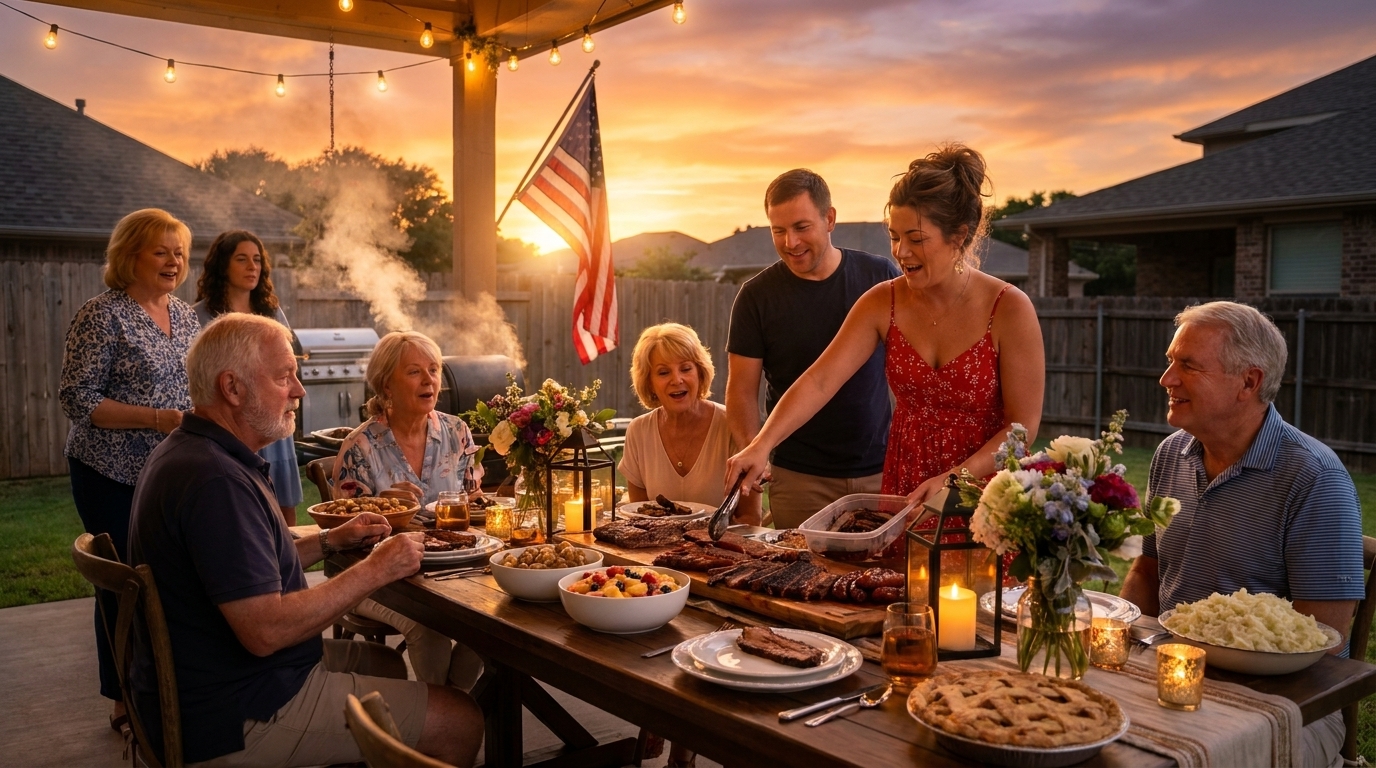
The first thing I noticed was not the food disappearing from my table. It was the sound of plastic lids knocking together inside my daughter-in-law’s canvas bag.
I was standing in the kitchen doorway with a stack of clean plates balanced against my hip when Rachel shifted the bag from one shoulder to the other. The movement made the containers inside bump together again. It was a small sound, almost harmless. Yet something about it made me stop.
Behind me, the kitchen was warm from the oven. The smell of roasted potatoes, onions, garlic, and black pepper hung in the air. Outside, my husband, Tom, was tending the grill beneath the pecan tree. Smoke drifted past the screen door and disappeared into the bright Texas afternoon.
This was supposed to be an ordinary Sunday family barbecue.
Instead, I found myself staring at a bag full of empty containers and wondering whether my own son had brought people to my home who no longer understood the difference between being welcomed and being entitled.
My name is Betty Miller. I was sixty-five years old then, and for nearly four decades I had believed that one of the most important things a family could have was a house where everyone knew they could come through the door hungry and leave feeling cared for.
Our home sat in a quiet neighborhood outside Fort Worth. Nothing about it was impressive. The brick patio had a crack near the steps. The wooden fence leaned slightly after years of wind and summer storms. Tom's old grill had a handle he had repaired twice instead of replacing.
But I loved that backyard.
It had held birthday parties, graduation lunches, Fourth of July cookouts, Easter afternoons, and countless Sundays when somebody stayed longer than expected because the conversation was too good to end. Children had run through the grass. Adults had argued over football. Neighbors had borrowed chairs. Plates had been passed from hand to hand until there was nothing left except crumbs and sauce stains.
Tom used to say I had turned feeding people into a competitive sport.
That Saturday morning, he sat across from me at the kitchen table while I wrote the menu in a small spiral notebook. His newspaper was folded beside his coffee.
“How many people are actually coming?” he asked.
“Eight.”
He raised an eyebrow.
I kept writing.
“Betty.”
“What?”
“You've written enough food for twenty.”
“Then we'll have leftovers.”
“We always have leftovers.”
“That sounds like a complaint.”
“It is an observation.”
I smiled and added another line to the list.
Brisket. Ribs. Skirt steak. Sausages. Potatoes. Salad. Tomatoes. Grilled onions. Bread. Cheese. Iced tea. Lemonade.
Tom leaned back in his chair.
“Are you feeding the neighborhood too?”
“Only if they happen to walk through the gate.”
He laughed, and I laughed with him.
That was how our marriage had worked for thirty-nine years. He teased. I ignored him. Then he helped anyway.
Around noon, I drove to Davis Market for the meat.
The heat was already rising from the pavement, making the parking lot shimmer. Inside the market, the air-conditioning felt almost cold against my arms. Mr. Davis was behind the butcher counter, wearing the same white apron I had seen him wear for years.
“Well, Mrs. Miller,” he said. “What's the occasion?”
“Family barbecue.”
He looked at my list.
“Family barbecue?”
“Yes.”
“You're buying like you're expecting the mayor.”
“Just give me the good cuts.”
He laughed.
He selected a brisket with a thick layer of fat, several meaty ribs, a well-marbled skirt steak, and thick steaks Tom liked to slice after grilling. When everything was weighed, he looked at the scale and then at me.
“Thirty-three pounds.”
“That sounds about right.”
“For eight people?”
I shrugged.
“I like having enough.”
He wrapped the meat carefully and handed me the bags.
The bill came to two hundred and fifty dollars.
I paid without hesitation.
At the time, that number did not bother me. I thought of it as money spent on people I loved. I had always thought that way. Food was never simply food in my house. It was preparation. It was hospitality. It was my way of saying, You matter enough for me to make an effort.
I did not yet understand that sometimes generosity teaches people the wrong lesson.
My son Julian was thirty-two. He had always been a thoughtful child. When he was little, he would drag a chair across the kitchen floor so he could help me set the table. As a teenager, he carried groceries without being asked. Even as an adult, he used to call me on Sundays just to ask how I was doing.
Then he married Rachel.
I never blamed her for every change in him. People grow up. Marriage changes priorities. Adults build lives separate from their parents.
But I noticed things.
Julian began checking Rachel's expression before answering questions. If she made a sharp remark, he laughed as though he hoped nobody else had heard it. Plans were canceled when she was not in the mood. Decisions that once took him five minutes suddenly required a conversation with her first.
His voice around her became careful.
That bothered me more than anything.
Rachel was polished. Her hair always looked freshly styled. Her clothes were expensive without being flashy. Her nails were immaculate. She wore perfume that lingered in a room after she left.
She was never openly cruel.
She was subtler than that.
She could insult something while making it sound like praise.
Her mother, Stella, was much the same.
Stella was sixty, divorced, and extremely proud of being “particular.” That was the word Rachel used whenever I mentioned her mother's tendency to criticize things.
I tried to include Stella in family gatherings because I told myself she lived alone and perhaps needed company.
Looking back, I realize I spent too much time finding explanations for behavior that needed no explanation.
Saturday afternoon, I called Julian.
“Hey, Mom.”
“Are you still coming tomorrow?”
“Of course.”
“About noon?”
“That's right.”
“Good. I'll have everything ready.”
There was a short pause.
“Mom?”
“Yes?”
“Rachel's bringing her mother.”
I smiled even though he could not see me.
“Stella is welcome.”
He exhaled.
“Thanks.”
That single word stayed with me.
It sounded like relief.
I should have asked why.
Instead, I told him I would see them the next day.
Sunday began before sunrise.
I seasoned the brisket while the coffee brewed. I prepared the potatoes, chopped vegetables, washed lettuce, sliced tomatoes, and mixed the dressing. By nine o'clock, the house smelled like a restaurant I had somehow opened inside my own kitchen.
Tom went outside with his old Texas Rangers cap and started preparing the grill.
“You happy?” he called through the screen door.
“I am.”
And I meant it.
At eleven, my nieces Erica and Louisa arrived.
Erica carried an apple pie wrapped in a dish towel. Louisa brought fruit salad and a bottle of wine.
“Aunt Betty,” Erica said, kissing my cheek, “it smells incredible.”
“What can I do?” Louisa asked.
I pointed toward the table.
“Plates first. Then help me with the salad.”
Neither of them asked what they were going to be served.
They simply helped.
That was the kind of family I understood.
At twelve-thirty, the doorbell rang.
Julian stood on the porch.
“Hi, Mom.”
For a moment, I saw the little boy who used to pull a chair across the kitchen floor.
I hugged him.
He hugged me back.
Then Rachel stepped forward.
She wore a bright red sundress and delicate sandals that looked completely unsuitable for grass. Stella followed behind her in beige trousers, carrying a large handbag.
“Betty,” Rachel said, leaning in for a brief air kiss. “Your house smells amazing.”
“Thank you.”
Stella looked around.
“Very cozy.”
Her eyes moved over the hallway, the old wooden cabinet, the framed photographs.
Then she smiled.
“Very lived-in.”
I knew exactly what she meant.
I smiled anyway.
“Come on. Everyone's outside.”
Rachel followed me through the house.
That was when I saw the bag.
A large canvas tote hung from her shoulder.
The top was open.
Inside were plastic food containers stacked neatly on top of one another.
Stella carried another grocery bag.
When she moved, I heard more lids knocking together.
I stopped for half a second.
Rachel noticed me looking.
“What?” she asked.
“Nothing.”
I continued walking.
I told myself they might have brought something.
Dessert, perhaps.
Maybe containers for something I had promised to send home.
There was always an innocent explanation.
At least, that was what I wanted to believe.
When we stepped outside, Tom greeted Julian and then looked toward Rachel and Stella.
“Glad you made it.”
Stella smiled.
“What a beautiful spread.”
Tom, proud as ever, gestured toward the grill.
“Betty bought thirty-three pounds of beef.”
Rachel's eyes widened.
Stella looked at her.
Rachel looked at Stella.
It lasted less than a second.
But I saw it.
There was no surprise in their expressions.
There was calculation.
“Thirty-three pounds?” Rachel said.
She laughed.
“No wonder we brought containers.”
The words landed differently than she intended.
The patio seemed to become strangely quiet.
Rachel blinked.
“I mean—” she said quickly. “You always make so much food, Betty. We just didn't want anything to go to waste.”
I looked at the tote bag again.
Nothing had been served yet.
I said nothing.
Lunch began.
At first, everything appeared normal.
Rachel and Stella sat down without asking whether they could help. I told myself not to be petty. They were guests.
Then Stella commented on the flower bed.
“Your roses are doing surprisingly well in this heat.”
“Thank you.”
“That one near the fence looks tired, though.”
I had watered that rose that morning.
Rachel touched the tablecloth.
“This is cute.”
“It's my mother's.”
“Oh.”
She paused.
“That explains it.”
I looked at her.
She smiled.
I smiled back.
Tom began serving the sausages.
Stella took a bite.
“Good,” she said. “A little salty for me.”
Rachel tasted the salad.
“I usually use a lighter dressing.”
Then she took another bite.
“This is nice, though.”
Julian sat beside her.
He said nothing.
That silence bothered me.
When Tom brought out the brisket, the conversation finally stopped.
He had done a beautiful job.
The outside was dark and crisp. The meat separated under the knife. The smell alone made everyone lean forward.
I felt proud.
For perhaps ten seconds.
Rachel reached for her phone.
“Wait. Don't cut everything yet.”
She stood and began photographing the food.
Stella took out her own phone.
“My friends are going to be jealous.”
Rachel laughed.
“They'll think we eat like this every Sunday.”
I heard the word “we.”
I thought of the morning I had spent cooking.
I thought of the two hundred and fifty dollars.
Then I thought of the containers waiting inside her bag.
Still, I said nothing.
People ate.
Rachel took brisket twice.
Stella asked Tom for one of the larger ribs.
Julian ate quietly.
After a while, Rachel leaned back and rubbed her stomach.
“Oh, wow.”
Stella sighed.
“We'll never finish all this.”
“It would be a shame to waste it,” Rachel replied.
Then she looked at Julian.
“Babe, can you get my bag?”
Julian stood.
He did not ask me.
He did not look at Tom.
He simply went inside.
My hands became cold.
A moment later, he returned carrying Rachel's canvas tote.
She opened it.
One container.
Then another.
Then another.
The empty plastic boxes appeared on the table in a neat little row.
Stella began opening her own bag.
Suddenly, my family lunch looked like an inventory operation.
Rachel pointed toward the serving platter.
“Put some brisket in that one.”
Julian picked up the tongs.
“And get some of the softer pieces.”
My son reached toward the meat I had spent all morning preparing.
I watched his hand move.
Tom stopped grilling.
Erica stopped folding napkins.
Louisa stood beside the drink pitcher without moving.
Julian lifted the first piece of brisket.
And I finally understood why Rachel had brought the containers.
Click Here to continue read next: PART2: My Son Reached for the Meat I Had Paid For, and I Realized the Real Problem Was Never About Leftovers
The Barbecue Was Meant to Bring My Family Together, But the Containers in My Daughter-in-Law’s Bag Made Me Question Why They Had Come
Part 1 of 8

