Sophie asked the question the following morning while we were eating breakfast.
“Why did Noah leave last night?”
I set down my coffee.
“He felt uncomfortable sleeping here, so he decided to return to the place where he is staying.”
“But you made his bed.”
“I did.”
“And we watched the animal program.”
“We did.”
She frowned at her cereal. “Wasn't he happy?”
I considered how to answer without making Noah's private feelings into a problem Sophie needed to solve.
“He enjoyed parts of the evening,” I said. “But enjoying a visit and feeling ready to sleep somewhere are different things.”
“Does he not like us?”
“I don't think that's what it means.”
Sophie looked unconvinced.
“Then why did he leave?”
I reached across the table and touched her hand.
“Because he has lived through a lot of changes. Sometimes a place can feel unfamiliar even when the people there are kind. Noah needs time to decide what feels safe to him.”
Sophie picked at a loose thread on her sleeve.
“Will he ever stay?”
“I hope he will, if that's what he wants and if the people helping him agree it's right. But we cannot make him do it.”
She nodded slowly.
“Can I ask him next time?”
“You can ask whether he wants to play or draw. But I think we should let him decide when he wants to talk about sleeping here.”
Sophie accepted that, although she looked disappointed. She had imagined having a brother who would share her room during storms, help her build complicated block towers, and tell her stories before bed. She was beginning to understand that the brother she had met was not a character who could step into those expectations simply because she wanted him to.
At our next visit, Noah arrived carrying a small bag of groceries.
Elena explained that he had asked to bring something to share. He had chosen a packet of biscuits and a bag of oranges from the local shop.
“I bought them with the money I was given,” he said, setting them on the table. “I don't want you buying everything.”
I felt an ache in my chest, but I did not tell him that he never needed to bring anything. That might have sounded like another attempt to remove his choice.
“Thank you,” I said. “We can share them.”
He looked relieved.
Sophie opened the packet of biscuits and arranged them on a plate. Noah watched her for a moment, then moved two of the biscuits closer together.
“Those are the chocolate ones,” he explained. “They taste better if you don't crush them.”
“I don't crush biscuits,” Sophie protested.
“You broke one in half last time.”
“That was on purpose.”
They began debating the proper way to eat biscuits, and soon the tension in the room eased.
Later, Noah asked whether he could look at the spare bedroom again. I took him upstairs and showed him the room without suggesting that he should use it. He walked around the bed, examined the lamp, and opened the wardrobe.
“Is this where my clothes would go?”
“If you decide you want to keep clothes here, we can make space.”
He ran his fingers along the empty shelf.
“Would you buy me new clothes?”
“If you need them, yes. But we can choose them together. You don't have to replace everything you own.”
He glanced at his backpack.
“I want to keep my hoodie.”
“Then we'll keep it.”
The hoodie was faded and torn, and part of me wanted to replace it immediately. But I understood that it was one of the few possessions Noah had carried through his years of uncertainty. Removing it without permission would have told him that my idea of what was better mattered more than his attachment to what he already had.
He looked around the room once more.
“Maybe I could stay here sometime.”
“Maybe,” I said. “We don't have to decide today.”
He seemed content with that answer.
Downstairs, Sophie was arranging colored pencils on the kitchen table. She had made a sign that read “ART CLUB,” though she had not asked Noah whether he wanted to join.
When he saw it, he stopped in the doorway.
“What's that?”
“An art club,” Sophie said. “You can join if you want. Or not.”
Noah examined the sign.
“Who runs it?”
“I do.”
“Are there rules?”
“Only three. Don't draw on the walls, don't take someone's pencil without asking, and don't tell people their pictures are bad.”
Noah thought for a moment.
“What if the picture is bad?”
“Then you can help them make it better if they ask.”
He smiled.
“That's a good rule.”
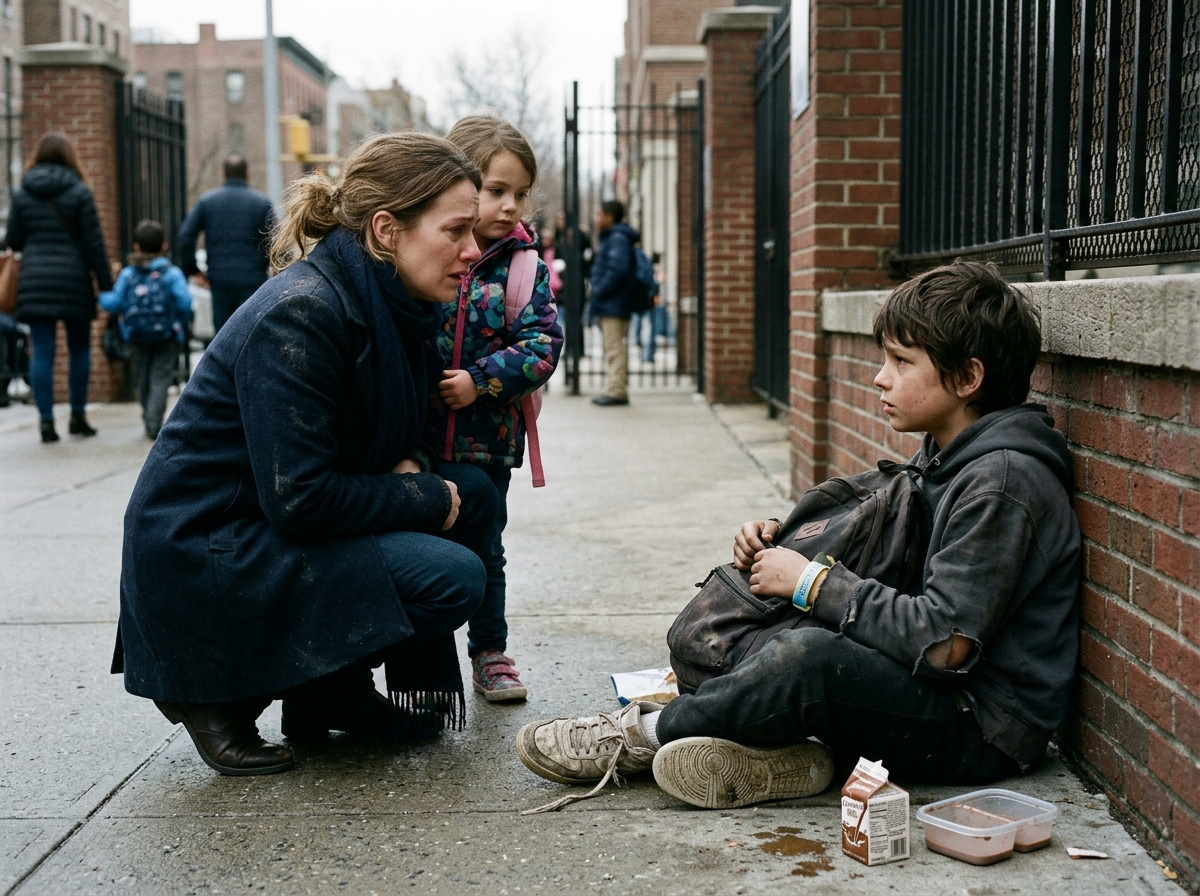
They spent the next hour drawing. Sophie made a picture of the garden, while Noah drew the school entrance. He did not include the students who had bullied him, but he drew the pavement where he had sat and the curb beside the road.
I noticed the detail and felt the old anger rise. I wanted to ask whether he still thought about that morning, whether the children had been punished, and whether he feared seeing them again. Instead, I let him decide what the picture meant.
When he finished, he turned the page around.
“This is where you found me.”
I nodded.
“Yes.”
“I thought you were going to tell me to leave, too.”
The words were quiet, almost matter-of-fact.
I pulled out the chair beside him.
“I'm sorry that you expected that.”
He studied the drawing.
“You didn't know me.”
“No. I didn't.”
“Why did you stop?”
I thought about the question. I could have said that it was the right thing to do, but that would have made the moment sound simple. I had stopped because I saw a child being humiliated, because I could not bear to watch, and because something about him had seemed familiar. The bracelet had changed everything that followed, but it had not been the reason I first intervened.
“Because those students were hurting you, and I knew it was wrong. You deserved someone to stop them.”
He nodded, then added a small figure beside the curb. The figure had long hair and a hand extended toward him.
“That's you,” he said.
I looked at the drawing.
“Thank you for including me.”
He shrugged, as though he were embarrassed by the exchange, and returned to his pencils.
That evening, after Noah left with Elena, Sophie asked whether she could put the drawing on the refrigerator.
“It's Noah's picture,” I reminded her. “We should ask him first.”
The next time he visited, Sophie showed him the refrigerator and asked whether he would like to display it there. Noah considered the idea, then agreed.
She placed it beside her bean-plant drawing.
For the first time, the refrigerator held something Noah had chosen to share with the household. It was a small act, but it mattered because he had made the decision himself.
The following week, Elena told me that Noah had been talking about the overnight visit. He had said that he felt embarrassed for leaving, but he was also glad he had been allowed to change his mind without an argument.
“He wants to try a longer visit again,” she said. “Not necessarily overnight yet. He would like to spend an entire afternoon here and have dinner.”
I agreed.
When Noah arrived, I did not mention the previous attempt. We made sandwiches, worked on a puzzle, and watched the rain gather in the garden. After dinner, he helped Sophie put away the pencils.
As he prepared to leave, he paused beside the spare bedroom door.
“Maybe next time,” he said.
I nodded.
“Whenever you're ready.”
He went downstairs and collected his backpack.
That night, Sophie asked whether Noah would ever become her brother in the way she imagined.
“He is your brother,” I said gently. “But the relationship will grow in its own way. You don't have to make it look like anyone else's family.”
She thought about that.
“Can I still hope he'll stay?”
“Of course.”
“And can he still leave if he wants?”
“Yes.”
She nodded, apparently satisfied that both things could be true.
After she went to bed, I sat in the living room and looked at the drawing on the refrigerator. The small figure beside Noah stood with one hand extended, but the picture did not show whether he had taken it.
That detail belonged to Noah.
I would not fill it in for him.
Click here to continue reading: PART 11: The School That Had Humiliated My Son Finally Asked Me to Help, but I Refused to Let His Pain Become a Public Story
The Blue Hospital Bracelet That Made a Mother Stop in the Middle of the Street
Part 10 of 28