The following Saturday, I prepared enough food for six people, although only four of us were expected to eat.
I noticed the mistake while arranging plates on the dining table. There was one for me, one for Sophie, one for Noah, and another for the support worker who would accompany him. The remaining two sat at the far end, untouched, their clean white surfaces reflecting the afternoon light.
For years, I had imagined what it might feel like to have my son back in my life. In those private fantasies, he was always older, standing in a doorway with questions I could answer and anger I could somehow endure. I had imagined apologizing, explaining the circumstances surrounding his birth, and eventually hearing him say that he understood.
I had never imagined that he might arrive hungry, inspect the room before sitting down, and keep his backpack beside his chair because he did not trust anyone enough to leave it elsewhere.
When the doorbell rang, I wiped my hands on a kitchen towel and hurried toward the entrance. Then I stopped myself. Noah had told Elena that he preferred not to be greeted with sudden hugs or excited questions, and I had promised to respect that.
I opened the door calmly.
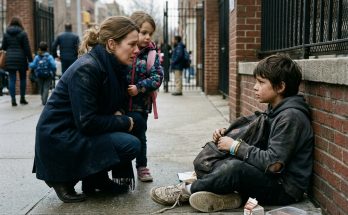
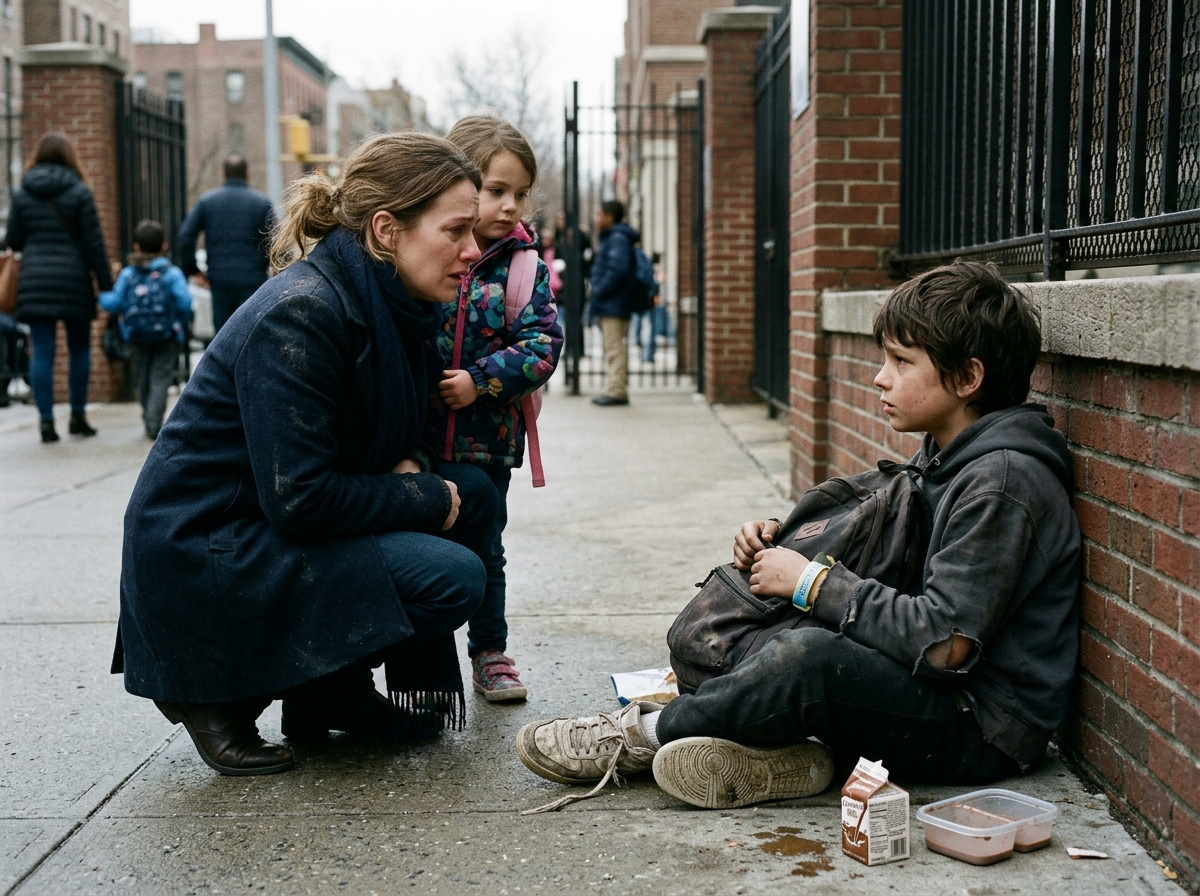
Noah stood beside Elena Ruiz, wearing a clean green sweatshirt and the same oversized sneakers he had worn during our first meeting. His backpack hung from one shoulder. The blue hospital bracelet was partly visible beneath his sleeve.
“Hi, Noah,” I said.
He looked past me into the house.
“Hi.”
“You're welcome to come in. We made lunch, but you don't have to eat if you aren't hungry.”
He glanced at Elena before stepping over the threshold.
Sophie appeared at the end of the hallway, holding a sheet of paper behind her back. She had spent most of the morning asking me whether she should wear her favorite dress, whether Noah liked drawing, and whether brothers were supposed to play the same games as sisters. Eventually, I had told her that she did not need to become a different person to make him comfortable.
Now she seemed to have remembered that advice.
“Hello,” she said. “I saved you something.”
Noah stiffened slightly.
“It's not a present,” Sophie added quickly. “Well, it is, but you don't have to keep it.”
She handed him the paper.
It was the drawing he had left behind during his previous visit. She had colored the house, added a crooked tree beside the door, and drawn a small blue circle in the sky. His name remained beneath the third figure.
Noah examined the page.
“You changed the tree.”
“It looked too small before.”
He ran a finger over the colored branches. “It's better.”
Sophie smiled. “I thought so.”
That small exchange eased the tension in the hallway. Noah removed his backpack but kept it beside his chair when we sat down to eat. He accepted a sandwich, a bowl of soup, and a glass of water. He thanked me after each item, and every time he did, I felt the urge to tell him he never needed to thank me for food.
I resisted.
Gratitude was his way of protecting himself, and I would not take even that small choice away from him.
Sophie talked about a classroom project involving plants. She had been assigned to grow beans in a clear container and had become convinced that the first sprout was responding to music.
“It's probably responding to sunlight,” I said.
“But I played it a song.”
“Perhaps it appreciates your musical taste.”
Noah looked up from his soup. “Plants don't understand songs.”
“You don't know that,” Sophie replied.
“I do. They don't have ears.”
“They don't have mouths either, but they grow.”
Noah paused, apparently considering the argument. Then he laughed.
It was brief and unexpected. I nearly stopped breathing, not because it resembled some imagined memory of his childhood, but because it was the first time I had heard him laugh without immediately hiding it.
I reminded myself that his laughter was not proof that he had forgiven me. It was simply laughter, and it belonged to him.
After lunch, Sophie asked whether he wanted to see the garden. Noah hesitated until Elena reminded him that he could decline any activity he did not want to do.
“I'll look,” he said.
They went outside while Elena and I remained in the kitchen. Through the window, I watched Sophie show him the bean plant she had placed on the patio table. She explained how she had watered it, measured its growth, and spoken to it every morning.
Noah leaned over the container.
“You're giving it too much water,” he said.
“How do you know?”
“The soil is wet.”
Sophie looked at the container with grave concern. “Do you think I hurt it?”
“Probably not. Just stop pouring water on it every five minutes.”
“I don't pour water every five minutes.”
“Every ten minutes, then.”
She shoved his shoulder lightly. He stepped away, laughing again.
Elena stood beside me at the window.
“How are you feeling?” she asked.
I watched the children arguing over a plant.
“Like I want to make up for everything today.”
“And what do you think Noah needs?”
I swallowed.
“Time.”
“Exactly. You can offer him consistency, but you cannot decide how quickly he should trust you. He needs to know that a good afternoon won't turn into an obligation tomorrow.”
I nodded. I had spent years believing that my absence could be measured in missed birthdays, lost photographs, and unanswered questions. Now I was beginning to understand that the damage also lived in smaller things: Noah's instinct to keep his belongings close, his uncertainty about whether a meal would remain available, and the way he looked at Elena before accepting an invitation.
Those habits had helped him survive. They would not disappear because I wanted them to.
When the visit ended, Noah came back inside and collected his backpack.
“Thank you for lunch,” he said.
“You're welcome.”
He looked toward Sophie, who was still carrying her bean plant.
“Can I come again next week?”
The question nearly undid me.
“If that is what you want, we can talk with Elena and arrange it.”
He nodded.
At the door, he paused and looked back into the hallway. His eyes rested briefly on the framed photograph of the newborn I had kept for nine years.
“That's the baby picture?” he asked.
“Yes.”
He studied it from where he stood.
“I looked smaller.”
“You were very small.”
He almost smiled. Then he stepped outside beside Elena.
After the door closed, I returned to the dining room. The extra plates remained at the far end of the table, untouched. I carried them to the kitchen and washed them one by one, allowing myself to cry only after the water was running.
I had wanted Noah to feel at home.
Instead, I had offered him a house he did not know, a family he had never asked for, and a mother whose promises had already failed him once.
The next visit would not erase that.
I would have to keep coming back, even on days when he barely spoke, even when he was angry, even when his questions exposed truths I wished I had faced years earlier.
For the first time, I understood that being his mother could not be proved by a hospital bracelet or a birth certificate alone.
It would have to be shown in the ordinary hours that followed.
Click here to continue reading: PART 6: The Birthday He Could Barely Remember Revealed How Much of His Childhood Had Been Taken Away
The Blue Hospital Bracelet That Made a Mother Stop in the Middle of the Street
Part 5 of 28