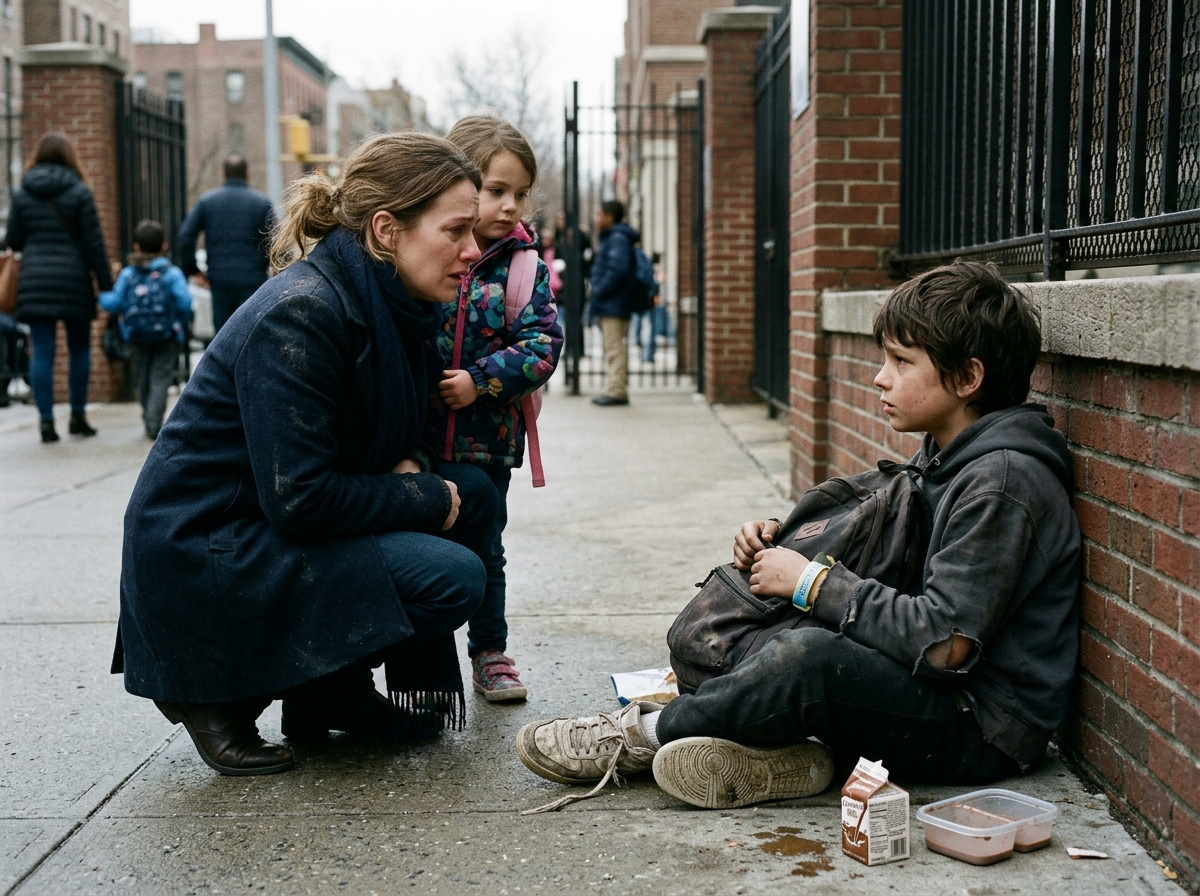
The first time Noah used the word “home” in front of me, he was talking about a pencil.
He had been drawing at the kitchen table when the pencil rolled off the edge and disappeared beneath a cabinet. He leaned down to retrieve it, then asked whether he could leave his sketchbook at my house until the next visit.
“You can,” I said. “Would you like me to keep it somewhere safe?”
He nodded toward the shelf near the living room.
“Could you put it there? That's where I keep things when I'm home.”
I did not correct him or ask whether he meant my house. I simply picked up the sketchbook and placed it on the shelf he had chosen.
“That's fine,” I said.
He returned to his drawing.
I stood by the cabinet for a moment, my hand resting against the wood. The word had been spoken so casually that he might not even have noticed it. Yet it carried more weight than any declaration of affection he had made since our reunion.
Home.
I wanted to believe it meant he was beginning to feel safe with me. But I also knew that children who had lived without stability sometimes used familiar words because they wanted the world to become predictable. I could not assume that one sentence meant Noah had decided to trust me.
The next visit reminded me of that.
Noah arrived in a difficult mood. He barely spoke during lunch, refused to look at the drawing Sophie had made, and snapped at me when I asked whether he wanted more food.
“I said I'm not hungry.”
“All right,” I replied.
He pushed his chair back so abruptly that it scraped against the floor.
“Why do you keep asking me things?”
I stopped moving.
“I was checking whether you wanted more.”
“I don't want you checking all the time.”
His voice rose, and Sophie froze with her fork halfway to her mouth.
I took a breath.
“I'm sorry. I'll give you more space.”
Noah looked startled by the apology, but his anger did not disappear.
“You always want to know what I'm doing. What I'm thinking. Whether I'm happy. Whether I'm sad.”
I had to admit that he was right. I had been watching him closely, trying to read every change in his expression, hoping to discover whether he felt comfortable or whether something had gone wrong. My concern had begun to feel like another form of pressure.
“I've been asking too many questions,” I said. “I'll work on that.”
He stood up.
“I want to go.”
I looked toward Elena, who had accompanied him that day. She reminded him that he could end the visit whenever he wanted, and she asked whether he felt safe leaving with her.
“Yes.”
I did not ask him to stay.
At the door, I told him I was sorry the visit had been difficult. He gave no answer. He left with Elena, his backpack hanging from one shoulder, and I watched the car disappear down the street.
Sophie came into the hallway.
“Did we do something wrong?”
“No,” I said. “Noah was upset, and I asked more questions than he wanted me to ask. We need to respect that.”
“Will he come back?”
“I hope so. But it's his choice.”
That evening, I spoke with Elena about what had happened. She explained that Noah's reactions were understandable given his experiences. A safe place could still feel unfamiliar, and kindness could make him anxious if he had learned that accepting help created obligations he could not control.
“He may test whether you remain consistent when he's angry,” she said. “That doesn't mean every difficult moment is a test. Sometimes he is simply having a difficult moment. Your job is to keep the boundaries clear and not take his feelings as a judgment of your worth.”
I wrote that down.
I had spent years carrying guilt for leaving Noah, and I was tempted to treat every unhappy moment as evidence that I was failing him again. That instinct could make me demand reassurance from the very child I had hurt. I needed to learn to tolerate his anger without asking him to make me feel better.
The following week, I sent a message through Elena confirming the next planned visit and saying that Noah could decide what we did. I did not ask whether he was still upset or whether he wanted to talk about the previous meeting.
He agreed to come.
When he arrived, I greeted him at the door and stepped aside. Sophie was in the garden with her bean plant, and I told Noah that he could join her or stay inside.
He chose the kitchen.
I placed a plate of sandwiches on the table and then went to the living room to fold laundry. I could hear him opening a cupboard, filling a glass of water, and settling into a chair. I did not go back to check on him.
After several minutes, he called out.
“Claire?”
“Yes?”
“Where do you keep the pencils?”
“In the drawer beside the window.”
He opened the drawer and found the box Sophie had arranged for him. A moment later, he began drawing.
I continued folding the laundry.
The quiet felt unfamiliar. I had grown used to monitoring every sign of distress, but I was learning that leaving someone alone for a while could be a form of care. Noah did not need me to turn every silence into a conversation.
Later, Sophie came inside and asked whether he wanted to see how much the bean plant had grown. He agreed, and the two of them spent several minutes comparing its height with a ruler.
“You were right,” Sophie said. “I was giving it too much water.”
Noah looked pleased.
“Plants need time.”
“So do people,” she replied, surprising both of us.
Noah glanced toward me through the open door. I pretended not to notice.
At the end of the visit, he packed his sketchbook into his backpack but left the pencil box on the shelf.
“Can I keep these here?” he asked.
“Of course.”
He looked toward the shelf.
“And the sketchbook?”
“You can leave it here, too, if you want.”
He hesitated, then took the book back out of his bag and placed it beside the pencils.
I did not tell him how much that small decision meant to me. I did not ask whether he considered the house his home. I simply left his belongings where he had chosen to put them.
Over the next month, the visits became more regular. Noah began arriving with small requests: a glass of water, a particular book, a place to charge a device, or permission to use the garden table. Each request gave him an opportunity to discover whether the answer would remain the same from one visit to another.
I tried to make our routines predictable. Lunch was served at an agreed time. He knew where the bathroom was, where he could find clean towels, and which cupboard held the snacks. If plans changed, I told him in advance whenever possible.
I also learned to avoid promises that depended on things beyond my control. I did not say that he would never have to move again or that every adult in his life would keep their word. I told him what I could do, what I could not decide, and who would help explain the next steps.
One evening, Noah asked whether he could spend a longer afternoon at the house. He wanted to finish a drawing with Sophie and then read in the living room.
I checked with Elena, and we agreed on a plan that fit his current support arrangements.
When Noah arrived, he went directly to the shelf, collected his sketchbook, and settled at the kitchen table. Sophie joined him with a collection of stickers, which he rejected until she showed him a sheet of tiny stars.
“Those are acceptable,” he announced.
“Acceptable?” Sophie repeated. “You make it sound like you're a teacher.”
“I could be a teacher.”
“You'd give everybody homework.”
“Only the people who talk too much.”
Sophie threw a soft paper star at him. It landed on his sleeve, just above the blue hospital bracelet.
For a fraction of a second, Noah's expression changed. He covered the bracelet with his hand, and the laughter stopped.
Sophie noticed immediately.
“Sorry,” she said. “I didn't mean to hit it.”
Noah looked at the star, then at her.
“You didn't hurt me.”
“Do you want me to move the stickers?”
He shook his head.
“No. They're fine.”
He peeled the star from his sleeve and stuck it on the corner of his drawing.
I watched him quietly. The bracelet had become a symbol of the life he had lived before us, but it was also his possession, something he had carried through years when almost nothing else remained constant. I would never ask him to remove it to make the past easier for me to look at.
When the visit ended, Noah packed his sketchbook but left the pencils on the shelf.
As he stood by the door, he looked toward the kitchen.
“Can I come here on Saturday again?”
“If the plan works for you, yes.”
He nodded.
Then, after a pause, he asked, “Can I keep calling it home when I'm here?”
The question took the breath from my lungs.
I wanted to say that it was his home, that he belonged there, and that he could stay as long as he needed. But I knew the longer-term arrangements had not yet been finalized, and I could not make a promise that other professionals and legal decisions would need to support.
So I answered carefully.
“You can call it home if that's how it feels to you. I want you to feel safe here. And I'll be honest with you about any decisions that affect where you stay.”
Noah watched my face, checking for something.
“Okay.”
He left with Elena, and I closed the door slowly.
I did not know exactly what the future would look like. The question of his long-term care was still being assessed, and the years ahead would bring conversations none of us could predict. But I understood that home was not a word I could demand from him, nor was it a feeling I could create with a bedroom, warm meals, or gifts.
It had to grow from repeated experiences of safety, honesty, and choice.
That night, I walked into the living room and saw his sketchbook resting on the shelf beside the pencils. On the open page, he had drawn the house, the tree, and three figures standing near the garden.
This time, he had added a small blue line around one wrist.
I did not know whether it represented the hospital bracelet or simply a detail he wanted to remember. I left the drawing exactly as he had made it.
Then I turned off the lamp and let the house settle into silence, grateful not because Noah had finally forgiven me, but because he had begun to leave small pieces of his life where he might choose to find them again.
Click here to continue reading: PART 9: The Day Noah Asked Whether He Could Stay, I Had to Choose Between My Longing and His Need for Security
The Blue Hospital Bracelet That Made a Mother Stop in the Middle of the Street
Part 8 of 28