
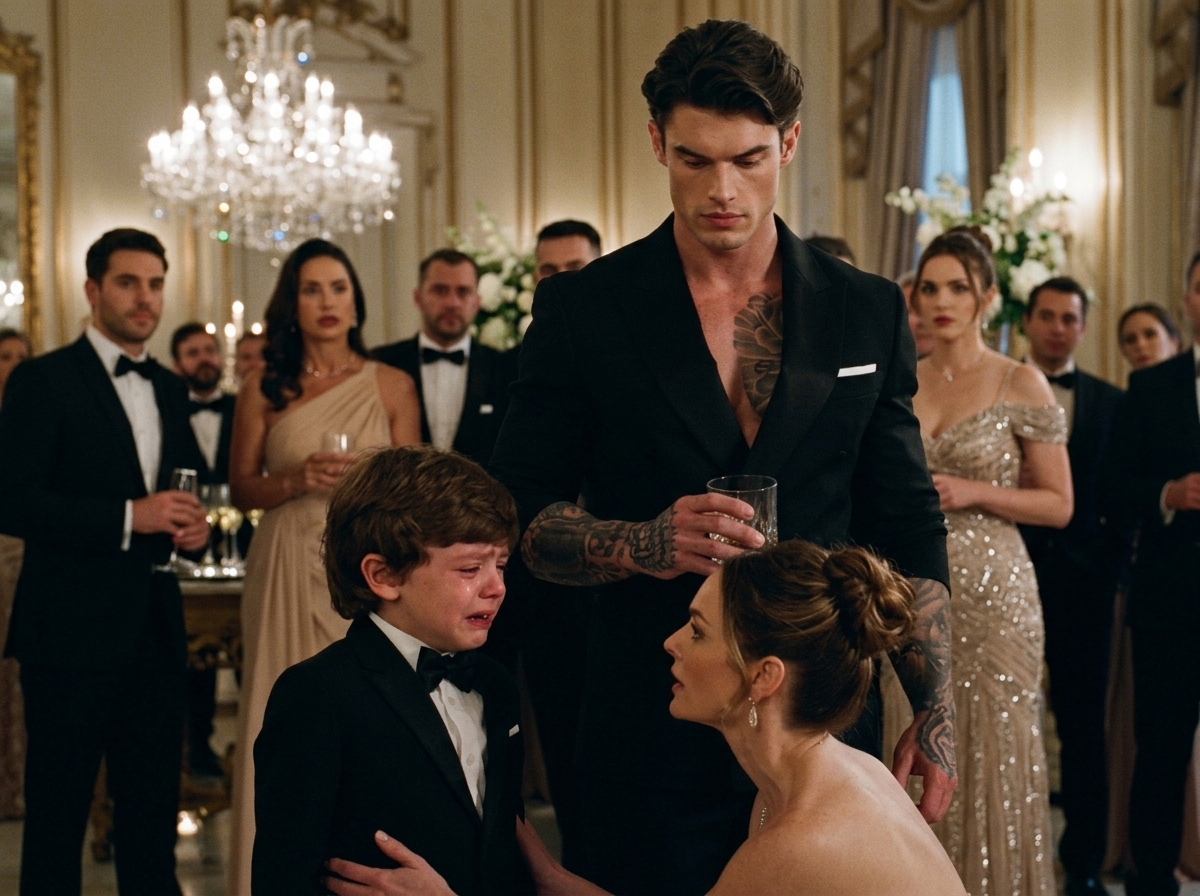
Oliver's next birthday arrived on a bright morning in late autumn. He woke before Daniel's alarm and appeared in the kitchen wearing his pajamas, his hair untidy and his face full of expectation.
“I'm seven now,” he announced.
Daniel looked up from the coffee machine. “That is what the calendar suggests.”
“Seven is older than six.”
“A remarkable observation.”
“Does that mean I can have two pieces of cake?”
Daniel pretended to consider the question. “We will need to consult the birthday rules.”
Oliver laughed and ran to the living room, where a small stack of wrapped presents waited beside the sofa. Daniel had kept the celebration simple. There would be a few friends after school, a cake from the bakery, and a family dinner at home. Oliver had asked for yellow decorations because he said the house needed to look sunny even if the weather turned cold.
The morning moved quickly. Daniel prepared breakfast, checked that Oliver's school clothes were ready, and placed a small card beside the lunchbox. He had written a message about how proud he was of the boy Oliver was becoming, not only for what he could do but for the kindness he showed when nobody was watching.
At school pickup, Oliver rushed toward him holding a folded piece of paper.
“It's a birthday card from Mrs. Bennett,” he said. “She wrote that I'm a good friend.”
Daniel smiled. “That is something to be proud of.”
Oliver opened the card again, reading the words slowly. “Do you think Mommy would say that too?”
“I think she would be happy to see how you treat people.”
Oliver nodded, then tucked the card carefully into his backpack.
At home, the birthday gathering was cheerful and slightly chaotic. Two classmates arrived early, one arrived late, and another changed his mind about the party games three times. Daniel found himself moving chairs, cutting fruit, and trying to keep a bowl of popcorn away from a child who had decided it would be more interesting to pour it into a toy truck.
Mara arrived carrying a small gift wrapped in yellow paper. Inside was a set of colored pencils and a notebook with thick pages suitable for drawing. Oliver thanked her and immediately began planning what he would draw first.
“Maybe the house from the community center,” he said.
“That's a good idea,” Mara replied.
After the children played games and ate cake, Oliver asked whether he could show his friends the family book. Daniel paused before answering. The book contained drawings and memories that Oliver had chosen to share with a few people, but a birthday party was different from a classroom project. He wanted to make sure his son was comfortable with the decision rather than simply excited by the idea of showing something important.
“You can,” Daniel said, “but you don't have to show every page. Choose the ones you want your friends to see.”
Oliver considered this, then selected the pictures of the pancakes, the crowned tomato, and the yellow flowers. He left the letter and the more personal pages in the book. His friends laughed at the tomato drawing and asked whether Daniel had really made pancakes that looked like a broken map.
“He did,” Oliver said proudly. “He's better now, but not perfect.”
Daniel accepted the judgment with dignity.
The children moved on to a game, and the family book was returned to the shelf. Oliver did not appear troubled by having shared only a few pages. He had made his choice and moved forward, learning that something could be precious without needing to be shown to everyone.
After the guests left, Daniel and Oliver sat together in the living room, surrounded by discarded wrapping paper and a few balloons that had begun to lose their shape. Oliver examined his new notebook and asked Daniel whether he could write something on the first page.
“Of course.”
He thought for a long time before writing: Things I want to remember.
Beneath the heading, he listed the yellow flowers, Mara's music box, the tomato song, the family book, and the day he had sung at school. He also wrote, Dad says it's okay to be sad and happy together.
Daniel read the list without interrupting. Oliver had not included every important event in his life, and he did not need to. The page was a beginning, a place to record memories as they came.
“Do you think I'll remember all these things when I'm grown up?” Oliver asked.
“Some details may change,” Daniel replied. “You might forget exactly what the cake tasted like or what color your balloons were. But you can keep writing things down, and we can keep telling the stories.”
Oliver looked at the notebook. “Will you still tell me stories about Mommy when I'm big?”
Daniel felt the question reach a place in him that had grown more tender over the past year. He thought about how easily adults assumed that children would eventually stop needing the same stories. But Oliver's relationship with Grace would continue to change as he grew, and he would need different answers at different ages.
“Yes,” Daniel said. “Whenever you want to hear them, I'll tell you what I remember. And if there are things I don't remember clearly, I'll tell you that too.”
Oliver nodded. “Promise?”
“I promise to be honest with you and to keep talking about her whenever you want.”
The boy seemed satisfied. He returned to the notebook and drew a small sun in the corner of the page.
Later that evening, after Oliver had gone to bed, Daniel sat in the kitchen with a cup of tea. Mara had stayed to help clear the last of the birthday decorations, and she was folding paper napkins while he put away the remaining plates.
“He's growing up,” she said.
“Yes. Faster than I expected.”
“He seems more comfortable talking about Grace.”
Daniel nodded. “He still has difficult moments, but he's no longer afraid that every conversation about her will make the whole day fall apart.”
Mara placed the napkins in a drawer. “You've both learned a lot.”
Daniel looked toward the hallway. “I used to think that my job was to protect him from the pain of losing her. Now I think my job is to help him understand that the pain can be part of his life without taking over all of it.”
Mara smiled. “That's a good way to put it.”
They spoke about ordinary things for a while: her schedule at the restaurant, the community center's upcoming activities, and the books Oliver had begun reading independently. Their friendship had become a steady part of Daniel's life, but it remained free of expectations neither had chosen. They cared about each other, respected one another's boundaries, and shared a history that had grown naturally from the moment Mara had sung to Oliver.
When Mara left, Daniel went upstairs to check on his son. Oliver was asleep with the new notebook beside his bed, its first page open to the list of things he wanted to remember. Daniel closed it gently and placed it on the bedside table.
He stood for a moment, listening to the quiet room. He remembered Oliver as a smaller child who had once cried so desperately in the restaurant that Daniel had believed he would never find a way to comfort him. He remembered the helplessness, the offer of money, and the moment Mara's voice had reached his son.
That memory remained painful, but it no longer represented failure. It was the beginning of a change in how Daniel understood love. He had learned that he could not control every feeling his son experienced, and that trying to do so would only make both of them more afraid. He could offer comfort, honesty, patience, and a place to return when the world felt too large.
The next morning, Oliver asked whether they could visit Grace's grave during the weekend. He wanted to tell her about his birthday and leave a copy of the new drawing. Daniel agreed, and they spent Saturday afternoon choosing which picture to bring.
Oliver selected a drawing of the house with the yellow flowers outside. In the window, he had drawn two figures standing side by side. A third figure appeared in a photograph on the wall inside the house.
“Why did you draw Mommy in the photograph?” Daniel asked.
“Because she isn't here in the house, but she's still part of it.”
Daniel felt a quiet ache. “That's a thoughtful way to show it.”
They made a copy and placed it in an envelope. At the cemetery, Oliver carried the picture himself, walking carefully along the path. The weather was cool, and the leaves had begun to fall from the trees. Daniel brushed away a few leaves near Grace's headstone while Oliver placed the envelope beneath the ledge.
“Hi, Mommy,” Oliver said. “I'm seven now. I had cake, and Mara gave me colored pencils. I drew a new picture, and Dad says I can keep making our book.”
He paused, then looked toward Daniel.
“Can I tell her something private?”
Daniel nodded. “Of course. I'll stand over here.”
He stepped a short distance away, giving Oliver room without leaving him alone. The boy stood quietly for a minute, then spoke in a voice too soft for Daniel to hear. Whatever he said, he seemed calmer afterward. He returned to his father and reached for his hand.
“Ready?” Daniel asked.
“Yes.”
They stood together for a moment before leaving. Daniel did not ask what Oliver had said. The conversation belonged to his son, and he wanted him to know that love did not require him to share every private thought.
On the way home, Oliver asked whether Daniel had ever wished he could go back and change something about the time before Grace died.
Daniel considered the question carefully. There were moments he had replayed countless times: conversations he wished he had handled differently, ordinary days he wished he had appreciated more, and decisions he had made without knowing how little time remained. He could not honestly say he had never wished to change anything.
“Yes,” he said. “Sometimes I wish I had slowed down more. I wish I had worried less about work and spent more time enjoying ordinary moments with her.”
“Do you think she knew you loved her?”
Daniel felt his throat tighten. “Yes. I believe she did. We told each other, and we showed it in many ways. I still wish we had more time, but I don't think she doubted that I loved her.”
Oliver looked out the window. “I'm glad.”
Daniel reached across the console and briefly touched his son's shoulder. “Me too.”
That evening, they made dinner together. Oliver washed vegetables while Daniel prepared the pan, and they discussed what they wanted to do during the school holidays. There would be a trip to the library, another visit to the community center, and perhaps a weekend at the lakeside park where Grace had once laughed in the wind.
Oliver wanted to bring the notebook and write down anything funny that happened. Daniel agreed, and they added the idea to the calendar.
At bedtime, Oliver asked for the lullaby. Daniel sat beside him and began the familiar melody. Oliver joined in, his voice steady and warm. When the song ended, he opened his eyes.
“Dad, I think I understand something now.”
“What is it?”
“Mommy is gone, but I don't have to stop being happy because I miss her.”
Daniel looked at his son for a long moment. “That's right.”
“And when I'm sad, I don't have to pretend I'm happy.”
“That's right too.”
Oliver smiled and settled under the blanket. “I think I'm getting better at this.”
“You're learning,” Daniel said. “And so am I.”
He kissed Oliver's forehead and stood. At the doorway, he looked back at the small figure beneath the blanket and felt the familiar mixture of love and longing. Grace would never watch her son grow into the next year of his life, and that truth would always hurt. Yet Oliver was growing, and Daniel was learning to meet that growth with openness rather than fear.
The promise he had made was not that he would keep every sadness away or preserve every memory perfectly. It was that he would remain honest, keep listening, and help his son carry the love that had shaped their family.
Daniel left the hallway light on and went downstairs. The house was quiet, but it was not empty. The drawings, the notebook, and Grace's photograph remained where they belonged, alongside the ordinary evidence of a family still living.
He knew there would be more questions, more difficult days, and more memories that arrived without warning. He also knew that he did not have to face them perfectly. He only had to keep showing up.
Click here to continue reading: PART 17: The Morning Oliver Realized His Mother’s Love Had Never Stopped Growing
A Wealthy Father Challenged an Entire Restaurant to Calm His Grieving Son, Until a Quiet Waitress Sang Words That Made the Boy Stop Crying
Part 16 of 28

