
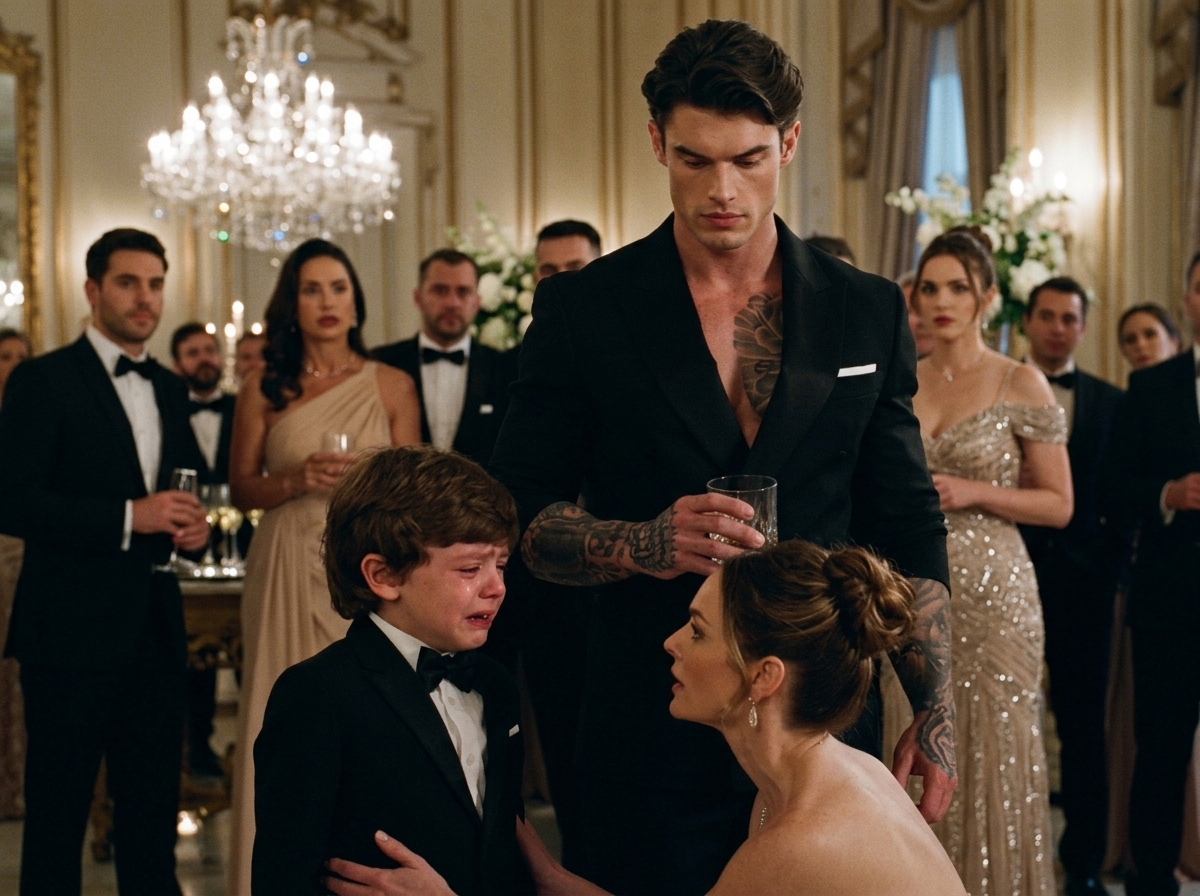
“Five thousand dollars to anyone who can make my son stop crying.”
The announcement cut through the restaurant's evening noise. Forks paused above plates, conversations dwindled, and several customers turned toward the man standing beside a corner table with a little boy clinging to his coat. The father looked exhausted, his expensive suit creased at the elbows, his jaw tight from hours of trying to soothe a child who seemed determined to cry until he could no longer breathe.
The boy was perhaps six years old. His dark hair stuck to his damp forehead, and his small hands were wrapped around a photograph he refused to release. Every few seconds, he called for his mother, then pressed the picture against his chest as if the person in it might somehow hear him.
“Please,” the father said, looking around the room. “Someone must know what to do. I've tried everything.”
A businessman at the next table offered a chocolate from his dessert. The boy shook his head violently. A woman approached with a glass of water, but he turned away before she could set it down. Someone suggested calling a doctor. Another customer quietly asked whether the child needed his father to take him outside.
The father heard all of them and answered none of them. He had already spent most of the afternoon trying to comfort his son, and the longer the crying continued, the more helpless he felt. His name was Daniel Whitmore, a successful property developer who could negotiate contracts worth millions without raising his voice. Yet standing in the middle of a crowded restaurant, he could not find a single sentence that would ease his six-year-old son's pain.
His son, Oliver, had been crying since they left the cemetery that afternoon.
It was the anniversary of his mother's death.
For three years, Daniel had tried to make that day manageable. He took Oliver to visit her grave, brought flowers, and allowed his son to choose a small gift to leave beside the headstone. Sometimes Oliver talked about his mother afterward. Other times, he remained quiet and asked to go home.
This year had been different. Oliver had brought a photograph of his mother, Grace, and spent the entire drive to the cemetery asking whether she could hear him. Daniel had answered as gently as he could, explaining that people who loved us remained in our memories even when they could no longer be with us. But when Oliver asked why his mother had to leave him, Daniel had no answer that could make sense to a six-year-old.
The cemetery visit had ended with Oliver crying into his father's jacket. Daniel had held him until the boy's breathing steadied, then carried him to the car. He thought a meal in a familiar restaurant might help distract him. Instead, the warm lights, clattering dishes, and smell of freshly baked bread seemed to make Oliver's grief more intense.
Now the boy stood beside his father, trembling with exhaustion.
“I want Mommy,” Oliver sobbed. “I want Mommy to sing to me.”
Daniel crouched and tried to meet his son's eyes. “I know, sweetheart. I know you miss her.”
“You said she loved me.”
“She did. More than anything.”
“Then why doesn't she come back?”
Daniel's mouth opened, but the words would not come. He pulled Oliver close, holding him while the boy's cries rose again. Around them, the restaurant's customers returned to their meals, though many continued to glance toward the distressed child.
Near the service counter, a waitress watched the scene with growing concern. Her name was Mara Ellis, and she had worked at the restaurant for almost two years. She was twenty-nine, with dark brown hair usually tied into a loose bun and a small silver pendant she kept tucked beneath her uniform.
Mara had learned to recognize the difference between a child throwing a tantrum and a child overwhelmed by something he could not explain. Oliver was not demanding a toy or refusing dinner. He was searching for someone he believed should be there.
She set down the tray she was carrying and approached Daniel.
“Sir, would you like me to bring him something warm to drink?” she asked. “Maybe some milk or hot chocolate?”
Daniel looked up at her. “I've offered him everything. He won't take anything.”
Mara glanced at Oliver. “Perhaps he doesn't need anything to eat or drink right now.”
“What does that mean?”
“It might mean he needs someone to listen.”
Daniel gave a tired laugh without humor. “I've been listening for hours. He keeps asking for his mother. I can't bring her back.”
The final sentence came out more sharply than he intended. Mara did not take offense. She saw the grief behind his frustration and the way his hand trembled slightly where it rested on his son's shoulder.
“I'm sorry,” she said quietly.
Daniel looked away. He was accustomed to people offering condolences, but most of them said the same things: time would help, his son was young, and he would eventually adjust. He knew they meant well. He also knew none of those words could make Oliver stop looking for the person he had lost.
When the boy began crying harder, Daniel stood abruptly.
“Five thousand dollars,” he repeated, his voice louder now. “I don't care whether you're a singer, a teacher, or a complete stranger. If you can calm my son, I'll pay you. Just please, somebody help him.”
A few customers exchanged uncomfortable looks. The offer was generous, but the desperation behind it made the money seem almost irrelevant. Daniel was not trying to buy a performance. He was trying to find a way through a moment he could not bear to watch.
Mara remained beside the table.
“Sir,” she said, “may I try something?”
Daniel turned toward her. “Can you sing?”
“A little.”
“Then sing. Please.”
Mara looked at Oliver, who had buried his face against his father's side. She did not reach for him or ask him to look up. Instead, she pulled a chair away from the table and sat a short distance from the boy, lowering herself until her voice would not have to travel far.
For a moment, she said nothing.
The restaurant continued around them. A server carried plates to another table, someone near the window laughed at a joke, and a coffee machine hissed behind the counter. Mara waited until Oliver's sobs separated into uneven breaths.
Then she began to sing.
Her voice was soft, almost conversational, and the melody was simple enough to sound like something a mother might hum while rocking a child to sleep.
“Stop crying, my beloved child, Rest your head and close your eyes. Though the night may seem so long, You are safe within my arms.”
The words were unfamiliar to most of the customers. There was no music accompanying her, no dramatic rise in the melody, only the steady warmth of a voice that seemed to know where it was going.
Mara continued.
“Stop crying, my beloved child, Let the gentle morning rise. When the world feels cold and wide, Love will stay here by your side.”
Oliver's sobbing slowed.
Daniel noticed first that his son's shoulders had stopped shaking so violently. Then he saw the boy lift his head. His cheeks were wet, and his lower lip trembled, but he was no longer crying with the same desperate force.
Mara kept singing, watching him carefully without demanding his attention. She repeated the final lines, letting the melody settle rather than forcing it to end.
When the last note faded, the restaurant seemed unusually quiet.
Oliver stared at her.
Mara offered him a small, uncertain smile. “Hello, sweetheart.”
The boy took one step away from his father.
Daniel felt an astonishment so intense that, for a moment, he forgot the promise of money. He had spent the afternoon trying to persuade Oliver to breathe slowly, drink water, look at photographs, and remember happier days. Yet a waitress he had never met had sung a few lines, and his son had listened.
“Oliver?” Daniel whispered.
The boy did not answer him. He continued staring at Mara, his expression changing from exhaustion to confusion, then to something that looked almost like recognition.
“You know that song,” Oliver said.
Mara's smile faded slightly. “I know the melody, sweetheart.”
Oliver shook his head. “No. Mommy sang it.”
Daniel's hand tightened around the back of the chair.
Oliver stepped closer to Mara, still holding the photograph. “That's the song my mommy used to sing to me when I couldn't sleep.”
Mara went very still.
The boy opened the photograph and held it up. It showed a smiling woman with dark hair, sitting on a sofa with a small child asleep against her shoulder. The picture had softened at the edges from being handled so often.
“Mommy sang those words,” Oliver said. “She said I was her beloved child.”
Mara looked at the photograph, then at the boy. Her face had lost its color.
Daniel noticed. Until that moment, he had assumed the waitress had simply remembered a familiar lullaby from childhood. But the expression on her face was not the expression of someone who had heard a common song. It was the look of someone standing at the edge of a memory she had spent years trying to understand.
He rose slowly.
“Wait,” he said. “How do you know that song?”
Mara did not answer.
Daniel looked from her to his son. “Where did you learn those words?”
The waitress lowered her eyes to the photograph. Her fingers had begun to tremble, and she pressed them together as though trying to steady them.
“I heard it a long time ago,” she said.
“From whom?”
Mara swallowed. When she finally looked up, there were tears gathering in her eyes.
“From a woman who told me that song was the only thing that could comfort her little boy.”
Daniel stared at her.
Oliver moved closer to his father, still watching the waitress. “Do you know my mommy?”
Mara looked at the child, and something in her expression seemed to break.
“I think,” she whispered, “I may know more about your mother than you realize.”
Click here to continue reading: PART 2: The Waitress Recognized the Photograph in the Boy’s Hands, and Daniel Learned That the Lullaby Connected Two Families Through a Secret No One Had Explained
A Wealthy Father Challenged an Entire Restaurant to Calm His Grieving Son, Until a Quiet Waitress Sang Words That Made the Boy Stop Crying
Part 1 of 28

