
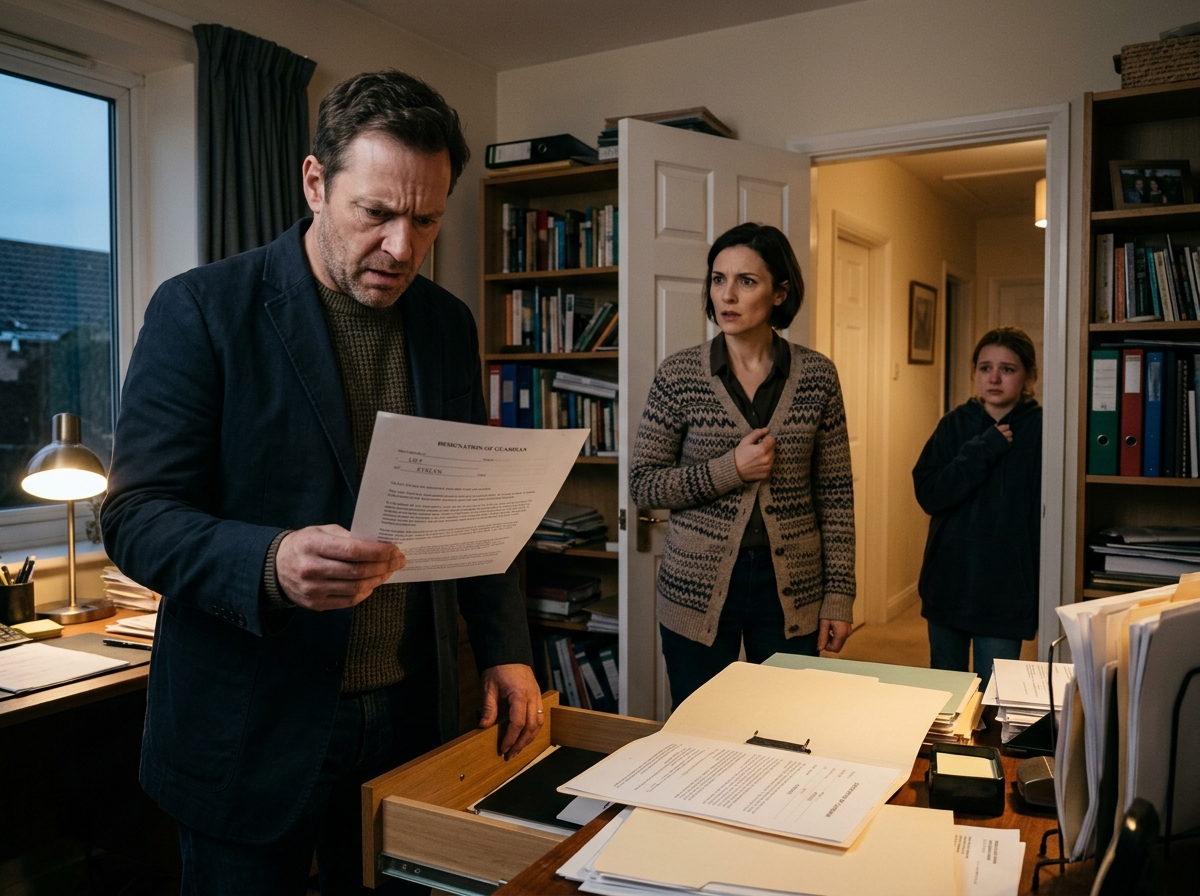
The question came after dinner, when Lily was helping Richard put away the dishes. She had been unusually quiet throughout the meal, and he had assumed she was tired from school. As he rinsed a plate, she asked whether he thought she would ever forgive Vanessa.
Richard turned off the tap. He had expected many difficult questions over the years, but this one carried a weight he did not want to mishandle. He knew Lily had spent months learning that her feelings were allowed to exist without being corrected. He did not want to replace the pressure Vanessa had created with a new expectation, even one that sounded kinder.
“I don't know,” he said. “You might forgive her someday, or you might decide that you don't want to. You don't have to decide now.”
Lily dried a glass and placed it in the cupboard. “People say forgiveness helps you feel better.”
“Sometimes it does. But forgiveness isn't the same as pretending something didn't happen, and it doesn't mean you have to have a relationship with someone. Different people understand it differently.”
“What if I don't forgive her and I stay angry?”
Richard leaned against the counter. “Then we can help you work through the anger. You don't have to forgive someone to deserve peace. And if your feelings change later, you can think about that then.”
Lily looked down at the dish towel. “I don't want to spend my whole life being angry at her.”
“You don't have to. But letting go of anger doesn't have to mean letting Vanessa back into your life. You can decide what you need, and you can change your mind as you grow older.”
She nodded, though her expression remained uncertain. Richard recognized that the question was not only about Vanessa. Lily was trying to understand how to carry a painful experience without allowing it to become the center of every future relationship. He could offer guidance, but he could not decide the emotional conclusion for her.
The next day, he mentioned the conversation to Lily's counselor. The counselor agreed that Lily should not be pressured toward forgiveness or toward permanent anger. She could explore her feelings without turning them into a moral obligation. The most important thing was that she felt safe and understood, and that any future contact with Vanessa remained entirely separate from the question of forgiveness.
Richard left the appointment feeling reassured that he did not need to find a perfect answer. He had spent much of the past year trying to anticipate every question and prevent every possible source of distress. He was learning that being a good parent did not mean eliminating uncertainty. It meant helping Lily face uncertainty without making her feel alone.
At school, Lily was preparing for an end-of-year activity with her friends. She had volunteered to help organize part of the event, and she was excited about choosing decorations. When one of the other students changed the plan at the last minute, Lily became frustrated but managed to explain what bothered her without withdrawing from the group.
She told Richard about it on the drive home. “I was angry, but I didn't want to make everyone stop talking to me.”
“What did you do?”
“I told them I wanted us to agree before changing things. Then we picked something else.”
“That sounds reasonable.”
“I was still annoyed afterward.”
“You can be annoyed and still handle something well.”
Lily smiled. “I guess.”
Richard thought about how often she had once been made to feel that anger was proof she was difficult. Now she was learning that emotions could be acknowledged without becoming weapons. She could disagree, set a boundary, and remain part of the group.
A few days later, Vanessa received an update from her therapist about the next stage of her work. The therapist encouraged her to continue examining how she responded to rejection and uncertainty, particularly in relationships where she wanted closeness. Vanessa admitted that she still found it difficult to accept the finality of the divorce. She sometimes imagined Richard and Lily having ordinary evenings together and felt a sharp longing for the home she had lost.
Her therapist did not tell her to stop feeling that longing. Instead, she asked what Vanessa did when the feeling appeared. Vanessa admitted that she sometimes wanted to send Richard a message, ask whether Lily was doing well, or find out whether the family had begun talking about her again.
“What would you hope to get from that message?” the therapist asked.
“Reassurance,” Vanessa replied. “Maybe proof that I still matter.”
“And whose responsibility is it to manage that feeling?”
“Mine.”
Vanessa wrote the answer down. She could miss the family without trying to enter their lives. She could feel regret without asking Lily to help soothe it. The loneliness was real, but it did not give her permission to cross a boundary.
Richard had no knowledge of these sessions. He did not need to know whether Vanessa felt lonely or whether she thought about them. Their separation had created a necessary distance, and he was no longer responsible for helping her manage the emotions that came with it.
That weekend, Lily asked whether they could sort through some old belongings in her room. She wanted to make space for new books and school materials. Richard helped her move a box from the closet, and together they found old toys, notebooks, and a few birthday cards from years earlier.
Among the cards was one from Vanessa, written when Lily was nine. It contained a cheerful message about enjoying her birthday and being proud of the person she was becoming. Lily read it twice, then placed it on the floor beside the box.
“Do you want to keep it?” Richard asked.
“I don't know.”
“You can keep it, throw it away, or leave it here and decide later. There's no right answer.”
Lily picked it up again. “I think I'll keep it for now. It doesn't mean I want to see her.”
“I understand.”
She placed the card in a small envelope and put it in the box with other old memories. Richard did not ask why she had chosen to keep it. The card belonged to a time when her relationship with Vanessa had included good moments, and Lily was allowed to preserve those moments without agreeing to anything about the future.
As they continued sorting, Lily found a drawing she had made at school when she was younger. It showed a house with a large sun above the roof and several figures standing in the garden. She studied it, then laughed softly.
“I used to draw houses all the time.”
“You still do sometimes,” Richard said.
“Not as much.”
She placed the drawing with the papers she wanted to keep. Richard wondered whether the picture reminded her of the family they had lost or simply of a childhood hobby. He did not ask. Lily was learning to decide what her memories meant, and he did not want to supply an interpretation she had not requested.
Later, she asked whether Vanessa had ever apologized to Richard. He explained that Vanessa had acknowledged her choices during their separation and had sent him a letter after the divorce. He told Lily that he had received it but had not shared it with her because she had not asked to read it and he did not want to add another emotional task to her life.
“Was it a good apology?” Lily asked.
“It was more honest than some of the things she said before. She acknowledged what she did and didn't ask me to change my decision.”
“Did it make you forgive her?”
Richard thought carefully. “It helped me understand that she was beginning to take responsibility. But an apology doesn't automatically change how you feel. I can hope she continues to change without wanting to be married to her.”
Lily nodded. “So you can accept the apology but still be done?”
“Yes.”
The answer seemed important to her. She had been trying to understand whether every relationship needed a final emotional resolution, as if the story could not end until everyone agreed about what had happened. Richard wanted her to know that people could make different decisions about the same history. Vanessa could regret her actions, Richard could end the marriage, and Lily could remain unwilling to meet her.
None of those choices had to cancel the others.
That evening, Lily asked if they could visit Rebecca again during the next school break. Richard agreed to arrange a video call and said they could discuss a visit later if the schedules and circumstances allowed. Lily seemed pleased, and they spent the rest of the evening talking about which photographs she wanted to ask Rebecca about.
Richard was glad that Lily's relationship with her mother's family was becoming more active. It gave her a connection to Anna that did not depend on the painful history with Vanessa. It also reminded him that family could include people who were not physically present every day, and that a child's sense of belonging could be supported by more than one relationship.
As the weeks passed, Lily continued to make progress in ways that were not always obvious. She became more comfortable asking teachers for help, spent more time with friends, and no longer checked her phone as frequently when she was at home. She still wanted it nearby, and Richard saw no reason to make that preference a problem. The device had become associated with safety, and she could decide how much distance she was ready to put between herself and that reassurance.
One afternoon, she left her phone charging in the kitchen while she went upstairs to get a book. Richard noticed it on the counter and did not call after her to remind her to take it. When she returned, she picked it up without looking around the room or checking whether anyone had touched it.
The moment passed unnoticed by Lily. Richard, however, recognized the change. She was no longer organizing every movement around the possibility that someone might take away her ability to contact him. The phone had returned, gradually, to being a phone.
He did not praise her for leaving it behind. He knew that if he turned every ordinary action into evidence of recovery, Lily might feel that she was being watched for signs of improvement. She deserved the freedom to change at her own pace without having to perform that change for anyone.
On a Sunday evening, they sat together and reviewed the coming week's schedule. Lily had a school activity, a meeting with her counselor, and plans to see a friend. Richard told her which evenings he would be home early and which day he had a later meeting. They agreed on a backup arrangement for the evening he might be delayed.
“Thanks for telling me,” Lily said.
“Of course.”
She wrote the schedule in her planner and went upstairs. Richard watched her leave, aware that predictability had become a quiet form of reassurance. It did not guarantee that nothing unexpected would happen. It meant that when something changed, they would discuss it rather than leave her to guess.
Before bed, Lily came back downstairs and asked whether he thought she was doing better.
Richard looked at her. “I think you're finding more ways to live your life without fear making every decision. You still have hard days, and that's okay. You don't have to prove you're better to make me happy.”
She smiled a little. “I just wanted to know.”
“I know.”
She hugged him briefly, then returned upstairs. Richard remained in the living room, feeling grateful but careful not to turn the moment into a conclusion. Lily was not a problem he had solved. She was his daughter, growing and changing, and his job was to keep making space for that growth.
He understood now that the question of forgiveness might return many times, in different forms. Lily might someday decide she had released her anger toward Vanessa. She might never want contact. She might feel differently at different stages of her life. Richard would respect those changes without treating any one decision as the price of peace.
The past could remain painful without controlling every future choice. That was the freedom he wanted Lily to have: not the obligation to forgive, not the duty to remain angry, but the right to decide what she needed as she grew older.
Click here to continue reading: PART 20: Richard Closed the Last Folder From the Guardianship Crisis and Realized That the Family’s True Ending Was Not Forgiveness, but a Future Lily Could Enter Without Fear
Richard Returned Home Before Sunset and Heard His Daughter Begging for Her Phone, but Vanessa’s Explanation Made Him Question Everything
Part 19 of 20

