
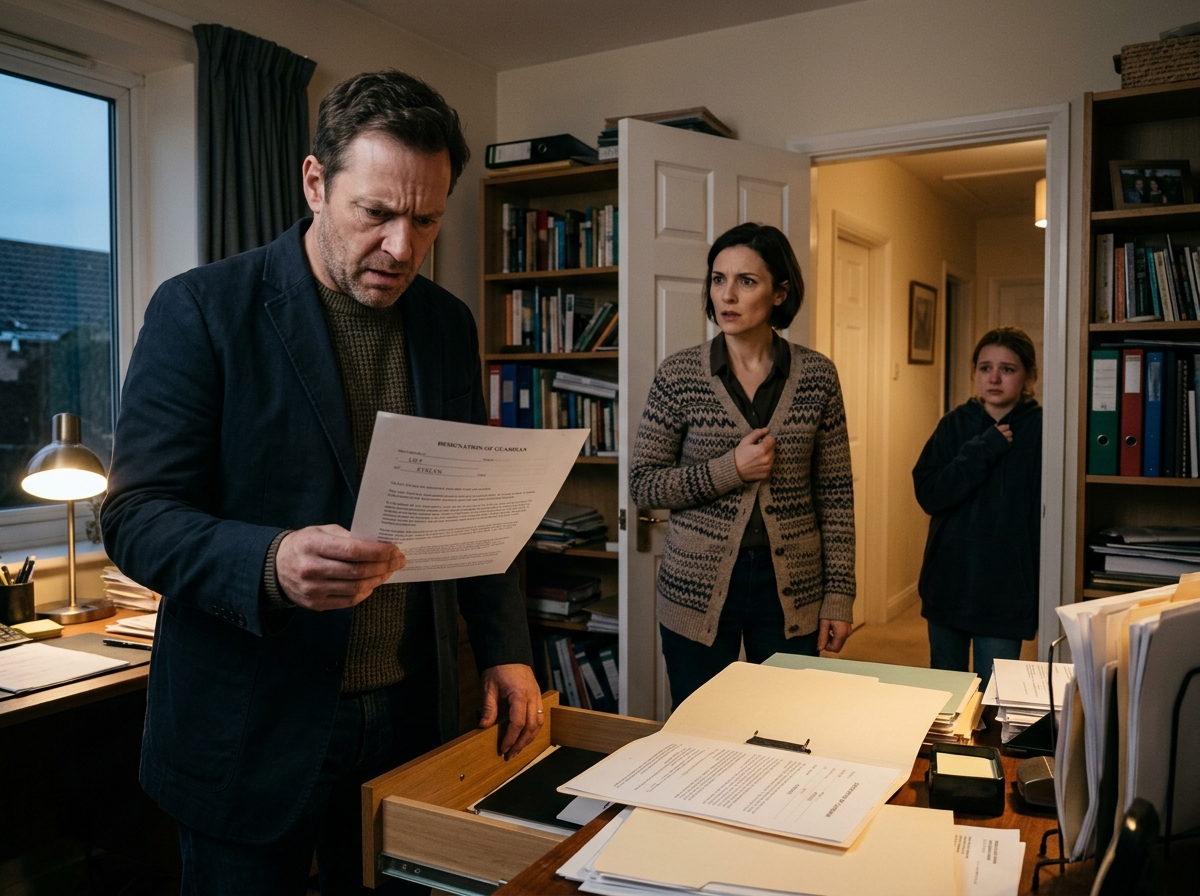
The folder had been sitting in the locked cabinet for more than a year. Richard had kept it there because Mr. Lawson had advised him to preserve the correspondence, the proposed guardianship document, and the records that established what had happened. The papers had once represented a threat to Lily's future, and Richard had been afraid that putting them away would mean failing to remain vigilant.
Now the cabinet held other important documents as well: the completed divorce records, the current guardianship arrangements, and the contact information for the professionals who had helped them through the crisis. Richard opened it on a quiet Sunday morning and reviewed the contents one final time. Everything was in order, and nothing required immediate action.
He removed the old proposal naming Evelyn Mercer as a proposed guardian and placed it with the retained legal correspondence. The paper no longer seemed powerful. It was an unsigned document that had never transferred authority, evidence of a plan that had failed to become a legal arrangement. Richard had no reason to destroy it, but he no longer needed to treat it as though it might suddenly change Lily's life.
He locked the cabinet and put the key back in its usual place. Then he made breakfast and called Lily downstairs. She came into the kitchen wearing a loose sweater, her hair still untidy from sleep, and asked whether they could go to a bookshop later that afternoon.
Richard checked the calendar. There were no conflicts, so he agreed. Lily began telling him about a book she wanted to find, then changed the subject to an activity her friends had planned for the following week. Richard listened, answering questions as they came, and realized that he had not thought about the folder again.
The ordinary conversation continued while they ate. Lily complained that one of her teachers assigned too much reading, then admitted that she liked the subject more than she expected. Richard teased her about how often she had changed her opinion, and she told him that people were allowed to change their minds.
He laughed. “You're right. They are.”
The words stayed with him after breakfast. For much of the crisis, Richard had been searching for certainty. He had wanted to know whether Vanessa could change, whether Evelyn intended harm, whether Lily would recover, and whether the marriage could be saved. He had sometimes treated each answer as though it would settle every question that followed.
Life had not offered that kind of certainty. Instead, it had given him clearer boundaries, more honest conversations, and a better understanding of what he could control. He could not decide what Vanessa became. He could not know what Evelyn wanted. He could not dictate how Lily would remember her childhood. He could decide how he responded to each of them, and he could make sure his daughter had a stable home.
Later that afternoon, Richard and Lily visited the bookshop. She moved between the shelves, reading the backs of several novels before choosing one. Richard picked up a book about cooking, and Lily immediately asked whether he intended to ruin another dinner.
“That happened once,” he said.
“It happened twice.”
“The second time was an experiment.”
“It was still bad.”
They laughed, and he bought the book anyway. Their exchange was light, unguarded, and free from the need to prove that everything was fine. Richard was learning that peace often appeared in small moments that did not announce themselves as victories.
On the drive home, Lily asked whether Vanessa ever called him. Richard said they occasionally exchanged necessary messages about the final arrangements, but there was no ongoing personal contact. The divorce had been completed, and neither of them was trying to reopen the relationship.
“Do you think she'll get married again?” Lily asked.
“I don't know. She may, or she may not.”
“Would that be bad?”
“No. Vanessa is allowed to build a new life. So are we.”
Lily considered the answer. “I think I hope she gets better.”
Richard kept his eyes on the road. “I hope that too.”
“But I still don't want to see her.”
“You can hope someone becomes healthier and still choose not to have a relationship with them.”
Lily nodded. She did not appear troubled by the contradiction. She had learned that caring about someone's future did not require her to offer access to her own life. It was a distinction Richard hoped she would carry into adulthood.
At home, she put the new book on her desk and began reading. Richard prepared dinner, following the instructions in his new cookbook more carefully than he had followed any recipe in years. The meal was edible, though Lily declared that it needed more seasoning. He told her she could be responsible for seasoning next time, and she accepted the challenge.
The following week, Lily had another session with her counselor. She spoke about the fact that she no longer thought about Vanessa every day, though certain memories still appeared unexpectedly. The counselor explained that remembering something painful did not mean she had returned to the beginning. A memory could arise without controlling what she did next.
Lily told Richard about the session on the way home. She said she sometimes felt guilty when she went several days without thinking about Vanessa, as if forgetting meant she was pretending nothing had happened.
Richard considered the concern. “You don't have to keep hurting to prove that something hurt you.”
Lily looked at him. “What do you mean?”
“You can remember what happened, know it was wrong, and still have a good day. You don't owe the past all your attention.”
She looked out the window for a moment, then smiled faintly. “That sounds nice.”
“It is.”
They continued home, talking about what they wanted for dinner. Richard did not insist that Lily accept his explanation immediately. He knew she would have to discover for herself that moving forward did not mean denying what had happened.
Vanessa was also learning how to live without making the past the center of every day. She continued therapy and maintained the boundaries she had agreed to. She did not attempt to contact Lily, ask relatives for information, or use her progress as a reason to seek another chance. She had accepted that the marriage was over and that Lily might never choose to speak with her.
There were still moments when she wished things had ended differently. She sometimes remembered the early days of the marriage, when she had believed she and Richard were building a secure family. She missed the ordinary routines, the conversations at dinner, and the feeling of belonging to a household. But she no longer used those memories to argue that she deserved to return.
In therapy, Vanessa spoke about the difference between grieving a relationship and trying to reclaim it. She could mourn what she had lost without treating the loss as an injustice inflicted by Richard. The marriage had ended because of choices she had made and the consequences that followed. Accepting that truth did not require her to hate herself, but it did require her to stop making herself the only person whose pain mattered.
She continued to examine the influence Evelyn had exerted over her. She understood that her mother had appealed to an old wound: the desire to be approved of by the person who had once made her feel unworthy. Vanessa had wanted to prove that she was strong enough to control her household and that she would not be the frightened child she remembered. In trying to prove it, she had frightened Lily.
That recognition remained painful, but Vanessa no longer treated it as an excuse. She could feel compassion for the child she had been while accepting responsibility for the adult she had become. She could acknowledge Evelyn's influence without giving her mother ownership of Vanessa's choices.
Evelyn remained absent from Lily's life. No new evidence suggested that she had tried to approach the child, interfere with school arrangements, or pursue a legal claim. Richard continued to maintain the appropriate records and contact information, but he no longer spent his evenings imagining what might happen if Evelyn reappeared. He had taken reasonable steps to protect Lily, and he would respond if circumstances changed.
The guardianship issue was closed in every practical sense. Richard's arrangements were secure, the unauthorized proposal had no legal effect, and the divorce had ended the household arrangement that allowed Vanessa to influence Lily's daily life. There was no secret application waiting to emerge and no unresolved document capable of changing the outcome.
One Saturday, Richard received a message from Rebecca asking whether Lily would like to visit during the school holidays. Richard discussed the idea with Lily, who was excited but also nervous about traveling. They talked through the practical details, including who would accompany her and how she could contact Richard during the visit.
Lily asked several questions, and Richard answered them without impatience. They agreed to review the plan with Rebecca and make sure everything was clear before deciding. The conversation was not about fear of being taken away. It was about planning a visit, understanding the arrangements, and allowing Lily to take part in decisions affecting her.
When she went upstairs, Richard remained at the table, looking at the notes they had made. The contrast with the earlier guardianship proposal was unmistakable. Then, someone had been planning Lily's future in secret, hoping that Richard would eventually sign a document he had never agreed to. Now, Lily could ask questions, express hesitation, and help decide what happened next.
That was the kind of security he wanted for her. It was not simply protection from a particular person. It was a life in which she could participate in decisions about herself, where the adults around her explained what they were doing and respected her right to be heard.
The visit with Rebecca was arranged for later in the year, with the necessary travel details reviewed and agreed upon by the adults responsible. Lily helped choose what to pack and selected a few photographs of Anna to show her aunt. She also packed her favorite book and a small notebook for writing about the trip.
Richard watched her prepare without hovering. He answered questions when she asked and reminded her that she could call him if she needed help. He did not suggest that she should be fearless, nor did he imply that anxiety meant she was not ready. She could be excited and nervous at the same time.
When Lily returned from the visit, she was full of stories. She had learned more about Anna's childhood, seen family photographs she had never encountered before, and spent time with Rebecca in a way that made her feel closer to her mother's history. She also complained about the long journey and the uncomfortable seat, which Richard took as a welcome sign that the trip had become an ordinary memory rather than a test of whether she was safe.
Over dinner, she described a funny story Rebecca had told about Anna trying to repair a broken radio without knowing how it worked. Richard laughed so hard that he had to put down his fork. Lily repeated the best part, and they spent several minutes laughing together.
The story did not erase Anna's death or the pain of the years that followed. It gave Lily another memory of her mother, one that belonged to curiosity and affection rather than loss alone. Richard was glad that Lily could build a fuller picture of her family without being asked to choose which parts deserved to survive.
As the months continued, Lily's world expanded. She became more confident at school, developed stronger friendships, and began talking about what she wanted to study in the future. She still attended counseling when it was useful, but her conversations were increasingly about ordinary adolescent concerns rather than the fear that had once dominated her life.
Richard continued to listen. When she asked for advice, he offered it. When she wanted privacy, he respected it. When he made a mistake, he apologized without expecting her to comfort him. He was not perfect, and he knew that he would sometimes misunderstand her or answer a question badly. The difference was that mistakes could now be discussed without becoming threats to the relationship.
One evening, Lily asked whether he ever regretted divorcing Vanessa.
Richard did not answer immediately. He wanted to be honest about the grief without suggesting that he doubted the decision.
“I regret that things happened the way they did,” he said. “I regret that I didn't recognize sooner how frightened you were. I regret the future I thought I would have. But I don't regret making the decision to protect you and establish a home where you could feel safe.”
Lily nodded. “I think that's what I wanted to know.”
“I'm glad you asked.”
She leaned against him for a moment, then went to finish her homework. Richard watched her leave, feeling the quiet certainty that had eluded him during the crisis. The past still mattered, but it no longer dictated the terms of their relationship. They could discuss it, remember it, and then return to their lives.
Later that night, Richard opened the cabinet one final time to make sure the documents were in order. He checked the folder, confirmed that the completed legal arrangements were stored securely, and closed the cabinet. He would keep the records for as long as necessary, but he would not keep reopening them as though the danger were still unfolding.
The story had begun with a locked study, a missing phone, and a child afraid that her place in the family could be taken away. It had moved through hidden documents, old wounds, legal questions, separation, and the difficult work of rebuilding trust. It had not ended with everyone forgiving one another or the family returning to its old shape.
It ended with something quieter and more durable. Richard had chosen his daughter's safety over the appearance of an intact marriage. Vanessa had been required to face her choices without demanding that Lily repair the damage. Evelyn had remained outside the child's life, and the proposed guardianship had never acquired legal force. Lily had gained the freedom to decide what relationships she wanted, what memories she wished to keep, and how much of her story she was willing to share.
Richard turned off the light in the study and went upstairs. Lily was reading in bed, her phone charging beside her, a book open across her knees. She looked up and asked whether he could leave the hallway light on.
“Of course,” he said.
She returned to her book without watching him leave. Richard stood in the doorway for a moment, then walked down the hall. The light remained on, a simple comfort that did not need to be justified or earned.
He could not give Lily a childhood without pain, but he could give her a future in which her voice mattered. He could not make every adult in her life trustworthy, but he could teach her that trust was built through consistent actions and that boundaries were not cruelty. He could not promise that fear would never return, but he could make sure she knew where to turn when it did.
The family he had imagined had ended. The responsibility he carried as Lily's father had not. And as he listened to the quiet sounds of their home settling for the night, Richard understood that the most important ending was not a reunion, a final apology, or a declaration that everything had been forgiven.
It was a child who could close her bedroom door without fear, knowing that tomorrow would belong to her.
The End
Read more original stories on Feel Every Story.
Richard Returned Home Before Sunset and Heard His Daughter Begging for Her Phone, but Vanessa’s Explanation Made Him Question Everything
Part 20 of 20

