
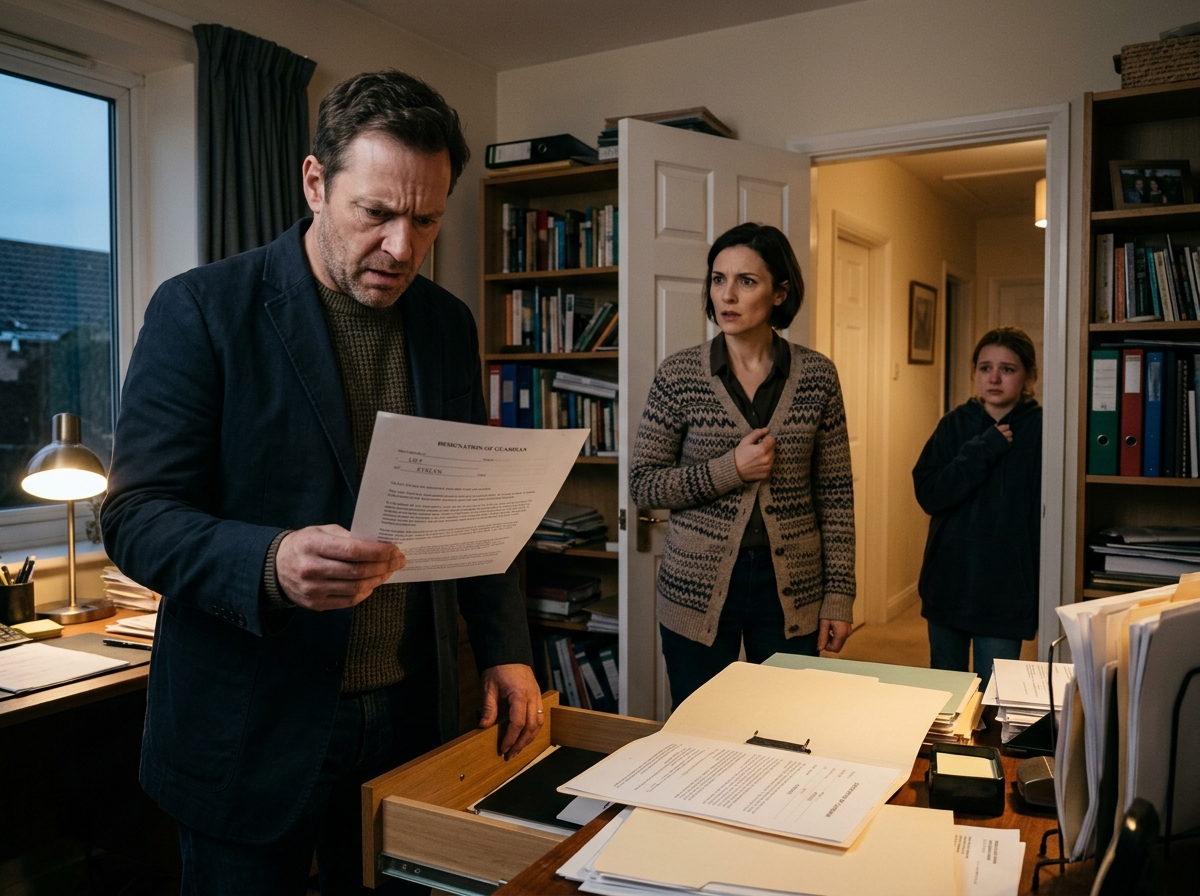
The first night without Vanessa was quieter than Richard had expected. He had imagined that the absence of arguments would make the house feel peaceful, but every sound seemed to carry a question. The refrigerator hummed in the kitchen. A branch scraped against Lily’s bedroom window. Somewhere upstairs, a floorboard creaked as the heating system settled. Richard found himself listening for footsteps that no longer came.
Lily seemed relieved at first. She left her bedroom door open while she worked on a school assignment and brought her phone downstairs without asking permission. Yet the freedom made her uneasy in ways Richard had not anticipated. When he told her she could keep her phone overnight, she asked twice whether he was certain. When he said she could call him at any time, she stared at him as though she wanted to believe him but had learned not to trust promises too quickly.
Richard did not tell her she should be over it. He understood that his decision to protect her would not immediately undo the fear she had accumulated. Instead, he made their evenings predictable. They ate dinner together, reviewed her homework, and talked about the next day's schedule. If he had to leave for work early, he told her who would be available and how to contact him. He wanted her to know that the details of her life would no longer be used to frighten her.
Vanessa stayed with a relative while she began individual counseling. She and Richard communicated mainly through brief messages about household matters and the legal review. He had made it clear that she was not to contact Evelyn about Lily or make further arrangements involving their daughter. Vanessa agreed, though she sometimes sent messages asking whether Lily was willing to speak with her.
Richard did not answer those questions immediately. He consulted Lily's counselor and considered what would be safest for his daughter. He did not want to punish Vanessa simply because he was angry, but he would not make Lily responsible for easing her stepmother's distress. Any contact had to be guided by Lily's welfare, not by Vanessa's need to feel forgiven.
One afternoon, Richard received an email from Mr. Lawson, his attorney, asking him to review a message that had been recovered from the family tablet. Vanessa had used the tablet for household matters, and Richard had initially assumed the message was an ordinary exchange about appointments. The subject line referred to a document, and the sender's name was Evelyn Mercer.
Richard opened the email and read it slowly. Evelyn had thanked Vanessa for meeting with her and asked whether Richard had signed the guardianship papers yet. She also asked whether Lily had become more cooperative and whether Vanessa had managed to make the girl understand that the arrangement would be better for everyone.
Richard read the message a second time. It had been sent several weeks before he came home early. Vanessa had not merely considered naming Evelyn as a backup guardian. She had been discussing Lily's behavior with her mother and treating the proposed arrangement as a plan that might soon be put into effect.
He forwarded the message to his attorney, then sat back in his chair. The discovery made him feel cold. He had hoped Vanessa's actions had grown from confusion and fear after Evelyn reappeared in her life. The message suggested that Evelyn had been actively encouraging the idea of taking responsibility for Lily, despite the troubling history in her own court records.
That evening, Richard spoke with Lily's counselor about the message and asked how much of the new information Lily needed to hear. The counselor advised him to avoid sharing every adult detail at once. Lily needed to know that she was safe and that no guardianship change had been made. She did not need to become the investigator of her stepmother's past or the person responsible for deciding what happened next.
Richard followed that advice. When Lily asked whether Evelyn had tried to contact them, he told her that Vanessa and Evelyn had discussed the guardianship arrangement, but that he was dealing with the matter through his attorney. He assured Lily that no one was going to take her away without his knowledge or consent.
Lily looked down at her hands. “Did Vanessa really think Evelyn would be better for me?”
“I don't know everything Vanessa was thinking,” Richard answered. “But I know that she should never have used the possibility of sending you away to frighten you.”
“Maybe she thought I was bad.”
“You are not bad because you get upset or disagree with an adult. You can make mistakes, and you can learn from them. That doesn't mean you deserve to be threatened.”
Lily nodded, but she did not look convinced. Richard resisted the urge to ask her to believe him immediately. He had spent too long accepting her silence as evidence that everything was fine. He would have to allow her to question him, to express anger, and to take time before trusting the reassurance he offered.
The next day, Mr. Lawson confirmed that the proposed document had not been signed by Richard and had no authority to transfer Lily's care. He also advised Richard to preserve the message from Evelyn and keep a record of any further contact. If Evelyn attempted to approach Lily or present herself as someone entitled to make decisions for her, Richard should seek immediate legal guidance.
Richard asked whether Vanessa had broken the law by preparing the document. Mr. Lawson explained that the answer depended on the document's exact contents and any actions taken with it. A draft or proposal was not the same as an enforceable guardianship order, and the attorney did not want to make a legal conclusion before reviewing the complete record. What was clear was that Richard had not consented, and Vanessa had no authority to replace him as Lily's guardian.
That distinction mattered, but it did not ease Richard's concern. Even if the document had never been filed, Vanessa had allowed Lily to believe she might be sent away. She had taken her phone, discouraged her from calling her father, and used the threat of separation to keep her quiet. The legal status of the paper did not change the harm those actions had caused.
Vanessa called that evening. Richard answered only after checking that Lily was settled upstairs.
“I heard you found the email,” Vanessa said.
“I did.”
“I should have told you about the contact with Evelyn.”
“Yes, you should have.”
Vanessa paused. “I wasn't trying to hurt Lily. I thought I was making arrangements in case something happened to you.”
“Then why were you discussing her behavior with Evelyn and asking whether she had become more cooperative?”
“I was trying to understand how to handle her.”
“You could have spoken to me. You could have asked for help. Instead, you made a plan behind my back and used it to frighten my daughter.”
“I know how it sounds.”
“It sounds like what happened.”
Vanessa began crying. Richard felt a familiar urge to soften his voice and reassure her, but he stopped himself. Her distress might be genuine, yet it could not become the center of a conversation about Lily's safety.
“I need you to understand that I cannot make decisions about your relationship with Lily based on what you want,” he said. “We have to consider what she needs and what her counselor recommends.”
“Does she hate me?”
“I am not going to ask her to manage your feelings.”
The line fell silent. After a moment, Vanessa said she understood. Richard ended the call without promising that everything would be all right.
Over the following days, Lily began showing small signs of relief. She no longer hid her phone when Richard entered the room. She started telling him about school without first checking his expression. One evening, she asked whether she could invite a friend over on Saturday. When he agreed, she smiled, then seemed surprised by her own happiness.
Richard did not mistake these moments for complete recovery. At times, Lily still became anxious when an adult raised their voice, even if the conversation had nothing to do with her. She also struggled to believe that plans would remain unchanged. If Richard said he would pick her up at a certain time, she asked him to repeat it. He answered patiently and made sure he followed through.
Meanwhile, Vanessa continued counseling. She told Richard she had begun to understand that she had repeated some of the controlling behaviors she had experienced as a child. She had interpreted Lily's independence as rejection and her questions as challenges to her authority. Evelyn had reinforced those beliefs, telling Vanessa that a child who resisted discipline would eventually control the household.
Richard listened, but he did not accept Vanessa's childhood as an excuse. He reminded her that Lily was twelve and had needed an adult who could respond to her fear rather than punish it. Vanessa admitted that she had been wrong to use the phone as a way to isolate Lily and that threatening to send her away had been cruel.
Her admission mattered, but Richard remained cautious. He had learned how quickly Vanessa could shift from remorse to defensiveness when she felt challenged. He wanted to see whether she could take responsibility consistently, even when Lily was not ready to forgive her.
The message from Evelyn remained a troubling piece of evidence. It suggested that Vanessa had not acted entirely alone, but it did not prove that Evelyn had intended to harm Lily physically. Richard would not make that claim without evidence. He could, however, refuse to let a woman with a documented history of neglect become involved in his daughter's care simply because Vanessa wanted to repair her own childhood.
One evening, Richard found Lily sitting at the kitchen table, drawing in a notebook. She had drawn a house with a large window, a garden, and two figures standing beside the front door. When he asked what it was, she said it was a house where nobody had to be afraid to ask a question.
Richard sat down beside her. He wanted to tell her that their home would always be safe, but he knew such a promise would have to be supported by his actions. Instead, he said he would do everything he could to make sure she could speak freely and be heard.
Lily returned to her drawing. After a moment, she slid the notebook toward him so he could see the picture more clearly.
Richard looked at the two figures by the door. He did not ask who they represented. He simply stayed beside her while she continued drawing.
Click here to continue reading: PART 6: Vanessa Asked for One Chance to Explain Herself to Lily, but Richard’s Conditions Exposed the Difference Between Regret and Real Accountability
Richard Returned Home Before Sunset and Heard His Daughter Begging for Her Phone, but Vanessa’s Explanation Made Him Question Everything
Part 5 of 20

