
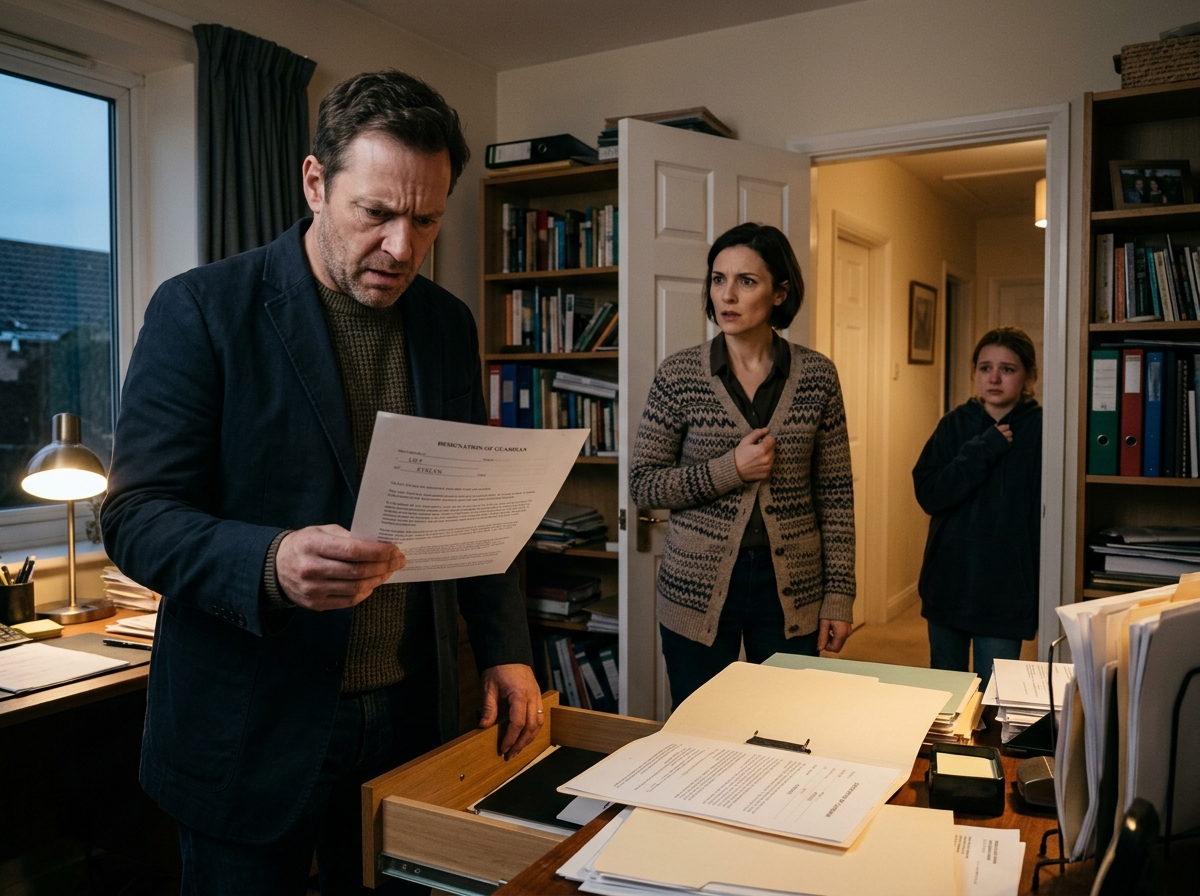
Vanessa's first request to see Lily came in a message sent late on a Sunday evening. She wrote that she missed the girl and wanted to apologize in person. She said she understood that she had caused harm, but she hoped Lily would eventually remember the good moments they had shared rather than only the frightening ones.
Richard read the message several times before replying. He did not doubt that Vanessa missed Lily. For three years, she had been part of the household, attending school events and helping with ordinary routines. Whatever had happened recently, their relationship had not been made entirely of cruelty. But the good memories could not be used to pressure Lily into meeting someone she was still afraid of.
He spoke with Lily the following morning, asking how she felt about the possibility of seeing Vanessa. He made it clear that she could say no without being punished or disappointing him. Lily stared at her cereal bowl for a long time.
“Will she get angry if I don't want to see her?” she asked.
“That's not your responsibility,” Richard replied. “She may feel disappointed, but she has to handle that herself.”
Lily thought about it, then said she was not ready. She did not want to be in the same room with Vanessa yet, and she did not want to hear another explanation about why she had been treated that way. Richard thanked her for telling him and assured her that he would respect her decision.
He replied to Vanessa that Lily was not ready for contact. If Vanessa wanted to work toward rebuilding the relationship, she would need to continue counseling, respect Lily's boundaries, and accept that contact might take time. Richard would not arrange a meeting simply to relieve Vanessa's guilt.
Vanessa called him shortly afterward. Her voice sounded strained.
“How long am I supposed to wait?” she asked.
“I can't give you a date.”
“She's my family too.”
“She is your family, and she's also the child you frightened. She gets to decide when she feels ready.”
“I said I was sorry.”
“An apology doesn't require her to be ready.”
Vanessa fell silent. Richard could hear her breathing through the phone. He knew the answer was painful for her, but he would not soften it into a promise that Lily would eventually forgive her. That outcome was not his to guarantee.
In her next counseling session, Vanessa admitted that she had expected an apology to make her feel less ashamed. She had imagined that once she acknowledged her mistakes, the family would begin returning to normal. Instead, Richard remained cautious, Lily did not want to see her, and the legal arrangement involving Evelyn was still under review.
Her counselor asked whether Vanessa was sorry for the way she had treated Lily or mainly distressed that she had lost access to the family. Vanessa initially insisted that she was sorry for both. But as the conversation continued, she began to recognize how often she had focused on what she wanted: reassurance, forgiveness, a chance to return home, and proof that she was not becoming her mother.
She had spent much of her childhood feeling powerless. When she became an adult, she had promised herself that no one would ever make her feel that way again. When Lily challenged her or asked to call Richard, Vanessa had interpreted the child's behavior through the lens of her own history. She had treated ordinary disagreement as a threat to her authority, then reached for the same forms of control she had once hated.
Understanding that pattern was painful. It did not make the harm disappear, and it did not turn her into a victim of her own choices. She had been harmed as a child, but she was now the adult responsible for how she treated another child. She could not make Lily carry the burden of proving that Vanessa had become a better person.
Meanwhile, Richard met with Lily's counselor to discuss how to support her without turning the situation into a constant subject of conversation. The counselor advised him to maintain predictable routines, allow Lily to express mixed feelings, and avoid suggesting that she owed Vanessa a meeting because they had once shared a household.
Richard also learned that Lily might miss Vanessa at times even while feeling frightened of her. Those feelings were not contradictory. Children could care about adults who had hurt them, and they could feel guilty about wanting distance. He needed to reassure Lily that she was allowed to feel whatever she felt without being forced to choose a single emotion.
One evening, Lily asked whether Vanessa had been a good person before everything changed. Richard considered his answer carefully.
“I think Vanessa has done kind things, and I think she has also done things that were wrong,” he said. “People can have different parts to them. But the kind things don't make the hurtful things acceptable.”
Lily traced a line on the table with her finger. “I used to like baking with her.”
“You can remember that and still be upset about what happened.”
“Does that mean I'm being unfair?”
“No. It means you have more than one feeling.”
Lily looked relieved. She told him that she sometimes missed the evenings when Vanessa helped her make cookies, but she was afraid that if she spoke to Vanessa, the conversation would become another argument about how difficult she was. Richard told her that she did not need to put herself in that position before she felt ready.
A few days later, Vanessa sent a handwritten letter for Lily. She had asked her counselor to help her write it without making excuses or asking for forgiveness. Richard read it first, as agreed with Lily's counselor, to ensure that it did not contain threats or pressure. The letter acknowledged that Vanessa had taken Lily's phone to prevent her from contacting her father, had threatened to send her away, and had made her feel that ordinary mistakes could cost her place in the family.
Vanessa wrote that Lily had not caused those choices. She explained that she had been afraid and angry, but she did not say that those feelings made her behavior acceptable. She also told Lily she did not have to reply or meet with her.
Richard showed Lily the envelope and asked whether she wanted to read it. She hesitated, then said yes. He sat nearby while she read silently. Halfway through, she paused and wiped her eyes. When she finished, she folded the letter and placed it back in the envelope.
“Do I have to write back?” she asked.
“No.”
“Will she be angry if I don't?”
“I can't control how she feels. But she said you don't have to reply, and I'm going to hold her to that.”
Lily nodded. She took the letter upstairs and put it in a drawer. Richard did not ask whether she had forgiven Vanessa. He was glad she had been able to read the apology, but he understood that hearing the words was only one step in a longer process.
Vanessa waited for a response. When none came, she felt the familiar urge to send another message explaining what she meant. Her counselor helped her recognize that doing so would shift the responsibility back onto Lily. The letter had been an apology, not a request for immediate emotional relief. Vanessa needed to tolerate the silence without treating it as rejection she had to overcome.
She began working on a different question in therapy: what would it mean to be accountable even if she never returned to the household? The answer required her to stop measuring progress by whether Richard softened toward her or Lily agreed to see her. She needed to address her behavior because it was wrong, not because change would guarantee a particular reward.
She also began examining her relationship with Evelyn. For years, Vanessa had told herself that her mother was dead because the truth was too painful to discuss. When Evelyn contacted her, Vanessa had wanted an explanation for the childhood she had lost. She had hoped that a reunion might provide the acknowledgment she had never received. Instead, she had allowed Evelyn's opinions to influence the way she treated Lily.
Vanessa admitted to her counselor that she had been desperate for her mother's approval. When Evelyn praised her for being strict and warned her that Lily was becoming manipulative, Vanessa had felt briefly understood. She had mistaken that feeling for wisdom. The woman who had once failed to protect her was now telling her how to raise a child, and Vanessa had accepted the guidance because she wanted their relationship to mean something different.
That realization left her ashamed, but it also made the next decision clearer. She would not contact Evelyn about Lily again. She would not ask her mother to defend the guardianship plan or explain why it was reasonable. If she wanted to understand her past, she would have to do so without allowing Evelyn to direct Lily's future.
Richard, meanwhile, kept the legal process moving. His attorney confirmed that the proposed guardianship document remained without legal force and that Richard's own arrangements were still in place. He secured copies of the relevant records and made sure the school had clear instructions about who was authorized to collect Lily. He also asked the attorney to advise him on what to do if Evelyn tried to approach Lily directly.
There was no evidence that Evelyn had filed anything with a court or attempted to collect Lily from school. Richard did not assume that she would. But after seeing the messages, he was unwilling to rely on Vanessa's promises alone. He wanted the boundaries to be clear, documented, and enforceable where necessary.
At home, Lily slowly began to reclaim parts of her routine. She invited a friend over, joined an after-school activity, and started talking about her plans for the summer. Richard noticed that she no longer asked whether he was certain every time he agreed to something. She was still cautious, but the fear no longer seemed to occupy every corner of her day.
One evening, while they were preparing dinner, Lily asked whether Vanessa would ever live with them again.
Richard put down the knife and turned toward her. “I don't know. That depends on what happens next, and on what is safe for you. I'm not going to promise something I can't be sure of.”
Lily absorbed the answer. “Okay.”
He appreciated that she had asked, and he wanted her to know that she would be included in decisions that affected her life. He would not tell her every legal detail, but he would not allow adults to use uncertainty as a weapon against her again.
Vanessa's request for a chance to apologize had not restored the family. It had revealed how much she still wanted forgiveness to arrive on her schedule. Learning to accept Lily's boundaries was becoming part of the work she needed to do.
For Richard, the lesson was equally difficult. He could care about Vanessa's pain and still refuse to let her near Lily until it was safe. He could hope she would change without making his daughter responsible for proving that change had happened.
The next step would not be a family meeting or a dramatic reunion. It would be a slower process of accountability, legal clarity, and consistent behavior. Richard was prepared to let that process take time.
Click here to continue reading: PART 7: Evelyn Finally Contacted Richard Directly, and Her Explanation for Wanting Lily Revealed a Motive Far More Complicated Than Vanessa Had Admitted
Richard Returned Home Before Sunset and Heard His Daughter Begging for Her Phone, but Vanessa’s Explanation Made Him Question Everything
Part 6 of 20

