
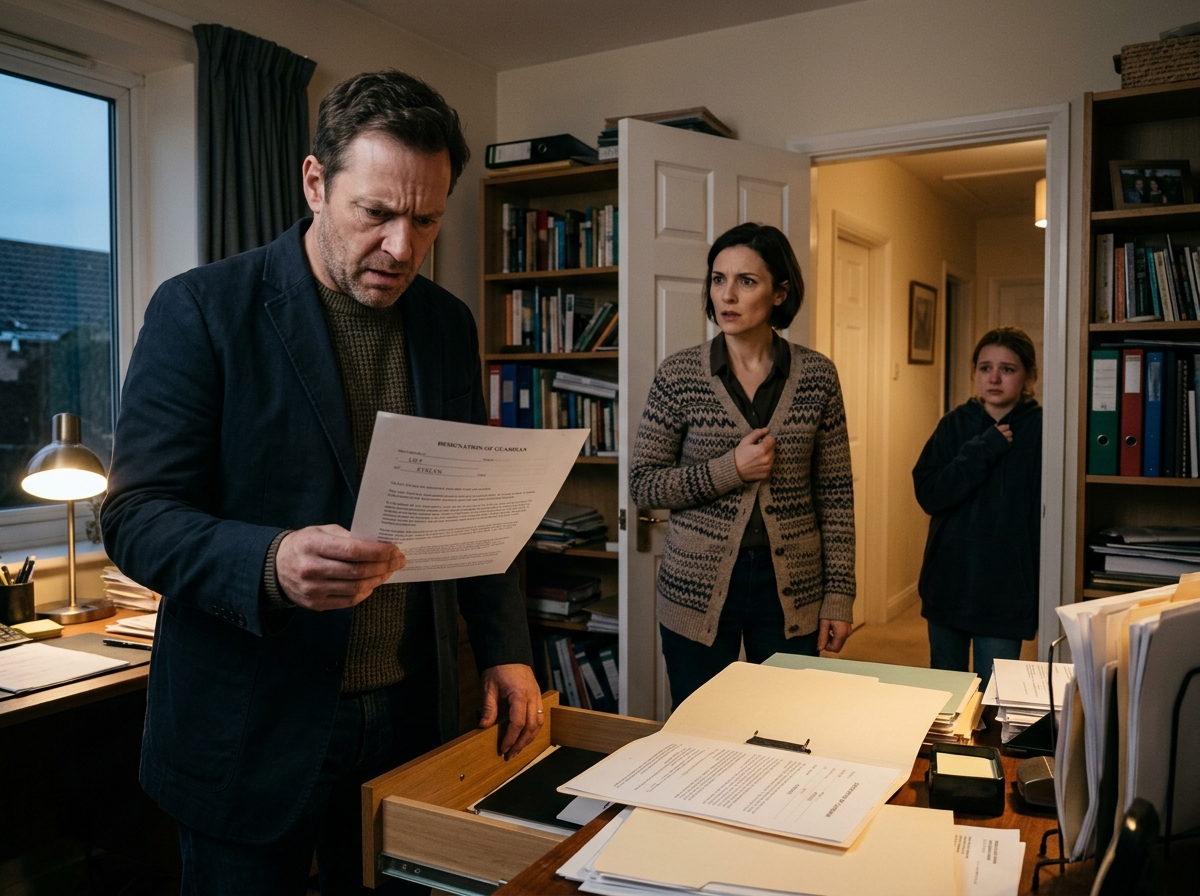
The message arrived on a Wednesday morning, sent to Richard's personal email address from an account he did not recognize. The subject line contained only his surname. He nearly deleted it, assuming it was advertising, until he saw the full name at the bottom of the message.
Evelyn Mercer.
Richard read the opening sentence, then stopped. Evelyn wrote that she understood he had questions about the guardianship document and that she wanted an opportunity to explain her intentions. She claimed that Vanessa had misunderstood some of their conversations and that her only concern was Lily's future. She asked Richard to meet her privately so they could discuss the matter without further distress to the family.
He forwarded the message to Mr. Lawson without replying. The attorney advised him not to meet Evelyn alone or accept her account without corroboration. If a conversation became necessary, it should occur with appropriate safeguards and a clear purpose. Richard agreed. He had no intention of allowing Evelyn to control the discussion simply because she had finally decided to speak.
Later that day, Vanessa called. She sounded anxious.
“Has my mother contacted you?”
“Yes.”
“What did she say?”
“She wants to explain the guardianship document.”
Vanessa exhaled sharply. “She told me she would leave you alone.”
Richard was quiet for a moment. “You still seem to be treating her promises as something you can rely on.”
“I thought she had changed.”
“Maybe she has changed in some ways. That doesn't mean she should be involved in Lily's care.”
Vanessa admitted that she had not expected Evelyn to contact Richard directly. She had believed her mother would wait until Vanessa had persuaded him to consider the proposed arrangement. The admission reinforced Richard's concern that the plan had been more developed than Vanessa initially claimed.
“Did Evelyn tell you why she wanted to be named as Lily's guardian?” he asked.
“She said she wanted to help.”
“Help with what?”
Vanessa hesitated. “She said she had resources. She could offer Lily a better school, more opportunities, a quieter home. She thought you were working too much and that Lily needed more attention.”
Richard felt anger rise. “And you thought a woman you had hidden from me, a woman whose own history included losing custody, was the right person to decide that?”
“I wasn't thinking clearly.”
“You were thinking clearly enough to hide the papers.”
Vanessa fell silent. Richard regretted the sharpness of the words, but not their meaning. He was tired of hearing her describe the plan as though it had appeared out of nowhere. She had chosen to keep it secret, and she had allowed Lily to believe she might be taken away.
“I know I handled it badly,” Vanessa said. “I don't expect you to trust me. I just want you to know that I wasn't trying to get rid of Lily.”
Richard believed that Vanessa might not have intended to abandon Lily. But intention did not erase the effect of her threats, nor did it explain why she had been willing to involve Evelyn in a decision that should have remained with Lily's legal parent.
“Then you need to be honest about what you were trying to do,” he replied. “Not just what you didn't intend.”
After the call, Richard arranged for his attorney to respond to Evelyn. The reply stated that Richard had not authorized any guardianship change, that he did not consent to Evelyn taking responsibility for Lily, and that any further communication about the matter should be directed through the attorney. It also made clear that Evelyn was not to approach Lily at school or elsewhere as though she had authority over her.
Evelyn responded the following day. Her message was more detailed than the first. She wrote that she had spent years regretting the way she had raised Vanessa and that she wanted a chance to make amends. She acknowledged that she had lost custody when Vanessa was young but claimed that the circumstances had been complicated by poverty, an abusive relationship, and a lack of support. She said she had worked hard to rebuild her life and believed she could offer Lily stability.
Richard did not dismiss the possibility that Evelyn's life had changed. People could grow, and a troubled past did not automatically determine every future action. But the question was not whether Evelyn deserved a chance to tell her story. The question was whether she should be given authority over a twelve-year-old girl who had never met her and had already been frightened by the possibility.
He asked Mr. Lawson to verify Evelyn's current circumstances and review any relevant public records. The attorney cautioned that not every detail of Evelyn's private life would be accessible or relevant. He would focus on what could be established and what mattered to Lily's safety. Richard agreed.
In the meantime, Richard told Lily that Evelyn had contacted him. He did not share the full contents of the messages, but he explained that she wanted to discuss the guardianship arrangement and that he had declined to meet privately.
Lily's face tightened. “Does she know what Vanessa said to me?”
“I don't know what Evelyn knows. I'm not going to assume she understands what happened.”
“Could she come here?”
“Not without my agreement. I've also told her not to approach you or your school.”
Lily looked relieved, but she still asked whether Richard could promise that Evelyn would never appear. He could not make that guarantee, and he refused to offer one simply to quiet her fear.
“I can promise that I'll take it seriously if she tries to contact you,” he said. “You won't have to handle it alone.”
That answer was less absolute than Lily wanted, but it was honest. Richard knew the difference mattered. He would not protect his daughter by making promises that depended on another person's behavior.
Several days later, Mr. Lawson received information confirming that Evelyn had recently moved to a smaller town and was living with a partner. There was no immediate evidence that she had harmed a child in recent years, but the historical records remained serious. The attorney also found that Evelyn had made no formal application to become Lily's guardian. The document appeared to have been prepared privately, with the expectation that Richard might eventually be persuaded to sign it.
The discovery clarified the legal position but left the motive unresolved. Why had Evelyn wanted to be named in the first place? Had she genuinely hoped to repair her relationship with Vanessa by helping Lily, or had she seen the guardianship proposal as a way to regain control over a family from which she had once been excluded?
Richard could not answer that question from the available evidence. He would not invent a sinister motive simply because he disliked the plan. He could, however, insist that Evelyn remain outside Lily's life unless and until there was a compelling reason to consider otherwise.
Vanessa eventually agreed to meet with Richard and Mr. Lawson to discuss the document. She arrived looking tired, with a notebook in her hands. She admitted that Evelyn had encouraged her to prepare the paperwork and had repeatedly told her that Richard might become unable to care for Lily if he continued working such long hours. Evelyn had also suggested that Lily's recent behavior showed she needed a different environment.
“Did she tell you to take Lily's phone?” Richard asked.
“No,” Vanessa replied. “That was my decision.”
“Did she tell you to threaten Lily with being sent away?”
Vanessa looked down. “No. I did that.”
Richard waited for her to continue.
“I thought I was losing control,” she said. “Every time Lily asked to call you, I felt as though she was proving I wasn't enough. Evelyn kept telling me that children respect adults who don't let them challenge authority. I believed her because I wanted her to think I was doing a good job.”
Mr. Lawson asked whether Vanessa had ever promised Evelyn that she would transfer Lily's care to her.
Vanessa shook her head. “I said I would discuss the arrangement with Richard. I never told her I could do it without him.”
“But you did not tell Richard,” the attorney observed.
“No.”
The answer was plain, and Vanessa did not try to soften it. Richard could see that she was beginning to recognize how much she had withheld. Still, he did not agree to change the boundaries he had established.
The meeting ended with clear instructions: Vanessa would not make further arrangements with Evelyn involving Lily; she would provide any remaining messages or documents related to the proposal; and all future discussion of guardianship would take place through the appropriate legal channels. Richard would continue making decisions for Lily, with guidance from his attorney and professionals who could assess her welfare.
After the meeting, Vanessa asked Richard whether he believed her now.
“I believe you when you tell me what you did,” he said. “Trust will take longer.”
She nodded, accepting the answer without arguing.
The next day, Richard received another message from Evelyn. This time, she did not ask to meet. She wrote that she understood he had refused the guardianship arrangement and that she would not approach Lily. She said she hoped Vanessa could repair the damage and that she regretted the pain her involvement had caused.
Richard forwarded the message to his attorney and did not respond. He could not determine whether Evelyn's words came from genuine remorse or a desire to end the dispute. He did not need to decide that question immediately. Her promise not to approach Lily was useful, but it did not erase the concerns raised by the earlier messages.
Lily's counselor helped her understand that she did not owe Evelyn a relationship. The woman was Vanessa's mother, but that biological connection did not give her a right to Lily's time or affection. Lily could be curious about her, angry with her, or unwilling to meet her. None of those reactions would make her unkind.
For the first time, Lily said aloud that she did not want to meet Evelyn at all. Richard thanked her for being clear and told her he would respect that boundary. He did not suggest that she might feel differently later, even though he knew feelings could change. The decision belonged to Lily now.
Vanessa continued counseling and began exploring why Evelyn's approval had mattered so much to her. She admitted that part of her had hoped the guardianship proposal would prove that her mother trusted her to make good decisions. If Evelyn praised her for being strict, Vanessa could pretend that the pain of her childhood had somehow led to competence rather than damage.
But she had sought that approval at Lily's expense. The realization was difficult, and it did not make Vanessa's behavior acceptable. It did help her understand why she had ignored the warning signs when Evelyn encouraged her to control the girl.
Richard could see that Vanessa was beginning to speak more honestly about her motives. He also knew that honest explanations did not guarantee safe behavior. He would continue to judge the situation by what she did, not only by what she said she understood.
The guardianship document was now a closed legal question in one important respect: it had never been validly approved, and it could not remove Lily from Richard's care. The deeper family questions remained. Vanessa had to decide what kind of relationship she could have with Lily without demanding access. Richard had to decide what boundaries were necessary to keep his daughter safe. Evelyn would have to accept that regret did not entitle her to a place in Lily's life.
Richard did not feel triumphant. He felt tired, protective, and more aware than ever that the truth had to be established through patience and evidence. He had no interest in punishing Evelyn for the past simply because she had once failed as a mother. He was interested in preventing that past from becoming a threat to his own child.
That evening, Lily asked whether the legal papers were finished.
“The document can't make you leave,” Richard told her. “My attorney has confirmed that. We're keeping the records safe, and no one has authority to change your home without the proper legal process.”
Lily let out a breath she seemed to have been holding for weeks. She leaned against him, and he rested a hand on her shoulder.
For now, Evelyn would remain outside their lives. Vanessa would continue working through the consequences of her decisions. And Richard would keep making sure that Lily's future was decided through care, honesty, and her welfare—not through hidden paperwork or threats.
Click here to continue reading: PART 8: Vanessa’s Final Explanation Forced Richard to Choose Between the Marriage He Had Hoped to Save and the Safety His Daughter Needed Most
Richard Returned Home Before Sunset and Heard His Daughter Begging for Her Phone, but Vanessa’s Explanation Made Him Question Everything
Part 7 of 20

