
The day the final arrangements were confirmed, Claire woke before sunrise. She lay still for several minutes, listening to the quiet house and watching the first light spread across the bedroom wall. There had been a time when she imagined that if Daniel ever left, she would be unable to face the morning. Now she knew that grief could be overwhelming without making ordinary life impossible.
She dressed, made coffee, and checked the documents she needed for the day. The separation had been moving toward this point for months, through counseling sessions, practical meetings, difficult conversations, and long periods when neither of them knew how to speak without touching the hurt beneath every sentence. There was no sudden discovery or dramatic event to change their course. Daniel had made his decision, and Claire had gradually learned to stop treating that decision as something she could reverse through enough remorse.
They met later that morning to complete the remaining formalities. Daniel arrived on time, carrying his own folder. He looked tired, though not uncertain. They greeted each other politely and sat down to review the details. Claire noticed the way he read each page carefully, asking questions when something needed clarification. She felt a brief pang of affection for the familiar habits she had once taken for granted.
When the documents had been reviewed, Daniel thanked her for handling the process responsibly. Claire told him she had tried to make the arrangements clear and fair. Neither spoke as though their cooperation meant the marriage had somehow been saved in another form. They were doing what needed to be done because both of them deserved a separation that did not create more harm than necessary.
Outside, Daniel paused beside the entrance. “I wanted to say something before we go.”
Claire waited.
“I don’t want you to think the years we had together meant nothing to me,” he said. “I loved you. I was happy with you for a long time. What happened changed what I could live with, but it doesn’t make every memory false.”
Claire felt tears rise immediately. Those were the words she had wanted to hear for months, but she understood that they were not an invitation to return. Daniel was acknowledging the truth of their past, not offering to restore their marriage.
“I don’t think the years meant nothing,” she replied. “I’m grateful for the good parts. And I’m sorry I damaged something that mattered so much to both of us.”
Daniel nodded. For a moment, they stood together without speaking. Then he said he hoped they would both find a way forward. Claire wished him the same, and they parted.
She did not follow him to the car. She did not ask whether he might change his mind in the future. She went home and sat quietly at the kitchen table, allowing the finality of the day to settle over her.
The house no longer held the same practical meaning it once had. Daniel was not coming back to live there, and Claire would eventually need to decide what to do with it. For now, she moved through the rooms slowly, noticing the small signs of their life together: a mark on the wall from furniture they had moved, a shelf Daniel had installed, a faded photograph from a holiday. She did not rush to remove everything. The marriage had ended, but she did not need to erase the evidence that it had existed.
In the weeks that followed, Claire continued therapy. She talked about the shame she felt when she remembered the shower and the fear that people would always define her by the lie. Her therapist asked what she would do if that fear never disappeared completely.
Claire thought about the question for several days. She had once believed that she needed to eliminate fear before she could be honest. Now she understood that honesty was often the choice she needed to make while afraid. She might never be able to prevent discomfort, disappointment, or the possibility that someone would reject her. But she could stop treating those possibilities as emergencies that justified concealment.
She began practicing that principle in small situations. When she made a mistake at work, she acknowledged it instead of inventing a reason it had happened. When a friend asked how she was coping, she did not claim to be fine simply to keep the conversation comfortable. When she felt embarrassed, she tried to name the feeling rather than hide it behind an explanation.
These changes did not make her a different person overnight. She still had moments of defensiveness and days when shame made her want to disappear. But she began to recognize that growth was not a performance in which she needed to convince everyone that she had become worthy of forgiveness. It was a pattern of choices she would have to keep making whether anyone noticed or not.
Sophie visited Claire one afternoon to return a book she had borrowed. They sat in the living room and talked about ordinary things before Sophie asked how Claire was managing after the separation became permanent.
“Some days are harder than others,” Claire admitted. “But I’m trying to stop treating the sadness as something I have to fix immediately.”
Sophie nodded. “That sounds healthy.”
Claire smiled faintly. “I’m learning.”
There was no grand declaration between them. Sophie had her own life and her own feelings about what had happened. She could care about Claire without becoming responsible for her recovery, just as Claire could care about Sophie without expecting her to forget the deception.
Before leaving, Sophie hugged Claire. The embrace lasted a little longer than the one they had exchanged at the café months earlier. Claire felt grateful, but she did not interpret it as a promise that their relationship would return to what it had been. It was a kind moment between two people who were still learning how to be family after a painful rupture.
Margaret remained more reserved. Claire heard occasionally from her through family messages, but they did not resume their former closeness. Claire stopped expecting every interaction to move toward reconciliation. Margaret’s pain belonged to her, and she was entitled to decide what kind of relationship she could manage.
Emily and Claire also continued cautiously. They sometimes exchanged messages, and once they met for coffee. Emily still had questions about the months when she had believed the pregnancy was real. Claire answered them without defensiveness. She did not ask Emily to say that the friendship was repaired, and Emily did not offer a promise she was not ready to make.
Over time, Claire came to see that the different relationships in her life would not heal at the same speed. Some might become warmer. Others might remain distant. A few might never return to their former closeness. She could grieve those possibilities without trying to force them into one shared ending.
Daniel faced a different kind of rebuilding. He returned to living independently, gradually creating routines that were not organized around his brother’s household. He continued working and spent time with Sophie and other relatives. He also continued counseling, where he worked through the anger and distrust that remained after the marriage ended.
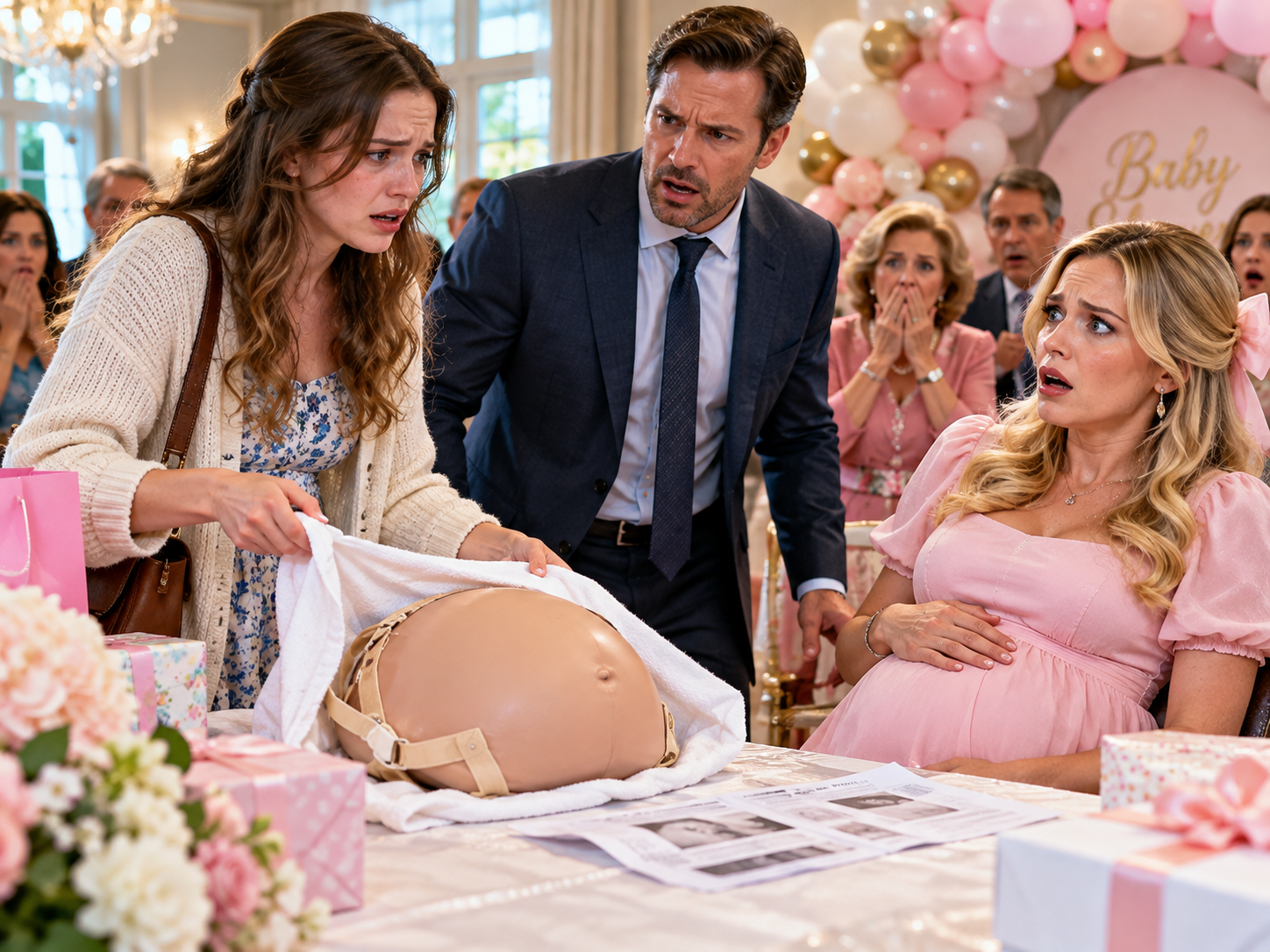
At first, he found himself thinking about the lie whenever someone mentioned pregnancy or a baby shower. He would remember the artificial belly, the notebook, and the false appointments. Sometimes the memories came with a flash of anger; sometimes they left him feeling hollow. He learned not to treat every return of grief as evidence that he had made the wrong decision.
His counselor encouraged him to distinguish between missing Claire and wanting to resume the marriage. Daniel could miss her voice, her humor, and the ordinary companionship they had shared without deciding that living together was still right for him. He could wish that things had happened differently without believing that the past could be repaired by returning to it.
That distinction gave him room to remember the marriage more honestly. He did not have to rewrite every happy moment as a deception. Claire had loved him, and they had shared real affection. The pregnancy lie had been a terrible breach of trust, but it did not mean every kindness between them had been false.
One evening, Daniel visited Sophie and her mother for dinner. The conversation was relaxed, and for a while they talked about work, family news, and a television show they had all been watching. The baby shower was not mentioned until later, when Margaret’s name came up and Sophie asked how Daniel was doing.
“I’m getting there,” he said. “Not every day feels the same.”
His stepdaughter looked at him with concern. “Do you regret leaving?”
Daniel considered the question. “I regret that things reached a point where I felt I had to. I regret what happened. But I don’t think staying would have made the hurt disappear.”
Sophie nodded slowly. She did not ask him to defend the decision further. Their relationship had already survived one painful exchange at the shower, and Daniel was determined not to make his daughter carry the burden of deciding whether he had done the right thing.
Later that night, he drove home through streets he knew well. He thought about the future he had imagined when Claire announced the pregnancy. For a long time, he had treated that future as something stolen from him. Now he understood that he was grieving not only the child he believed was coming, but also the certainty he had once felt about his life.
He could not recover that certainty, and perhaps he should not try. A life could change without warning. People could disappoint each other. Love could be real and still fail to protect a relationship from choices that caused lasting harm. What mattered now was not building a future that promised never to hurt, but building one in which he could respond honestly when hurt arrived.
Claire reached a similar understanding in her own way. She had wanted a child because she wanted a family with Daniel, but she had also wanted the pregnancy to prove something about herself. She had treated the imagined baby as evidence that she was a successful wife, someone who could give Daniel what she believed he wanted. The lie had grown from that belief, but it had not made her more valuable or less valuable as a person.
She had never received a diagnosis that said she could not conceive. The uncertainty she had feared had remained uncertainty all along. She could not know what her future might hold in that regard, and she no longer wanted to answer the question through fantasy. If she ever chose to pursue parenthood again, she would have to face the real circumstances honestly, with the understanding that there were no guarantees.
She also stopped thinking of Daniel’s departure as proof that she was unlovable. He had left because the marriage had been damaged in a way he did not believe he could repair. That was a consequence of her choices, not a universal judgment on every part of her life. She could accept the consequence without using it to justify further shame or dishonesty.
Months after the shower, Claire opened a drawer and found a small card from one of the relatives who had attended the celebration. The card had been among the gifts, its message offering congratulations and wishing the family happiness. She sat with it for a moment, then placed it with the other records she had kept. She did not destroy it, and she did not put it on display. It belonged to the history of what had happened.
The artificial belly was gone from the house, and the blue notebook was stored away. Yet the meaning of those objects remained. They reminded her that deception had not been a single moment of panic. It had required repeated choices, each one made to protect the lie from the truth. Remembering that did not mean she had to remain trapped in shame. It meant she had to remain honest about the path that had brought her there.
Daniel and Claire did not return to being husband and wife. They continued to move forward separately, carrying different memories of the same marriage and different hopes for the lives ahead. They had learned that love could not substitute for honesty, that remorse could not demand forgiveness, and that the truth did not guarantee a happy ending.
But the truth did offer something the lie never could: a place from which each of them could make real choices. Daniel could decide to leave without doubting whether he had been given the facts. Claire could begin rebuilding herself without pretending she had not caused harm. Sophie could love her stepfather and maintain boundaries with Claire. Margaret could grieve the child she had imagined without being asked to treat the experience as a misunderstanding.
The family would not forget the shower. They would remember the shock, the anger, the artificial belly on the gift table, and the moment a future everyone had celebrated collapsed. But that moment would not have to define every conversation forever. Each person could carry the memory differently, and none would have to invent a happier version of what had happened.
Claire had once believed that if she could control what people saw, she could protect herself from rejection. Instead, she had lost the very trust she wanted to preserve. Now she was learning that honesty could not guarantee acceptance, but it was the only way to build relationships in which acceptance meant something real.
Daniel had once believed that love and a shared future would naturally lead to a family. He learned that the future was never guaranteed, and that love required more than hope when trust had been broken. He could honor the good years without returning to a marriage he no longer felt able to continue.
Their story did not end with forgiveness that made everything right. It ended with a painful separation, relationships that would take time to find their new shape, and two people beginning to live with the consequences of choices that could not be undone.
The child they had imagined never existed. The happiness they had felt while anticipating that child had been real. The deception that sustained it had also been real. Holding all three truths together was difficult, but it was more honest than choosing only the parts that made the past easier to bear.
And at last, Claire no longer tried to turn the truth into a promise that Daniel would return. She accepted that he had chosen another path, and she began choosing her own—not as a way to earn him back, but because she wanted to become someone who could face fear without building a lie around it.
The baby shower had exposed the lie. The months afterward had revealed its cost. What remained was not the future Claire had invented, nor the marriage Daniel had hoped to preserve, but the difficult possibility of living honestly after both had been lost.
Click here to continue reading: PART 17: The First Holiday After Their Separation Brought Back Memories Neither Daniel Nor Claire Was Ready to Face, and One Unexpected Gesture Reminded Them That Kindness Did Not Require Reconciliation
My Daughter Interrupted a Perfect Baby Shower With One Quiet Accusation, and the Strange Object She Placed on the Gift Table Changed Everything
Part 16 of 20


One Comment on “PART 16 – When the Separation Finally Became Permanent, Claire Stopped Waiting for Forgiveness to Rescue Her, and Daniel Found a Way to Remember Their Marriage Without Denying Its Pain”