
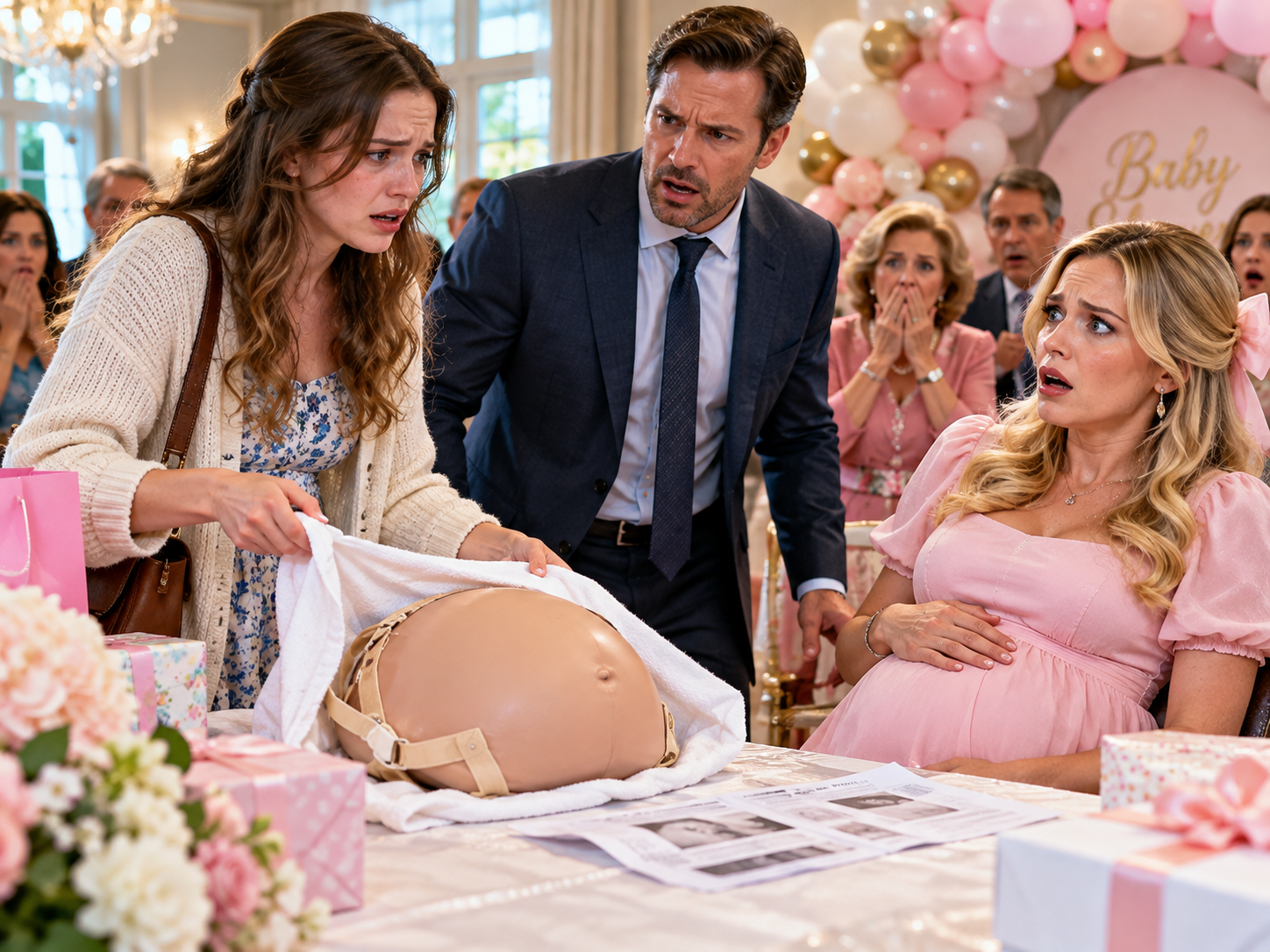
Claire had spent months telling different versions of the same story to different people. Her mother had heard about the supposed medical appointments. Daniel's family had heard about the baby's progress. Friends had received photographs and updates, and relatives had been encouraged to plan for a child whose arrival was supposedly only weeks away. Now that the truth was known within the family, Claire faced another problem: she had to decide how to tell the people outside it.
She began with her closest friend, Emily, who had been one of the first people Claire told about the pregnancy. Emily had attended the announcement dinner, helped choose colors for the nursery, and sent Claire messages asking how she was feeling. She had even organized a small collection of baby books from friends. Claire had avoided her calls since the shower, claiming she needed rest and privacy.
When Emily finally asked to visit, Claire agreed. They met at Claire's house on a Saturday afternoon. The artificial belly and the blue notebook had been removed from the storage room and placed in a box that Claire intended to keep for the time being. The nursery remained untouched. A small wooden crib stood against one wall, and the shelves held books Emily and other friends had bought.
Emily looked around and smiled sadly.
“I thought you might want company,” she said. “I know the last few weeks must have been difficult.”
Claire stared at her hands.
“Emily, there's something I need to tell you.”
Her friend sat down slowly. “All right.”
Claire took a breath, then explained that she had never been pregnant. She told Emily about the prosthesis, the fabricated appointments, and the notebook in which she had recorded reminders to maintain the lie. She admitted that she had allowed everyone to believe the pregnancy was real because she was afraid of facing the possibility that she might not be able to conceive.
Emily listened without interrupting. At first, she seemed confused, as though she expected Claire to clarify that she had experienced an early pregnancy loss or that a doctor had discovered a medical problem. When Claire finished, Emily stared at her for several seconds.
“You mean there was never a baby?”
“No.”
“Not even at the beginning?”
“No.”
Emily leaned back in her chair. She looked toward the nursery again, then returned her gaze to Claire.
“I bought those books because I believed you were having a child.”
“I know.”
“I told my sister. She gave me a bag of clothes her daughter had outgrown. I brought them here because I thought you would need them.”
Claire's face crumpled. “I'm sorry.”
Emily did not immediately accept the apology. She looked hurt, but what seemed to trouble her most was the realization that she had been made part of a story without knowing it.
“Why didn't you tell me you were struggling?” she asked. “You know I would have listened.”
“I was ashamed.”
“Of what? Not being pregnant?”
“Of not being able to give Daniel a child. Of everyone finding out that I was scared. Of being the person who couldn't make it happen.”
Emily shook her head. “You don't know that you can't have a child. You never even had a proper fertility evaluation.”
“I know.”
“Then you lied about a problem you hadn't been diagnosed with, and you made everyone believe the lie.”
Claire lowered her eyes.
Emily's voice softened slightly, but her disappointment remained. “I wish you had trusted me enough to tell me the truth. I could have helped you deal with the uncertainty. Instead, you let me celebrate something that wasn't happening.”
Claire began to cry. “I thought I could stop before anyone got hurt.”
“But people were already getting hurt. You just didn't want to see it.”
The words were difficult to hear because they echoed what Daniel had said. Claire had wanted to believe the lie was temporary, that she could keep it contained until she found a painless way to end it. She had treated every delay as a way to protect the people she loved, when in reality she had been protecting herself from the consequences of honesty.
Emily stood and walked toward the window. For a while, she watched a neighbor carry groceries from a car to the front door. When she turned back, her expression was calmer but not forgiving.
“I need time,” she said. “I care about you, but I don't know what to do with this yet.”
Claire nodded. “I understand.”
“Do you?”
“I think I'm beginning to.”
Emily collected her coat. Before leaving, she said she hoped Claire would continue therapy and learn to tell the truth before fear turned into another deception. She did not promise to return soon or help with the nursery. Claire thanked her for coming, then watched her walk down the front steps.
After Emily left, Claire sat alone in the living room. She told me later that the conversation had hurt more than she expected because Emily had not shouted or insulted her. She had simply refused to make Claire's shame more comfortable by pretending the lie was understandable enough to excuse.
“I wanted her to tell me she still loved me,” Claire said when we spoke that evening. “I wanted her to say she understood why I did it.”
“Did she say she didn't love you?”
“No.”
“Then perhaps she is taking time to decide what the friendship can look like now.”
Claire sighed. “I know. I just hate that I have to wait.”
I reminded her that other people had waited while she controlled what they knew. Daniel had waited for appointments that never existed. His mother had waited for a grandchild. Emily had waited to celebrate a baby she believed was real. Claire was now experiencing uncertainty from the other side, and she would have to learn to tolerate it without demanding that anyone resolve it for her.
The following week, Claire began contacting the people who had received her pregnancy updates. She did not send a dramatic public announcement. Instead, she wrote individual messages to friends and relatives, explaining that she had fabricated the pregnancy and that Daniel had not known the truth until the baby shower. She acknowledged that she had misled them and apologized for involving them in the deception.
The responses varied. Some people expressed sympathy for her fear and encouraged her to continue counseling. Others said they needed distance. One relative asked whether the entire marriage had been built on lies. Claire admitted she could not answer for every aspect of her relationship, but she acknowledged that the pregnancy deception had been deliberate and sustained.
She did not ask anyone to keep the information secret. She did ask them not to invent a miscarriage or medical emergency to make the situation easier to explain. That decision mattered. For the first time, she was allowing the truth to stand without dressing it in a more acceptable story.
Daniel learned that Claire had begun telling people what happened. He did not praise her or treat it as proof that he should return. He told her during counseling that honesty was necessary, but it could not undo the past.
“I know,” she replied. “I'm not doing it to make you come home. I'm doing it because I should have done it before.”
The counselor asked Daniel whether he believed her. He said he believed she was making an effort, but he was not ready to trust her fully. Claire accepted the distinction. She was learning that a sincere action could be worthwhile even when it did not produce immediate forgiveness.
Meanwhile, Sophie faced her own difficult conversations. Some relatives still believed she should have handled the discovery privately. She explained that she had tried to raise her concerns before the shower but had not understood the full extent of the deception until she found the prosthesis and its instructions. She admitted that the public confrontation had been painful for everyone present, but she refused to apologize for telling Daniel the truth.
I supported her decision to be honest about the timing without accepting blame for the lie itself. Sophie had not handled every moment perfectly, but she had been confronted with a situation no young adult should have had to manage. The responsibility for the artificial pregnancy remained with Claire.
One afternoon, Sophie and Claire met briefly at my house. They had agreed to speak because neither wanted the relationship to remain frozen at the moment of the shower. Sophie told Claire that she had been hurt by the accusation that she had ruined the marriage. Claire apologized and admitted that she had blamed Sophie because it was easier than facing the consequences of her own choices.
“I knew the lie was wrong before you found it,” Claire said. “You didn't make me do any of it. I am sorry I treated you as if you had.”
Sophie listened, then said she appreciated the apology. She did not promise that everything would be normal between them. She said she needed time to feel comfortable around Claire again, especially because the confrontation had changed how she understood their relationship.
Claire nodded. “You don't have to make me feel better about that.”
It was the first conversation between them that did not end with either woman trying to force a particular emotional outcome. Sophie left feeling relieved, and Claire seemed to understand that respecting a boundary was part of taking responsibility.
Daniel continued living with his brother. He and Claire attended counseling, but their discussions had shifted away from whether they could quickly restore their marriage. They were examining the choices that had led to the deception and the damage it had caused. Daniel spoke about his fear that he would never know when to trust Claire again. Claire spoke about her habit of treating shame as something she had to hide rather than a feeling she could share honestly.
Neither conversation offered an easy solution. But they were finally discussing the real problem instead of trying to preserve the appearance of a happy pregnancy.
One evening, Daniel called me and said he had received a message from Emily. She had told him she was sorry for what he was going through and that she had only recently learned the full truth from Claire. She did not offer an opinion about whether he should stay married. Daniel said he appreciated that she had reached out without telling him what decision to make.
“I don't want everyone choosing sides,” he said. “I want to make my decision based on what happened between Claire and me, not on what the family thinks I should do.”
I told him that was sensible. Other people could offer support, but they could not decide what he could live with.
As the weeks passed, Claire stopped asking whether Daniel would return. She still hoped for reconciliation, but she was beginning to understand that hope could not become another demand. She continued therapy, maintained her practical responsibilities, and answered questions from relatives honestly. When someone criticized her, she tried to listen without immediately defending herself. Sometimes she succeeded. Sometimes she left the conversation overwhelmed and had to discuss it with her therapist.
The nursery remained in place for a while, but Claire eventually began packing the items into boxes. She did not throw them away in anger or keep them arranged as though the baby might still arrive. She stored the crib parts and folded the blankets, acknowledging that the room had become a reminder of a future she had invented. She would decide later what to do with the space.
Emily did not resume their friendship immediately. They exchanged a few messages, and Emily agreed to meet Claire for coffee several weeks later. Their conversation was cautious. Emily said she cared about Claire but needed to rebuild her confidence that what Claire told her was true. Claire accepted that the friendship might never return to its former closeness. She did not demand that Emily prove her affection by forgiving her quickly.
That was a painful lesson, but it was also a necessary one. Claire had spent months trying to control how other people saw her. Now she was learning that she could tell the truth, make better choices, and still be unable to control what others believed or whether they stayed.
The family had not become united by the discovery. Some relationships were strained, others were slowly recovering, and Daniel's marriage remained uncertain. But the deception was no longer being maintained through silence. People were beginning to respond to the truth rather than to the story Claire had created.
For the first time, Claire was not trying to make the future look a certain way before it arrived. She was beginning to face it as it was: uncomfortable, unpredictable, and no longer something she could manage by pretending a child existed.
Click here to continue reading: PART 8: When Daniel Returned to the House to Make a Decision About Their Marriage, Claire Finally Understood That Telling the Truth Was Only the Beginning of Repair
My Daughter Interrupted a Perfect Baby Shower With One Quiet Accusation, and the Strange Object She Placed on the Gift Table Changed Everything
Part 7 of 20

