
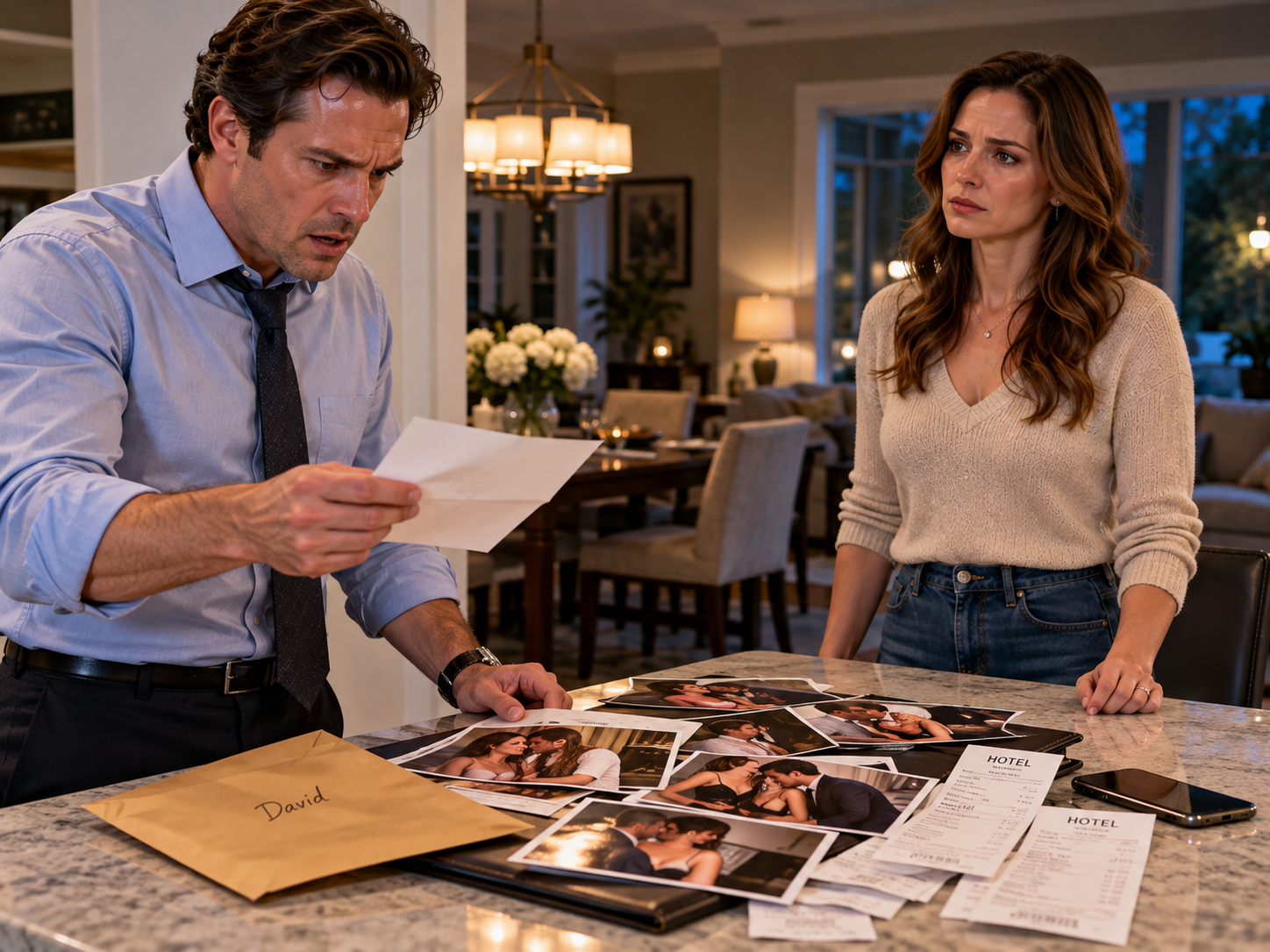
The question came during a quiet Sunday afternoon when the children were sorting through a stack of photographs at Sarah’s house. I had arrived to collect a bag of school materials that had been left behind, and Sarah invited me to sit for a few minutes while the children finished what they were doing. They had found several old pictures from family trips and school events, and they were debating which ones should be kept in their rooms. My daughter held up a photograph of the four of us at the beach and asked whether she should put it in the box for my apartment or leave it at her mother’s house.
I told her she could do either, or keep a copy in both places if she wanted. She looked at the photograph again, then asked whether it was strange to keep pictures of a family that no longer lived together. I said I did not think so. The pictures showed things that had happened, and the fact that our family had changed did not mean those memories were false. She seemed to consider that, then asked whether she should remember the happy things or the reasons we had divorced.
Sarah and I exchanged a brief glance. I knew the question was important, and I did not want to answer too quickly. My daughter was asking how to organize her memories, not asking for a detailed account of our marriage. I told her she did not have to choose between remembering the good parts and understanding the difficult parts. She could remember trips, birthdays, laughter, and ordinary moments when we had been happy. She could also know that her parents had experienced serious problems and that I had made choices that hurt her mother. One truth did not cancel the other.
My son, who had been listening while pretending to arrange the photographs, asked whether that meant we had been happy even though Dad had done something wrong. I told him yes, there had been happy times, but happiness did not make the wrong choices harmless. I explained that people could share real affection and still hurt each other through dishonesty. I did not want them to grow up believing that a relationship was either entirely good or entirely bad, because that would make it harder for them to understand the complexity of their own lives later.
I also told them that they did not need to defend me or their mother when they remembered the past. They could love both parents without choosing which one had been right in every situation. I would take responsibility for my actions, and Sarah could speak about her experience in her own way. The children did not need to decide who deserved more sympathy. Their job was to be children, to grow, to ask questions, and to have relationships with both parents without carrying the burden of our marriage.
My daughter asked whether Mom was still angry with me. I told her I could not speak for her mother’s private feelings, and I would not ask her to find out. I explained that Sarah had been hurt, and she had made a decision about what she needed for her life. She could have feelings about what happened that were different from mine. I did not want the children to think that a parent’s sadness or anger was something they needed to fix. Sarah and I had adults we could talk to when we needed help managing our emotions.
Sarah quietly added that the children were allowed to remember the good things without pretending the difficult things had not happened. She said our family had changed, but the years they had lived together were still part of their story. I was grateful for the way she answered. She did not use the moment to accuse me, and she did not soften the truth to protect my feelings. She simply gave the children permission to hold more than one idea at a time. I recognized how much emotional work that kind of answer required.
Afterward, the children continued sorting the photographs. They decided to keep several pictures in each house and place others in a shared box they could look through whenever they wanted. My daughter chose the beach photograph for her room at Sarah’s house, while my son selected a picture from a school event to bring to my apartment. They argued briefly over who should keep a photograph of our old dog, then decided to make a copy. Their attention shifted naturally from the divorce to the practical question of how to divide the pictures. I watched them work, aware that the solution was theirs to create.
I left Sarah’s house with the school materials and a quiet sense of sadness. I had once thought that if the marriage ended, I would need to decide whether the past had been worth anything. That was the wrong question. The past had contained real love and real harm. The children had experienced moments of joy and moments of uncertainty, and neither kind of memory needed to erase the other. My responsibility was not to rewrite their childhood into a story that made me feel better. It was to help them understand that their memories belonged to them, even when those memories included my failures.
I discussed the conversation with my therapist later that week. I admitted that part of me had wanted to hear the children say they remembered our family as happy. I wanted reassurance that my affairs had not destroyed every good thing we had shared. My therapist asked why I needed the children to confirm that. I said I wanted to believe that I had not ruined everything. She reminded me that my children were not responsible for helping me decide how to feel about the past. They could have their own memories, and those memories did not need to serve as evidence for or against my worth.
I realized that I had been searching for a verdict for years. Before Sarah discovered the affairs, I had wanted the continued appearance of family life to prove that my choices were manageable. After the divorce, I wanted the children’s happiness to prove that I had become a better father. When I encountered mutual friends, I wanted their reactions to tell me whether I was forgiven. I had been treating other people’s experiences as measurements of my own value. I needed to stop asking them to perform that role.
The children’s memories belonged to them. Sarah’s memories belonged to her. My friends could form their own opinions, and my therapist could help me understand my behavior without deciding what everyone else should think. My responsibility was to live with the truth rather than constantly search for a version of it that would make me feel absolved. I could acknowledge that the marriage had contained happiness without using that happiness to reduce the harm I caused. I could acknowledge the harm without demanding that everyone remember only the painful parts.
A few weeks later, our daughter brought the beach photograph to my apartment. She wanted to place it on a shelf beside a newer picture of herself and her brother. She explained that she liked having the old photograph because it reminded her of the day we had built a sandcastle together. I asked whether she wanted help arranging the pictures, and she said she had already decided where they should go. I let her choose. The photographs belonged to her room and her memories, not to my desire to preserve a particular image of our family.
When she finished, she stepped back and looked at the shelf. She said she liked seeing the pictures together, even though they were from different times. I told her I thought it looked nice. She returned to her room, satisfied, and I remained in the hallway for a moment. I felt grateful that she could keep a memory of our family without needing to deny the divorce. I also felt a quiet grief that I had not understood sooner how much honesty mattered to the life we had shared.
That grief was not new, but it had changed. At first, regret had felt like an emergency that demanded immediate relief. I had wanted Sarah to forgive me, the children to reassure me, and my friends to recognize that I was trying. Now I was learning to let regret exist without turning it into a request. I could remember what I had done and still make dinner, attend school events, and help with homework. I could feel sad about the marriage without asking the children to comfort me. The past did not need to dominate every moment for me to take it seriously.
Sarah and I continued coordinating the children’s schedules. We sometimes discussed school matters in person and sometimes exchanged messages. Our conversations were usually practical, and we had become better at resolving disagreements without letting old resentment take over. I no longer expected her to provide emotional reassurance, and she no longer needed to defend every decision about her private life. We had established boundaries that made cooperation possible. Those boundaries did not erase the history between us, but they allowed us to focus on the responsibilities we still shared.
One afternoon, Sarah mentioned that our daughter had been asking whether we would attend her next school presentation together. I told her I could attend and asked whether the time worked for her. We confirmed the arrangements and agreed to sit wherever there was room. I did not ask whether she wanted to arrive together or whether the event would feel awkward. We could both be present for our daughter without pretending to be a couple. The distinction had once seemed painful and complicated. Now it felt like a straightforward part of the family life we had built after the divorce.
At the presentation, our daughter looked toward the audience before beginning. She spotted us and smiled, then turned back to her notes. I listened carefully and applauded when she finished. Sarah did the same. Afterward, our daughter rushed toward us and asked what we thought of her work. We both told her what we had liked, and she began explaining the part she had found most difficult. The conversation centered on her effort and excitement. We did not use the moment to discuss the past or measure how well we were getting along.
When it was time to leave, Sarah and I helped the children gather their belongings. We exchanged a few details about the following week, then said goodbye. I walked to my car with the familiar mixture of gratitude and loss. There was no longer a need to turn each shared event into a test of whether we could recover what we had lost. We had succeeded at something important: our daughter had been able to look into the audience and see both parents supporting her. That was enough.
As the months continued, I became less preoccupied with the question of whether the divorce had defined my life permanently. It would always be a major part of my history, but it did not need to become the only thing I was capable of being. I could continue growing, forming friendships, caring for my children, and learning to build honest relationships. None of those things erased the past, and none of them required Sarah to return to my life in the way she once had. My future could be meaningful without becoming a reward for my regret.
I thought about the photograph on my daughter’s shelf and understood why her question had mattered. She had not been asking us to choose between a happy childhood and an unhappy marriage. She wanted to know whether she could keep the memories she loved while understanding the reasons her parents lived apart. The answer was yes. She could remember the beach, the school events, the meals, and the laughter. She could also know that I had hurt her mother through repeated dishonesty and that the marriage had ended as a result. Her memories did not have to protect me, and the truth did not have to destroy them.
I wanted my children to learn that love did not mean pretending nothing bad had happened. It meant treating the people we loved with care, telling the truth even when it was uncomfortable, and accepting responsibility when our actions caused harm. It also meant recognizing that the people we hurt had the right to make decisions about their own lives. Sarah had exercised that right. I could respect her decision while remaining grateful for the years we had shared and committed to the children we continued to raise together.
I no longer needed to ask whether our marriage had been a success or a failure. It had been a real relationship, with good moments, painful moments, and a final outcome I had helped bring about through my choices. The children were not required to turn that history into a simple story. Neither was I. I could carry the memories honestly, without making them an argument for reconciliation or an excuse for what I had done.
The most important part of the family we had now was not that we had found a way to make the divorce painless. We had not. It was that the children could ask questions without being forced to take sides, could keep photographs without defending the past, and could love both parents without feeling responsible for our feelings. I could not return the family to the shape it once had, but I could help protect the relationships that remained.
Click here to continue reading: PART 20: The Last Promise I Made to Myself Was Not That I Would Never Feel Regret Again, but That I Would Never Use Regret as an Excuse to Avoid the Truth
I Thought I Had Caught My Wife Betraying Me, Until Her Calmness Made Me Wonder What She Had Been Hiding All Along
Part 19 of 20

