
I slept for less than two hours.
Every time I closed my eyes, I saw Sarah across the café table, her fingers resting beneath Michael's hand. Then I saw the photographs in the folder, each one showing a different version of the man I had pretended not to be. I had spent years separating my affairs from my family in my mind. Now the two parts of my life had collided, and I could not force them apart again.
At five in the morning, I went downstairs and made coffee. The house was dark, and the windows reflected the kitchen lights. I opened my phone and scrolled through old messages, searching for evidence that Sarah had been happy, that she had trusted me, that there had been a moment when everything was still repairable. I found birthday photographs, pictures of the children at the beach, and a message from Sarah reminding me to bring home milk.
There were dozens of messages in which she had asked when I would arrive. My replies were brief and confident: Soon. Running late. Don't wait up. I remembered sending some of them from hotel rooms, sometimes while another woman was asleep nearby.
I had once considered those messages proof that I was managing my life efficiently. Now they looked like a record of how often I had asked Sarah to wait for someone who wasn't coming.
When the children came downstairs, I put my phone away. Our daughter asked whether I could help her find a missing school assignment. Our son wanted to know if we could go to the park that weekend. I answered both questions and poured cereal into bowls. They spoke about school while I watched Sarah's empty chair at the table.
She appeared a few minutes later, dressed for the day. Her eyes looked tired, but she greeted the children normally and asked whether they had packed their lunch bags. She didn't mention the folder or the letter. I waited for her to look at me, hoping for some sign that the previous night had been a terrible misunderstanding.
She gave me no such sign.
After the children left for school, I followed her into the kitchen. She was rinsing a cup when I asked whether we could talk.
“We can talk tonight,” she said. “I have things to do this morning.”
“I need to understand what you're planning.”
She placed the cup on the drying rack. “You need to understand that I haven't decided everything yet. I'm getting information. I have a right to do that before making a decision about our future.”
“But you went to a lawyer.”
“Yes.”
“You could have spoken to me first.”
She looked at me, and for the first time that morning I saw anger beneath her calm expression. “I did speak to you, David. I spoke to you about our distance, about the nights you were away, about how lonely I felt. You told me I was imagining things. You said work was stressful and that I needed to be patient.”
“I didn't know you were thinking about leaving.”
“You didn't ask.”
The answer left me with nothing useful to say. I had treated the absence of a final warning as evidence that no danger existed. I had wanted Sarah to announce the consequences before she acted, giving me one last chance to persuade her that my promises deserved another opportunity.
She picked up her bag. “I need time to think. Please don't make the children part of this conversation.”
“I wouldn't do that.”
“Then don't question them about where I've been or who I've seen. They deserve to have their own lives without becoming messengers between us.”
She left before I could respond. I stood in the kitchen, hearing the front door close, and felt the strange helplessness of a man who had spent years controlling information suddenly unable to control what happened next.
At work, I made mistakes I would ordinarily have caught. I read the same email several times and forgot the point of a meeting halfway through. A colleague asked whether I was feeling well. I said I hadn't slept. That was true, but it was not the reason I was distracted.
During lunch, I called Michael's office. I told the receptionist that I was Sarah's husband and wanted to discuss the letter she had received. The receptionist explained politely that the firm represented Sarah and could not discuss her confidential information with me. If I needed legal advice of my own, I would have to consult an independent attorney.
I nearly argued. I wanted to demand an explanation from the person who had apparently helped my wife prepare to leave. Then I heard how ridiculous I sounded in my own head. Michael had no obligation to explain Sarah's private conversations to me. He had not been the one who promised fidelity and then repeatedly broke that promise.
I ended the call and sat with my hands on the desk.
For years, I had assumed that whatever Sarah knew about my affairs would remain trapped inside her own suspicions. I had underestimated her because she didn't confront me. I had mistaken restraint for ignorance and quiet endurance for consent. Now she was making decisions with information I had spent years trying to hide.
That evening, I arrived home early. Sarah was helping our son with a school project at the dining table. Our daughter was drawing in the living room, surrounded by colored pencils. I watched them for a moment before Sarah noticed me.
“Dinner will be ready soon,” she said.
“I can help.”
She looked at me, then handed me a list of groceries she needed for the next day's meals. I went to the store and returned with everything on the list. It was a small, ordinary task, but I felt an uncomfortable desire for her to notice that I had done it without being asked twice.
When I placed the bags on the counter, she thanked me and continued preparing dinner. The lack of praise stung more than it should have. I had begun to see how often I performed the minimum expected of a husband and waited for Sarah to reward me as though I had done something extraordinary.
After dinner, we helped the children finish their homework. Sarah read with our daughter while I checked our son's assignment. The house settled into its usual rhythm, but I was aware of every silence between us. When the children went upstairs, I found Sarah putting away the last dishes.
“I want to apologize,” I said.
She kept her attention on the cupboard. “For what?”
“For the affairs. For lying. For making you feel as though you couldn't ask questions.”
She closed the cupboard and turned toward me. “Those are the things you did. I'm asking whether you understand what they did to me.”
I struggled to answer. “I hurt you.”
“How?”
The question unsettled me. I had expected an apology to be a statement, something I could offer and then wait for her to accept. Sarah was asking me to look at the damage instead of repeating a list of offenses I already knew how to name.
“I made you doubt me,” I said. “I made you feel alone. I let you carry the family while I did things I knew would hurt you if you found out.”
“You also made me question my own judgment,” she said. “There were nights when I knew something wasn't right, but you explained it so confidently that I wondered whether I was becoming suspicious for no reason. I kept asking myself whether I was tired, whether I was being unfair, whether I should give you more time.”
She rested her hands on the counter.
“Do you know how exhausting it is to live with someone and feel that you can't trust your own understanding of the life you're living?”
I had no answer that could repair what she described.
“I thought if I kept the family stable, the affairs wouldn't matter,” I admitted.
“Stable for whom?”
I looked at her.
“You had your work, your freedom, your secrets, and your excuses. I had the children, the bills, the appointments, and the job of pretending everything was normal. You called that protecting the family because you didn't want to face what you were doing.”
Her voice remained quiet, but I felt each sentence settle between us.
“I was selfish,” I said.
“Yes.”
She did not soften the answer. I found myself wanting her to say that I was not a bad person, that people made mistakes, that we could start over if I truly regretted what had happened. Instead, she allowed my admission to stand without rescuing me from it.
“Are you still seeing anyone?” she asked.
“No.”
“Are you sure?”
I hesitated, then realized how my hesitation would sound. “I haven't been seeing anyone for some time.”
“That's not the same answer.”
I forced myself to be precise. “I ended the relationships I was involved in. I have not been faithful to you during our marriage, and I understand why you don't believe my assurances now.”
Sarah nodded slowly. “Thank you for answering the question directly.”
It was the first moment that evening when I felt she had heard something I said. The relief was so small that I was ashamed of how much I wanted it.
“Can we work on this?” I asked. “Can we go to counseling? I'll do whatever you need.”
She sat down at the kitchen island. “I don't know yet whether I want to repair the marriage. I am willing to discuss counseling, but it cannot become another way for you to persuade me to stay before I have decided what I want.”
“I wouldn't do that.”
“You've spent years telling me what you wouldn't do.”
I lowered my eyes. She was right, and the only honest response was to accept that my promises no longer carried the weight I wanted them to carry.
“I understand,” I said.
“No, David. You are beginning to understand. There is a difference.”
We agreed to arrange a conversation with a marriage counselor, but Sarah made it clear that attending would not guarantee reconciliation. She also said she would continue receiving independent legal advice while she considered our future. I did not like hearing it, but I did not argue.
Over the next few days, I began making changes that were less visible than dramatic declarations. I stopped contacting the women I had been involved with. I made my work schedule transparent and stopped inventing meetings to explain my absence. I answered Sarah's questions without turning them into accusations against her. I also arranged an appointment with an individual therapist, because I had spent years treating my behavior as something that happened around me rather than something I repeatedly chose.
None of these actions produced immediate warmth. Sarah did not suddenly reach for my hand or begin telling me about her day. She continued to take the time she needed. I had to learn that changing my behavior did not create a debt she was required to repay with forgiveness.
At the first counseling appointment, I sat beside her in a room with pale walls and two boxes of tissues on a small table. The counselor asked why we had come. I began by saying I had made mistakes and wanted to save my marriage. Sarah listened, then explained that she had spent years living with uncertainty while I insisted that nothing was wrong.
The counselor asked me to describe the affairs without minimizing them. I spoke about the deleted messages, the fake meetings, the hotel rooms, and the lies I told when I came home. I could feel my face growing hot, but I continued. For once, I did not say the relationships had meant nothing. Their emotional importance was not the point. They had meant that I repeatedly chose deception over the commitments I had made.
Sarah described the way she had stopped asking questions because every answer seemed to leave her feeling more confused. She explained that she had turned to Michael not because she was looking for another relationship, but because she needed to understand what her choices might be if she decided to leave.
I listened without interrupting.
When the counselor asked whether I could accept that Sarah might decide not to remain married to me, I felt a knot form in my stomach. My first instinct was to say that I would fight for our family. Then I understood that the word fight could become another way of refusing to hear her.
“I don't want her to leave,” I said. “But I understand that I don't get to decide for her.”
Sarah looked at me briefly. I couldn't tell what she thought of the answer.
After the appointment, we walked to our cars in silence. I wanted to ask whether she felt better, whether she believed I was sincere, whether she thought we had a chance. I said none of those things. She had spent years managing my emotions while I ignored hers. I would have to learn how to carry my own uncertainty without making it another task for her.
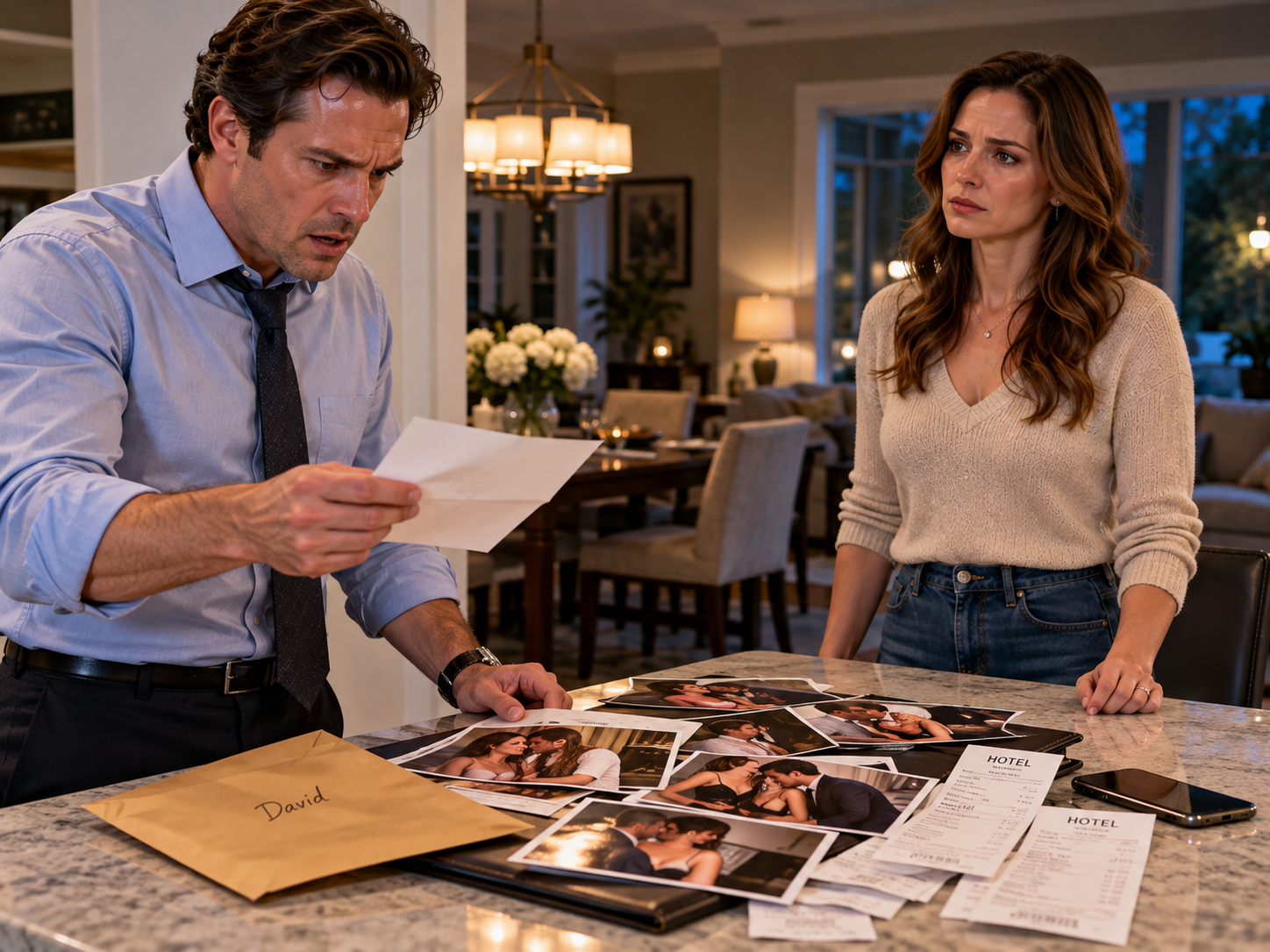
That night, I found the folder on the kitchen counter. Sarah had moved it from the study and placed it beside the household bills. I opened it again, not to search for a technicality that might save me, but to look at the dates. The affairs had overlapped with school concerts, family birthdays, and evenings when Sarah had stayed awake waiting for me. The evidence showed more than where I had been. It showed the life I had chosen while asking her to believe I was somewhere else.
At the bottom of the folder was a copy of the letter from Michael. It listed questions Sarah had wanted answered about finances, parenting arrangements, and what separation might mean for the children. There was no secret lover waiting to replace me. There was a woman preparing herself for the possibility that she might have to build a different life.
I returned the letter to the folder and closed it.
The next morning, Sarah told me she had scheduled another appointment with Michael. She wanted to review the practical options before making any decision about the marriage. I felt the same surge of fear I had felt at the café, but this time I did not accuse her of betrayal.
“Okay,” I said. “Let me know if there is anything about the children's schedule I need to prepare for.”
She looked at me carefully, perhaps expecting an argument. When none came, she nodded.
“Thank you.”
After she left, I stood alone in the kitchen. The house was quiet, and the morning light fell across the counter where the folder had rested. I still wanted Sarah to choose me. But for the first time, I understood that wanting her to stay was not the same as having the right to keep her.
I had spent nine years assuming the worst consequence of my affairs would be an uncomfortable confrontation followed by forgiveness. Now I was facing a more difficult possibility: Sarah might hear every apology, observe every change, and still decide that the marriage had cost her too much.
That was the point at which my life finally became uncertain for a reason I could not blame on anyone else.
Click here to continue reading: PART 4: When Sarah Finally Told Me What She Wanted, I Had to Choose Between Respecting Her Freedom and Repeating the Same Selfishness That Had Nearly Destroyed Us
I Thought I Had Caught My Wife Betraying Me, Until Her Calmness Made Me Wonder What She Had Been Hiding All Along
Part 3 of 20

