
The final conversation about our marriage happened on a rainy afternoon in early spring. I had come to the house to collect our son's sports bag, which he had forgotten before leaving for a weekend tournament. Sarah was in the kitchen preparing a list of things the children needed for the coming week. The windows were fogged at the edges, and the rain tapped steadily against the glass.
I found the bag beside the stairs and carried it toward the door. Sarah looked up from her list.
“David, do you have a few minutes?”
I set the bag down. “Of course.”
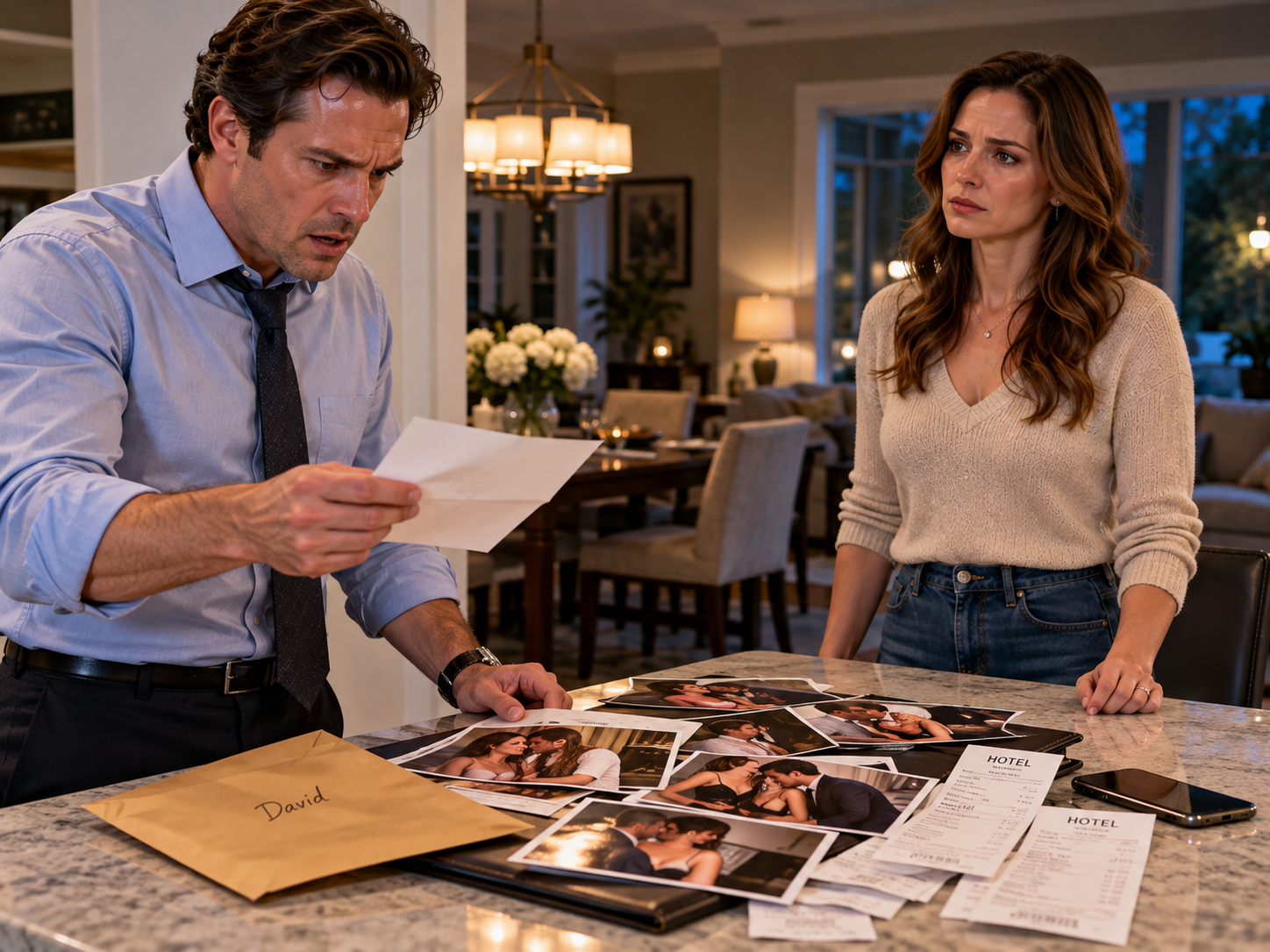
She motioned toward the kitchen island. I sat on the same stool where I had opened the folder that first revealed how much she knew. The counter had been cleaned, and there were no photographs or envelopes between us now. Still, I remembered the dry feeling in my mouth when I saw the evidence of my affairs arranged in neat rows.
Sarah put her pen down.
“I wanted to tell you something directly,” she said. “I've been thinking about whether we should continue discussing our marriage in counseling, or whether we should focus on being parents and let that part of our lives remain in the past.”
I felt a small surge of hope. “What are you thinking?”
“I think we have talked about what happened enough to understand why we separated. I don't want to keep reopening the same conversations unless there's a practical reason. I want us to move forward.”
I nodded slowly. “I agree.”
She watched me for a moment, then continued. “I also want you to understand that moving forward doesn't mean I have forgotten what happened. It means I don't want those years to control every interaction we have now.”
“I understand.”
“I hope you do. I don't want you to keep looking for signs that I might come back. I don't want you to interpret a friendly conversation as a change in my decision. I want to be able to speak with you about the children without feeling that I have to manage your hopes.”
The honesty hurt, but I recognized the fairness of what she was asking. I had spent months trying to read meaning into every smile, every thank-you, and every conversation that lasted longer than necessary. I had turned ordinary cooperation into evidence that the marriage might still be repaired.
“I have been doing that,” I admitted. “I've been hoping that if I changed enough, you'd eventually reconsider.”
Sarah nodded. “I know.”
“I don't think that hope has been fair to you.”
She looked down at her hands. “I don't blame you for wishing things were different. I wished that too, for a long time. But I can't return to the marriage because you're finally becoming the person I needed you to be.”
I felt my throat tighten. I wanted to argue that people could change, that the past did not have to determine the future, and that nine years of marriage deserved another chance. Each thought had some truth in it. None gave me the right to ask Sarah to risk her peace again.
“I won't ask you to reconsider,” I said.
She looked up, and I could see the relief in her expression. “Thank you.”
We sat quietly for a moment. Rainwater ran down the window in narrow streams, distorting the garden outside. I thought about the life we had built, the children who had filled the house with noise, and the ordinary evenings I had once treated as guaranteed. I had not understood the value of those things until I had made it difficult for Sarah to remain in the life we shared.
“Do you ever think about the café?” I asked.
Sarah considered the question. “Sometimes.”
“What do you remember?”
She leaned back slightly. “I remember being frightened about the future. I remember talking to Michael about what I could do if I decided to leave. I remember feeling relieved that someone was listening without telling me I was overreacting.”
She paused. “I also remember seeing you standing outside the window.”
My stomach tightened. “You saw me?”
“Yes. Not at first. I noticed movement near the window and recognized you when you turned away.”
I stared at her. The revelation surprised me, though it should not have. I had been so focused on the image of her hand in Michael's that I had never considered whether she had noticed me watching.
“Why didn't you come after me?”
“What would I have said? You had seen me with someone who was offering comfort, and I knew you would have questions. But I had spent years answering questions you asked while refusing to answer the ones I asked you. I wasn't ready to defend myself for accepting kindness.”
I looked down at the counter. “I thought you were betraying me.”
“I know.”
“I felt the same pain I had caused you.”
Sarah did not smile or tell me that I had finally learned my lesson. She simply listened.
“For a moment,” I continued, “I was convinced I had been wronged. I couldn't see anything except the fact that another man was holding your hand. I didn't think about the women I had been with, or the lies I had told, or how many times you had probably sat alone wondering where I was.”
“That was the part I wanted you to understand,” she said. “Not that you deserved to suffer, but that your choices had consequences beyond what you intended.”
I nodded. “I understand that now.”
“I hope you do. But I don't want you to live in guilt forever, either. That wouldn't help the children, and it wouldn't change what happened.”
Her words surprised me. I had assumed that taking responsibility meant carrying the shame indefinitely, as though suffering long enough might balance the harm. Sarah was telling me that my guilt could become another way of keeping the marriage alive in my mind, another reason to make our conversations revolve around me.
“I want to keep changing,” I said. “Not because I expect anything from you.”
“Then keep doing that.”
She picked up her pen and returned to the list. The conversation had ended without a dramatic reconciliation, and I felt strangely grateful. We had spoken honestly about the moment that had changed everything, and neither of us had needed to win the argument.
Before I left, Sarah reminded me about our daughter's upcoming performance. I confirmed the time and told her I would arrive early. She thanked me, then returned to her work. I carried our son's sports bag to the car and drove away through the rain.
At the performance, I sat beside Sarah because the seating arrangement made it convenient. We greeted each other politely and watched our daughter take her place onstage. She looked nervous at first, then found us in the audience. When she saw both of us, she smiled and began.
Afterward, we congratulated her together. She hugged Sarah, then me, and talked excitedly about a mistake another student had made during the final song. Sarah laughed, and I joined her. For a moment, the three of us stood together in a familiar pattern, sharing a small family happiness that did not require us to pretend the marriage still existed.
On the drive back to my apartment, I thought about how different the evening felt from the years when I had rushed home late, hoping Sarah would accept my explanation and allow the household to return to normal. I had once believed that preserving the appearance of a happy family was the same as protecting the family itself. Now I understood that the children needed honesty and dependable care more than they needed us to maintain an image.
I continued attending therapy. I also continued building routines that made it harder to fall back into old habits. I kept my calendar accurate, told people when I would be late, and stopped using vague explanations when I had made a mistake. When I felt tempted to conceal something because the truth might be uncomfortable, I tried to ask myself what I was protecting: another person's well-being, or my own image.
The answer was not always flattering. Sometimes I still wanted to avoid embarrassment. Sometimes I caught myself preparing an excuse before I had even been asked a question. But I had become more willing to stop, reconsider, and tell the truth.
The children grew accustomed to the arrangements. They moved between our homes with their school bags, favorite books, and the occasional forgotten sweater. We continued sharing important information about school, health, and activities. Sarah and I did not agree about everything, but we learned to discuss disagreements without using the past as a weapon.
I was especially careful not to turn my progress into a story I told the children about how much I had changed. They did not need to become judges of my character. They needed a father who arrived when he said he would, listened when they spoke, and took responsibility when he made a mistake.
One Saturday, our son asked whether I thought Sarah and I would ever be friends again. I considered the question before answering.
“We can be respectful and work together as your parents,” I said. “We both care about you and your sister. What our relationship looks like in the future may be different from what it was before.”
He thought about that, then asked whether we could all attend his next game. I told him we could arrange it, and I checked with Sarah before confirming. She agreed, and we sat together at the game the following weekend.
The afternoon was pleasant. Our son played well, and our daughter spent most of the match taking photographs. Sarah and I talked briefly about the children's school plans and laughed when our son celebrated a goal that was later ruled offside. There was no romantic tension, no hidden promise, and no need to interpret the afternoon as anything other than two parents sharing an important moment with their children.
When the game ended, Sarah left with the children while I stayed to speak with another parent. I watched them walk toward the car and felt a familiar ache, but it was no longer mixed with the expectation that Sarah should turn around and invite me back into the life we had ended.
I returned to my apartment and prepared dinner. After eating, I sat at the table with the photograph I had brought from our former home. It showed the four of us on a beach years earlier. Sarah was laughing, our son was holding a bucket, and our daughter was leaning against my shoulder. I remembered the day clearly. We had eaten sandwiches in the sun, built a sandcastle, and driven home tired and happy.
The photograph was not false because the marriage had ended. The happiness in it had been real. So had the harm I later caused. I no longer needed to choose one truth and deny the other.
I put the photograph back on the shelf and opened my notebook. I wrote about the afternoon, about the ease of co-parenting when I didn't ask it to mean more than it did, and about the importance of letting Sarah live without monitoring her choices. I also wrote about the jealousy that still appeared occasionally and the way I could acknowledge it without acting on it.
I had once believed that the end of a marriage meant that one person had won and the other had lost. But there was no victory in the way our marriage ended. Sarah had chosen to leave because she no longer wanted to live with my dishonesty. I had lost the relationship I had taken for granted. Our children had to adjust to two homes. None of us had received the future we might have imagined when we married.
Still, the end of the marriage did not mean every part of our family life had to be destroyed. We could continue to care for our children. We could speak honestly about practical matters. We could remember good years without using them to excuse the bad ones. And I could become a more dependable person without expecting Sarah to return as a reward.
A few weeks later, I saw Sarah at the school entrance after dropping off our daughter. She was speaking with another parent and smiling. She looked comfortable, and I recognized the same ease I had seen in the café. The old memory stirred briefly, but it no longer felt like an accusation. I greeted her, confirmed the pickup time for that afternoon, and wished her a good day.
She did the same.
As I walked toward my car, I realized that the moment had passed without my needing to know who she was meeting or what she planned to do after school. I could leave her life in her hands. That simple boundary was something I had failed to respect throughout our marriage.
I had once thought the knife of betrayal was something another person placed in your heart. Now I understood that the pain could also come from recognizing the damage you had chosen to inflict, especially when the person you hurt finally refused to carry it for you.
Sarah had not needed to betray me to make me feel that pain. She had simply stopped pretending that my lies were harmless.
I could not undo what happened, and I could not demand a different ending. But I could live with more honesty than I had shown before, be present for the children who still depended on me, and stop treating another person's patience as permission to hurt them.
The marriage was over. The responsibility to become better was not.
Click here to continue reading: PART 9: When Our Children Began Treating Two Homes as Normal, I Realized That My Greatest Responsibility Was Not Winning Back Sarah but Making Their New Life Feel Safe
I Thought I Had Caught My Wife Betraying Me, Until Her Calmness Made Me Wonder What She Had Been Hiding All Along
Part 8 of 20

