
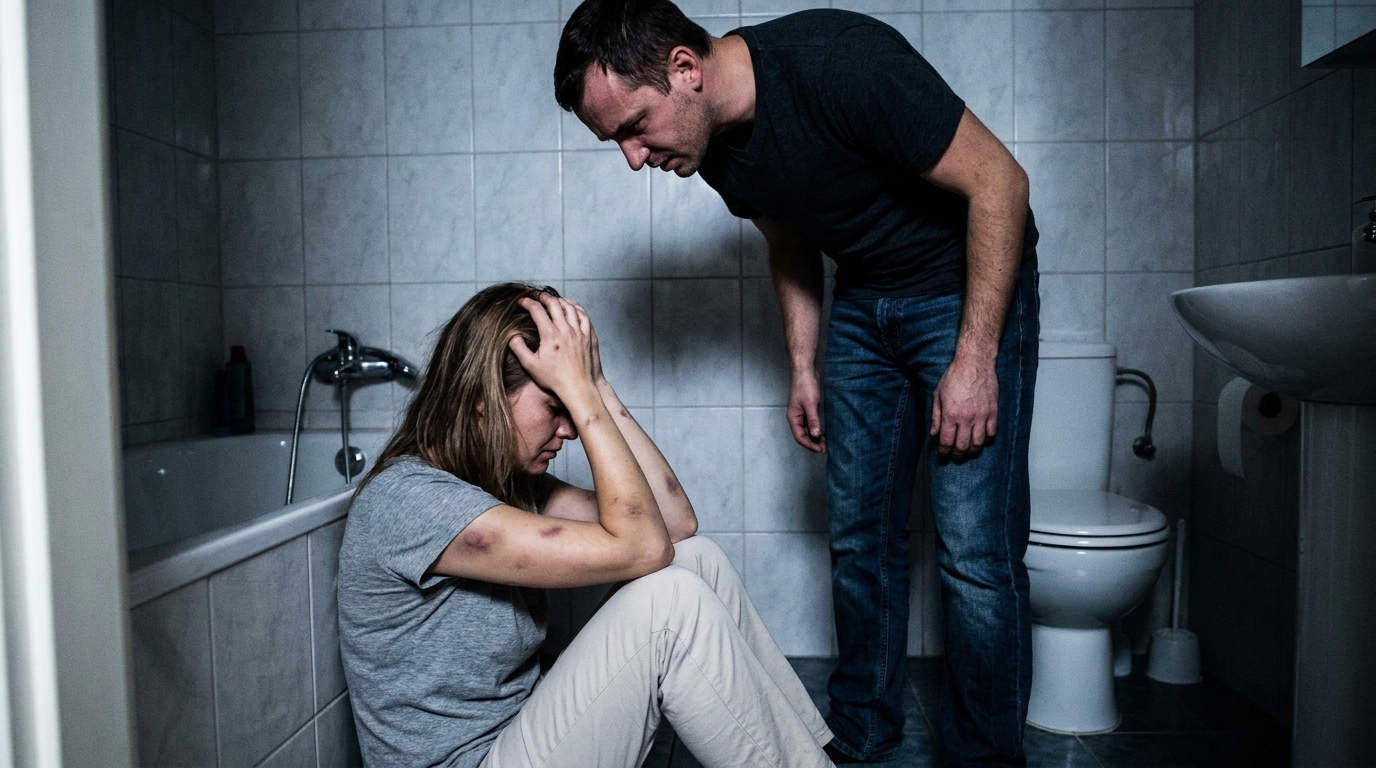
The lock turned.
For half a second, nothing happened. My husband seemed to hesitate, his fingers still wrapped around the metal, as though he expected me to step aside now that the last barrier had failed.
I did not.
I held my son against my chest and planted one foot against the side of the tub. My heart was beating so hard that the sound seemed to fill the bathroom. The door moved another few inches.
Then someone shouted from outside the house.
“Police! Step away from the door!”
My husband froze.
His mother froze behind him.
I closed my eyes for one brief moment.
They were here.
The dispatcher’s voice came through my phone, calm and unmistakably professional. “Stay where you are. Do not open the door any farther yourself.”
My husband slowly removed his hand from the lock.
His mother looked at him.
“What do we do?”
He did not answer.
The question itself told me enough. Until that moment, they had believed they controlled the room. They had controlled the conversation. They had controlled which version of events I heard and which version they expected me to repeat.
Now somebody else had arrived.
Someone who had not heard their rehearsed explanations.
Someone who had not been part of the family.
The front door opened downstairs.
Footsteps entered the house.
My husband stepped backward.
His mother grabbed his arm.
“Don't say anything.”
I heard her whisper.
He pulled his arm free.
For the first time since the attack began, he looked genuinely uncertain.
A voice called from below.
“Everyone stay where you are.”
The hallway outside my bathroom became strangely still.
My son stirred against me.
I lowered my face to his hair and whispered that everything was all right, although I did not yet know whether it was.
My husband looked through the opening.
Then he looked at me.
“You called them.”
It was not a question.
“Yes.”
His jaw tightened.
“You could have told me you were going to do that.”
I stared at him.
“You were trying to force the door open.”
His eyes moved toward the monitor.
The little device was still glowing beside my feet.
He seemed to remember what it had captured.
His mother did too.
A second voice came from downstairs.
“Sir, step away from the woman and the child.”
My husband raised both hands.
“I wasn't doing anything.”
The sentence was so ordinary that it almost sounded absurd.
I had heard him say it before in smaller situations.
I wasn't angry.
I didn't mean it.
You misunderstood.
It had always been easier for him to describe my reaction than to account for his behavior.
Now there were witnesses.
He stepped away from the bathroom.
I stayed where I was.
A woman appeared at the end of the hallway. She kept her distance and spoke gently.
“Are you the person who called?”
I nodded.
“Yes.”
“Are you and the baby injured?”
I looked down at my son.
“He's been handled roughly.”
The woman glanced toward my husband.
His mother immediately began talking.
“That isn't true. The baby was upset, and I picked him up because she wasn't—”
“Ma'am,” the officer interrupted. “Please wait.”
My mother-in-law stopped.
I saw something change in her expression.
She had been prepared to manage me.
She had not been prepared to manage a stranger.
The officer asked me to come out slowly.
I told her I was not dressed properly.
She said that was fine.
The words nearly broke something inside me.
No judgment.
No irritation.
No demand that I make myself presentable before being believed.
She asked whether I could walk.
I said yes.
My legs were shaking, but I stepped out.
My husband moved toward me.
The officer immediately raised one hand.
“Stay there.”
He stopped.
I walked into the hallway with my son wrapped against me.
The monitor remained on the bathroom floor.
The officer looked at it.
“Is that recording?”
“Yes.”
“Can you tell me what it captured?”
I swallowed.
“My husband and his mother talking about me before they attacked me.”
My husband shook his head.
“That isn't what it sounds like.”
The officer looked at him.
“We'll listen to it.”
He said nothing.
I was taken downstairs.
Another officer waited near the front door. He asked me to sit on the couch while they checked the baby.
My son had stopped crying.
His tiny fingers had found the edge of the towel.
I kept one hand on his back.
My mother-in-law came down behind me.
“I want to explain.”
The officer told her she would have an opportunity.
She sat in a chair opposite me.
For a moment, neither of us spoke.
Then she looked directly at me.
“You have no idea what you've done.”
I looked at my son.
“I know exactly what I did.”
Her lips tightened.
“You've destroyed our family.”
“No.”
My voice was quiet.
“You did that.”
My husband stood several feet away.
He looked at me.
I expected anger.
Instead, he looked tired.
That expression might once have pulled me toward him.
It did not anymore.
One of the officers returned carrying the monitor.
“We're going to review this.”
My husband immediately said, “There's context.”
The officer answered, “Then we'll hear it.”
The monitor was placed on the table.
The recording began.
My mother-in-law's voice filled the room.
“She’s exhausted. That’s the point.”
Nobody moved.
Then my husband's voice.
“If she tries to leave with him, I’ll stop her at the front door.”
His mother looked at the floor.
The recording continued.
“She’ll cry. Let her. She always gives in when she thinks she’s upsetting everyone.”
The room remained silent after the clip ended.
My husband finally spoke.
“We were discussing a family situation.”
The officer looked at him.
“You discussed preventing her from leaving with the child?”
“No. I meant—”
He stopped.
The officer waited.
My husband had no answer that could make the sentence disappear.
The second officer asked me to describe what happened after the conversation.
I did.
I described being grabbed.
I described hitting the floor.
I described my son being taken.
I described seeing him thrown onto the mattress.
I described running into the bathroom.
I did not exaggerate.
I did not need to.
The facts were ugly enough.
When I finished, the officer asked whether I had any immediate place to go.
I looked down at my son.
“I don't want to stay here.”
“You don't have to.”
The sentence was simple.
I nodded.
My mother-in-law began crying.
Not quietly.
She covered her face and shook her head.
My husband stared at the floor.
I watched them from across the room and felt something unexpected.
Not satisfaction.
Not revenge.
Distance.
For the first time, their emotions did not automatically become my responsibility.
One officer asked whether I had identification and a few things for the baby.
I said my bag was upstairs.
The officer said they could accompany me.
My husband stepped forward.
“I'll get it.”
“No,” I said.
He stopped.
“I'll go with the officer.”
The officer nodded.
We went upstairs together.
The hallway looked different now.
The same carpet.
The same framed photograph.
The same closed doors.
But the house no longer felt like a place where their version of reality was the only one available.
In the bedroom, I found the baby's bag.
My hands were still shaking.
The officer waited while I packed diapers, clothes, formula, and a blanket.
Then I noticed something tucked beneath the edge of the dresser.
A small envelope.
I recognized the handwriting immediately.
My husband’s.
I did not open it.
Not yet.
I slipped it into the baby bag.
Downstairs, my husband was speaking with the other officer.
He looked up when I returned.
His eyes went to the bag.
Then to the envelope.
His face changed.
Only slightly.
But I saw it.
He knew what I had found.
I held the bag against my side.
“What is this?”
He did not answer.
His mother looked at him.
“What did you leave there?”
He said nothing.
The officer noticed the exchange.
“Is there something in that envelope that matters to this situation?”
My husband finally spoke.
“No.”
His voice came too quickly.
I looked at the envelope again.
Whatever was inside had frightened him more than the recording had.
And that meant I was not leaving it behind.
Click Here to continue read next: PART6: The Envelope Contained Something He Had Hidden Long Before the Bathroom Door Closed, and Its Meaning Changed What I Thought Had Happened
The Door Was Locked, but the Recording Had Already Told Me Why They Wanted It Open
Part 5 of 8

